





A good content strategy is the key to turning individual marketing actions into a functioning system for measurable business growth Instead of simply publishing content haphazardly, a well-thought-out strategy provides you with a clear roadmap. This allows you to strategically link reach, trust building, and customer loyalty.
Why a content strategy makes the difference
Many companies create content, but very few realize its full potential. The difference rarely lies in the quality of an individual blog post, but rather in the lack of overarching planning.
Without a clear strategy, you're essentially flying blind. You produce content that might be good in itself, but it neither contributes to your business goals nor reaches the right target audience at the right time. A content strategy transforms these haphazard actions into a coherent system.
She ensures that every blog post, video, and social media post serves a clear purpose. Instead of just talking about your products, you build a genuine relationship with potential customers by solving their problems and answering their questions. This is precisely what establishes your company as a trusted authority in your niche.
From mere visibility to real growth
The entire process follows a simple yet effective logic: Targeted content creates reach among your relevant users. You then use this reach to build trust. And this trust ultimately leads to sustainable growth in the form of leads and new customers.
The following infographic summarizes this core process – from initial attention and building trust to achieving concrete business goals.
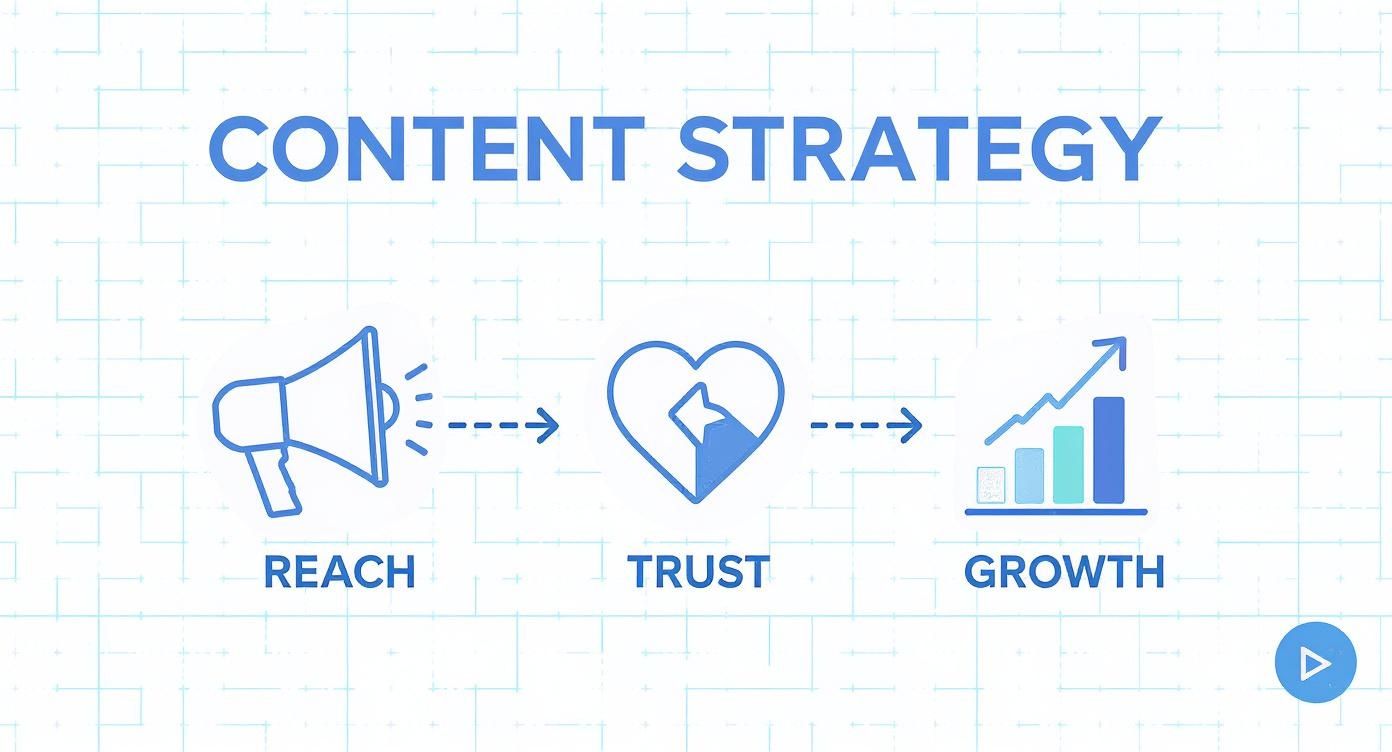
As you can clearly see here, these phases are inextricably linked. They form the foundation for any measurable success in content marketing.
Don't see your content strategy as a rigid document, but rather as your agile compass in the marketing jungle. It helps you use your resources – time and budget – as effectively as possible to achieve your goals.
A market that rewards strategy
The increasing importance of a strategic approach is also evident in market developments. The German content marketing market is currently experiencing an impressive growth phase. Forecasts predict that revenue in the area of digital content creation will increase by [amount missing] annually until 2030. 13,8 % will increase. This corresponds to an estimated market volume of 2.65 billion US dollars.
This trend makes one thing clear: the competition for users' attention is intensifying. Companies that invest in a professional strategy now will secure a decisive advantage for the future.
Those who want to go a step further can learn how modern companies manage their entire Develop a content marketing strategy with AI, in order to work even more efficiently and in a more data-driven way.
The foundation of your strategy: Understanding goals and target groups
Every good content strategy stands or falls on two things: a crystal-clear goal and a genuine understanding of the people you want to reach. Before you even write a single line of text, you need to know exactly..., What They want to reach and for who They're actually doing the whole thing.
Without this foundation, you're groping in the dark. You might be diligently producing content, but it will be ineffective because it neither contributes to your business goals nor solves your customers' real problems. Therefore, don't see this first step as a chore, but as the most crucial step you'll take to secure your success.
Concrete goals instead of vague wishes
A classic mistake I see time and again is vague goals like "more traffic" or "increasing our brand awareness." These are wishes, not goals. Strategically, they are worthless because they are impossible to grasp, let alone measure. Truly good strategies utilize the SMART method. Therefore, your goals must be specific, measurable, achievable, relevant, and time-bound.
Imagine you are a mid-sized provider of project management software. A typical vague goal would be: "We want to generate more leads."„
A SMART goal that you can actually work with sounds like this:
„"We will increase the number of qualified leads via our company blog next quarter by 15 %. To this end, we are creating and promoting three new white papers on the topics of 'Team Efficiency', 'Agile Project Management' and 'Resource Planning'."‚
Do you see the difference? This goal is precise, has a clear metric and a timeframe. It gives the team an unambiguous direction and makes success measurable in the end.
Buyer Personas: Give your target audience a face
Once the "what" is clarified, the next question is "for whom." It's simply not enough to just roughly outline the target audience. You have to immerse yourself in their world. That's precisely what this is for. Buyer Personas – These are semi-fictional profiles that bring your ideal customers to life.
A well-crafted persona goes far beyond demographic data such as age or job title. It illuminates the psychographic characteristics, the true drivers behind your customers' decisions: their concerns, their goals, their daily struggles.
To create such profiles, you need real data, not mere assumptions. The following methods have proven particularly effective in practice:
- Talk to your customers: Conduct interviews with your best existing customers. Ask them what their biggest challenges at work are, where they get their information, and what ultimately tipped the scales in favor of your solution.
- Analyze survey results: With tools like SurveyMonkey or Google Forms You can quickly gather quantitative data from a larger group. Find out which content formats are popular or which problems are mentioned most frequently.
- Get your sales and support team on board: Your colleagues on the front line are a real goldmine. They hear every day what questions customers ask, what frustrates them, and where the shoe really pinches.
With all these puzzle pieces, you bring your persona to life. Practical tools like the free Persona Generator by HubSpot can help to structure the collected information clearly.
This is what it looks like, for example, when the tool guides you through the individual steps:

The generator guides you step by step through the most important characteristics – from the role in the company to goals and specific challenges.
From persona to the right content idea
Let's stick with our software provider and develop a persona: "Project Manager Petra".
- Role: Project manager in a medium-sized IT company.
- Challenge: She constantly loses track of things because she has to manage several complex projects simultaneously. Communication within the team is often chaotic.
- Goals: She wants to complete projects on time and within budget, without burning out her team.
- Information behavior: Reads specialist blogs, listens to podcasts on the topic of "New Work" and exchanges ideas in LinkedIn groups for project managers.
This description makes it immediately clear what kind of content Petra really needs. She's not looking for empty advertising slogans, but concrete solutions to her problems.
Petra's profile provides direct insights into specific content ideas:
- A blog article: „5 tried and tested strategies to keep track of parallel projects“
- A checklist for download: "The perfect project kick-off meeting"„
- A short video tutorial: "How to automate recurring tasks and save time"„
If you clearly define your goals and know your target audience as well as if they were a colleague, you've laid the crucial foundation. Every subsequent step of your content strategy builds on this, ensuring that your content not only exists but also truly makes a difference.
This is how you find topics that truly resonate with your target audience.
Okay, you now know, What They want to reach and for whom You're writing. Fantastic. That lays the foundation. Now comes the creative, yet analytical part of your strategy: finding your topics. And I can tell you from experience: relevant content that truly resonates isn't a matter of chance. It's the result of a smart process that aligns the real needs of your target audience with Google's rules of the game.

The biggest mistake I see time and time again? Companies that only think from their own perspective. They produce content about topics they consider important, but which completely miss the mark with the market. A successful content strategy turns this on its head: We start with your customers' questions, problems, and desires. Your job is to find the perfect intersection – between what your target audience is searching for and what your brand stands for as an expert.
It all starts with keyword research.
To understand what goes on in the minds of your potential customers, the Keyword research The essential first step. This involves identifying the exact words and phrases people enter into Google when they have a problem you can solve. This is the absolute foundation for your content to even have a chance of being found organically.
The so-called [are] particularly interesting here. Long-tail keywords. These are longer, very specific search queries. While they often have a lower search volume, the underlying purchase intent is usually many times higher. Consider this: Someone searching for "project management software for small agencies" is much further along in the decision-making process than someone who simply Googles "software" in general. We show you the best approach in our comprehensive guide, which explains how to create a professional Keyword research step by step functions.
Think beyond keywords
A thorough keyword analysis is the foundation, but it's only half the battle. To find topics your target audience will not only search for but love, you need to dig deeper. Your goal should be to uncover your customers' most pressing questions – sometimes even before they can type them into Google themselves.
Here are a few practical methods that have proven effective time and again:
- Spy on the competition: Look at what content is performing really well for your competitors. Tools like Ahrefs or Semrush We'll tell you which articles generate the most traffic. This isn't an invitation to copy! It's an invitation to be inspired: Can you cover the topic better, in a more up-to-date way, or from a completely new perspective?
- Dive into forums and social media: Platforms like Reddit, Quora, or LinkedIn groups are veritable goldmines. Here, people speak frankly about their problems. Keep an eye out for recurring questions and heated discussions. These are often crystal-clear signals for topics with high engagement potential.
- Listen to your own teams: Go talk to your colleagues in sales or customer service. What questions do they hear every single day? What objections or misunderstandings keep cropping up? Each of these questions is a perfect starting point for a helpful blog post, an FAQ, or a short video tutorial.
The best content doesn't just answer one question – it anticipates the next. Try to always think one step ahead of your target audience and offer solutions they haven't even actively searched for yet.
Bring order to the chaos: Pillar Pages and Topic Clusters
Once you've compiled a long list of exciting topic ideas, you face the next challenge: How do you structure them all effectively? Individual, unrelated blog posts are no longer sufficient to be perceived as an authority on a topic by Google. This is precisely where the ingenious model of... Pillar Pages and Topic Clusters into the game.
Think of your content as a perfectly organized library.
- The Pillar Page: This is your central reference work. A very comprehensive, in-depth article that covers a broad core topic (e.g., "content marketing") from A to Z. It is the anchor point for everything else.
- The Topic Clusters: These are the specialized textbooks. Several, more specific articles (e.g., "Keyword Research for Beginners", "Social Media Content Plan", "Writing SEO Texts"), each of which illuminates a small sub-aspect of the core topic in detail.
- The magic of internal links: Each cluster article links back to the central pillar page. And the pillar page, in turn, links to all its associated cluster articles.
This architecture offers two huge advantages: Your users find themselves in a logical, easily understandable world of knowledge. And for Google, you signal concentrated thematic expertise, which sustainably boosts your ranking for the entire subject area. By aligning your content strategy with this model from the outset, you build an extremely SEO-strong foundation for long-term visibility.
Strategically selecting the right channels and formats
Imagine you've found a brilliant topic perfectly tailored to your target audience. But all that effort is wasted if the message is presented in the wrong way or reaches the wrong place. The choice of formats and channels is therefore not a minor detail, but an absolutely crucial lever for the success of your content strategy. It's not about being everywhere. It's about being exactly where your customers are actually listening.
Your analysis of buyer personas is the compass that guides you. Remember "Project Manager Petra"? She reads industry blogs over breakfast and participates in LinkedIn groups. So, she'd probably just dismiss an elaborate TikTok dance video with a weary smile. But an in-depth white paper or a practical blog post? Bullseye.
The right format for every stage of the customer journey
Each content format has its superpowers and plays them best at a different stage of the customer journey. The real art lies in precisely aligning the format with your marketing goal.
To raise awareness: At the beginning of your journey, you need content that's easy to consume and even easier to share. Short videos, entertaining social media posts, or snappy infographics are ideal for reaching a broad audience and making a positive first impression.
To generate leads (Consideration): Now things are getting serious. Your target audience is actively searching for solutions to their problems. This is where substance comes into play: in-depth blog articles, detailed white papers, webinars, or comprehensive e-books offer real added value. In return for this expert knowledge, users are also willing to provide their contact information.
To solidify the purchase decision: Just before reaching their goal, potential customers need that final push. Convincing arguments are now essential. Case studies, honest customer testimonials, product comparisons, or detailed demo videos dispel any remaining doubts and make the decision to choose your offer easy.
A common mistake I often see is focusing on a single format for a topic. Think bigger and recycle cleverly! A one-hour webinar can be the perfect foundation for a whole series of blog posts, various social media clips, an infographic, and a quote carousel for LinkedIn. That's pure efficiency.
Select channels specifically for the target group
The same logic applies when selecting your channels. Instead of bombarding all platforms with a scattershot approach, focus your budget and time precisely where your target audience is actually active. This not only saves time and money but also maximizes your impact enormously.
A B2B company that sells complex software solutions is unlikely to find its decision-maker target group on TikTok. Here's the thing: LinkedIn The central focus is cleverly complemented by expert articles on the company's own blog and guest contributions in relevant industry magazines. An e-commerce shop for handcrafted jewelry, on the other hand, thrives on visual inspiration. Instagram and Pinterest These are the perfect stages to emotionally charge the products and awaken desire.
To help you decide which format is best suited for which goal, I have created a small overview.
Comparison of content formats according to objective
This table helps in deciding which content format is best suited to achieve specific marketing goals such as brand awareness, lead generation, or customer retention.
| Content format | Primary goal | Suitable for | Resource expenditure |
|---|---|---|---|
| Blog article | Lead generation, SEO | Detailed explanations, problem solutions | Medium |
| Whitepaper/E-Book | Lead generation | Comprehensive, data-driven content | High |
| Infographics | Brand awareness | Visualizing complex data | Medium |
| Short videos (reels/shorts) | Brand awareness, engagement | Entertainment, quick tips | Low to medium |
| Webinars | Lead generation, expert status | Interactive knowledge transfer, demos | High |
| Case studies | Purchase decision | Success stories, proof of concept | Medium |
| Customer testimonials | Purchase decision | Building trust, social proof | Small amount |
This table is of course not a rigid rule, but a guideline. The boundaries are often fluid, but it gives you a good sense of which tool from the content toolbox is best suited for which task.
Media consumption in Germany is constantly evolving, making a flexible channel strategy absolutely essential. Currently, they use 65.5 million people In Germany, social media – that's around 78 % of the total population. But while overall usage is growing, the balance is shifting. Facebook, for example, saw a year-on-year decline of around 1.2 million users. You can find more on these fascinating developments in the Social media statistics from meltwater.com.
These figures are more than just statistics. They demonstrate the importance of staying ahead of the curve and constantly and critically evaluating your channel choices. Focus on the platforms that are relevant to your target audience not only today, but also tomorrow.
By strategically linking the right format with the relevant channel, you ensure that your message is not only sent but also truly heard. This creates a cohesive user experience that builds trust and elegantly guides your target audience through the customer journey, instead of annoying them with irrelevant content.
From plan to implementation: How to breathe life into your content strategy
A brilliant strategy is worthless if it gathers dust in a drawer. The truly crucial step that separates a good idea from genuine marketing success is its implementation. This is where true commitment is revealed, because now things get serious: the carefully planned topics, formats, and channels must be translated into a functioning, reliable production process. The heart and command center for everything that follows is a dynamic editorial calendar.
Don't just see it as a simple calendar. It's the cockpit of your content marketing. It creates transparency, clearly defines responsibilities, and ensures your content machine runs smoothly and efficiently. Without such a plan, you risk chaos, missed deadlines, and inconsistent publications—all poison for your painstakingly developed strategy.
What makes a powerful editorial plan
Whether you start with a simple Google Sheet, use an agile Trello board, or opt for a professional tool like Asana is initially secondary. The fundamental building blocks of a good editorial calendar are always the same. It must answer all the important questions relevant to production and publication at a glance.
These elements are absolutely essential:
- Topic/Working Title: A concise description of the content.
- Focus keyword: The primary keyword that everything is optimized for.
- Content format: Is it a blog article, a video, an infographic, or a social media post?
- Responsible party: Who is responsible for creating it?
- Status: Where is the content currently at? (e.g., briefing, in progress, approved, planned)
- Deadline: By when does the content need to be finished?
- Publication: When will the article go online?
- Target persona: For whom exactly are we creating this content?
- Call-to-Action (CTA): What should the user do after consuming the content?
- Distribution channels: Where is the content advertised? (e.g., newsletter, LinkedIn, Instagram)
A well-maintained plan not only helps you keep track of things, but also allows you to plan your resources efficiently and identify bottlenecks early on.
Consider your editorial plan as a living document. It must be flexible enough to respond to current trends or short-term opportunities without losing sight of long-term strategic goals.
From briefing to approval: The path to stress-free content
A clearly structured workflow is the best protection against friction and ensures consistently high quality. This process actually begins long before the first word is written – namely, with a precise briefing. This document is the bridge between your strategy and its creative implementation. It provides the creator with everything they need: objective, target audience, focus keyword, key messages, and stylistic guidelines.
After production, a clearly defined approval process follows. Determine who reviews the content (e.g., for factual accuracy, SEO criteria, or brand compliance) and how feedback is provided. A final review is invaluable, especially when it comes to search engine optimization. There are specific procedures for WordPress-based websites. Learn more about the specifics of a professional review process. WordPress SEO optimization You can find out more in our follow-up article.
The high art of content recycling
Efficiency in content marketing also means getting the most out of every piece of content produced. Not everything needs to be reinvented from scratch. Content recycling is a smart method for achieving significantly greater reach with less effort.
Imagine you've just delivered a one-hour webinar on a complex topic. This single piece of great content ("hero content") is a goldmine. From it, you can easily derive a whole series of smaller pieces of content for a wide variety of channels:
- Blog article series: Each main point of the webinar will be covered in its own detailed blog post.
- Social media clips: Cut the most concise quotes or tips into short videos for LinkedIn or Instagram.
- Infographic: Visualize the most important statistics and processes from the webinar.
- Quote graphics: Create compelling graphics with the strongest key messages for social media.
- Podcast episode: Use the audio track of the webinar as the basis for a podcast episode.
This approach not only saves immense resources but also ensures that your core message is consistently delivered and amplified across various formats and channels. If you want to further accelerate these processes, it's worth taking a look at how you can... Successfully using artificial intelligence in business can support content creation and strategy optimization.
The numbers speak for themselves: German companies are highly willing to invest in well-thought-out content strategies. Spending on content marketing in Germany has grown steadily in recent years. Around [amount missing] flows annually. 9.8 billion euros in this area, and according to industry studies, spending is increasing by approximately five percent per year. This impressively demonstrates how crucial professional implementation has become for business success.
Measure success and continuously optimize the strategy.
Developing a content strategy is one thing. But the real work? That only begins after the "publish" button is clicked. Without consistent performance measurement, you're groping in the dark. Don't see your strategy as a rigid set of rules, but as a dynamic process that is constantly questioned and improved based on data.
The trick is not to get lost in a sea of key performance indicators (KPIs). Instead of chasing countless metrics, you should focus on the handful that truly contribute to your business goals. Only then will pure data become tangible insights that move you forward.
The right key performance indicators (KPIs) for your goals
Depending on your goals – increased reach, stronger engagement, or decisive conversions – very different Key Performance Indicators (KPIs) will come into focus. Choosing the right metrics is absolutely crucial to avoid comparing apples and oranges.
Reach metrics (awareness): These numbers show you how many people you can actually reach. Here are the organic visibility and the organic traffic The be-all and end-all. Tools like the Google Search Console are indispensable for this.
Engagement metrics (Consideration): These KPIs reveal how deeply users engage with your content. Do they stay engaged or are they gone after three seconds? Key indicators here are: average length of stay, the Bounce rate and of course Social Shares.
Conversion metrics (Decision): At the end of the day, the effort has to pay off. Metrics like the Number of leads generated, the Conversion rate a form or the direct Sales, which are based on specific content, show the true business impact.
Collecting and correctly interpreting data
Your two most important (and free) helpers are Google Analytics and the Google Search Console. While Analytics shows you what people are looking for. on The Search Console reveals how Google sees your website and for which search terms you are found.
Take a look at Search Console: Which pages get the most impressions and clicks? Then check Analytics and examine the time spent on those specific pages. An article with thousands of clicks, but only 15 seconds Length of stay? That's a red flag. Something is definitely wrong here – the content clearly doesn't live up to the title's promise.
The true value lies not in the data itself, but in the questions you derive from it. Don't just ask "What happened?", but always "Why did this happen and what does it mean for our next steps?"„
The optimization cycle
The insights gained from your analyses fuel a continuous optimization process. This recurring approach ensures that your content strategy becomes increasingly effective over time.
Improve poorly performing content: Browse for articles with untapped potential – for example, those languishing on page two of Google but generating little traffic. Often, an optimized title, a more compelling meta description, or a content refresh is all it takes to catapult them to the top.
Successful formats scale: You've discovered that list-format instructions are incredibly popular with your target audience? Great! Then produce more of them or use this knowledge to explore related topic clusters.
Adapt the strategy in an agile way: If you notice that a particular channel is only bringing in visitors who immediately leave, you need to rethink your distribution strategy. Perhaps your money and time would be better invested in a different channel. Or you could strengthen your website's fundamental SEO authority. Speaking of authority, one of the most proven methods for achieving this is to strategically focus on high-quality content. Building backlinks to improve your SEO performance.
This cycle of measuring, analyzing, and adapting is the heart of any dynamic content strategy. It ensures that you use your resources wisely and achieve sustainable growth.
Practical questions: A short FAQ on content strategy
Even the best-laid plans raise questions in practice. That's perfectly normal. Here I've compiled some of the most common stumbling blocks and ambiguities that I repeatedly encounter in my work when it comes to developing a Developing a content strategy.
How often do we really need to publish something new?
I hear this question all the time. The honest answer: It depends. What matters isn't some magic number, but your resources and what your target audience expects.
My firm conviction: One really good, in-depth article per week This will get you much further than five superficial posts that no one is really interested in. Quality beats quantity, always. Consistency is more important than frequency. A reliable rhythm builds trust – with your readers and with Google.
What is the actual difference between content strategy and content marketing?
The two terms are often lumped together, but they describe two completely different things. I like to explain it like this:
- Content marketing This is the concrete implementation. This is the craft: writing blog articles, shooting videos, designing infographics. It's the "what" and "how" of your work.
- The Content strategy It's the brain behind everything. It answers the "why." Why are we doing all this? Who do we want to reach? And how do we ultimately measure whether it was worth it?
Basically, it's quite simple: Without a sound strategy, content marketing is just noise. The strategy is the map, the marketing is the journey itself.
When will we finally see results from all this work?
Content marketing is definitely a marathon, not a sprint. Anyone expecting quick overnight success will be disappointed. But patience pays off.
Often, you can see initial positive signals – such as increased traffic or better rankings for individual keywords – after just three to six months. However, to see truly tangible, business-relevant results, such as a noticeable increase in leads, you should realistically expect to have a longer timeframe. six to twelve months The key is to do the math. The secret lies in perseverance and continuous optimization.
Do you want to make sure your content strategy is on the right track from the start? The team at LinkITUp brings over 15 years of SEO experience to sustainably increase your visibility and achieve your business goals. Let's talk about a personalized consultation..
Article created using Outrank