




Anyone running a website today who simply hopes to be found on Google is leaving their success to chance. A website without a well-thought-out SEO strategy is essentially invisible – it drifts aimlessly in the vast digital ocean, without a clear goal or a real course. To create a Develop a solid SEO strategy To achieve this, more than just a few isolated actions are needed. A clear, comprehensible plan is required, one that is designed for sustainable and, above all, measurable growth.
Why an SEO strategy determines success or failure
I see it time and time again: Many companies approach SEO purely reactively. An important page suddenly stops ranking? Quickly change the title. Traffic plummets? Quickly throw in a few new keywords. But that's not how it works, at least not in the long run. A strategic approach isn't a nice extra; it's the absolute foundation for having any chance in the competitive landscape.
It's not about simply... any to attract visitors to the site. The goal is to... correct The goal is to generate traffic – that is, to attract people who have a real problem for which you offer a solution, and who ideally become customers. Unplanned, isolated measures only waste valuable time and budget and ultimately lead to frustration.
The small but crucial difference between tactics and strategy
It's easy to visualize: Tactics are your tools – the hammer, the saw, the screwdriver. Strategy is the blueprint for the house. Sure, you can hammer in a few nails (a tactic), but without the overarching plan (the strategy), it will never become a stable, functioning house.
In everyday SEO practice, this looks like this:
- Tactics: Optimizing a single blog post for a specific keyword.
- Strategy: Develop a comprehensive content plan based on topic clusters. This will help you build genuine authority in your niche and guide potential customers throughout their entire customer journey.
A good strategy ensures that all these individual parts mesh together like gears and ultimately contribute to your business goals.
Organic search is simply unbeatable in Germany.
Organic search isn't just any channel; it's often the decisive one. Current figures impressively demonstrate this: In Germany, SEO accounts for an average share of 58 % of total website traffic By far the most important marketing channel per month. And it gets even better: Approximately 70 % of all clicks in the search results go to organic results. These figures underscore the importance of a strong organic presence. You can find more information in these [documents/sections]. SEO statistics on seranking.com.
A well-thought-out strategy ensures that your investments – whether time or money – yield the best possible return. Instead of focusing on quick, short-term success, you build sustainable visibility that will provide you with qualified leads and customers for years to come.
Without a clear plan, you're merely a pawn of the algorithms. You react to updates instead of proactively building a position that can withstand future changes. A solid strategy gives you back control and finally makes your digital success predictable.
Laying the foundation: Defining goals and understanding target groups
Anyone who wants to develop an effective SEO strategy must first know where they want to go. Many people immediately dive into keyword research, but that's like building a house without a blueprint. So before you get lost in search volume and competitor analysis, you should ask yourself a crucial question: What exactly do I want to achieve with SEO?
Without a clear goal, your efforts are just a shot in the dark – in the end, you won't even know if you hit the mark. Only a well-thought-out strategy will transform your website from a digital business card into a true growth engine.
The following infographic highlights the difference between a haphazard approach and a strategic approach.
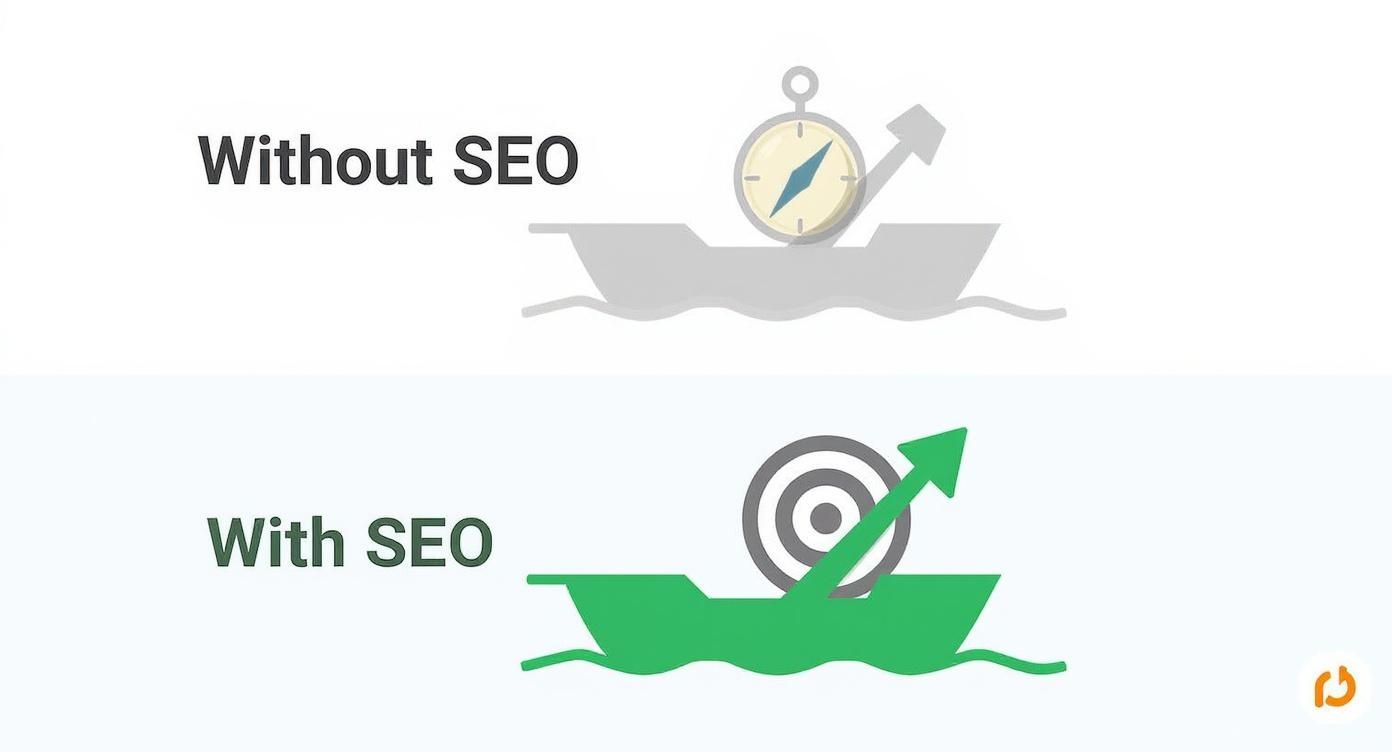
It's immediately clear: A clear strategy leads directly to success, while uncoordinated actions simply vanish into thin air.
Concrete goals instead of vague wishes
„"More traffic" is not a goal, but a pipe dream. To make your SEO strategy truly tangible and measurable, you need concrete, well-defined goals. SMART Framework This is an unbeatable tool for that. Every goal must be specific, measurable, achievable, relevant, and time-bound.
Imagine an IT service provider. Their goal might look like this:
„We aim to increase the number of qualified inquiries via our contact form for the ‚Cybersecurity for SMEs‘ service within the next six months by 25 % "Increase. This is measured via dedicated conversion tracking in Google Analytics."“
This goal is not only concrete, it also dictates all further steps – from selecting the right keywords to creating content. Suddenly everything makes sense.
Who exactly are you trying to reach?
Demographic data such as age or place of residence only scratches the surface. To create content that truly hits the mark, you need to understand the mindset of your target audience. This is where the so-called... Buyer Personas into the game.
A buyer persona is essentially a profile of your ideal customer, based on real data and sound assumptions.
- Problems and questions: What challenges does your target group face that your offer can help them overcome?
- Information search: Where do these people look for answers? Do they Google, ask in specialist forums, scroll through social networks, or listen to colleagues?
- Your language: What terms do your potential customers use? Do they talk about "Managed IT Services" or are they searching for "Computer help for small businesses"?
By answering these questions, you will not only understand, What people are looking for, but Why. This is how you create content that not only ranks well, but truly engages your target audience.
Assess the competition realistically
Competitive analysis isn't about simply copying the competition. It's about uncovering their strengths and weaknesses to identify your own opportunities. Don't just look at the established market leaders, but also at the up-and-coming newcomers.
Take a look at your top 3 to 5 competitors for your most important topics and ask yourself these questions:
- What do they rank with? Are they blog articles, detailed landing pages, or simple product pages?
- Where are the gaps? What important questions are your competitors leaving unanswered? This is your opportunity!
- What about the technology? Do the pages load quickly? Do they work perfectly on a mobile phone?
- Who links to them? Which authorities in your industry are lending their trust to your competitors by providing a backlink?
This analysis will deliver a goldmine. You might discover a crucial niche topic that everyone else has overlooked. Or you might find that your competitors' loading times are disastrous. These are the perfect opportunities to gain a decisive advantage and develop an SEO strategy that truly stands out from the crowd.
Finding the right keywords and topics for your niche
When developing an SEO strategy, keyword research is absolutely crucial. But let's be honest: the days of simply compiling a list of keywords and scattering them around the website are long gone. Today, we need to think in terms of entire topic areas, not just individual words.

The key to success lies in building so-called Topic Clusters. The principle is ingeniously simple: You define a central main theme – your so-called Pillar Page —and group several detailed articles around it. These specific articles illuminate individual aspects of the main topic and consistently link back to the pillar page. This clearly signals to Google that you are a true authority on an entire subject area.
From idea to topic cluster – a practical example
Imagine a local IT service provider specializing in small and medium-sized enterprises (SMEs). Instead of simply targeting the broad keyword "IT service provider," they choose to focus on... „IT security for SMEs“. This will be his pillar page, a truly comprehensive guide.
From this central anchor point, he can now develop a whole range of specific subtopics that address the concerns and questions of his target group:
- Subtopic 1: „"Recognizing phishing emails and training employees" (perfect for a blog post)
- Subtopic 2: „"Setting up a firewall for small businesses" (a concise guide)
- Subtopic 3: „"Costs for professional data backup" (a clear landing page)
- Subtopic 4: „Building a GDPR-compliant IT infrastructure“ (as a detailed white paper)
Each piece of content is geared towards a specific long-tail keyword and links internally back to the main IT security page. This clean structure creates thematic depth that search engines love and that delivers real added value to your visitors.
Understanding and effectively addressing search intent
Behind every single Google search lies a clear intention, which Search intent. If your content doesn't meet this objective, you have little chance of achieving good rankings, no matter how perfectly optimized it is otherwise. Basically, we distinguish four types:
- Informational: The user wants to know something. ("How does a firewall work?")
- Navigational: The user wants to go to a specific page. ("LinkITUp Login")
- Transactional: The user wants to do something, usually to buy something. ("Buy a managed firewall")
- Commercial Investigation: The user is about to make a decision and is comparing. ("Best virus protection for company networks")
For our IT service provider, this means: They shouldn't just create content for direct purchase decisions (transactional content). It's much more important to engage potential customers much earlier, namely while they're still researching. A blog article about "recognizing phishing emails" attracts precisely those people who might not even consider professional IT services for several months.
A deep understanding of search intent is non-negotiable. If you build a page designed to drive a purchase but only provides general information, it will fail. Always tailor the format and content of your page precisely to the likely intent of the searcher.
The right tools for keyword research
To uncover all these topics and keywords, you need the right tools. Fortunately, there's a good mix of professional tools and free resources available.
- Professional tools like Ahrefs or SEMrush: Sure, they cost money, but they provide comprehensive data on search volume, keyword difficulty, and your competitors' strategies. This allows you to quickly uncover relevant keywords for your topic clusters.
- Free alternatives: You can get far even without a budget. Google Search Console It's a real goldmine. Under the "Performance" tab, you can see which search queries your website is already receiving impressions or clicks for. Often, hidden gems lie here – keywords that already rank on page two or three and that, with targeted optimization, can propel you to the top.
Another pro tip: Simply take a look at the "Related Questions" box or the "Related Searches" at the very bottom of the Google results pages. These are direct indications from Google of which related topics interest users. A detailed Keyword Research Guide can help you to use these tools optimally.
By combining these methods, you build an SEO strategy that is based not on gut feeling, but on solid data and a genuine understanding of your target audience.
Build a stable technical framework for your website
The best content and the cleverest keywords are completely useless if Google can't properly crawl, index, and understand your website. This is precisely where technical SEO comes into play – the foundation upon which your entire strategy rests. Many shy away from it because it sounds complicated. In reality, however, it's about doing the basic homework and paving the way for search engines.
Imagine your website like a house. Your content – text, images, and videos – is the furniture and decoration. Technical SEO, on the other hand, is the foundation, the walls, and the roof. If the foundation crumbles, even the most beautiful furnishings are useless. It's the same with your website: without a solid technical foundation, all other SEO efforts are wasted.
Focus on the user experience
Previously, technical SEO was solely the domain of developers. Today, it's inextricably linked to user experience (UX). Google aims to deliver the best results to its users – and this primarily includes websites that load quickly, are stable, and are intuitive to use.
It is precisely at this point that the Core Web Vitals These are concrete metrics that measure how users perceive a page's loading time, interactivity, and visual stability. It's no longer just about pure loading times, but also about whether elements suddenly shift during loading or how quickly the page responds to a click. A good user experience is no longer a nice bonus, but a crucial ranking factor. If you'd like to delve deeper into the subject, you can find more information in our article on... Google Core Web Vitals a detailed explanation.
This will be particularly crucial on mobile devices. Since Google uses the mobile version of a website for indexing by default (mobile-first indexing), top-notch mobile optimization is essential. Forecasts predict that by 2025... 72,6 % All internet users will be online exclusively via their smartphones. This shows how critical a technically flawless mobile presence is for success.
Identifying typical technical stumbling blocks
When developing an SEO strategy, a technical audit should always be one of the first steps. The good news is that many of the most common problems can be fixed with manageable effort, yet have a huge impact on your visibility.
When conducting your analysis, look out for these classic problem areas:
- Duplicate Content: This occurs when identical or very similar content is accessible under different URLs. This confuses search engines and weakens your ranking. A classic example is different versions of a page, for instance, with...
httpvs.httpsorwwwvs.non-www. - Incorrect redirects: A 301 redirect signals that a page has permanently moved. If these redirects don't work or are missing entirely, users and crawlers will land on 404 error pages – a frustrating signal for everyone.
- Illogical page architecture: A clear, flat hierarchy helps Google understand the relationships between your pages and identify the most important content. Logical internal linking is key to success here.
- Lack of security (HTTPS): An encrypted connection is now an absolute basic requirement and an official ranking factor. Learn more here., What are SSL certificates? and why they are indispensable for your website.
The following table summarizes the most critical technical SEO aspects and explains their impact on ranking and user experience.
Comparison of the most important technical SEO factors
| factor | Description | Why it's important |
|---|---|---|
| Mobile-first indexing | Google primarily evaluates the mobile version of your website. | A poor mobile experience directly leads to worse rankings. |
| Sideloading speed | The time it takes for a page to load completely. | Fast pages improve UX, lower bounce rate and are an important ranking factor. |
| Security (HTTPS) | Encrypted connection between browser and server. | It protects user data, builds trust, and is a proven ranking factor. |
| Clean URL structure | Short, descriptive and logically structured URLs. | Helps users and search engines to grasp the page content at a glance. |
| Structured data | Code snippets (schema markup) that describe the content of a page. | Enables rich snippets in search results, thus improving the click-through rate. |
| Crawlability & Indexability | The ability of search engines to find and analyze your website. | If Google can't crawl your pages, they can't rank. |
These factors are not just technical details, but direct levers to send positive signals to both Google and your visitors.
Technical SEO is not a one-time task, but an ongoing process. Schedule regular checks to ensure your website remains technically sound.
Search engines make thinking easier
You can actively help Google so that the search engine better understands the content of your pages and presents it more appealingly in the search results. The magic word for this is... structured data, often also referred to as schema markup.
Essentially, structured data acts as a kind of "translator" for search engines. It uses a standardized format to classify the information on your page and clarify relationships between different elements.
A practical example from everyday life:
Imagine you have a food blog with recipes. Without structured data, Google simply sees a block of text with headings and paragraphs. However, with the appropriate schema markup for recipes, you can explicitly mark up:
- Preparation time: 30 minutes
- Evaluation: 4.8 out of 5 stars
- Calories: 450 kcal
Google can use precisely this information to display so-called [relevant keywords/advertisements] in the search results. Rich Snippets Displaying the most prominent results – those marked with stars, images, or additional information – can dramatically increase your click-through rate, even if you don't rank in first place. The technical framework is therefore the invisible force that gives your SEO strategy the necessary boost.
Creating content and building authority – Google loves that.
Once the technical foundation of your website is in place, it's time to get down to brass tacks. Now it's all about the two currencies that determine victory or defeat in the SEO game: excellent content and high-quality backlinks. Without these two elements, even the most technically perfect website remains invisible. Anyone who wants to develop a sustainable SEO strategy must learn to create content that not only targets keywords but also delivers genuine added value and exudes authority.

This is exactly where Google's EEAT concept comes into play: Experience (Experience), Expertise (Specialized knowledge), Authoritativeness (Authority) and Trustworthiness (Trustworthiness). Every single piece of content you produce and every link you acquire should contribute to these four pillars.
From dry text to valuable content
Many companies make the mistake of writing content primarily for search engines. The result is often soulless text that contains keywords but fails to engage a single reader. The trick is to shift perspective and create content that solves the real problems of your target audience.
Would you like a small before-and-after example?
Imagine a tax advisor who wants to rank on the topic of "depreciation".
- Previous (Typical SEO text): „"Depreciation is an important part of accounting. There are straight-line and declining-balance depreciation methods. Companies must consult the depreciation tables." Yawn.
- Afterwards (Valuable, EEAT-optimized content): „"Your new company car: How to make the most of depreciation and save on taxes immediately. In this practical guide, we show you with a concrete example calculation which method is best for you and how to avoid typical mistakes that can cost you dearly."“
The difference is enormous, isn't it? The second approach demonstrates real-world experience, delivers tangible benefits, and immediately builds trust. In fact, entire 57 % of the marketing manager In Germany, content development is considered the most effective SEO measure. This is also reflected in the length of blog articles: the average length is steadily increasing and now stands at around 1,400 words – a clear sign that superficial content is a thing of the past. More You can find insightful SEO statistics at aioseo.com.
The art of sustainable link building
Backlinks are and will remain one of the strongest ranking factors. Essentially, they are digital recommendations from other websites. However, the days when you could buy links from dubious directories are definitely over. Today, it's about acquiring links through top-notch quality. earn.
A single high-quality backlink from a thematically relevant, reputable site can be worth more than a hundred irrelevant links from inferior sources.
Google views links as a sign of trust. If a reputable industry website links to you, it's a strong signal that your content is valuable. This strengthens your authority and, consequently, your rankings.
Instead of relying on outdated tactics, you should focus on methods that will bear fruit in the long term.
Strategies for building high-quality backlinks
Modern link building is inextricably linked to content creation. It's about creating something so good that others will naturally want to link to it.
Here are three approaches that actually work in practice:
- Create "Linkable Assets": These are the kinds of content that naturally attract links. Think original studies, comprehensive guides, free online tools, or unique infographics. If you collect your own data and present it in an engaging way, journalists and bloggers will be eager to cite and link to it.
- Address industry experts directly: Identify opinion leaders, journalists, and bloggers in your niche who have already covered related topics. If you've created outstanding content that perfectly complements their existing articles, you can specifically draw their attention to it. A personal, non-spam approach is crucial here.
- Use guest posts strategically: Guest articles on relevant, reputable platforms are an excellent way to demonstrate your expertise and gain a valuable link. Look for blogs or online magazines that have a genuine readership and maintain high editorial standards.
A well-thought-out approach to link building is essential to cementing your authority in the long term. You can find further information in our guide. Link building strategies, which will help you build a strong and clean link profile. Ultimately, it's the combination of outstanding content that meets EEAT criteria and a strong backlink profile that will catapult your website to the top of the search results.
So, your strategy is in place. But that's only half the battle. The real work begins now that everything is live. Don't see your SEO strategy as a rigid set of rules, set in stone. Instead, consider it a living document that needs to breathe, grow, and adapt. Without closely monitoring your progress and being prepared to adjust course, you'll be groping in the dark.
The key to long-term success is actually quite simple: Make data-driven decisions. Gut feeling is a good guide, but hard numbers are ultimately more reliable. It's about seeing with crystal clarity which measures are effective, which are ineffective, and where untapped potential lies.
Which KPIs really count
The world of web analytics can be overwhelming. It's tempting to get lost in an ocean of data. My advice: Focus on a handful of key performance indicators (KPIs) that directly contribute to your business goals.
For the vast majority of companies, these are the decisive metrics:
- Organic traffic: How many visitors find their way to your site via search engines? Don't just look at the absolute number, but especially at the trend over time. Steady, healthy growth is the best indicator of a successful strategy.
- Keyword rankings: Keep an eye on the rankings of your most important keywords. Are your focus keywords climbing the search results? Are they perhaps even appearing in the top 100 for entirely new, relevant search queries?
- Click-Through Rate (CTR): Of all the users who see your page in the search results – how many actually click on it? A low CTR can be a clear indication of weak page titles or meaningless meta descriptions.
- Conversion Rate: This is the ultimate metric, the key performance indicator that ultimately matters. How many of your visitors from organic search do what you want them to do? Whether that's submit an inquiry, make a purchase, or download a PDF.
Free tools for priceless insights
You don't need a huge, expensive arsenal of tools to measure your SEO success. To get started, two free tools from Google are perfectly sufficient – and they are truly powerful.
Google Search Console (GSC)
The Google Search Console Google Search Console (GSC) is your direct line to Google. It's like a behind-the-scenes look, showing you how the search engine perceives your website. Here you'll find invaluable data on your keyword rankings, clicks, impressions, and average click-through rate (CTR). Another invaluable advantage: GSC proactively warns you of technical problems, such as when pages become inaccessible.
Google Analytics 4 (GA4)
While the GSC shows you what before What happens after the click will tell you Google Analytics 4 everything thereafter This happens. You can see exactly which pages your organic visitors access, how long they stay, and—most importantly—whether they convert. Be sure to set up conversion tracking here to see the true business value of your SEO efforts in black and white.
A good report tells a story. It doesn't just show, that the traffic around 20 % has increased, but also explains, Why. For example, because a very specific blog post has finally climbed to the first page for an important keyword.
From measurement to agile adaptation
Collecting data is the easy part. Drawing the right conclusions from it and using it to your advantage is what matters. SEO strategy The real art lies in refining it. Plan regular cycles, for example monthly or quarterly, in which you delve deeply into your data and critically examine your strategy.
Keep asking yourself these questions:
- Which content generates the most organic traffic and conversions? Can we produce more of it?
- Are there any pages with a noticeably high bounce rate? Do we perhaps need to revise the content or improve the user experience?
- Where do we rank on page two? Often, targeted on-page optimization is enough to make the decisive leap forward.
This regular analysis transforms your once static strategy into a dynamic process. It's a cycle of continuous improvement. This is precisely how you ensure that you not only celebrate short-term successes, but remain at the top in the long run.
Practical questions about SEO strategy
When developing an SEO strategy, the same questions always come up. No wonder, as the topic is complex. Here I've answered the most frequently asked questions for you, to ensure clarity from the start and help you avoid typical pitfalls.
How long will I have to wait for my SEO strategy to bear fruit?
Patience is truly a virtue here. SEO is a marathon, not a sprint. Even if you see initial positive signals – for example, faster indexing of new pages – after just a few weeks, in practice it usually takes longer. 6 to 12 months, until truly noticeable and, above all, stable improvements in rankings and traffic become apparent.
Exactly how quickly this happens depends on many factors: How strong is the competition in your niche? What was the technical state of your website when it launched? And how consistently do you implement the planned measures?
What is actually the difference between on-page and off-page SEO?
Simply put: On-page SEO is everything you do directly on your own website Do things to improve your website for Google and your visitors. This ranges from the quality of your text to technical details like loading times and internal linking.
Off-page SEO, on the other hand, takes care of all the signals that from outside Link to your website and strengthen its trustworthiness. The most important lever here is clearly building high-quality backlinks from other relevant sites.
An important point from my experience: A large budget can accelerate many things, but the most effective SEO measures primarily require time, the right know-how, and clean implementation.
A truly good strategy always links both areas, because this is the only way to build sustainable success in organic traffic.
Do you want to develop a professional SEO strategy that actually delivers results? LinkITUp We are your experienced partner for sustainable visibility and guaranteed rankings. We support you from analysis to successful implementation. Request your free initial consultation now!