





Anyone who has a strong Develop an SEO strategy If you want to, you must first lay a data-driven foundation, namely... before One plunges into the world of keywords and technical details. It's about setting crystal-clear goals, truly understanding your target audience, and taking an honest inventory of your current online presence.
Laying the foundation for your SEO strategy
Many people jump straight into keyword research without doing their homework. But a truly successful SEO strategy doesn't start with tools, but with a few fundamental strategic questions: Who are we? Who do we want to reach? And what exactly do we want to achieve with our website? Without these answers, you're optimizing blindly.
The first and most important step is to align the overarching business goals with the specific SEO objectives. Instead of just focusing on vague metrics like "more traffic," you need goals that you can actually measure and evaluate.
Clearly define goals and target groups
What does success really mean for your company? An increase in qualified inquiries by 15 % Next quarter – that's a concrete goal. A mere increase in visitor numbers without conversions, on the other hand, is often just a "vanity metric" that looks good but doesn't deliver results.
So ask yourself these questions:
- What is our primary business objective? Is the goal to increase sales, generate more leads, or raise brand awareness?
- How exactly can SEO help here? For example, through more demo requests via organic search or higher sales in a specific product category.
- Who is our ideal target group? Think beyond mere demographics. What problems do these people have, what questions do they ask, and how do they search for solutions online?
An SEO strategy without clearly defined goals and a precise target group analysis is like a ship without a compass. You drift on the ocean of the internet without knowing which port you're actually heading for.
This process – defining goals, understanding the target group, analyzing the current situation – forms the stable backbone of your entire strategy.
The following infographic nicely illustrates how these three elements – goals, target audience, and analysis – interlock to create a solid SEO foundation.
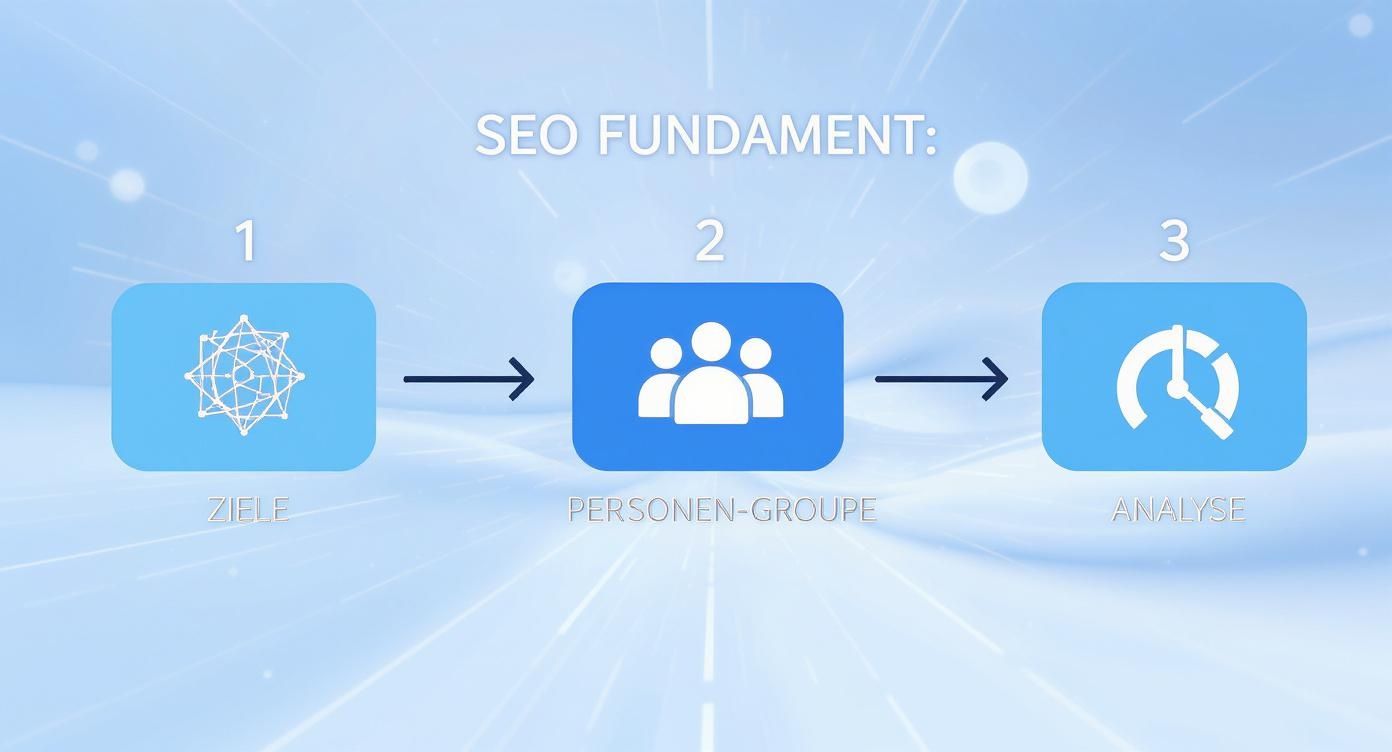
It is clear that every sound analysis is based on clear goals and a deep understanding of the target group.
Take an honest inventory
Before you Improve search engine ranking To do this, you naturally need to know where you currently stand. Conduct a thorough analysis of your website. Which content is already generating traffic and leads? Where are you being held back by technical issues?
Anyone in Germany who wants to develop a successful SEO strategy cannot avoid a thorough analysis of their own website and the competition. An interesting study by SE Ranking shows that the most visited websites in Germany rank for an average of a whopping... 6.51 million keywords. At the same time, almost 74 % All keywords are searched only ten times or less per month. This underlines how extremely important niche and long-tail keywords have become.
Be sure to use tools like Google Search Console. There you can see in black and white which keywords you're already ranking for and where untapped potential lies. This initial analysis prevents you from making false assumptions and ensures you invest your resources precisely where they will have the greatest impact. Only on this solid foundation can you develop a sustainable SEO strategy that truly delivers results.
Finding the right keywords and understanding the competition
Now that the foundation is in place, it's time to get down to brass tacks: keyword research. This is far more than just creating a simple list of search terms. Think of it as a detailed blueprint that shows you exactly what content you need to precisely target your audience and outpace the competition.
Thorough research is the bridge between what your customers have in mind and the solutions you offer. It uncovers the actual language of your target audience and gives you the tools to build relevance and authority on Google. Those who only skim this step are building their entire strategy on sand.
Why it's about more than just search volume
Many people initially focus on the keywords with the highest search volume. While this is understandable, it's often a misconception. These so-called Short-tail keywords (For example, "buying shoes") are extremely competitive, and the intention behind them is usually vague. The real treasure often lies elsewhere.
The real opportunities lie with the Long-tail keywords. These are longer, more specific search queries like "waterproof hiking shoes for wide feet women". Sure, the search volume is lower. But users who search so specifically are often close to making a purchase decision. The conversion rate here is, on average, 2.5 times higher than with short, general terms.

Imagine you sell running shoes online. Instead of just targeting "running shoes," it's better to build strategic topic clusters:
- Information searches: „"Which running shoe for overpronation?"“
- Comparison searches: „Nike Pegasus vs. Asics Gel-Kayano“
- Purchase intentions: „Buy Brooks Adrenaline GTS 22 size 44“
These thematic clusters signal to Google that you have in-depth knowledge of the topic. This makes you visible at every stage of the customer journey. For a more detailed look, we also have a comprehensive guide. Instructions for keyword research compiled to provide you with even more practical methods.
To take a close look at the competition
You don't have to constantly reinvent the wheel. A truly smart SEO strategy learns from the competition to identify and fill its own gaps. Focus on the top 3-5 competitors for your most important keywords and analyze them thoroughly.
Ask yourself the following questions:
- What are they actually ranking for? SEO tools help you quickly find out which keywords and pages are generating the most traffic for your competitors.
- Which content formats are used? Are they blog articles, guides, videos, or more like product comparisons?
- Where do their backlinks come from? Who in your industry links to your competitors? These are potential link sources for you.
- Where are their weaknesses? Perhaps they completely ignore certain long-tail keywords, or their pages are not technically up to date.
Every weakness of your competitor is an opportunity for you. Look for the "content gaps"—relevant topics that your competitors aren't ranking for, but that your target audience is searching for. These are the real gold nuggets.
A concrete example from practice: You notice that your main competitor has many general blog articles, but no detailed tutorials or case studies. Bingo! That's your gap. Create high-quality, practical content that precisely addresses this need and delivers added value that the others are missing.
Create a strategic keyword map
After research and analysis, the next step is to develop the structure. Keyword map It's essentially the blueprint for your website architecture and content plan. It systematically assigns your target keywords to the individual pages of your website and brings order to the chaos.
The following table shows the differences between the keyword types and how you can use them strategically.
Comparing keyword types for your SEO strategy
This table shows the differences between short-tail, mid-tail and long-tail keywords and their strategic use.
| Keyword type | Example | Search volume | Competition | Conversion rate | Strategic deployment |
|---|---|---|---|---|---|
| Short-tail | „SEO agency“ | High | Very high | Low | Important for the homepage and key service pages for brand presence. |
| Mid-tail | „"SEO Agency Kaiserslautern"“ | Medium | High | Medium | Ideal for local landing pages or specific service pages. |
| Long-tail | „"What does SEO cost for small businesses?"“ | Low | Low | High | Perfect for detailed blog articles, FAQ pages, or how-to guides. |
Such a map ensures that you don't accidentally optimize multiple pages for the same keyword (keyword: keyword cannibalization) and that each page pursues a clear, unique goal.
This structured approach transforms a loose collection of keywords into a powerful plan. This is the perfect foundation for the next steps in your SEO strategy: technical optimization and content creation.
Technical SEO: The foundation for your visibility
You can have the best content in the world and a brilliant keyword strategy – but if your website's technical foundation is shaky, all that effort is for nothing. Think of technical SEO like the foundation of a house. If it's brittle, everything you build on top of it will collapse sooner or later.
At its core, technical optimization is about making life as easy as possible for Google. Search engine bots need to be able to effortlessly crawl, understand, and index your site. At the same time, you remove barriers that frustrate real users. Neglect this, and your SEO efforts will be wasted.
Why the Core Web Vitals are so crucial
Google has a clear goal: to offer its users the best possible experience. That's precisely why the Core Web Vitals It has become such an important ranking factor. These metrics objectively measure how your site "feels" to a visitor.
Three aspects are the focus:
- Largest Contentful Paint (LCP): How quickly does the largest image element or the largest block of text load? Find out more below. 2.5 seconds This is the gold standard.
- First Input Delay (FID) / Interaction to Next Paint (INP): How quickly does your site respond when someone clicks or types? Delays are absolute mood killers here.
- Cumulative Layout Shift (CLS): How stable is the layout during loading? Nothing is more annoying than when everything suddenly shifts just before you're about to click a button. A low score here is desirable.
A technically sound website is not an end in itself. It is a direct investment in the satisfaction of your visitors and simultaneously sends strong, positive signals to Google.
Optimizing these metrics isn't rocket science. Tools like Google PageSpeed Insights provide concrete starting points, whether it's compressing images or cleaning up JavaScript code.
Mobility is no longer optional, but the rule.
Just take a look around at how people surf the internet today. The numbers speak for themselves: It is expected that 2025 already 72,6 % the internet user exclusively They will be online via their smartphones. A mobile-first approach is therefore no longer just a trend, but the absolute foundation for any online success.
Google made this change years ago and now evaluates websites based on… Mobile-first principle. In concrete terms, this means: The mobile version of your site is the basis for ranking, not the desktop view. A site that is difficult to use on a smartphone will struggle in search results. Period.
A clean architecture and secure connections
A logical and intuitive site structure not only helps your visitors navigate your website, but also helps Google crawlers understand the connections and thematic focus of your content. A good rule of thumb: every important page should be reachable from the homepage with a maximum of three clicks. Well-planned internal linking will then strategically strengthen your most important subpages.
Another non-negotiable point is security. An HTTPS-encrypted connection is standard today and an official ranking factor. The right ones SSL certificates are essential to gaining the trust of users and search engines.
Also, keep a regular eye out for these typical technical stumbling blocks:
- Duplicate Content: Avoid having identical content on different URLs. This confuses search engines and weakens your ranking.
- Broken links (404 errors): Broken links frustrate users and waste valuable crawling budget.
- Incorrect redirects: Ensure that redirects (e.g., 301 redirects) are set up correctly to avoid losing valuable link authority.
These technical tasks are an ongoing process. But it's one that directly translates into better rankings and more satisfied visitors.
Create content that actually gets read
Okay, the technical foundation of your website is in place. Now comes the part that's often the most fun, but also crucial: the content. It can't be said often enough: content is the fuel for your entire SEO machine. Without valuable, relevant, and engaging content, even the cleverest keyword research and flawless technical optimization will be wasted.
Good content is so much more than just text with a few keywords sprinkled throughout. The real leverage lies in identifying and solving the genuine problems of your target audience. Answer their questions so well and comprehensively that they experience real added value. If you manage to produce content that people actually want to read and – ideally – even share, you're sending the strongest possible signals to Google.
From keyword to finished content plan
Your keyword research is the treasure map, the content plan the detailed roadmap. Instead of just writing blindly, translate your painstakingly developed keyword clusters into a solid editorial plan. This is the only way to ensure that your content builds logically upon itself and that you are perceived as an authority on your topic.
For each keyword cluster, consider which format best suits the search intent:
- For "How do I…" keywords: This practically screams for detailed step-by-step instructions or perhaps even a video tutorial.
- For information-driven searches: Here you can score points with comprehensive advice articles (pillar pages) or a glossary that explains the most important terms.
- For keywords with clear purchase intent: Now, what's needed are compelling case studies, hard-hitting product comparisons, or perfectly optimized landing pages.
Such a plan not only provides you with a clear structure, but also ensures that you have the right content ready for every phase of the customer journey – from the first vague search to the concrete purchase decision.
My most important tip here: Forget about the search engine for a moment. Write for a person who is currently experiencing a problem. If you help that person, Google will reward you. This is the core of any content strategy that works in the long run.
This small shift in perspective – away from simply ticking off keywords and towards genuine problem-solving – is the game-changer. It leads to content that not only ranks well but also generates leads and closes sales.
The art of on-page optimization
Is the text finished? Great, now it's time for fine-tuning, the so-called on-page optimization. Here, we ensure that both users and search engines understand at a glance what the page is about and why it's relevant. It's a bit like plating a dish in a Michelin-starred restaurant: the ingredients are there, now they just need to be presented perfectly.
This screenshot from the Wikipedia article on on-page optimization summarizes the key elements quite well.

This clearly demonstrates that on-page SEO is much more than just keywords. Technical aspects such as loading time, page structure, and content-related factors like text quality and meta information are all interconnected.
Focus on these crucial points:
Title tag and meta description: This is your calling card in Google search results. The title must contain the main keyword and pique interest. The meta description is your chance to clearly highlight the benefits and encourage clicks. Think of these two elements as a small, free advertisement for your website.
Meaningful heading structure: Use a clear hierarchy (H1, H2, H3 etc.) to structure your text. There is exactly one per page. H1 – and it must get to the heart of the main issue. H2- and H3Headings divide the text into easily digestible bites and are perfect places to include important secondary keywords or questions.
Natural keyword placement: Your main keyword should be prominently placed: in the title, in the H1 and ideally right in the first paragraph. But please avoid Keyword stuffingUnnaturally stringing together search terms reads terribly and has long been penalized by Google. Write fluently, use synonyms and related terms to strengthen the thematic context for the search engine.
Image optimization: Images are great for breaking up text, but they can also be real loading time killers. Therefore, compress all images before uploading them. And even more importantly: give each image file a descriptive filename (e.g.,.
seo-strategy-content-plan.jpginstead ofIMG_1234.jpg) and fill in the ALT day with a short, precise description of the image content. This not only helps with accessibility but also with ranking in Google image search.Clear calls to action: Every page should have a clear objective. What should the reader do after reading your text? Download a white paper? Subscribe to the newsletter? Request a product quote? A clear and prominent call to action at the end of the text is crucial to transforming your SEO successes into measurable business results.
Build genuine authority through strategic link building.
Once your content is ready and optimized for your users, you can focus on one of the crucial levers for top rankings: building authority. In the SEO world, authority is practically synonymous with high-quality backlinks. Think of them as recommendations from other websites, and for Google, they remain one of the strongest signals that your content is relevant and trustworthy.
It used to be said that "more is better." Thankfully, those days are long gone. Today, quality is the only thing that matters. A single link from a reputable, thematically relevant website is many times more valuable than hundreds of links from dubious web directories or unrelated blogs.
Quality always beats quantity.
A well-thought-out link building strategy focuses on creating links to earn, It's not about simply accumulating them. It's about building relationships and creating content so outstanding that others will naturally want to use it as a reference. A haphazard, aggressive approach can even backfire and lead to painful Google penalties.
Therefore, you should absolutely avoid tactics such as:
- Purchased links: This clearly violates Google's guidelines and is playing with fire.
- Private Blog Networks (PBNs): These networks of low-quality pages that exist solely for linking are now being very reliably exposed by Google.
- Off-topic links: A link from an online casino to your tax advisor? Absolutely worthless and a negative signal for search engines.
Instead, focus on sustainable methods that build trust and solid authority in the long term.
""Linkable Assets": The magnet for strong backlinks
By far the most effective way to get high-quality backlinks is through content that others simply link to. must. These so-called ""Linkable Assets"" are the core of any modern link building strategy.
What makes content extremely link-worthy? Here are a few practical examples:
- Original studies & data: Conduct your own survey in your industry and publish the results. Journalists and bloggers love exclusive data and are always happy to cite the original source.
- Comprehensive guides & instructions: An „Ultimate Guide“ to a complex topic can quickly become the standard resource in your niche.
- Free tools & calculators: A simple but useful online tool that solves a real problem can organically attract links over the years.
A good linkable asset solves a problem or answers a question so comprehensively and well that it would be almost negligent for others in your industry not to reference it.
Once such content is online, the real work begins: the targeted approach of potential link providers.
The art of personal address
Simply hoping that the right people will find your great content on their own is rarely a successful tactic. Active outreach is absolutely essential. Specifically seek out journalists, bloggers, and webmasters who have already written about similar topics. A look at the backlinks of your strongest competitors often reveals who in your industry likes to link to you.
The next step? A personal and compelling email. Forget generic mass emails. Show that you've done your homework. Refer to a recent article by the person and explain concisely the added value your content offers their readers. A well-executed outreach campaign will showcase your excellent content and secure the backlinks you deserve. Learn the best approach in our detailed guide to sustainable outreach. Link building strategies.
One particularly smart method, by the way, is this: ""Broken Link Building"". You'll identify broken links (404 errors) on relevant websites. Then, you politely contact the webmaster, point out the broken link, and suggest your own high-quality content as a replacement. It's a classic win-win situation: the webmaster can fix their site, and you gain a valuable backlink. This approach is an integral component of a truly holistic approach. Develop an SEO strategy want.
Measure success and continuously adapt the strategy.
An SEO strategy is never set in stone. Anyone who believes that has already lost. The digital world never sleeps – Google is constantly changing its rules, the competition is upping its game, and your customers' behavior is evolving. A strategy that you create once and then let gather dust is essentially no strategy at all, but pure wishful thinking.
The real key to success lies in constantly measuring, questioning, and adjusting your own measures. Only in this way can you find out which levers are truly effective and where you might be wasting your budget.
Focus on the key performance indicators that really matter
It's easy to get bogged down in SEO reporting. There are countless metrics, but many are purely "vanity metrics"—they look good on paper but won't move your business forward one bit. Instead, focus on the handful of key performance indicators (KPIs) that actually make a difference.
This Key Performance Indicators (KPIs) should form the basis for all reporting:
- Organic visibility: This is essentially your SEO thermometer. An index value that shows you at a glance how present your website is in the search results for your most important keywords. A great early indicator of trends.
- Keyword rankings: Sure, we all want to see those. But don't just focus on the big trophy keywords. Keep an eye on the long-tail keywords too – that's where you often find high-converting traffic. The shifts in search volume are especially important so you can react quickly.
- Organic traffic: How many people actually reach your site via Google? More importantly, are they the right people? The sheer number of visitors says nothing about the quality.
- Click-Through Rate (CTR): Your page ranks in position 3, but nobody is clicking on it? Then that's a clear warning sign. The CTR shows you, without embellishment, how appealing your "advertising banner" in the search results – meaning the title and description – really is.
- Conversions: This is the key metric. How many visitors fill out the contact form, call, or make a purchase? This reveals whether all the effort ultimately translates into hard cash.
Data alone is meaningless. It's just columns of numbers. True value only emerges when you begin to recognize patterns and draw the right conclusions from the data for the next steps.
You don't need expensive professional tools for this. Google Search Console and Google Analytics They are free and incredibly powerful. Search Console is your direct line to Google and shows you how the search engine sees your site. Analytics, in turn, reveals what visitors then do on your site.
From number to action: agile adaptation
Your monthly reporting shouldn't be a one-way street that ends up in a drawer. See it as the starting point for an agile cycle: analyze, formulate a hypothesis, test, and repeat.
A classic example from practice: You take a look at your data and see that an important blog article is stuck on page two for its main keyword and has a miserable click-through rate.
This is your chance to take action:
- Analysis: The ranking is basically there, but something about the snippet in the search results is preventing people from clicking.
- Hypothesis: I bet a title with a clear number or direct appeal and a meta description that immediately highlights the greatest benefit would significantly increase the CTR.
- Adjustment: They rewrite the title and description and play the changes live.
- Measurement: A few weeks later, take another look at that exact URL. Has the click-through rate (CTR) improved? Has the ranking perhaps even changed?
This cycle is the heart of every successful SEO strategy. If you have a Develop an SEO strategy, which is not just a document on your hard drive, but breathes and adapts, you are always a crucial step ahead of the competition.
Frequently Asked Questions about SEO Strategy (FAQ)
Here I have compiled some answers to questions that I encounter repeatedly in practice. Use them to avoid typical pitfalls from the outset and to refine your own strategy.
How long does it actually take for an SEO strategy to show results?
To be clear: SEO is a marathon, not a sprint. Anyone expecting quick overnight results will be disappointed. We typically see the first positive signals – for example, better rankings for specific long-tail keywords – after about... three to six months.
These initial signs are invaluable, as they indicate you're on the right track. However, to truly and sustainably compete for top positions for highly competitive keywords, you should realistically expect a timeframe of six to twelve months. Ultimately, the speed of progress depends heavily on the level of competition in your industry, the technical condition of your website, and the investment you're willing to make.
What are the most common mistakes that cause an SEO strategy to fail?
A classic mistake is conducting overly superficial keyword research. Many people jump on keywords with high search volume without truly understanding the underlying search intent. The result: expensive content is produced that completely misses the target audience.
Another stumbling block I often see is the neglect of technical SEO. A slow website that's difficult to use on a mobile phone has a poor chance with Google from the start – no matter how good the content is.
One of the biggest, but often overlooked, mistakes: You create fantastic content, but have no plan for link building. Without external signals in the form of high-quality backlinks, your website simply lacks the authority to stand out against the established competition.
In short: Inaccurate keywords, technical deficiencies and a lack of off-page strategy are the main reasons why many SEO projects fail.
On-page or off-page SEO – what should I focus on first?
This isn't an "either-or" question, because both are inextricably linked. I like to compare it to building a house: On-page SEO (i.e., technology, content, internal linking) is the foundation.
Without a solid foundation, even the most beautiful facade (off-page SEO) is useless – the house would be in danger of collapsing. Therefore, always start by getting your on-page factors under control. Create a technically sound, fast, and user-friendly foundation.
Once this foundation is in place, off-page SEO becomes the crucial lever. Targeted link building then gives your website the necessary authority and boost to truly catapult its rankings to the top. A truly successful strategy always orchestrates both areas perfectly.
Do you want to develop a professional SEO strategy that delivers truly measurable results? LinkITUp is your experienced partner for sustainable visibility and top rankings. Visit us at https://seobuchen.com/ and let's achieve your goals together.