





Imagine sailing across the ocean without a compass or chart. Pretty clueless, right? That's exactly how it feels to do SEO without a clearly defined... Key Performance Indicators (KPIs) KPIs are essentially the metrics that tell you clearly whether your strategy is working and whether your measures are truly effective.
Why KPIs are your most important compass in SEO
SEO without KPIs is pure gambling. You invest time and money in content, technical optimizations, and link building, but in the end, you don't know if it will actually lead to more visibility, more traffic, or—most importantly—more revenue. It's like a ship without a compass: you're moving, but whether you're getting anywhere near your destination remains a complete mystery.
KPIs transform this guesswork into a clear, data-driven process. They are the crucial indicators that make your success objectively measurable and traceable. Instead of relying on gut feeling, you can demonstrate in black and white which tactics have the greatest impact on your business goals.

The subtle difference: Metrics vs. KPIs
In everyday language, the terms metric and KPI are often used interchangeably, but there is an important difference that one should be aware of. Metric It's initially just a simple metric, for example, the number of visitors to your website. KPI In contrast, this is a metric that is directly linked to a business goal that is important to you.
A good KPI always answers the question: "Are we getting closer to our goal?" There are thousands of metrics you could track. Instead, focus on a handful of crucial KPIs that truly reflect the success of your SEO efforts.
A practical example: The number of impressions in Google search results is a metric. Nice to know, but not yet a measure of success. The conversion rate from organic traffic, on the other hand, is a true KPI. It shows you how many visitors perform a valuable action, such as buying a product or submitting an inquiry.
That's why clear KPIs are simply indispensable.
Defining the right KPIs is the very first and most important step to a functioning Developing an SEO strategy. Without these key figures, you lack any basis for making smart decisions.
With clear KPIs you can:
- Making success tangible: You can finally express the return on investment (ROI) of your SEO work in concrete figures.
- Detect problems early: If an important KPI suddenly plummets, this is often a warning sign of technical errors or ranking losses.
- Use resources wisely: You can identify which measures will truly make a difference and direct your budget to where it will have the greatest impact.
- Sell your work internally: You can convince management or your customers of the value of your SEO activities with hard facts and figures.
At the end of the day, it's the KPIs that make the difference – between blind activism and an SEO campaign that works specifically towards results.
Which SEO KPIs really count?
So, now that we've covered the basics, let's get down to brass tacks. We'll look at the key performance indicators (KPIs) that form the core of any good SEO analysis. Don't see these KPIs as dry data points, but rather as the storyline of your online performance. We never consider them in isolation, but always in combination – only then can a clear picture of success emerge.
Each metric illuminates a different aspect of your strategy. Some show how visible you are in search results, others how users behave on your site, and still others what the final return on investment is for your business. Let's go through the most important KPIs step by step.
Visibility and traffic: The foundation for everything
These metrics are always the first check. They tell you whether potential customers can even find your website. Without them, nothing works.
Organic traffic: This is the sheer number of visitors who arrive at your site via unpaid search results. A steady increase here is arguably the most honest sign that your SEO efforts are working. Tools like Google Analytics 4 This development will show you exactly what it is.
Keyword rankings: Here you can see your position in Google search results for specific terms. The goal is simple: to rank at the very top for the truly relevant keywords, ideally on the first page. A ranking on page two or three will bring you virtually no visitors.
Impressions: This number from the Google Search Console This reveals how often your website was actually displayed in the search results. Many impressions, but hardly any clicks? That's often a clear indication that the title and description have room for improvement.
The following table gives you a quick overview of the most important SEO metrics, what they mean and where to find them.
Overview of key SEO KPIs and their importance
This table summarizes the most important SEO metrics, explains their primary function, and indicates which tool they are typically measured in.
| KPI (Key Performance Indicator) | What it measures | Typical tool for measurement |
|---|---|---|
| Organic traffic | The number of visitors via unpaid search results. | Google Analytics 4 |
| Keyword rankings | The position of a website for specific search terms. | Google Search Console, Ahrefs, Semrush |
| Impressions | How often a URL was displayed in the search results. | Google Search Console |
| Click-Through Rate (CTR) | The ratio of clicks to impressions in %. | Google Search Console |
| Length of stay | How long users actively interact with the site. | Google Analytics 4 (as "Average Interaction Duration") |
| Bounce Rate | The proportion of sessions with only one page view. | Google Analytics 4 |
| Conversion Rate | The percentage of visitors who perform a targeted action. | Google Analytics 4 |
| Cost-per-Acquisition (CPA) | The cost of acquiring a new customer. | Own calculation (SEO costs / conversions) |
These KPIs are your compass. They show you where you stand and where you need to go to achieve your goals.
Click-through rate (CTR): The bridge from visibility to visitor
The Click-Through Rate (CTR) Click-through rate (CTR) is one of the most important metrics. Why? Because it directly links visibility to actual traffic. It measures how many people who see your result actually click on it. A high CTR sends a strong signal to Google: "This result is highly relevant to the search query."„
The position in the search results has a gigantic influence. Very recent data shows that the first result grabs a whopping average of... 39,8 % of all clicks. The second position only gets... 18,7 % These figures brutally illustrate how crucial a top ranking is. Interestingly, featured snippets achieve... 42,9 % even a higher click-through rate, which underlines their immense importance. If you want to delve deeper into such dynamics, you can find more information on... seranking.com More exciting SEO statistics.
A perfectly crafted snippet can massively boost your click-through rate – even if it doesn't affect your ranking. Test different titles and meta descriptions. Find out what appeals to your target audience and entices them to click.
User engagement: Are visitors coming to stay?
Once a user lands on your site, the next crucial phase begins. These KPIs tell you whether your content meets expectations and the user experience is satisfactory. For Google, these are indirect but extremely strong quality signals.
A good user experience not only keeps visitors on the site, but is also directly evaluated by Google through metrics like Core Web Vitals. Our guide tells you everything you need to know about... Meaning and optimization of Google Core Web Vitals.
The most important engagement KPIs are:
Average Engagement Time: In Google Analytics 4, this KPI measures how long users spend active Interact with your site. A long dwell time is a clear indication that your content is perceived as valuable and engaging.
Bounce Rate: This is the percentage of visitors who leave your website immediately after visiting a single page. A high bounce rate can indicate unsuitable content or a poor user experience.
Pages per session: This number shows how many pages a visitor views on average during a single visit. A high value often signals a deeper interest in what you have to offer.
Business metrics: What does SEO ultimately deliver?
Ultimately, SEO must pay off for your business. Period. These KPIs bridge the gap between your SEO activities and concrete business goals, showing you the true return on investment.
Conversion Rate
The conversion rate is the percentage of visitors who perform a desired action – be it a purchase, filling out a contact form, or subscribing to a newsletter. It is the ultimate metric for translating the success of your SEO efforts into cash or valuable leads.
Cost-per-Acquisition (CPA)
The CPA, or cost per acquisition, calculates what you spend on average to acquire a new customer through organic channels. To calculate it, simply divide your total SEO costs by the number of conversions. A decreasing CPA is the best proof that your strategy is becoming increasingly efficient.
Finding the right KPIs for your business model
There's no one-size-fits-all formula for SEO KPIs. Every business is different. An international online store with thousands of products naturally has completely different goals than a local craft business that simply needs more qualified leads from its town. The key to success, therefore, lies in selecting precisely the metrics that best reflect the value of your SEO efforts for your specific business model.
Think of it like building a house: you wouldn't use the same tools for pouring the foundation and for the intricate woodwork inside. It's the same with SEO KPIs. For every task and every goal, there's a suitable tool – in our case, the appropriate metric.
This infographic nicely illustrates how the different levels of SEO measurement build upon each other – from general visibility to traffic to the truly valuable conversions.
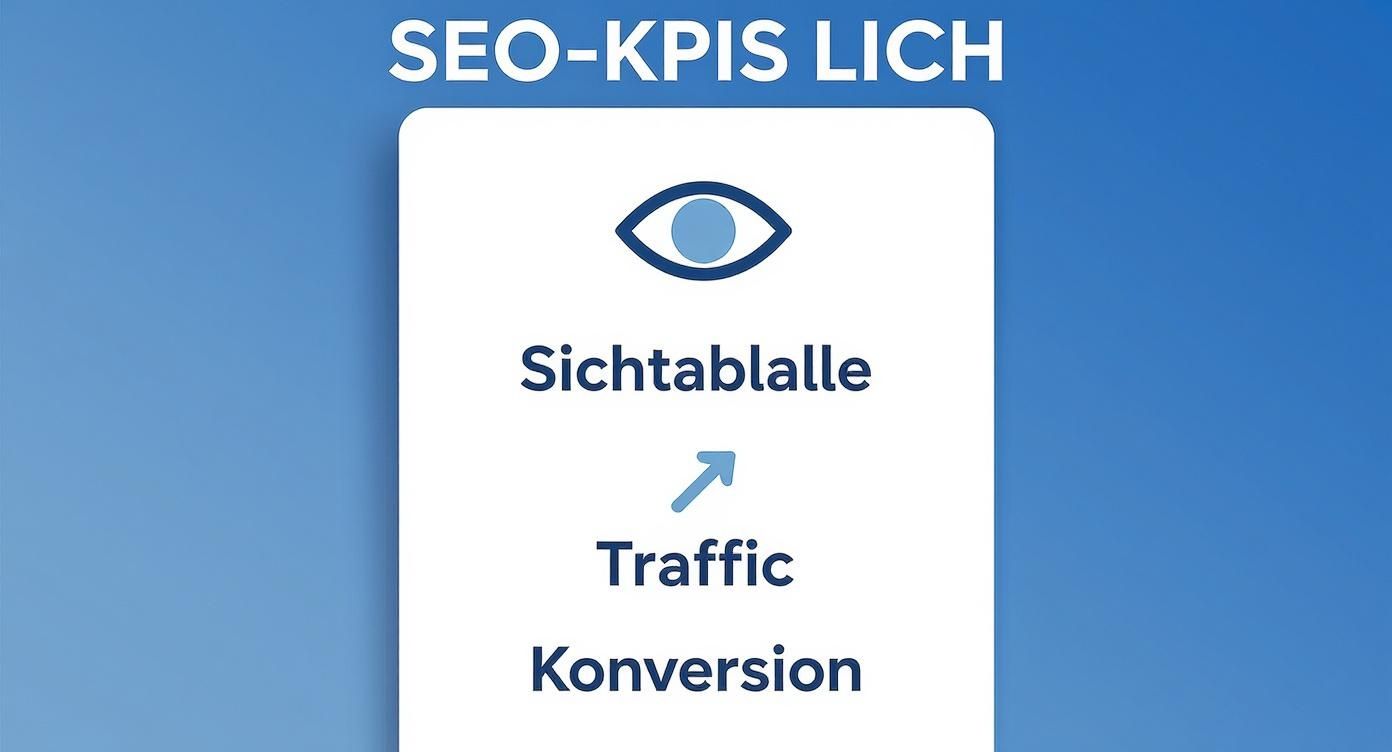
It's immediately clear: each step is a prerequisite for the next. Without visibility, there is no traffic, and without traffic, there are no conversions.
KPIs for e-commerce
For online shops, the matter is quite clear: it's about selling more. Therefore, the most important KPIs revolve directly around revenue and the efficiency of the sales process. It's not enough to simply attract visitors to the site; these visitors must ultimately become paying customers.
Here are the key figures that really matter:
- Organic sales: This is the ultimate challenge. This figure measures the total revenue that comes directly from visitors via organic search.
- Number of transactions: This shows how many sales were generated through SEO in total. An increase here is clear proof of success.
- Average Order Value (AOV): It reveals how much a customer spends on average per purchase. SEO measures targeting higher-priced products or clever cross-selling can specifically increase this value.
- E-commerce conversion rate: What percentage of organic visitors actually complete a purchase? This is a strong indicator of the quality of your traffic and the user-friendliness of your shop.
An e-commerce manager should spend less time worrying about a single keyword ranking on page two. It's far more important to analyze the conversion rate of the top 10 landing pages. That's often where the greatest untapped revenue potential lies.
KPIs for lead generation
The situation is quite different for companies that collect inquiries for services or complex products – think of B2B providers, consultants, or agencies. Here, the sales process is often much longer and sometimes takes place offline. The task of SEO in this context is to fill the pipeline with qualified leads.
These key figures are particularly important here:
- Number of organic leads: The total number of inquiries that came via contact forms, phone calls, or demo requests from organic search.
- Cost per Lead (CPL): What is the average cost of acquiring a new lead through SEO? A decreasing CPL indicates that your efforts are becoming increasingly efficient.
- Lead-to-customer rate: How many of the contacts acquired through SEO actually become paying customers? This metric often requires integration with a CRM system, but provides the ultimate proof of ROI.
KPIs for local businesses
For local businesses like restaurants, doctors' offices, or tradespeople, success hinges directly on local search results and Google Maps. The focus is clearly on attracting customers from the immediate vicinity.
The most important key figures can therefore often be found directly in the Google Business Profile:
- Clicks on the directions: It shows how many potential customers have actively sought out your business – an extremely strong buying signal.
- Calls via the company profile: Measures the direct calls made via the button in your Google listing.
- Local keyword rankings: Visibility for search queries with a clear local reference (e.g., "hairdresser Kaiserslautern") is absolutely crucial here.
- Number of ratings: Not only the quantity, but also the quality of the reviews significantly influences the ranking and the customers' purchasing decisions.
KPIs for content publishers and blogs
Websites that earn their money through advertising, affiliate marketing, or subscriptions pursue a different goal. They need to build a loyal readership and encourage people to stay on the site as long as possible and return regularly.
Qualitative metrics are absolutely essential here:
- Returning visitors: A high percentage of returning users from organic search is invaluable. It shows that your content is so good that people are happy to come back.
- Average interaction duration: How long do users actively engage with your articles? Longer dwell times are a clear signal to Google for high-quality content.
- Pages per session: A good indicator of how deeply visitors are engaging with your content and whether they discover further articles on your website.
How to measure your SEO KPIs with the right tools
The best SEO KPIs They're completely useless if you can't measure them accurately. Without reliable data, you're groping in the dark and simply can't prove the success of your work. Fortunately, there are a handful of really good tools that shed light on the matter and give you precise control over your performance.
At the heart of this tool universe are two free, but extremely powerful platforms from Google itself: Google Search Console and Google Analytics 4. Think of these two as the cockpit of your website.
The Google Search Console – Your direct window to Google
The Google Search Console (GSC) It's essentially your direct line to Google Search. It tells you how Google perceives your website and how users find it in search results. You could also say: It's the source of truth for everything that before This happens when you click on your page.
Here you will find the absolutely fundamental KPIs:
- Impressions: How often was your page displayed in the search results?
- Clicks: How many searchers actually clicked on your result?
- Click-Through Rate (CTR): The percentage ratio of clicks to impressions – a great indicator of the attractiveness of your search snippets.
- Average position: Where do you rank on average for specific search queries?
Google Search Console (GSC) is essential for optimizing your search engine performance and understanding which keywords you're visible for. A deep dive into this data is often the first step to improving your... To improve SEO score and drive more relevant traffic to your site.
Google Analytics 4 – Understanding User Behavior
As soon as a visitor lands on your website, it takes over Google Analytics 4 (GA4) The rudder. This tool specializes in analyzing user behavior. on to analyze your page. It answers the crucial question: What do people do after clicking on your search result?
GA4 provides you with the hard facts on engagement and business metrics:
- Organic traffic: How many visitors actually came via the unpaid search?
- Average interaction duration: How long do users actively engage with your content? Do they stay or do they leave immediately?
- Conversions: Are your business goals being met? Is anyone buying something, filling out a form, or calling?
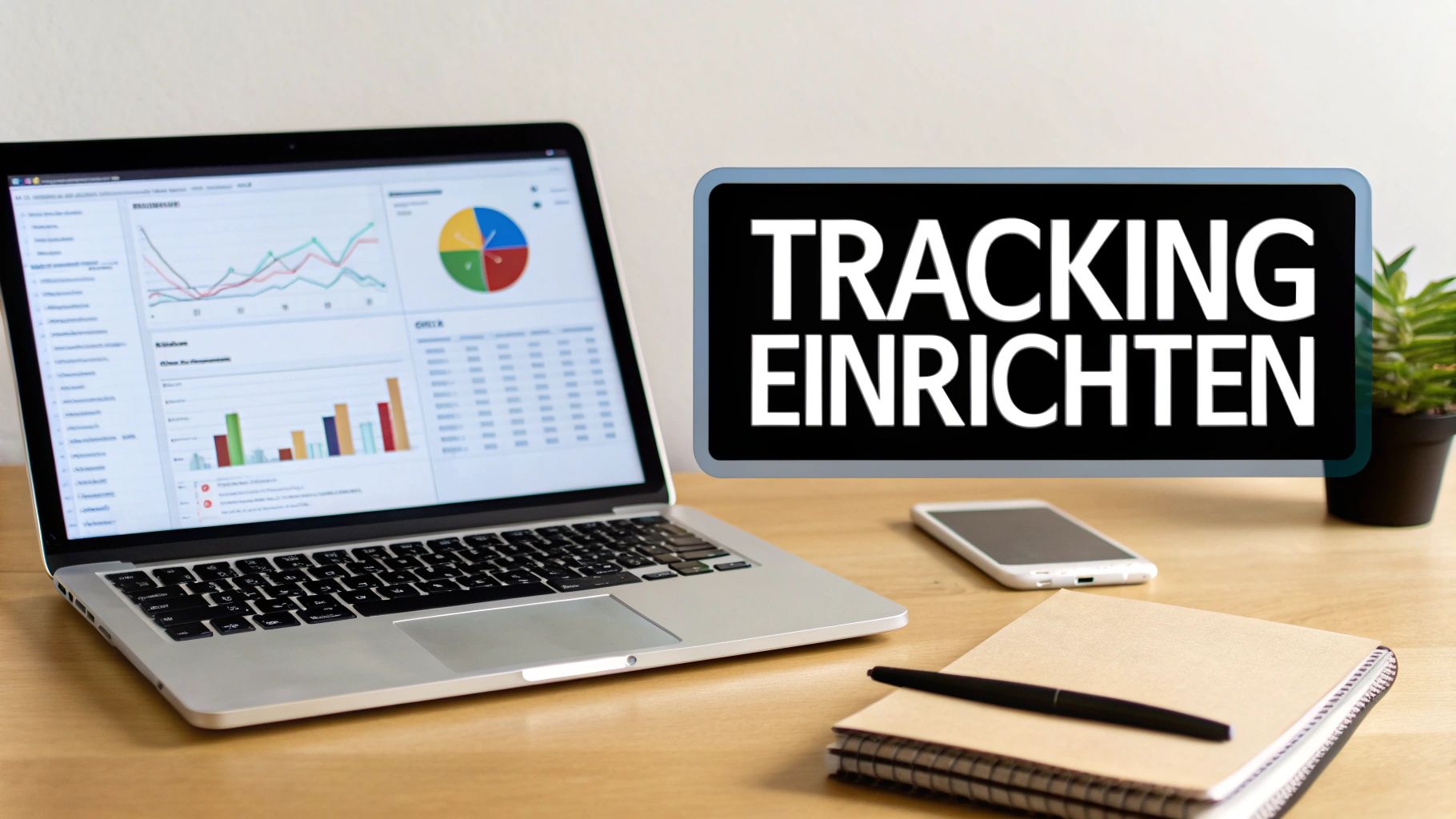
The following screenshot shows a typical acquisition report in Google Analytics 4, which breaks down traffic by different channels.
Here you can see at a glance how channels like "Organic Search" compare to paid advertising or social media, and where most users – and especially most conversions – come from.
The real magic happens when you mentally combine the data from GSC and GA4. Only then do you get a complete picture of your users' entire journey – from their first Google search to their final purchase on your website.
When professional third-party SEO tools are worthwhile
While Google tools form the foundation, they reach their limits with certain tasks. This is precisely where specialized third-party SEO suites like Ahrefs, Semrush, or the very popular Sistrix in Germany come into play. These paid tools are particularly worthwhile for more in-depth analyses.
Competitive analysis
One of the biggest advantages is the ability to analyze your competitors' strategies down to the smallest detail. You can find out which keywords your competitors rank for, where they get their best backlinks, and which content is really hitting the ground running for them. This is pure gold for identifying your own gaps and discovering new opportunities.
Comprehensive backlink monitoring
Google Search Console (GSC) only shows you a portion of your own backlink profile. Tools like Ahrefs, on the other hand, allow for comprehensive monitoring. You not only see who is linking to you, but you can also assess the quality and strength of these links. This is absolutely crucial for a sustainable off-page SEO strategy.
Market and visibility analyses
Tools like Sistrix have established the so-called Visibility Index. This metric summarizes your domain's overall visibility in Google search results and shows it over time – also in direct comparison to competitors. Such metrics are perfect for quick benchmarks and for identifying market trends early on.
Ultimately, the choice of the right tools depends on your goals and budget. However, for getting started and measuring your most important SEO KPIs, Google Search Console and Google Analytics 4 are an unbeatable and indispensable duo.
Create compelling SEO reports
Raw data alone has never impressed anyone. Even the best SEO KPIs Data is worthless if it gathers dust in a cluttered spreadsheet. The true value of your work only becomes apparent when you transform these numbers into a clear, compelling story – a story of progress, successes, and the next strategic steps. A strong report is your most important tool for convincing stakeholders and clients of the value of your SEO efforts.
Imagine simply presenting a long list of keyword rankings. While informative, it lacks a compelling narrative. Turn the tables and tell a story: "By optimizing our category pages for 'sustainable sneakers,' we not only improved our ranking by five places, but also increased organic traffic to these pages by..." 35 % "It increased. That brought us 15 additional sales last month." That's a story that resonates and has an impact.

The perfect dashboard with Looker Studio
A visual dashboard is the fastest way to convey the most important KPIs at a glance. Google Looker Studio (formerly known as Data Studio) is an extremely powerful and free tool for this. With it, you can process data from various sources such as Google Analytics 4 and the Google Search Console condense and visualize in interactive graphics.
A truly good dashboard should do a few things:
- Clarity at first glance: Key performance indicators (KPIs) such as organic traffic, conversions, and the visibility index must be immediately noticeable. No need for lengthy searches.
- Time comparisons: Show the development compared to the previous month or the same period last year. This makes trends and seasonal fluctuations immediately apparent.
- Meaningful segmentation: Offer the ability to filter data by channels, devices, or landing pages to quickly dig deeper.
An effective dashboard answers the most important questions in less than 60 seconds. It is not intended for in-depth analysis, but rather for quick orientation and monitoring the status quo.
The anatomy of an effective monthly report
A written monthly report goes a step further than a dashboard. It provides the necessary context, interprets the figures, and derives concrete recommendations for action. Instead of just showing the "what," it explains the "why" and, above all, the "what now?" In this way, a dry repository of numbers becomes a strategic compass for the coming weeks.
A professional SEO report needs a clear, logical structure so that everyone can understand and follow the results. Each section has its own purpose – from a quick summary for management to concrete next steps for the team.
Here is a proven structure for a monthly SEO report.
Structure of an effective monthly SEO report
This table outlines the essential components of a professional SEO report to ensure clear and comprehensive communication of the results.
| Report section | Content and purpose | Example KPIs |
|---|---|---|
| Executive Summary | A brief overview of the most important successes, challenges, and performance compared to goals. Ideal for those with limited time. | Organic traffic (MoM), total conversions, visibility trend |
| Performance Overview | Detailed presentation of the key KPIs with visual charts and comparisons to the previous month and year. Here are the hard facts. | Organic sessions, CTR, keyword rankings (top 10) |
| Analysis & Interpretation | This is where the real story is told. Why did certain KPIs rise or fall? What measures led to this? | Analysis of top landing pages, evaluation of the CTR for important keywords |
| Measures taken | A transparent list of all SEO activities implemented during the reporting period (e.g., content creation, technical corrections). | On-page optimization, link building, technical SEO audits |
| Outlook & Recommendations for Action | Concrete, prioritized next steps for the coming month. What needs to be done to achieve the goals? | Focus keywords for new content, optimization needs on pages X and Y |
Such a structured approach transforms complex data into compelling arguments. It not only demonstrates the success of your past work but also builds trust and provides a clear foundation for future decisions. In this way, reporting transforms from a tedious obligation into one of your most powerful strategic tools.
Your questions about SEO KPIs – answered briefly and concisely
Finally, we'll address a few questions that frequently arise in practice. This will clear up any remaining uncertainties and equip you with the tools to measure your SEO success even more precisely.
What is the difference between a metric and a KPI?
This question often leads to confusion, but the distinction is absolutely crucial for a powerful strategy. Think of metrics like all the available data points in your car: tire pressure, outside temperature, engine speed. One Metric It's simply a metric – for example, the number of daily visitors to your website or the page load time. It provides raw data, but without context, it doesn't tell us much.
A Key Performance Indicator (KPI) In contrast, it's like the fuel gauge or the speedometer. It's a carefully chosen metric directly linked to a goal that's crucial for you. While you could be monitoring hundreds of metrics, focus on a handful of KPIs that truly matter.
Remember this rule of thumb: Every KPI is a metric, but not every metric is a KPI. A true KPI always answers the question: "Does this bring us closer to our business goal?"„
The sheer number of visitors (a metric) only becomes a KPI when your goal is to increase brand awareness. The "conversion rate from organic traffic" is a prime example of a KPI, as it clearly demonstrates how SEO contributes to revenue or lead generation.
What are the 3 most important SEO KPIs for beginners?
Those just starting out with measuring their SEO success can quickly feel overwhelmed by the sheer volume of data. My advice: Don't overcomplicate things. Focus on these three key pillars to get a clear sense of your performance:
- Organic traffic: How many people find their way to your site via unpaid Google search results? This is the most basic pulse check for your visibility. If this number is increasing, you're doing something right.
- Keyword rankings: Where do you rank for the search terms that are truly relevant to your business? Without solid first-page rankings, significant traffic usually remains a pipe dream.
- Conversion rate: What do visitors who come via Google do? Do they buy? Do they make inquiries? Do they sign up for the newsletter? This KPI bridges the gap between your SEO efforts and what ultimately matters: business success.
How often should I check my SEO KPIs?
The frequency depends entirely on the specific KPI. Panickingly checking keyword rankings daily is pointless – they fluctuate. This only leads to hasty and often incorrect conclusions. A proven approach is this staggered schedule:
- Weekly: Take a quick look at major trends like organic traffic and conversions. This will help you quickly identify any problems or positive developments.
- Monthly: Now let's get into the details. The end of the month is the perfect time for a thorough analysis and meaningful reporting. One month is a solid period to evaluate the impact of your measures and identify patterns.
- Quarterly: Take time to gain a strategic overview. Are the overarching goals being achieved? Where do we need to make adjustments? This is where you set the course for the coming months.
Do you want to make sure you have the right ones? KPIs in SEO not just keep an eye on things, but also improve them in a targeted way? LinkITUp is your experienced partner for data-driven search engine optimization. We help you sustainably increase your online visibility and achieve measurable success. Learn more about our individual SEO services.