




Think of your marketing budget not as an expense, but as a solid investment. Marketing Return on Investment (ROI) The key metric here is ROI, which shows you in black and white whether this investment is paying off or wasting time. Simply put: ROI measures how much profit you get back for every euro you invest in marketing.
What marketing ROI really means
Return on investment (ROI) is like a compass for your marketing strategy. Without it, you're navigating through fog, pouring money into initiatives without knowing which ones will actually move your business forward. It's not about simply spending budgets. It's about investing wisely to create growth that is measurable and predictable.
Imagine a winemaker here in the Palatinate. He plants different grape varieties (your marketing campaigns) in different vineyards (your channels). Some vines require a lot of care and water (high costs) but ultimately produce a top-quality wine with a high yield (high profit). Others are easy to care for, but the wine is just a simple table wine. The ROI helps the winemaker decide which grape varieties to focus on next year to produce the best wine.
More than just a bare number
Marketing ROI is so much more than a dry formula. It's a strategic tool that helps you make truly informed business decisions. Understanding your ROI allows you to:
- Distribute budgets wisely: You can immediately see which channels – whether SEO, social media, or traditional advertising – deliver the best return on investment. This allows you to invest your money precisely where it will work hardest for you.
- Continuously improve campaigns: If an advertisement delivers a poor ROI, that's a clear signal. You know immediately that you need to adjust the target audience, the message, or the design.
- Proving the value of marketing: You can clearly demonstrate to management or partners how marketing directly contributes to revenue. This not only strengthens your position but also secures future budgets.
The right mindset is crucial.
Successful entrepreneurs don't see marketing as a necessary evil or a mere cost center, but as the ultimate engine of growth. Every ad, every blog post, every email – these are all targeted investments from which a return is expected. This mindset changes everything. The question is no longer, "What will this campaign cost us?", but rather, "What will this campaign bring us?"„
A positive ROI means your marketing not only pays for itself but also generates a profit. Every euro invested essentially comes back with a return. A negative ROI, on the other hand, is a warning sign: your strategy is burning money instead of growing it.
The real art lies in accurately allocating all costs and the resulting profits. This becomes particularly tricky with long-term strategies like SEO or building a strong brand. But this is precisely where true expertise shines through. Companies that manage to... Marketing return on investment Those who can measure precisely simply make better decisions. This gives them an invaluable advantage, especially in a competitive regional market like Kaiserslautern.
How to correctly calculate your marketing ROI
The Return on investment in marketing Calculating this might initially sound like dry number crunching. In reality, however, it is the crucial step to finally move away from pure gut feelings and towards solid, data-driven decisions.
Imagine it like this: You're exchanging an old, vague treasure map for a modern GPS. Both roughly indicate the direction, but only the GPS provides you with a precise route that you can review and optimize at any time.
The basic ROI formula
At its core, the calculation is surprisingly straightforward. You take the profit generated directly from the marketing activities, subtract the associated costs, and divide the result by the original costs.
The formula is: (Profit from investment – Cost of investment) / Cost of investment
The result is usually displayed as a percentage – simply multiply by 100. A positive result? Great, you've earned more than you spent.
A simple practical example:
Let's assume an IT service provider from Kaiserslautern activates a Google Ads campaign for 1.000 €. This campaign brings him new orders worth a total of 6.000 €.
- Profit: 6.000 €
- Cost: 1.000 €
- Calculation: (€6,000 – €1,000) / €1,000 = 5
Multiplied by 100, this results in an ROI of 500 %. That means every euro invested has returned five euros of profit to the company. Not bad, right?
This infographic sums up the process – from the budget used to the measurable actions and the noticeable growth.
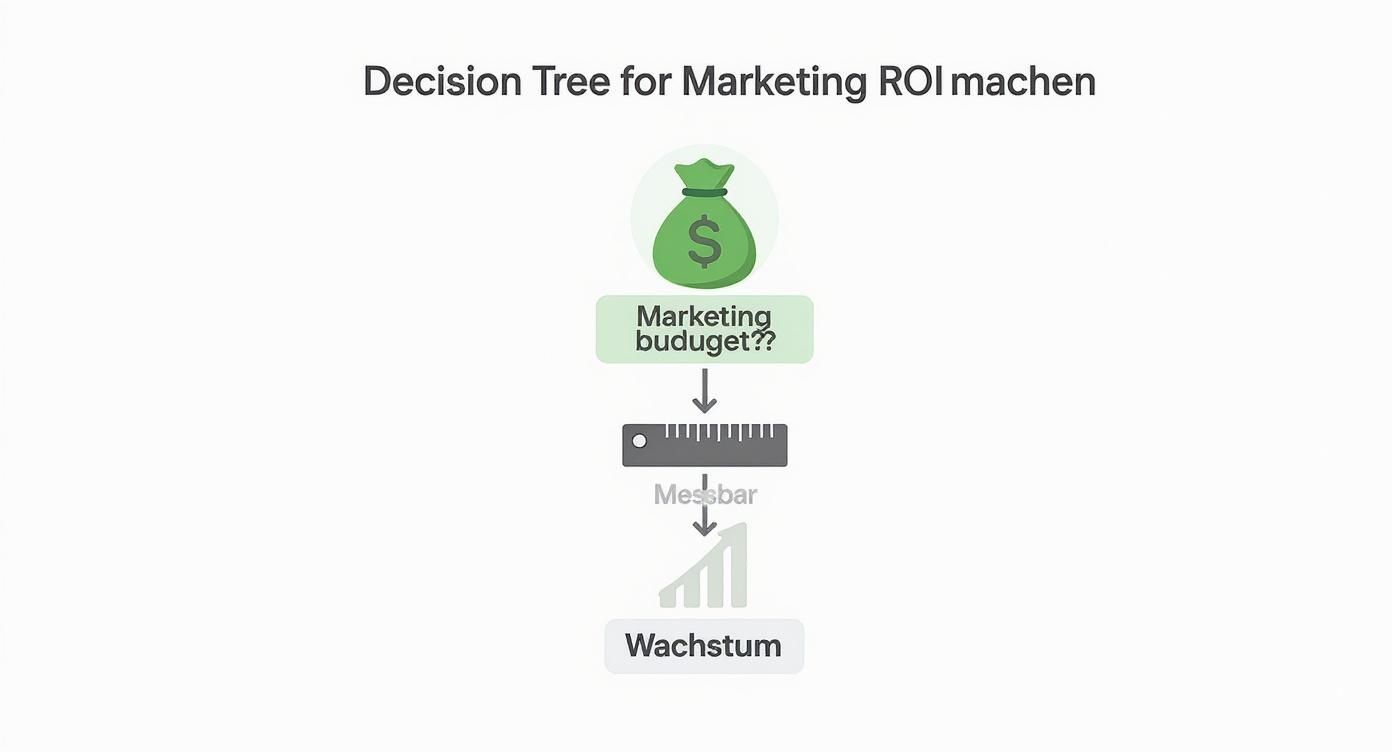
It is clear: Measurability is the key factor that distinguishes a mere expenditure from a smart investment.
If the simple formula is not sufficient
For fast, clearly defined campaigns, the standard formula is invaluable. But what about the marathon disciplines in marketing? Think of SEO or content marketing, whose fruits often only ripen after months.
This simple calculation quickly reaches its limits. The main problem: it only captures the very first purchase. It completely ignores the fact that a customer you acquire today might remain loyal to you for years and continue to buy from you.
The true value of a marketing campaign is rarely revealed in the first purchase. It lies in the total value a customer creates for you over the entire duration of their business relationship.
To grasp this much bigger picture, we need to expand our toolkit and use metrics that reflect this long-term value.
Advanced ROI calculation with CLV and CAC
Here, two crucial metrics come into play that will take your analysis to a new level: the Customer Lifetime Value (CLV) and the Customer Acquisition Cost (CAC).
- Customer Lifetime Value (CLV): This metric predicts how much revenue an average customer will generate with you during their entire "lifetime" as a customer.
- Customer Acquisition Cost (CAC): The CAC tells you how much you need to spend on average to acquire a single new customer.
These two values are more than just numbers; they offer a strategic perspective on your Return on investment in marketing.
This table shows the differences and helps you decide which model best suits your current situation.
Comparison of ROI calculation models
This table compares simple and advanced formulas for calculating marketing ROI and explains when each model is most suitable.
| Calculation model | formula | Use case | Advantages |
|---|---|---|---|
| Simple ROI | (Profit - Costs) / Costs | Short-term campaigns (e.g., Google Ads, Social Media Ads) with direct sales attribution. | Quick and easy to calculate, ideal for a first overview of profitability. |
| Extended ROI (with CLV/CAC) | CLV / CAC | Long-term strategies (SEO, content marketing, branding) that focus on customer loyalty. | It offers a strategic, sustainable perspective and assesses the long-term value of marketing investments. |
While the simple formula provides a snapshot, the extended calculation gives you, as it were, a preview of your company's future development.
As a rule of thumb: A healthy ratio of CLV to CAC is often... 3:1 or higher. This means that the value a customer brings over time should be at least three times the cost of acquiring them. This broader perspective suddenly makes channels profitable that don't focus on quick sales but on building stable, valuable customer relationships.
Using the right KPIs for a meaningful ROI
The best ROI formula is completely useless if the data you use is incomplete or simply wrong. To obtain a truly meaningful result, you need... Return on investment in marketing To determine this, you need to keep an eye on the right key performance indicators (KPIs). You can think of them like the instruments in a pilot's cockpit: without them, you're flying blind.
Let's take a practical example: You run a small software company here in Kaiserslautern. A potential customer lands on your website. What do they do next? Do they download your white paper? Request a demo? Or are they gone again after three seconds? Each of these actions is a valuable data point that tells you whether your investment has paid off or not.
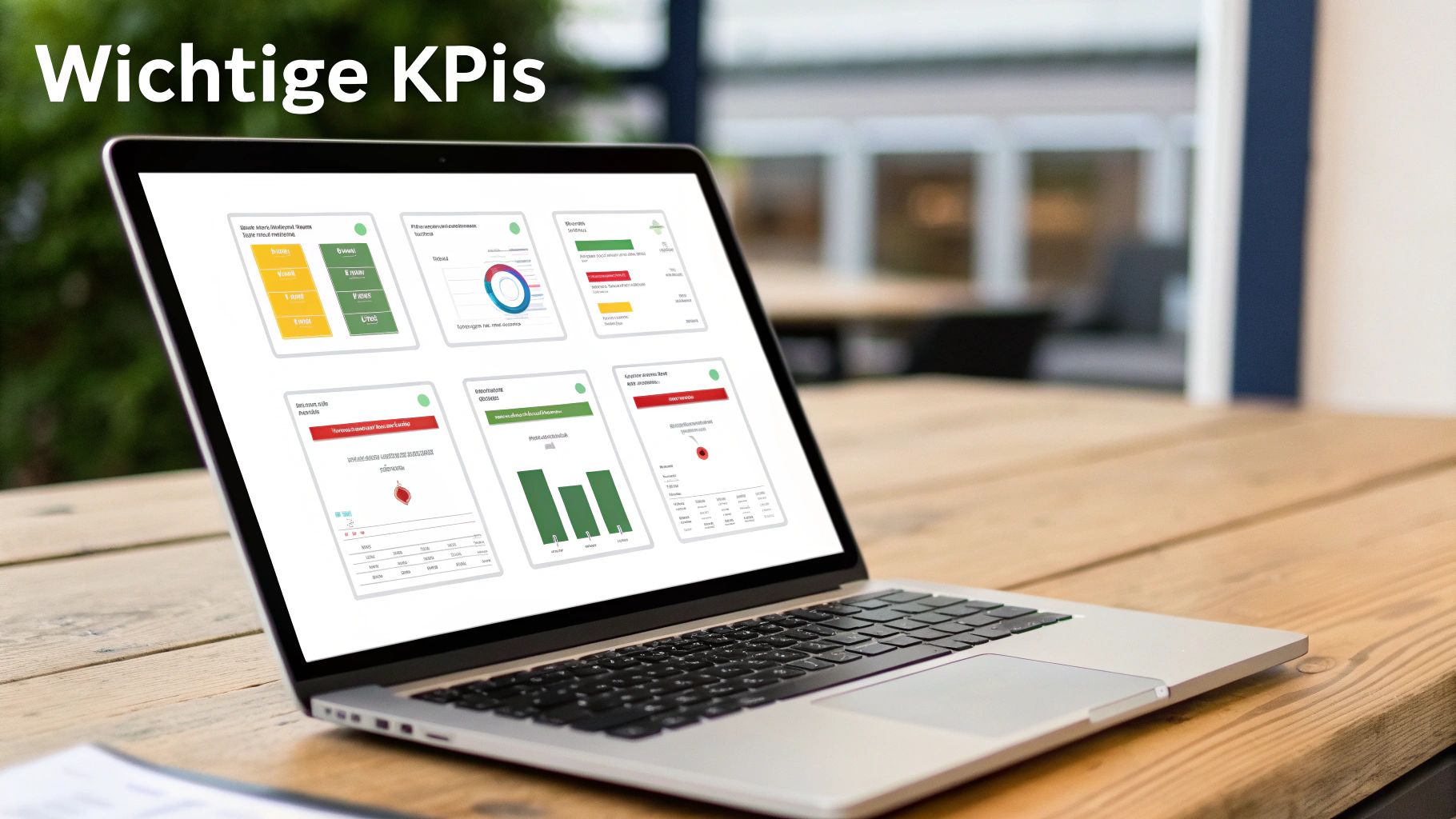
The trick is to focus on the few KPIs that really make a difference, instead of drowning in a flood of metrics that ultimately don't matter.
The four pillars of your ROI measurement
Instead of juggling dozens of metrics, focus on four crucial ones. These four KPIs build logically upon each other and tell the whole story – from a user's first click to the long-term value for your business. They are the foundation for any sound ROI analysis.
Conversion Rate: This number clearly shows you what percentage of your website visitors complete a desired action. This could be a direct purchase, but also subscribing to a newsletter or filling out a contact form. A low rate is often a warning sign of problems with user experience or the product or service itself.
Cost-per-Lead (CPL): What does it cost you on average to acquire a single potential customer (lead)? That's exactly what the CPL answers. If this value is too high, your advertising campaigns are probably too expensive or not targeted precisely enough.
Customer Acquisition Cost (CAC): This figure goes a crucial step further. It quantifies the total costs incurred to achieve a actually paying Acquiring customers involves not only marketing but also sales costs. Customer acquisition rate (CAC) is one of the most critical metrics for the scalability of your business.
Customer Lifetime Value (CLV): Customer Lifetime Value (CLV) is a glimpse into the future. It forecasts the total profit you can expect from a single customer over the entire business relationship. Ultimately, it is the ultimate indicator of customer satisfaction and long-term profitability.
As you can see, these key performance indicators (KPIs) are inextricably linked. A high conversion rate automatically lowers your cost per lead (CPL) and customer acquisition cost (CAC). Conversely, a high customer lifetime value (CLV) justifies higher customer acquisition expenditures, as long as the CAC remains profitable. Understanding this interplay is absolutely crucial. More on the special role of... KPIs in SEO You can read more about this in our follow-up article.
Applying KPIs in practice
Let's return to our IT company in Kaiserslautern. Let's imagine the company invests 2.000 € in a LinkedIn campaign that 1,000 visitors leads to a landing page.
- Conversion Rate: Of these 1,000 visitors, 50 a contact form. This results in a conversion rate of 5 %.
- Cost-per-Lead (CPL): The cost for these 50 leads amounted to €2,000. The CPL is therefore... 40 € per lead (€2,000 / 50).
- Customer Acquisition Cost (CAC): The sales department manages to, 5 to convert these 50 leads into paying customers. The cost for these 5 new customers is still the €2,000 from the campaign, resulting in a CAC of 400 € per customer.
And now comes the crucial question: Are 400 € Is it good or bad for a new customer? Without knowing the CLV, this question simply cannot be answered.
Customer Lifetime Value is the strategic anchor point for your marketing decisions. It determines how much you can afford to spend to acquire a new customer and separates profitable from unprofitable marketing channels.
If the average customer generates a profit of [amount] for the company over three years 3.000 € (CLV) brings in, the acquisition costs of €400 are an excellent investment. Return on Investment This is more than positive. However, if the CLV is only €350, the campaign is burning money – even though it appears to have successfully generated leads at first glance. Only by consistently tracking these KPIs can you truly manage your marketing budget intelligently and ensure that every investment leads to sustainable growth.
How to increase your marketing ROI in practice
Theory is one thing, but the real magic – and the biggest lever for your success – happens in the implementation. To achieve this Return on investment in marketing To not only calculate but also strategically increase results, you need to back the right horses. There are countless marketing channels, but three have proven to be particularly profitable and, above all, sustainable.
Here, we focus on the "power trio" of digital marketing: search engine optimization (SEO), content marketing, and email marketing. Each of these channels can significantly boost your ROI, but each in its own unique way. Understanding how these elements work together will enable you to make the best decisions for your business.
Search engine optimization (SEO): The engine for qualified traffic
Imagine your business had a permanently open stall on the city's busiest shopping street – without paying a single cent in stall fees. That's exactly what good SEO does for your website. Instead of buying expensive advertising space, SEO ensures that potential customers find you precisely when they are actively searching for your products or services.
The starting point for successful SEO is always smart keyword research. You need to find out which terms your target audience enters into Google and then precisely tailor your website to those queries. The result is highly qualified, organic traffic from people who already have a clear need.
In Germany, SEO is one of the channels with the best ROI. A survey shows: For 49 percent For German marketers, organic search is the digital channel with the highest return on investment. On average, every dollar invested in SEO yields a return of 22 US dollars That's a return of 2,200 percent. More on this and further information. You can find exciting digital marketing statistics at landingi.com.
SEO is not an expense; it's an investment in digital assets. A well-ranked website generates a steady stream of inquiries and sales for years to come, long after the initial investment.
Every click from organic search is essentially free – a click for which you would often have to pay dearly with paid ads. This cost advantage makes SEO one of the most profitable long-term strategies available. At the same time, an improved user experience and a clean site structure directly contribute to your conversion rate. To get the most out of this, you should consider how to optimize your Optimize conversion rate and thus convert more visitors into paying customers.
Content Marketing: The tool for genuine customer loyalty
While SEO brings people to your site, content marketing ensures they stay—and come back. Good content is the glue that creates a lasting relationship between your brand and your customers. It's about delivering real value long before you ask for anything in return.
Let's say you sell high-quality hiking boots in Kaiserslautern. Instead of just posting product images, you could create helpful content:
- Blog article: „"The 5 most beautiful hiking trails in the Palatinate Forest for beginners"“
- Video guides: „"How to lace up your hiking boots correctly: This is how you get maximum support"“
- Checklists: „"The ultimate packing list for a day trip in the Palatinate"“
With content like this, you'll transform from a mere salesperson into a trusted expert. Potential customers will build a relationship with you. And when the moment comes that they need new shoes – who do you think of first? Exactly, the expert who's already helped them.
This approach significantly increases Customer Lifetime Value (CLV) because it's built on trust and loyalty. A customer who feels well-advised doesn't just buy once. They become a loyal repeat customer and recommend you to others. This is how you maximize your CLV. Return on investment in marketing in the most sustainable way.
Email marketing: The direct line to the customer
Email marketing is often underestimated, but – when done correctly – it's one of the most profitable channels available. Why? Because you're communicating with people who have already explicitly given you permission to contact them. It's your own direct line to prospects and customers.
The real power lies in personalization and automation. Instead of sending everyone the same generic message, segment your contacts and deliver tailored content.
- A new subscriber receives an automated welcome series with helpful tips.
- A customer who has viewed a specific product receives targeted additional information about it.
- Long-standing regular customers receive an exclusive offer as a thank you.
Each of these personalized emails is far more relevant and significantly more likely to elicit a response. Once set up, automated campaigns work for you around the clock, generating revenue without requiring constant effort on your part. Sending costs are minimal, but the potential return is enormous – causing the ROI of this channel to skyrocket.
Practical example: How a Kaiserslautern-based SME multiplied its marketing ROI
Theory is all well and good, but at the end of the day we want to see what actually works. So let's look at a concrete example – one that could happen in one form or another every day in the Palatinate.
Imagine a small craft business in Kaiserslautern: the "Pfalzwerkstatt," specializing in custom-made wooden furniture. Like many small and medium-sized enterprises (SMEs), the workshop faced a classic problem: its marketing budget was being spread haphazardly. A little something for the local newspaper, a few flyers that mostly ended up unread in the trash, and the occasional social media post. The result? Stagnation and a big question mark over what the expenditures were actually achieving.
From gut feeling to clear data
The first step was the most painful – but also the most important. Instead of continuing to pump money into channels that "felt right," management took a hard look at where the most profitable orders actually came from. The realization was an eye-opener: The best customers found the old, somewhat outdated website through very specific Google searches like "carpenter Kaiserslautern" or "custom-made fitted wardrobe Palatinate.".
The course of action was clear. The budget was shifted away from expensive and ineffective print advertising and invested specifically where it was already demonstrably working. The new strategy rested on two pillars:
- Local SEO: The website received a complete relaunch. Modern design, optimized for local search queries, and packed with high-quality images that truly showcased the craftsmanship.
- Email marketing: Everyone who submitted an inquiry was added (with their consent) to an email list. This allowed for staying in touch, building trust, and turning prospects into long-term customers.
This simple restructuring was the turning point for the Pfalzwerkstatt.
The results were not long in coming.
After just six months, the new focus paid off. The investment in local SEO led to a tripling of the number of qualified inquiries via the website. Suddenly, it wasn't just random visitors contacting them, but people with a specific need and a genuine interest in buying.
A targeted marketing budget is like a sharp chisel in a carpenter's hand. It allows for precise work and maximum impact. In contrast, a scattershot approach is like trying to create a fine wood joint with a blunt axe – a lot of effort, little return.
Email marketing proved to be a real revenue generator. Newsletters offering inspiration for home projects and exclusive glimpses into the workshop turned one-time buyers into loyal, repeat customers.
This channel is often underestimated, yet email marketing is considered one of the most profitable in Germany. Studies show that companies receive an average return for every euro invested. Return on investment of $36 achieve. That's a return of 3.600 %You can find more information about these impressive figures in a [document/section/etc.]. Summary of email marketing statistics on hostinger.com.
ROI optimization in numbers: Before vs. After
A look at the hard facts of the Pfalzwerkstatt shows how dramatic the change was. Here is a comparison of the quarter before the changeover with the second quarter after the introduction of the new strategy:
| Metric | Previous (Q4) | After (Q2) | change |
|---|---|---|---|
| Marketing budget | 5.000 € | 5.000 € | Unchanged |
| Generated requests | 25 | 75 | +200 % |
| Completed projects | 5 | 18 | +260 % |
| Revenue through marketing | 15.000 € | 54.000 € | +260 % |
| Marketing ROI | 200 % | 980 % | +390 % |
The case of the Pfalzwerkstatt is no fairy tale. It vividly illustrates what happens when you stop guessing and start measuring. It's not about..., more To spend money. It's about using the available budget. intelligent and to use data-driven methods to Return on investment in marketing to really drive it up.
Data and tools: How to measure your ROI truly accurately

Successful marketing today is no longer a guessing game, but is based on solid data. To achieve this... Return on investment in marketing To control something precisely, you need the right tools. Without them, it's like navigating in fog – you hope to reach your destination, but you can't see the way clearly. Modern technologies finally shed light on the matter and show you what really works.
It's not just about collecting data. The trick is to intelligently combine the information from all your different sources. Only then can you create a complete picture of your customers and their journey to you.
No more data silos: A 360-degree view of the customer
The biggest obstacle to accurate ROI measurement is often the notorious data silos. Your customer data is likely scattered across various systems that don't communicate with each other.
- Website analysis (e.g. Google Analytics): It tells you where visitors come from and what they do on your site.
- CRM systems: This contains valuable information about your leads and customers, including their entire purchase history.
- Marketing automation platforms: These record how contacts respond to emails, webinars, and other automated messages.
As long as these systems operate in isolation, you'll only ever see fragments of reality. You might know how much traffic a campaign generated, but not which of those visitors later became loyal, repeat customers. The real magic happens when these data sources are connected.
Investing in the right technology is not just about cost. It's the foundation for more efficient campaigns and a significantly higher ROI because it bases decisions on facts rather than gut feeling.
By breaking down these silos, you can track your customers' entire journey – from their first click on an ad to their final purchase. Suddenly, it becomes crystal clear which marketing measures contribute what amount to revenue.
The right tools for the job
Modern tools not only help with collecting data, but above all with analyzing and interpreting it. Google Analytics is the essential starting point for understanding user behavior. A technically sound website is the fundamental prerequisite for this. In our article about the Importance of Google Core Web Vitals Learn how to optimize this data foundation.
Integrating with a CRM system is the logical next step. This gives anonymous website visits a face and connects them to specific leads and customers. Marketing automation tools complete the setup by capturing communication throughout the entire customer lifecycle.
Data-driven marketing is no longer just a trend in Germany, but a crucial lever for maximizing marketing ROI. Current studies show that German companies that rely on smart analytics and data-driven decisions achieve a return on investment of approximately [percentage missing]. 5 to 8 percent higher ROI achieve better results than their competitors. Particularly integrated solutions that combine various data sources deliver, on average, higher results. 50 percent more ROI as isolated approaches. Further insights into future marketing ROI can be found at nielsen.com.
At the end of the day, the right tools transform your marketing department from a mere cost center into a measurable growth engine. They give you the confidence to allocate budgets wisely, adjust campaigns in real time, and demonstrate the success of your work to management with hard data.
Practical questions: Short answers about marketing ROI
Even with the best guidance, questions often remain unanswered in everyday marketing. That's perfectly normal. Therefore, we've compiled the most common pitfalls and uncertainties when it comes to... Return on investment in marketing goes.
Consider the following points as a quick cheat sheet to help you overcome typical hurdles and place your decisions on an even firmer foundation.
So what exactly constitutes a good marketing ROI?
The honest answer? It depends. There's no single answer to this question, because a "good" value depends heavily on your industry, your business model, and above all, your profit margin. A software startup operates in a different league than an established craft business from Kaiserslautern.
However, a rule of thumb has become established as a rough guideline:
- A ratio of 5:1 (For every euro spent on marketing, you get €5 in revenue back) is absolutely sound. You can sleep soundly with that.
- A ratio of 10:1 Or even more is excellent. That's the Champions League.
But far more important than looking left and right is the development of your own figures. The real goal is to beat your own ROI quarter after quarter.
The best ROI is always the one that grows steadily. Don't focus too much on industry benchmarks; instead, concentrate on improving your own results month after month using data.
How do I measure the ROI for long-term strategies like SEO?
Many people fall into this trap. With channels like SEO or content marketing, which only reach their full potential over months, a short-term ROI perspective is simply the wrong approach. It's like planting a tree and then wondering after a week why you can't harvest any apples yet.
Instead of focusing solely on direct sales, we need to broaden our perspective. Strategic intermediate goals are crucial here, as they essentially predict future success.
Look at the development of organic traffic, the number of new leads generated through the website, or the steady improvement of your keyword rankings. The ROI is calculated here over longer periods, usually... 6 to 12 months, and often compared to the Customer Lifetime Value (CLV). Only in this way can you recognize the true, long-term value of these customers.
Do I need expensive tools to measure ROI?
No, absolutely not! You don't need a huge software budget for a clean start to data-driven success measurement. Free tools already lay a surprisingly strong foundation for this. Return on investment in marketing to keep an eye on.
These tools are perfectly sufficient to get started:
- Google Analytics: The key to understanding what's happening on your website – from traffic and user behavior to conversions.
- Google Search Console: Provides hard facts about your website's performance in organic search.
- The analytics tools of social media platforms: Each network has its own dashboard that shows you how your campaigns are performing.
- A simple spreadsheet program (e.g., Google Sheets): The perfect place to bring together costs and revenues from all channels in one central location and calculate the ROI.
Do you want to not only measure your marketing ROI, but finally and strategically increase it? We at LinkITUp We help businesses like yours maximize their online visibility through strategic SEO, ensuring a steady stream of qualified customer inquiries. Find out how, with over 15 years of experience, we can take your Google ranking to the next level. Visit us at our website and arrange a free initial consultation.