




Essentially, the marketing ROI answers the one crucial question that every entrepreneur asks: Does that even make a difference? It's the key performance indicator that bluntly reveals whether every euro you invest in advertising, content, or SEO generates a return on investment or simply vanishes into thin air. This transforms marketing from a mere cost factor into a measurable investment in your growth.
What Marketing ROI Really Means
Try viewing your marketing budget not as an expense, but as fuel for your company's growth engine. Return on Investment (ROI) It's like a fuel gauge, telling you how efficiently this engine is actually running. It measures how much profit you're generating in relation to your marketing costs. A positive ROI? Great, the engine is purring and propelling you forward. A negative ROI? Red alert – you're burning fuel without moving an inch.
This metric is far more than just a dry number in an Excel spreadsheet. It's an indispensable navigation system, especially for small and medium-sized enterprises (SMEs) here in the Kaiserslautern region. When resources are scarce, it's vital to know which paths truly lead to the goal and which are merely costly detours.
ROI helps you make decisions based on facts:
- Allocate budgets wisely: You can see in black and white which channels – whether Google Ads, Social media or local SEO – these are where you'll generate the most revenue. This allows you to shift your budget to where it will work hardest for you.
- Putting strategies to the test: ROI is the most honest critic. It shows you, without bias, whether the new campaign was a complete success or whether you urgently need to make improvements.
- Making growth predictable: Knowing the profitability of your actions allows you to plan future investments with confidence. This is the foundation for solid, sustainable growth.
The economic relevance in Germany
The question of marketing effectiveness is not theoretical talk, but has tangible economic implications. In Germany, for example, the average return on advertising spend (ROAS) in digital marketing is... 2.50 euros per euro invested. In other words: Every euro invested in digital advertising has 2.50 euros in sales generated. This figure clearly demonstrates how directly marketing investments drive business success. You can find more information in the Bitkom study on digital marketing.
A solid understanding of marketing ROI transforms gut feeling into knowledge. Suddenly, you no longer manage your marketing based on hope, but as a targeted investment with a calculable result.
For a local business in Kaiserslautern, this could be the crucial realization that investing in targeted SEO for regional search queries yields a much higher ROI than an expensive, broadly distributed social media campaign. This knowledge is precisely the key to gaining a competitive edge and making every marketing euro work for them.
Applying the ROI formula in practice
Calculating the return on investment in marketing often sounds like complicated rocket science, but it isn't. Essentially, we're just answering a very simple question: What do we get back for the money we spend? The trick is knowing the basic formula and feeding it with the right, honest numbers.
The basis for everything is this simple formula:
ROI = ((Revenue – Marketing Costs) / Marketing Costs) x 100
The result is a percentage. ROI of 200 % This means, for example, that for every euro invested, you not only got that euro back, but also made an additional two euros profit. Simple, right?
This infographic shows the path of the money at a glance – from the investment to the marketing campaign to the profit that is ultimately generated.
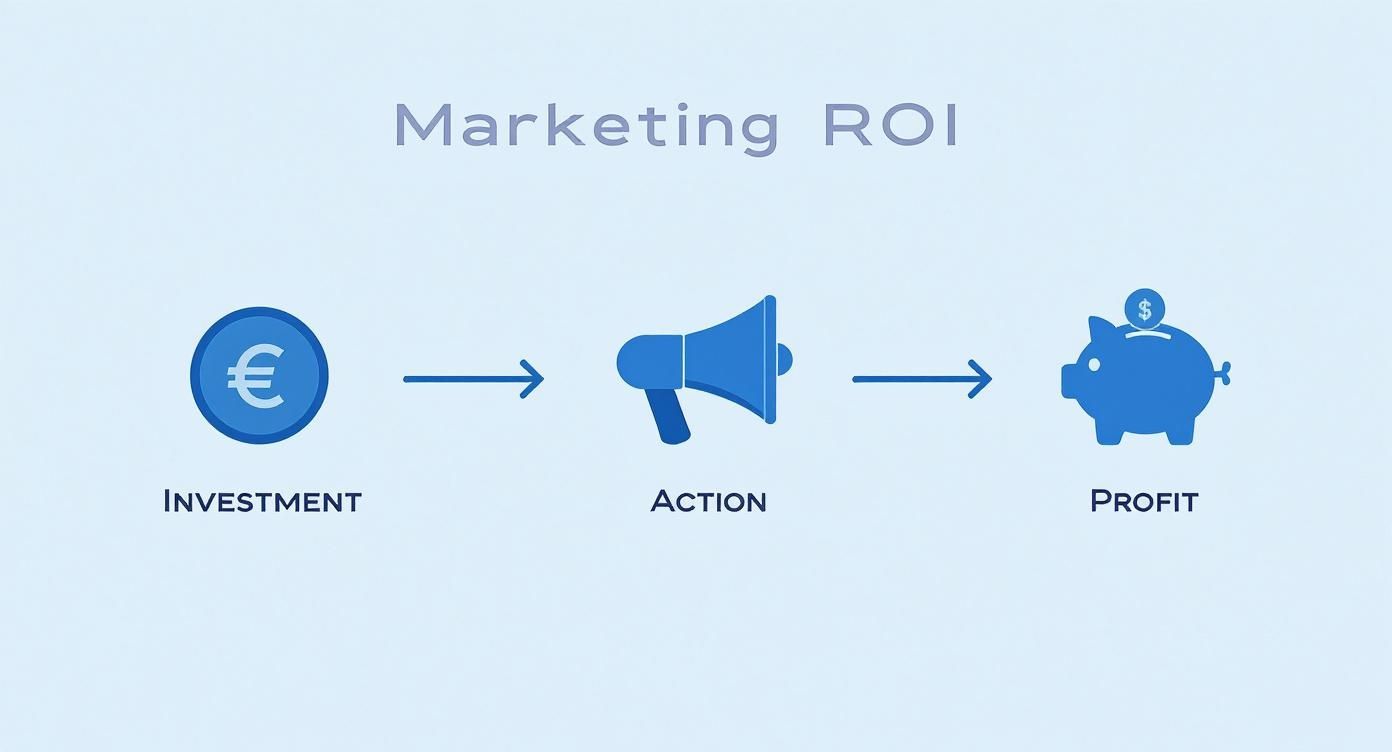
It's immediately obvious: Every marketing investment must have a measurable impact on profit. Otherwise, it's just wasted money.
What really belongs to marketing costs?
This is precisely where the most common mistake occurs. To obtain a meaningful result... return on investment marketing To calculate, you really need to all Lay the costs on the table. Those who underestimate the costs will end up with an artificially inflated ROI that has little to do with reality.
So what exactly belongs in the big pot of marketing costs?
- Direct advertising expenditure: This is the classic scenario – the budget for Google Ads, Facebook campaigns, or collaborations with influencers.
- Personnel costs: Yes, the salaries of your marketing team (proportional to the respective campaign, of course) are also costs.
- Tool and software licenses: Analysis tools, CRM systems, email marketing software – all of this costs money and must be included.
- Content creation: Expenses for copywriters, designers, videographers, or agencies. For example, if you need a strategic Create a content plan These costs are also part of the equation.
- Agency fees: Of course, if an external SEO or advertising agency is working for you, their fees must also be taken into account.
Only by honestly adding up these items will you get a clear picture of how profitable your measures really are.
A concrete calculation example
Imagine a small online shop from Kaiserslautern that sells handmade leather bags. The company wants to promote a new model and is launching a Google Ads campaign for this purpose.
The investment (marketing costs):
- Budget for Google Ads: 2.000 €
- Proportional salary of the marketing manager (10 hours of work): 500 €
- Costs for ad copy and images: 300 €
- Total marketing costs: €2,800
The profit (sales):
The campaign was a success! 80 bags for each 150 € sold. This results in direct sales of 12.000 €.
Now the calculations begin:
- ROI = ((€12,000 – €2,800) / €2,800) x 100
- ROI = (€9,200 / €2,800) x 100
- ROI = 3.2857 x 100
- ROI ≈ 329 %
A fantastic result! This means that for every euro the shop invested, it has... 3,29 € Profit made. That's what makes marketing fun.
Thinking outside the box: Expanded ROI models
The simple formula is a great starting point, but it also has its weaknesses. It's like a snapshot – it only shows the direct revenue of a single campaign. Long-term effects, such as customer loyalty, are completely ignored.
And this is exactly where the Customer Lifetime Value (CLV) This is where CLV comes into play. CLV looks to the future and estimates the total profit a customer will generate with you over their entire "lifetime" as a customer. Including this value makes the profitability picture suddenly much clearer and more meaningful.
To understand this principle of long-term perspective, it helps to look beyond the immediate horizon. Calculating the return on investment for real estate It works on a similar principle: It's not just today's rental income, but the appreciation in value and the income generated over many years that determine the true value. Marketing is no different: A customer acquired today can make repeat purchases for years to come, increasing the value of the original campaign far beyond the initial purchase.
Comparison of ROI calculation approaches
This table shows the difference between the simple, short-term ROI calculation and an extended approach that includes Customer Lifetime Value (CLV).
| Metric | Simple ROI calculation (short term) | Extended ROI calculation (long-term with CLV) |
|---|---|---|
| Time horizon | Focuses on the immediate revenue of a campaign (e.g., 30 days). | Consider the total value of a customer over the entire business relationship (months or years). |
| focus | Transaction-based: Measures the success of the first purchase. | Relationship-based: Measures the long-term value of an acquired customer. |
| Result | May underestimate the true value of marketing measures aimed at customer retention. | Provides a more realistic picture of profitability, especially for business models with repeat customers. |
| Use case | Good for fast, sales-oriented campaigns (e.g., clearance sales). | Essential for strategic decisions and the evaluation of channels such as SEO or content marketing. |
Ultimately, the expanded approach provides a much more strategic basis for your decisions. It helps you identify which channels not only generate quick sales, but also bring in the most valuable and loyal customers.
The most important KPIs for your marketing success
The Return on Investment (ROI) Your North Star is the ultimate goal of every marketing campaign. But to reach this star, you need a reliable compass and a detailed map. These are precisely your Key Performance Indicators (KPIs) – the crucial metrics that guide you step by step toward success.
Without the right KPIs, you're flying blind. You might see that you're spending money, but you have no idea if you're on track, burning through your budget, or close to reaching your goal. The right metrics make the abstract ROI tangible by breaking down the performance of your marketing efforts into understandable, measurable units.

The fundamental signposts to ROI
Some KPIs are so fundamental that they form the basis for almost every ROI analysis. They provide you with the raw data from which you can later derive the true value of your marketing investment. You could think of them as the four pillars of your reporting dashboard.
- Conversion Rate: This metric is pure gold. It shows what percentage of your visitors complete the desired action – be it a purchase, a newsletter signup, or a contact request. A high conversion rate means your message is getting through and your landing page is convincing.
- Cost per Acquisition (CPA): How much does it cost you on average to acquire a new customer? The CPA (Cost Per Acquisition) directly relates your marketing spend to the number of new customers. This makes it one of the most honest metrics for the efficiency of your campaigns.
- Customer Lifetime Value (CLV): This metric offers a glimpse into the future. It looks beyond the initial purchase and forecasts the total revenue a customer will generate over their entire business relationship with you. A high CLV justifies higher acquisition costs and is key to sustainable growth.
- Click-Through Rate (CTR): The click-through rate (CTR) measures how many people who see your ad or link actually click on it. It's a strong indicator of how relevant and appealing your advertising is to your target audience.
These metrics are like a patient's vital signs: each one provides an important clue, but only together do they paint a complete picture of the health of your marketing strategy. A high click-through rate (CTR), for example, is useless if the conversion rate on the landing page is close to zero. The interplay of these and other metrics... important KPIs in SEO This forms the basis for precisely controlling your actions.
Understanding the art of attribution
Imagine the customer journey like a football match. Who scored the winning goal? Was it the striker who put the ball in the net? The midfielder who delivered the perfect pass? Or perhaps the defender who initiated the attack in the first place?
This is precisely the question posed by Attribution modeling In marketing, it's about fairly distributing the value of a conversion across the various touchpoints a customer encountered before making a purchase. Choosing the right model is absolutely crucial for accurate conversion tracking. return on investment marketing.
Attribution models are not an academic exercise, but the foundation for fair budget allocation. A flawed model can lead to underfunding successful channels and overfunding inefficient ones.
Let's take a closer look at the most common models:
- Last-click attribution: This model gives all the credit to the last touchpoint before conversion. It's easy to measure, but completely ignores all previous interactions that influenced the customer's journey.
- First-click attribution: Here, the very first point of contact receives full recognition. This model is great for understanding which channels attract new prospects. However, it underestimates the channels that ultimately lead to a sale.
- Multi-touch attribution: This approach is the fairest and most realistic. It distributes the value of the conversion across several or even all touchpoints of the customer journey. Models such as the linear model (all touchpoints receive the same value) or the U-shaped model (first and last contact receive the most value) provide a much more nuanced picture.
For most companies, especially in the B2B sector with long sales cycles, a multi-touch model is the best choice. It recognizes that a single touchpoint is rarely responsible for a purchase. Rather, it's the interplay between the initial blog post, the informative email, and the final Google ad that convinces the customer. Correct attribution is therefore key to understanding the true contribution of each channel to overall success and precisely managing your ROI.
Practical strategies to boost your ROI
Enough theory, now let's get down to brass tacks. A strong Return on investment in marketing Success doesn't fall from the sky. It's the result of smart, measurable, and strategically implemented strategies. It's not about simply throwing more money at it, but about investing smarter and making the most of what you already have.
The following levers have been proven in practice and can noticeably increase the efficiency of your marketing activities. We focus on three absolute core areas that make all the difference, especially for small and medium-sized enterprises (SMEs): a strong foundation for organic traffic, optimal use of existing visitors, and the cultivation of valuable customer relationships.
Reduce costs sustainably with SEO and content
Every euro you invest in paid advertising is fleeting. Turn off the money tap, and the flow of visitors dries up. Search engine optimization (SEO) and top-notch content marketing are the exact opposite: a sustainable investment in the future of your business. Every good blog post, every optimized category page works. 24/7 for you – without costing per click.
The goal is crystal clear: to systematically reduce the cost per acquisition (CPA) by focusing on unpaid, organic traffic. Instead of paying for each individual visitor, you build genuine business value that generates qualified leads for years to come.
- Keyword research: Find out which search terms people with a clear intention to buy use that are relevant to your business in Kaiserslautern and the surrounding area.
- On-page optimization: Make sure your website is technically sound and that your content delivers exactly what your target audience is looking for.
- Local SEO: Your Google Business Profile is your digital business card. Maintain it to rank highly in local searches.
- Content creation: Don't write advertising copy, deliver real solutions. Position yourself as the expert people trust.
These measures will not only increase the quantity of your traffic, but above all its quality. Those who are actively searching for a solution and find you organically are often much more ready to buy.
Optimize the conversion rate in a targeted way
It's almost always more cost-effective to get more value from existing visitors than to constantly buy new, expensive visitors. This is precisely where conversion rate optimization (CRO) comes into play. Even tiny improvements can have a huge impact on your overall ROI.
Think of your website like a physical store. CRO ensures that the aisles are clear, the products are well-lit, and the checkout is easy to find. Every unnecessary click, every ambiguity on the path to purchase costs you real money.
The fastest way to double your ROI isn't to double your marketing budget, but to double your conversion rate. This approach fully leverages the potential of your existing resources.
One of the most powerful methods for this is the A/B testing. This involves pitting two versions of a page against each other – for example, with different headings, images, or buttons. Then simply see which version performs better.
A real-world example:
A local online retailer from the Palatinate region is testing the order button on their product page. Version A is labeled "Add to cart," version B "Buy securely now." After 1,000 visitors to each version, it turns out that version B achieves a [missing value] 15 % higher click rate. This simple change immediately generates more revenue without spending a single cent more on advertising – thus improving the ROI of all channels that drive traffic to this page. Here's how to proceed systematically to achieve your Optimize conversion rate, is a crucial factor for your success.
Increase customer value with email marketing
Acquiring a new customer is many times more expensive than retaining an existing one. Email marketing is one of the most powerful and cost-effective tools available for this. You can communicate directly with your contacts, build trust, and specifically encourage further purchases.
Automated email sequences allow you to gradually nurture new leads and repeatedly win back existing customers with personalized offers. A welcome series for new newsletter subscribers, a reminder about an abandoned shopping cart, or an exclusive discount for loyal customers – once set up, the system works for you automatically.
Especially in Germany, email marketing has proven to be extremely profitable. Studies show that the average Return on investment at an impressive 35 euros for every euro invested. Almost 35 % Companies are even achieving a return on investment of 36:1 or more! This underscores the enormous efficiency of this channel. The combination of low costs and direct, personal communication makes email marketing a must for a high marketing ROI. You can find more about these impressive figures in this article. Email marketing statistics.
These three strategies – SEO, CRO, and email marketing – are a true power trio. They work together perfectly to not only attract more visitors but also to convert those visitors into paying and, above all, loyal customers with maximum efficiency.
What constitutes a good marketing ROI? Realistic goals and industry benchmarks.
The most important question in marketing is: What actually constitutes a good return on investment? There simply isn't a one-size-fits-all figure. The "perfect" ROI is as individual as your company itself. What might be a dream result for an e-commerce startup aiming for rapid growth could be completely unrealistic for an established B2B company in Kaiserslautern.
The ideal ROI is not a rigid metric, but rather a target range that depends on your specific situation.
- Your industry: Those who sell luxury goods with high margins can – and must – aim for a higher ROI than a retailer who makes their money with low-priced consumer goods.
- Their business model: A B2B company with long sales cycles and intensive customer support assesses ROI very differently than an online shop that focuses on quick impulse purchases.
- Your company's stage: Are you new to the market? Then the first priority is building brand awareness and gaining market share. Initially, you might even accept a negative ROI. An established company, on the other hand, must primarily focus on profitability.
It is therefore crucial to keep one's expectations grounded in reality. A ROI of 1.000 % It's not impossible, but extremely rare. A solid, well-thought-out approach will often get you further than the unrealistic pursuit of fantastical numbers.
Typical ROI values as a guide
To give you a better sense of what's possible, let's look at average benchmarks for various digital marketing channels in Germany. Consider these figures as a compass to help you assess your own results and set realistic goals.
As a rule of thumb, a ROI ratio of 5:1 This is established. This means: For every euro you invest in marketing, you get five euros in revenue back. That corresponds to a ROI of 400 %. Many successful companies operate in this sector.
Very important: Benchmarks are signposts, not hard and fast rules. Use them to determine your own position, but always define your goals based on your individual strategy, margins, and growth plans.
The German marketing landscape clearly shows which channels generate the most revenue. A recent analysis of the German market has revealed that 63 % Marketing agencies view social media as the channel with the strongest ROI, closely followed by email marketing. 43 %. Things get really interesting when you look at the data: Marketing that consistently relies on data analysis can increase the ROI by additional factors. 5 to 8 percent Turn it up. The clever combination of digitalization and the use of AI leads to an average ROI of up to in Germany. 300 % and can simultaneously reduce costs by 37 % These figures underscore the power of a strategic mix of social media, email, and data-driven technologies. If you'd like to delve deeper into the numbers, you can find more information here. Digital marketing statistics.
Overview of benchmarks by channel
- Email marketing: It is rightly considered the undisputed ROI king. Returns of [value missing] are possible here with comparatively low costs. 30:1 or even 40:1 It's inside. Direct communication and cleverly used automation make this channel extremely efficient.
- SEO and content marketing: Patience is key here. The ROI is harder to measure and often only materializes in the long term. But once the system is up and running, the potential is enormous. Organic traffic then comes sustainably and without ongoing advertising costs – an invaluable advantage.
- Social Media Marketing: The ROI varies greatly depending on the platform and strategy. Values between 2:1 and 5:1 These are realistic expectations. However, it's often not just about direct sales, but also about important, "soft" goals such as brand awareness and building a loyal community.
By regularly measuring your own results and comparing them with these industry benchmarks, you will quickly gain a clear picture of where you stand and where untapped potential still lies.
Frequently Asked Questions about Marketing ROI
The path to measurable marketing success is often paved with questions. Even if the theory behind the Marketing ROI While things may seem clear, the same hurdles and uncertainties repeatedly arise in practice. Here you'll find quick, practical answers to the most frequently asked questions – so you can dispel common myths and make more confident decisions.
We examine the subtle yet crucial differences between key performance indicators (KPIs), find solutions for tricky measurements in long-term strategies, and provide practical tips that work for every business. This equips you to make your marketing investments based on hard data, not gut feeling.
What is the actual difference between ROI and ROAS?
This question often causes confusion, but the distinction is quite simple and extremely important for a proper analysis. Think of it like this:
ROAS (Return on Advertising Spend): This metric is a specialist. It specifically measures the Sales volume, The return on ad spend (ROAS) is the amount you get back for every euro you spend on advertising. The focus is therefore solely on the direct advertising costs of a specific campaign, for example, on Google or Facebook Ads. ROAS is perfect for seeing at a glance whether an individual ad is performing well.
ROI (Return on Investment): The ROI is the generalist – he looks at the big picture. He measures the Profit, which you in relation to all Marketing costs generate returns. This includes not only pure advertising expenses but also salaries, software licenses, and agency fees. The ROI therefore shows you the actual profitability of your entire marketing strategy.
In short: ROAS looks at the revenue per advertising euro, ROI at the profit per marketing euro invested.
How do I measure the ROI of long-term strategies like SEO or branding?
This is the ultimate challenge. The ROI for measures whose fruits are only harvested after months or even years cannot be measured as easily as with an advertising campaign. There are no immediate sales figures that can be directly attributed. The trick lies in shifting the focus from direct sales to "soft" metrics and long-term trends.
Long-term strategies like SEO are not an expense, but a strategic way to build wealth. You are investing in the sustainable visibility of your brand and thus becoming less dependent on expensive advertising, step by step.
To make this value tangible, you should keep an eye on these indicators:
- Organic traffic growth: Analyze how the number of your visitors from search engines grows over time. To assign a monetary value to this, you can calculate what you would have had to spend on paid advertising (Google Ads) to achieve the same number of visitors.
- Improving keyword rankings: Watch your website climb the rankings for the truly important keywords. Better rankings automatically mean more qualified visitors – for free.
- Increase in brand search queries: When more and more people specifically search for your company name, it's a clear signal of growing brand awareness. A direct success of your branding efforts.
Can small businesses with limited budgets effectively measure ROI?
Absolutely! Especially for SMEs, where every euro counts, accurate ROI measurement is vital for survival. The good news: you don't need prohibitively expensive professional tools. Most of the data you need to get started is freely available – it just takes a little discipline.
Three simple steps to get started:
- Use free analysis tools: Google Analytics It's an incredibly powerful tool for tracking website visitors, their behavior, and conversions. Set clear goals there to count things like contact requests or newsletter sign-ups.
- Use UTM parameters: Attach specific UTM parameters to all links in your marketing campaigns (emails, social media posts, etc.). This will allow you to see precisely in Google Analytics which action brought the most valuable visitors to your site.
- Keep a simple cost table: A simple Excel spreadsheet is perfectly sufficient to record all marketing expenses per month and per channel. You then regularly compare these costs with the results measured by the analytics tools.
The decisive factor is not the budget, but consistency. Make these simple steps routine, create a solid data foundation. This way you can... Marketing ROI Evaluate your activities thoroughly and invest your limited budget precisely where it will have the greatest impact.
Do you want to ensure that every euro you spend on SEO achieves the maximum ROI? LinkITUp We are your partner for measurable success in search engine optimization. We develop a customized strategy that sustainably increases your visibility and helps you exceed your marketing goals. Contact us now for a free initial consultation at https://seobuchen.com/ and let's unleash your growth potential together.