




Anyone running an online shop inevitably encounters one topic: SEO. But what does that actually mean? Quite simply: SEO, or search engine optimization, is the key to making your shop visible on Google and other search engines. It's about attracting customers who are specifically searching for your products – without having to pay a fortune for every single click. Consider it the foundation for stable growth and long-term success in e-commerce.
Why SEO is vital for your online shop
Imagine your online shop like a real brick-and-mortar store. Without a good SEO strategy, your shop is tucked away in a dark, forgotten alley. People will only find you if they get lost. With targeted e-commerce SEO, however, you catapult your business straight to the busiest shopping street in the digital world – exactly where your ideal customers already are.
SEO is therefore not just a technical gimmick, but the business foundation of your online business. While paid advertising (like Google Ads) delivers quick but often expensive results, with SEO you build something sustainable. You create a reliable channel that continuously provides you with customers ready to buy, builds trust, and establishes your brand as a major player in your industry.
The unbeatable power of organic search
Almost every purchase process today begins with a Google search. Whether someone types in "men's waterproof hiking boots" or "best organic dog treats," the first few results receive almost all the attention. The numbers bear this out: In German online retail, the majority of traffic comes from organic search. The average share is a substantial... 58 %. Even more impressive: Almost 40 % All clicks land on the very first search result; after that, click-through rates drop rapidly. You can find more interesting SEO statistics on this topic here. here.
SEO is not an expense, but an investment. Every euro you invest in organic visibility works for you around the clock and increases the value of your shop day after day.
Let's take a concrete example like the Mypet Online Shop. The success of this shop depends directly on how well it ranks for relevant search terms. Every single improvement in the ranking means more potential customers and therefore more revenue.
Your roadmap to success in e-commerce
This guide is your personal roadmap to improving your shop's visibility step by step. We'll look at the four crucial pillars of e-commerce SEO and break them down in an easy-to-understand way.
The following table gives you a quick overview of the core areas we will go through together.
Overview of core SEO areas for online shops
| SEO area | focus | Most important goal |
|---|---|---|
| Technical SEO | The foundation: crawling, indexing, loading time, mobile optimization | Build a fast, error-free, and search engine-friendly online store |
| On-page optimization | Content: Product texts, category pages, title & meta, images, internal links | Perfectly align each individual page with users and search engines |
| Content & Link Building | Authority: Guides, blog articles, guest posts, backlinks from other sites | Build trust and show Google that your shop is a relevant source. |
| Analysis & Optimization | Data: Traffic analysis, conversion tracking, user behavior | Making success measurable and making data-driven decisions |
Mastering these four areas will equip you perfectly. You'll not only be able to prevail against your direct competitors, but also confidently hold your own alongside the major marketplaces. Let's get started.
The technical SEO foundation of your shop
Imagine you're building a physical store. The foundation would be the first and most important thing, right? Without a stable foundation, it doesn't matter how beautiful the shelves are or how great the products are – the whole building is unstable. When it comes to SEO for your online store, technology is precisely that foundation.
Without a solid technical foundation, Google bots will struggle to understand your online store, if at all. Even the best product descriptions and marketing campaigns will be ineffective if Google can't find, crawl, and correctly evaluate your pages. It's the invisible but absolutely crucial foundation for everything that follows.
This infographic nicely illustrates why technology must always be the first step:
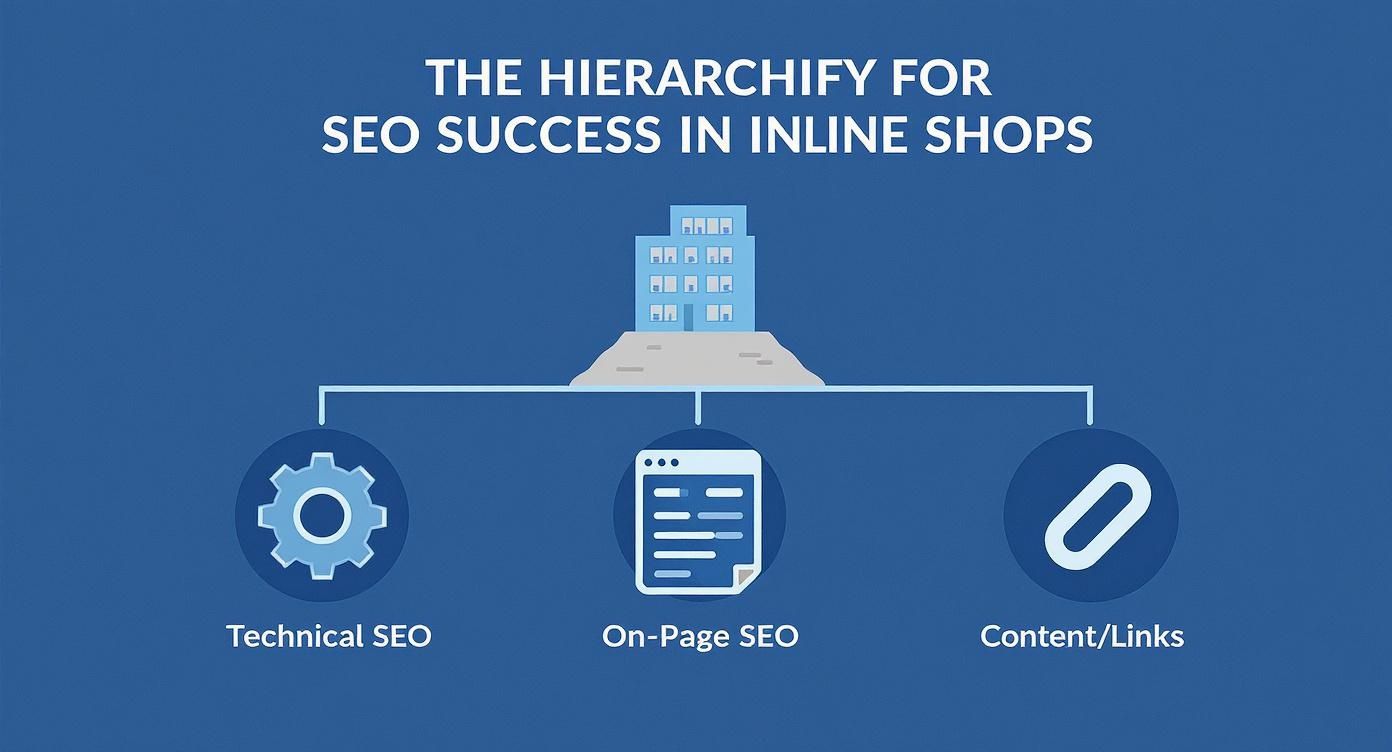
As you can see, content and on-page optimization build directly on this technical foundation. If the foundation is shaky, the other measures can never reach their full potential.
A logical page architecture as a guidepost
The structure of your shop is like the signage and layout of the aisles in a huge department store. If customers (and search engines) can't find their way around, they quickly become frustrated and leave. Ideally, you want a flat, intuitive hierarchy where every important page is accessible from the homepage with a maximum of three clicks.
This structure has proven successful for most online shops:
- Homepage: The foyer of your shop, the central starting point.
- Category pages: The large departments (e.g., "women's fashion").
- Subcategory pages: The more specific aisles (e.g. „summer dresses“).
- Product pages: The actual product on the shelf.
This clear structure, often supplemented by breadcrumb navigation, not only makes orientation incredibly easy, but also helps Google understand which pages are most important and distributes ranking power (link authority) effectively across the entire shop.
Charging speed: Every millisecond counts
In e-commerce, nobody has time to waste. Studies show that a delay in loading time of just one second can reduce sales by up to... 7 % Slow online stores not only annoy potential customers, but they also get penalized in Google's rankings. Page speed is a crucial ranking factor.
In modern search engine optimization, user experience is paramount. Google wants to deliver the best results to its users – and that includes fast, smooth-running websites that are perfectly usable on mobile devices.
Google measures this experience with very specific metrics, the so-called Core Web Vitals. These metrics assess how quickly your page loads, how quickly it responds to user input, and whether the layout shifts awkwardly during loading. Optimizing these values isn't just a "nice to have," it's essential for good rankings. You can find all the important information in our guide to... Optimizing Google Core Web Vitals.
Maintain control over indexing
Not every single page of your shop belongs in Google search results. Pages like the shopping cart, internal search results, or countless filtered views (e.g., "red sneakers in size 43") often generate "duplicate content." This means Google finds very similar content under many different URLs, which confuses the search engine and dilutes the ranking power of your truly important pages.
Fortunately, you can tell Google very clearly what to ignore. With instructions in the robots.txtBy using a `.js` file or "noindex" tags on the pages themselves, you retain full control. This ensures that only the optimized category and product pages are indexed and can unleash their full SEO potential.
Mobile optimization as an absolute priority
Shopping on smartphones is no longer a trend, but the norm. Most shopping trips now start on a mobile device. Google reacted to this years ago and indexes the web according to the "mobile-first" principle. In other words: The mobile version of your shop is the reference for your ranking, not the desktop view.
A mobile-friendly shop is therefore not an option, but a basic requirement for success. SEO for online shops. Pay particular attention to these points:
- Responsive design: The layout automatically adapts to any screen size – from small smartphones to large monitors.
- Readability: Fonts and sizes are easy to decipher even on small displays.
- Ease of use: Buttons, links and menus are large enough and spaced far enough apart to be easily tapped with a finger.
- No disruptive factors: Huge pop-ups that obscure all content are an absolute no-go on mobile devices and can be penalized by Google.
A seamless mobile shopping experience is one of the most powerful levers today to both make customers happy and sustainably secure your visibility on Google.
Optimally design product and category pages

Okay, the technical foundation of your shop is in place. Now we'll focus on the pages that generate revenue: your product and category pages. It can't be stressed enough: these are the absolute heart of your online store. This is precisely where it's decided whether a potential customer becomes a paying customer.
Think of these pages as your digital sales consultants. They have to do two jobs at once: provide crystal-clear information to search engines and convince real people to buy. It's about much more than just stringing together keywords. The real art lies in finding the perfect balance between clean technology and compelling storytelling.
The art of unique product descriptions
A classic mistake I see time and time again: shops simply copy the manufacturers' standard texts. This is not only incredibly boring for your customers, but it also creates duplicate content – an absolute no-go for Google. Your product descriptions are your big opportunity to stand out from the competition and build a genuine connection with your customers.
A good product description doesn't just rattle off facts. It tells a story, evokes emotions, and answers the customer's questions before they even think of them.
To write copy that truly sells, always ask yourself:
- Who is this for? Address your target audience directly and personally.
- What problem does my product solve? Focus on the benefits, not just the features.
- What makes it so special? Clearly highlight your unique selling points.
- How does it feel to use the product? Paint a picture in your customers' minds.
Especially for shops with customizable items, detailed explanations are invaluable. A great example is... Products with finishing options – here, the precise description of the options is often the decisive factor for the purchase decision.
Title tags and meta descriptions that generate clicks
The title tag and meta description are your calling card in Google search results. This is the very first point of contact. And this is exactly where you need to grab the user's attention so they click on your website. Her Click on the result and not on one of the other nine.
The Title Tag It must be concise and contain the most important keyword, ideally right at the beginning. Keep it below 50–60 characters, so that it isn't cut off awkwardly. A tried and tested method is: Main keyword | Second most important keyword | Your brand name.
The Meta Description This is your free advertisement. Although it's not a direct ranking factor, it has a huge impact on the click-through rate. Take advantage of the approximately 155 characters clever, to communicate the most important benefit and include a clear call to action such as "Discover now" or "Buy directly online".
An optimized title tag puts you in Google's shop window. A compelling meta description brings customers into your store. Both together are crucial for SEO success for online shops.
Don't forget: customers are also searching within Your shop. A study of the German e-commerce market has shown that around 83 % the buyer Use the internal search function. For 43 % This is actually the very first step. This underlines how important clear product and page titles are – for external audiences. and the internal search. More exciting Shopping statistics can be found at doofinder.com.
Using structured data for rich snippets
Structured data (or schema markup) is essentially a small snippet of code that you add to your pages to give search engines more context. It's like handing Google a perfectly formatted business card for each of your products.
This "business card" allows Google to, so-called Rich Snippets to be displayed directly in the search results. These are the small but significant enhancements that immediately catch the eye:
- Rating stars: Show at a glance how satisfied other customers are.
- Price: The current price, directly visible.
- Availability: A clear indication of whether a product is "in stock".
- Offers: Highlights discounts and special offers.
This additional information makes your search results stand out from the crowd and can noticeably increase the click-through rate. For online shops, the schemas are particularly important. Product, Review and Offer Extremely important. The setup might sound technical, but most modern shop systems have simple plugins or built-in solutions for this. The small effort is worthwhile, as it transforms a boring, standard result into an attractive eye-catcher.
A well-thought-out on-page optimization strategy naturally also includes how these pages are linked to each other. Read more about this in the following sections. The importance of internal links for SEO in our detailed article.
Content marketing that goes beyond simply selling products
Your product and category pages are naturally designed for direct sales. But what about all the potential customers who are just starting their search and don't yet know exactly what they need? This is precisely where content marketing comes in. It's about transforming your shop from a mere sales platform into a trusted advisor, an expert in your niche.
Think of it this way: backlinks are the currency of the internet. And truly excellent content is the reason why others are willing to give you this currency.
A smart content strategy is so much more than blatant product advertising. It answers your target audience's most pressing questions, solves their problems, and gradually builds a genuine relationship. Instead of simply shouting, "Buy my product!", you say, "I understand your problem, and here's the solution." This approach not only strengthens your brand immensely but also opens countless new doors through which potential customers can find their way to your shop via Google.
The right content formats for your shop
Not all content is equally suitable. In e-commerce, one thing counts above all: genuine added value that guides the user on their journey to a purchase decision. While pure product pages often only make up a small portion of total traffic, strategically created content can build enormous reach and boost the authority of your entire domain.
Here are the formats that are in SEO for online shops prove themselves time and time again:
- Comprehensive buying guides: A comprehensive guide like "The Ultimate Guide: How to Find the Perfect Hiking Backpack" reaches people who are still in the research phase. Such articles can cover dozens of long-tail keywords and instantly position you as an expert.
- Detailed product comparisons: Help undecided customers overcome their agonizing choice. An article like "iPhone 15 Pro vs. Samsung Galaxy S24: Which camera is better for you?" answers a very specific question and can provide the decisive push towards a purchase.
- Practical instructions and how-to articles: Show your customers how to get the most out of your products. A short video tutorial on "How to properly care for your leather shoes" builds trust and offers excellent service even after the purchase.
- Inspiring content and application examples: Instead of simply showcasing a product in isolation, present it in use. For example, a fashion shop could create a blog post about "Three Outfit Ideas for the Perfect Summer Wedding" and directly link to the relevant products within it.
The best content for e-commerce is content that not only informs but also inspires. It bridges the gap between a problem and a solution – and that solution is your product.
Backlinks: The turbocharger for your authority
Excellent content is the foundation, no question. But without backlinks, it will struggle to reach its full potential. For Google, links from other relevant and trustworthy websites are one of the strongest signals that your content is valuable. Every single high-quality link is like a personal recommendation that strengthens the authority of your entire domain.
A good example from practice shows how a single advice article can achieve, 44 backlinks from different domains to obtain. These links not only give the article itself a huge ranking boost. The "link power" (often also called Link Juice (designated) can then be distributed via internal links to your most important product and category pages.
Strategies for link building in e-commerce
Link building doesn't have to be a gamble. With the right tactics, you can strategically build high-quality links for your shop.
- Guest posts in industry blogs: Write a truly helpful article for a well-known magazine or blog in your niche. In return, you'll usually receive author credit and a valuable link back to your shop.
- Collaborations with influencers and experts: Work with thought leaders. If a well-known food blogger features and links to your new kitchen appliance in a recipe, that's an incredibly strong endorsement.
- Creation of unique resources: Develop something so useful that others will link to it automatically. want. This could be an interactive calculator, a detailed infographic, or a comprehensive industry study.
- Product sponsorship for events or clubs: Support local events or clubs with your products. In return, you'll often receive a prominent link on the partner page of the respective website.
Yes, these methods require time and effort. But the reward is a sustainably strengthened domain authority. And that not only leads to better rankings for your how-to articles, but ultimately increases the visibility of all your product and category pages.
Acquire new customers: Cleverly use local SEO and marketplaces
Getting your website to the top of Google's search results is the foundation. But let's be honest: the e-commerce universe is bigger than just the classic Google search. There are two often underestimated but extremely powerful channels out there that can give your shop a real boost: targeted customer acquisition right in your neighborhood and the strategic conquest of the major online marketplaces.
Both approaches catapult your reach into a new dimension. Local SEO transforms your store into a digital beacon for everyone searching nearby. Marketplace optimization, on the other hand, taps into the massive flow of visitors from e-commerce giants – instead of just helplessly fighting against them.
Local SEO: Your ace in the hole if you also have a brick-and-mortar store
Do you operate a physical store in addition to your online shop? Then local SEO isn't optional, it's absolutely essential. Put yourself in the shoes of a potential customer: Someone pulls out their smartphone and types "bike shop near me." You need to appear on their radar in that split second. The key tool for this is your Google Business Profile (formerly known as Google My Business).
A professionally maintained profile is so much more than a dull entry in an online business directory. It's your digital business card that pops up directly in Google search results and on Google Maps.
Think of your Google Business Profile as a mini-website directly on Google. For local customers, this is often the very first point of contact – and it determines whether they find their way to you or end up with a competitor.
A solid foundation for local SEO rests on three pillars:
- Completeness: Fill in every single field. Address, phone number, opening hours, website, and – most importantly – the exact business category. Leave no blanks!
- Up-to-dateness: Post short updates, current offers, or photos of new products regularly. This shows Google that your store is active and not just an inactive listing.
- Trust: Actively encourage your satisfied customers to leave reviews and respond to all feedback – even critical feedback. Genuine customer opinions are invaluable and one of the strongest ranking factors locally.
Marketplaces: Ride the wave instead of being swept away by it.
Platforms like Amazon, Otto, or eBay are not enemies. Think of them as vast oceans teeming with potential customers. Ignoring these marketplaces means surrendering a huge market share to the competition without a fight. The smart approach? View them as additional sales and marketing channels that work for you.
The numbers don't lie: German online retail is projected to reach a volume of [amount missing] in 2025. 92.4 billion euros predicted. Who dominates this market? That's right, the marketplaces, with a substantial share of 57 % of total e-commerce revenue – especially Amazon. With a well-thought-out SEO strategy, you can secure a piece of this gigantic pie. You can learn more about these figures in the E-commerce forecast on webstollen.de.
While the rules of the game on these platforms are unique, the basic principles are strongly reminiscent of the classic game. SEO for online shops:
- Product titles with the right keywords: Include the most important keywords directly in the title. This is the only way you will be found in the marketplace's internal search function.
- Compelling product descriptions: Use bullet points. Nobody reads long blocks of text. The most important benefits must be immediately obvious.
- Excellent product images: Showcase your products from every angle, in high resolution. Images are the number one conversion driver.
The real trick, however, lies in a two-pronged strategy: You leverage the enormous reach of online marketplaces to quickly and easily acquire new customers and boost sales. At the same time, through smart branding – for example, with a small, well-designed flyer included in the package – you can try to retain these customers in your own shop long-term. This reduces your dependence on marketplaces and allows you to build a loyal customer base.
This combination of local roots and presence in major marketplaces makes your brand more resilient and opens doors to customer groups you might otherwise never have reached.
Measure SEO success and act based on data.

SEO for online shops is not a sprint, but a marathon. You could compare it to steering a ship: you don't just hoist the sails and hope for the best. Instead, you have to constantly check your course, react to the wind, and navigate with data to reach your destination safely. Without the right instruments, you're essentially sailing blind.
That's precisely why analyzing your SEO performance is so incredibly important. It's about replacing gut feeling with hard facts. Only when you know exactly which measures are effective and which are ineffective can you refine your strategy and allocate your budget where it will truly make a difference.
The most important tools and key figures
The good news is: you don't need expensive specialized software to get started. Google provides the two most powerful (and free) tools right out of the box: Google Search Console and Google Analytics. Each tool has its own focus, but only by working together do they provide a complete picture of your performance.
In the Google Search Console Learn how Google "sees" your shop. The key metrics here are:
- Impressions: This is how many times your pages were displayed in Google results.
- Clicks: This is how often searchers have actually clicked on one of your links.
- Click-Through Rate (CTR): The ratio of clicks to impressions. A great indicator of how convincing your titles and descriptions are.
- Average position: Your average ranking for specific search queries.
Google Analytics, in turn, tells you what visitors on What your website does after they click. This is about business-relevant data.
SEO without data analysis is like driving with your eyes closed. You might be moving, but you have no idea whether you're on the right track or heading straight for a wall.
From traffic to revenue: interpreting the right KPIs
Mere visitor numbers are nice, but they don't pay the bills. At the end of the day, only the revenue generated by organic search counts. That's why you need to keep an eye on the right Key Performance Indicators (KPIs) to evaluate the true success of your SEO efforts. You can find a more in-depth introduction to this topic in our article on the most important ones. KPIs in SEO.
Here are the KPIs that every shop owner should know and love:
- Organic traffic: How are visitor numbers developing from unpaid search results? Always keep seasonal fluctuations in mind.
- Conversion rate (organic): This is the gold metric. What percentage of visitors who come via Google ultimately make a purchase?
- Revenue per organic visit: What is the average value generated by a single visitor who found you through organic search?
- Keyword rankings for high-revenue terms: Focus on the rankings of the keywords that have brought you the most money in the past.
By regularly analyzing this data – ideally weekly – you create a cycle of continuous improvement. You'll instantly recognize which optimizations have the greatest impact and can strategically invest your time and money where the highest return on investment awaits. This is how SEO for online shops from a vague hope to a predictable and scalable growth strategy.
Your most pressing SEO questions, answered briefly and concisely
In the day-to-day running of online shops, the same questions keep coming up. Here I've compiled the most frequently asked questions for you and summarized them concisely – your cheat sheet for the most important SEO topics, so to speak.
How quickly will I see initial SEO successes with my online shop?
Patience is key here – SEO is a marathon, not a sprint. Often, you'll see initial small successes after just four to six weeks, for example, when Google recognizes more pages of your shop or you rank better for very specific niche search queries (long-tail keywords).
Really noticeable results, meaning top rankings for competitive keywords that actually drive traffic and revenue, take time. Realistically, expect... six to twelve months, ...until the machine really gets going. SEO is not a one-off project, but an ongoing process.
What should I focus on: product pages or blog articles?
Clearly, both are important, but the order matters. Product and category pages These are your foundation. They are the pages that make money and target search queries from people who are already ready to buy. That's why they always take priority.
Blog articles are in a different league, but they are an incredibly strong teammate:
- They reach potential customers much earlier, when they are still gathering information and don't yet know exactly what they want to buy.
- Good content positions you as an expert and builds trust.
- There's hardly anything better for getting high-quality backlinks from other websites.
My tip: First, focus on perfectly optimizing your sales pages. Then, strategically use your blog to build authority and direct that authority to your most important product and category pages through targeted internal links.
Should I do SEO myself or hire an agency?
It depends. You can definitely handle many of the basics yourself. Revising product descriptions, adjusting title tags, or optimizing images – with a little willingness to learn, this is quite doable, and most shop systems will help you with it.
A professional agency becomes a game-changer when things get complex. Tracking down intricate technical errors, developing a well-thought-out link-building strategy, or reacting to sudden Google updates—these require experience and time. If you lack either of these, investing in experts is often the more direct path to success.
Do you want to ensure your online shop ranks at the top of Google? We at LinkITUp We build SEO strategies that truly work and sustainably increase your revenue. Let's have a no-obligation chat about it – Simply contact us.