


The Customer Journey Phases This is essentially the journey a customer takes with your company. It describes the individual stages someone goes through, from their first vague need to becoming a loyal, repeat customer.
What the Customer Journey really is
Forget rigid marketing models for a moment. Instead, think of the customer journey as a flexible map that traces your customers' paths. Everyone starts somewhere different and takes their own unique route, but the key milestones are usually the same. It's a story with a beginning, middle, and end, which, ideally, culminates in a long and successful relationship.

A journey begins with an idea.
Think about your last vacation planning. At the beginning, you probably only had a thought like: "I desperately need a break" or "I want to see something new again." That's exactly the first phase – the Awareness (awareness). A need exists, but a concrete solution is not yet in sight.
Then the research begins. They compare travel destinations, scour blogs, watch YouTube videos, and ask friends for tips. We call this phase of actively seeking information and comparing. Consideration (The weighing of options). Here, vague ideas slowly transform into tangible options.
From decision to enthusiasm
After much deliberation, a specific destination and the perfect hotel are chosen. The booking is completed – that's the end of it. Decision (The decision). At this moment, a prospect becomes a real customer.
But the journey is far from over. After your vacation, you enthusiastically post vacation photos, write a positive review for the hotel, and rave about your trip to your friends. These last two stages, Retention (Customer loyalty) and Advocacy (Advocacy) is absolutely crucial for long-term success.
Understanding these phases is far more than just a marketing tactic. It's about developing genuine empathy for the customer – understanding what they are thinking, feeling, and needing at every moment.
If you manage to adopt your customers' perspective, you can align your marketing activities so that they are perceived not as annoying advertising, but as welcome assistance. You become a travel companion that paves the way instead of blocking it. And this understanding is precisely the key to developing messages that truly resonate and create lasting impact.
The 5 crucial phases in detail
The customer journey isn't a rigid highway, but rather a personal voyage of discovery that each customer experiences differently. Nevertheless, there are five key milestones that characterize almost every one of these journeys. If you consider these Customer Journey Phases Understanding this allows you to reach out to your customers at exactly the right moment.
These phases are far more than just dry marketing terms. They reflect the very human development – from the first vague feeling that something is wrong, to enthusiastically recommending the product to friends.
Let's take a closer look at each stage.
Phase 1: Awareness (Attention)
It always starts with a spark, a trigger. It's the moment when someone becomes aware of a problem, a need arises, or an opportunity presents itself. In the Awareness phase However, this awareness is often still diffuse and unconcrete.
A local café owner might notice that the place is practically empty at lunchtime. A homeowner might frown upon an unexpectedly high heating bill. At this stage, the person isn't yet looking for your product, but rather for answers and clarity about their problem.
Typical questions that might be swirling around in your head are:
- „"Why are there no customers in my café at lunchtime?"“
- „"How can I get my energy costs under control?"“
- „"What signs indicate too much stress?"“
Your task here is to act as an understanding expert who knows the problem and provides initial food for thought – without directly waving a product around.
Phase 2: Consideration (Weighing the options)
Once the problem has a name, the active search for solutions begins. Welcome to the Consideration phase. The customer now understands what it's about and is specifically researching which paths and methods exist to achieve their goal.
The café owner might now be searching for "lunch specials for restaurants" or "how can I improve customer loyalty in my café?". The homeowner might be googling "modernize heating system" or "efficient insulation for old buildings". At this stage, options are weighed and alternatives are thoroughly examined.
Your company is now one of several providers on the radar. Building trust and clearly demonstrating why your solution is the best is absolutely crucial. Detailed information, comparisons, and crystal-clear advantages are invaluable here.
In the consideration phase, someone who has a problem becomes someone who actively seeks a solution. This is where the preliminary decision is made as to who even makes the shortlist.
This phase now mostly takes place online. A study on the customer journey in the German travel market, for example, showed that 87 percent Travelers consciously compare at least two providers before booking and on average 2.2 different options consider. By far the most important information channel is... 78 percent The provider's own website. These figures clearly demonstrate how critical good visibility and compelling arguments are at this stage. Those who wish to delve deeper can find more information here. The results of the Customer Journey study are available on research-tools.net.
Phase 3: Decision
The research is complete, the favorites have been chosen. In the Decision Phase The customer is ready to close the deal. They have decided on a specific type of solution and are now selecting the specific supplier or product they wish to purchase.
The questions are now razor-sharp and purchase-oriented:
- „"Which POS system has the best integration for my loyalty program?"“
- „"Does company XY offer a free initial consultation for my heating system renovation?"“
- „"Which provider has the best customer reviews and delivers the fastest?"“
Now you need to remove all conceivable obstacles. Clear pricing, a user-friendly ordering process, compelling guarantees, and genuine customer testimonials (social proof) are the final push you need.
Phase 4: Retention (Binding)
But the journey doesn't end with the purchase – quite the opposite. In the Retention phase The goal is to turn a one-time buyer into a loyal, repeat customer. The experience a customer has after The decision made regarding the purchase determines the future of the relationship.
Outstanding customer service, a smooth launch of the new product, or personalized follow-up support demonstrate to the customer that they made the right choice. This is the moment when trust is cemented and the foundation for future purchases is laid. And never forget: retaining an existing customer is almost always more cost-effective than acquiring a new one.
Phase 5: Advocacy
The last and most valuable of all Customer Journey Phases is the Advocacy phase. This is where magic happens: A satisfied customer becomes an active fan and ambassador for your brand. They don't just recommend you when asked, but because they are genuinely convinced of you and your offering.
This customer spontaneously writes glowing online reviews, shares their positive experiences on social media, and becomes your most credible advocate. Word-of-mouth marketing is and remains one of the most powerful marketing tools, and this phase is its powerhouse. To turn customers into true advocates, you must not only meet their expectations but exceed them—and then actively provide them with a platform to spread their enthusiasm.
Assign touchpoints and KPIs to each phase
The theory behind the Customer Journey Phases Understanding is one thing. But to truly bring your strategy to life, you also need to be able to measure its success. This is precisely where customer touchpoints and the corresponding key performance indicators (KPIs) come into play.
A touchpoint is any single moment in which someone – whether a potential or existing customer – comes into contact with your brand. A KPI, in turn, is the metric that shows you in black and white whether this touchpoint has fulfilled its purpose. Without this connection, you're left in the dark.
The following infographic depicts the five phases of the customer journey as a funnel. It clearly shows how the path leads from initial vague interest to loyal advocacy.
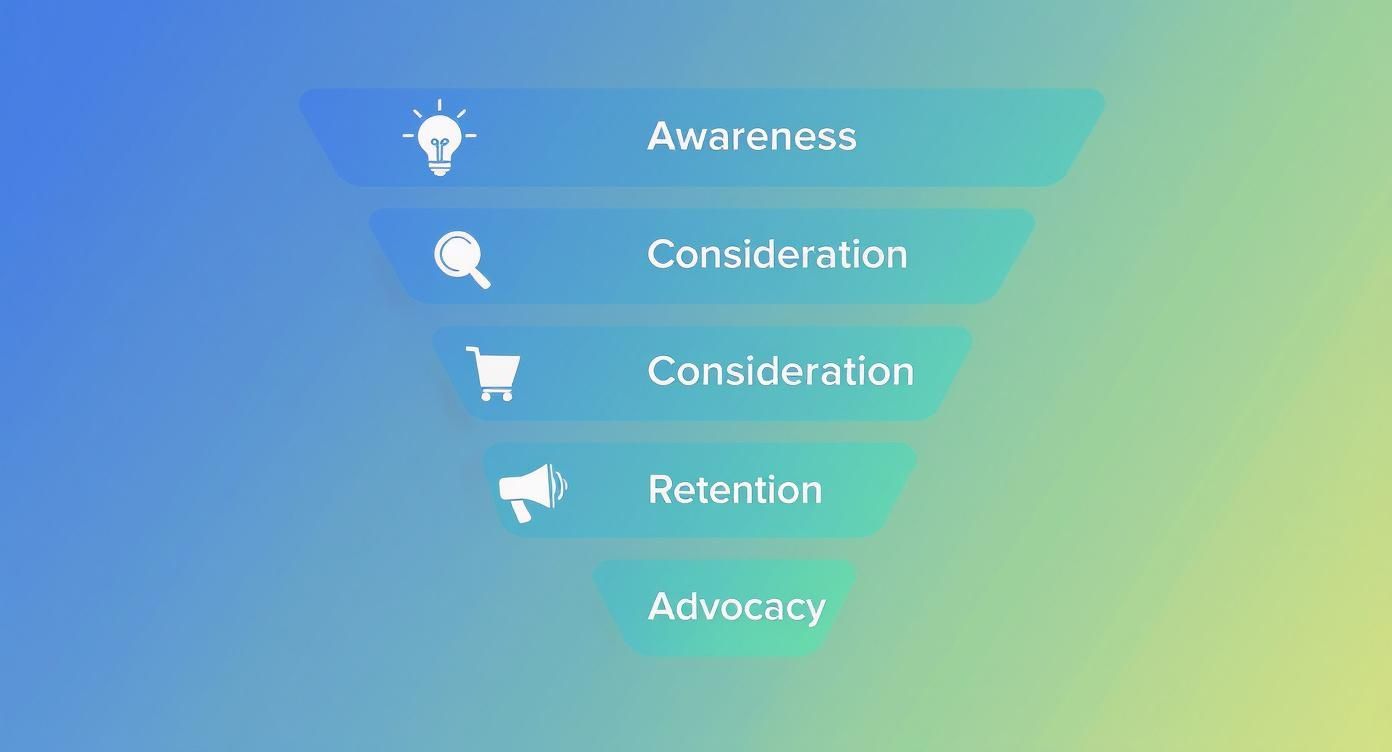
The journey therefore starts broadly, narrows down towards the purchase decision, and then unfolds again through customer loyalty and recommendations.
To make the whole thing more tangible, I have summarized the most important phases, typical points of contact and the associated metrics in a table.
Overview of the phases with touchpoints and KPIs
This table serves as a handy cheat sheet. It summarizes the five phases of the customer journey and assigns them typical customer touchpoints and relevant key performance indicators (KPIs) to help you keep track.
| phase | Typical touchpoints | Key KPIs |
|---|---|---|
| Awareness | SEO blog articles, social media posts, display ads, infographics | Impressions, reach, website traffic, keyword rankings |
| Consideration | Detailed product pages, webinars, case studies, comparison articles | Time spent on site, click-through rate (CTR), downloads, registrations |
| Decision | Pricing pages, free demos, customer reviews, live chat | Conversion rate, shopping cart abandonment rate, demo requests |
| Retention | Onboarding emails, excellent customer service, loyalty programs | Churn rate, customer lifetime value (CLV), repeat purchase rate |
| Advocacy | Feedback surveys, evaluation requests, referral programs | Net Promoter Score (NPS), number of positive reviews, social mentions |
This overview will help you plan your own measures more effectively and systematically monitor their success.
Awareness Phase: Creating and measuring visibility
In the very beginning, it's all about one thing: simply appearing on the radar of potential customers. People aren't specifically searching for you yet, but rather for solutions to their problems or answers to their questions. Therefore, your content must be primarily helpful and easy to find.
Typical touchpoints:
- SEO-optimized blog articles: Classic guides that target informal search queries (e.g., "how can I save on heating costs").
- Social media posts: Inspiring or useful posts that appear in the feed and, ideally, are shared.
- Online ads (display ads): Visual banners on thematically relevant websites, simply to build brand awareness.
- Infographics: Complex topics, presented visually and in an easily digestible way.
Key KPIs:
- Impressions: How many times were your content or ads viewed overall?
- Reach: How many individual Did you reach any people with this?
- Website traffic: How many visitors do you attract to your site?
- Keyword rankings: What position do you rank in search results for important keywords?
Consideration Phase: Building trust and fostering engagement
Once you have their attention, the real decision-making begins. Potential customers are now actively comparing different providers and solutions. Your task is to provide in-depth information and present yourself as the best choice.
Typical touchpoints:
- Detailed product and solution pages: The advantages and functions must be communicated very clearly here.
- Webinars or video tutorials: Showcase your expertise and explain your offer live or on demand.
- Case studies and testimonials: Nothing is more convincing than proof that your solution has already worked for others.
- Comparison article: Position your offer confidently alongside that of the competition and highlight your strengths.
Key KPIs:
- Time on Page: How long do visitors stay and engage with your content?
- Click-Through Rate (CTR): How many people click on your links in the search results or in your ads?
- Downloads: How often are your e-books, white papers, or case studies downloaded?
- Registrations for newsletters or webinars: A crystal-clear signal of genuine, in-depth interest.
Decision Phase: Removing barriers and securing the deal
Now things are getting serious – the customer is ready to buy. Every single touchpoint must now aim to eliminate any remaining doubts and make the purchase as smooth as possible.
Typical touchpoints:
- Price and offer pages: Transparency is paramount here. No hidden costs, no unclear service descriptions.
- Free trial versions or demos: Give potential customers the chance to try your product risk-free.
- Customer ratings and reviews: Genuine opinions from real users create trust (keyword: social proof).
- Live chat or quick contact options: Answer the final, crucial questions in real time.
„Each stage of the customer journey has different metrics and KPIs. In the ‚Discover‘ stage, we would look at [engaged] visits. In the ‚Try‘ stage, we would consider trial sign-ups as a key metric. In the ‚Buy‘ stage, it would be the website conversion rate.“ – Maninder Sawhney, Adobe
Key KPIs:
- Conversion Rate: The most important metric at this stage: What percentage of visitors complete the desired action (purchase, inquiry, etc.)?
- Shopping cart abandonment rate: How many people add something to their shopping cart but then abandon the purchase? This often represents untapped potential.
- Number of demo requests or sales calls: Direct indicators of concrete purchase interest.
Retention and Advocacy Phase: Cultivating relationships and gaining fans
The purchase is not the end, but the beginning. Now the really important work begins: retaining a customer and ideally turning them into a true fan who recommends you to others. The touchpoints become more personal and service-oriented.
Typical touchpoints:
- Personalized emails (onboarding, newsletter): Send helpful tips on product usage or exclusive offers instead of blatant advertising.
- Excellent customer service: Fast, competent and friendly help with problems is invaluable.
- Loyalty programs and customer events: Reward loyalty and create a sense of belonging.
- Feedback surveys and evaluation requests: Show that you value your customers' opinions and actively ask for reviews.
Key KPIs:
- Churn Rate (Emigration Rate): How many customers do you lose in a specific period?
- Customer Lifetime Value (CLV): What is the total value generated by a customer over the entire duration of the business relationship?
- Net Promoter Score (NPS): The classic question: "How likely is it that you will recommend us?"„
- Number of positive reviews and social mentions: Direct evidence of customer satisfaction and genuine advocacy.
Systematically collecting this data is the foundation of any successful marketing and sales strategy. If you'd like to delve deeper into the world of metrics, our guide provides detailed information on the most important ones. KPIs in SEO on seobuchen.com/.
The Customer Journey Map: Your Strategic Compass
The individual Phases of the Customer Journey Knowing something is one thing. But truly using that knowledge – putting theory into practice – requires a concrete tool: the Customer Journey Map.
Think of this map less as a rigid diagram and more as your customers' detailed journey map. It visualizes every step, thought, and feeling a person experiences on their way to your company and beyond. Ultimately, it's your compass for customer-centric marketing.
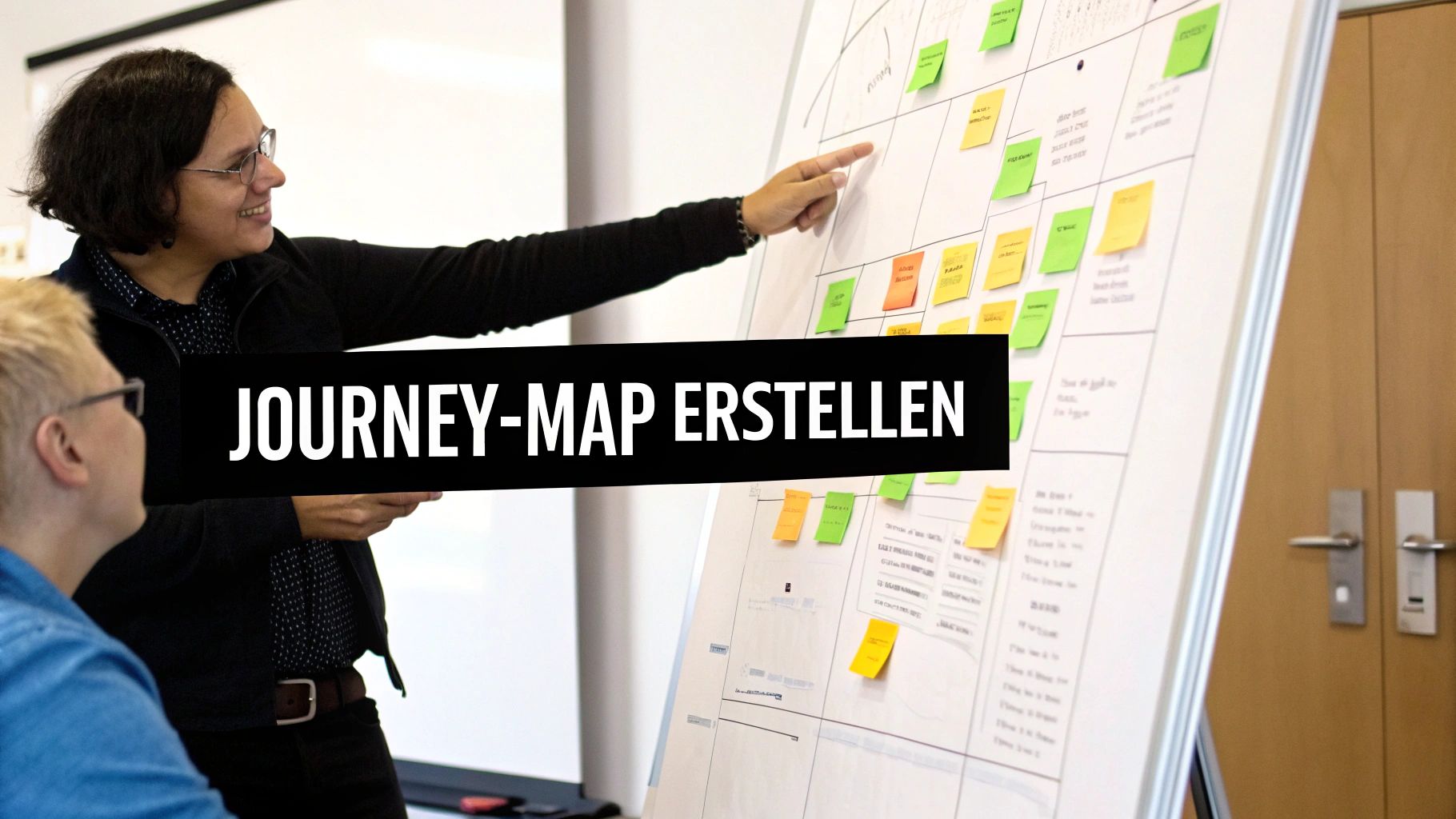
Drawing such a map essentially means putting yourself in your customers' shoes and walking their path. In doing so, you discover not only the obvious touchpoints, but also the hidden emotions and obstacles that determine success or failure.
The building blocks of a meaningful map
A good customer journey map is so much more than just a list of touchpoints. It only truly comes alive through the depth of information it contains. To create a truly comprehensive map, these core components are essential:
- Persona: Who is the person whose journey you are tracing? Give them a name, a face, and specific goals.
- Phases: The well-known stages – Awareness, Consideration, Decision, Retention and Advocacy – form the basic framework of your map.
- Touchpoints: At what specific points does your persona come into contact with your company? This could be a Google search, your website, a social media post, or a visit to your store.
- Customer actions: What does the customer do at each of these points? Do they click? Do they scroll? Do they read reviews or add something to their shopping cart?
- Emotions and thoughts: Try to understand what's going on in the customer's mind at this moment. Are they curious, uncertain, perhaps even frustrated, or already enthusiastic?
- Pain Points: Where are the sticking points? At what points of friction are there that could prevent the customer from taking the next step?
Putting these elements together creates a clear picture of your customers' reality – and this often has little to do with internal process assumptions.
A practical example: Ordering pizza on Friday evening
Let's step into the shoes of "Max," who wants to order a pizza online on a Friday evening. His journey could look something like this:
- Awareness: Max gets hungry and thinks to himself: "Pizza would be perfect right now." His first impulse? He pulls out his phone and googles "pizza delivery service [his city]".
- Consideration: He clicks on the websites of two pizzerias. Pizzeria A has a completely confusing menu. At Pizzeria B, he immediately notices the delicious pictures and good reviews. Pain point at A: Poor user experience. Positive moment at B: Social proof and appealing design are convincing.
- Decision: The decision falls on Pizzeria B. Max puts together his pizza, but the online configurator is agonizingly slow. Pain Point: A technical hurdle. He perseveres and completes the order.
- Retention: The pizza is coming 10 minutes It arrived earlier than expected, it was hot, and the delivery driver was super friendly. A week later, an email arrived with a 10 %-Voucher for the next order delivered to your inbox.
- Advocacy: Max is completely satisfied. He opens Google Maps and leaves a smooth 5-star rating.
By capturing these small but crucial moments – the emotions, the points of friction, and the positive surprises – on your map, you uncover the biggest levers for improving the customer experience.
This analysis immediately reveals the problem areas. The chaotic menu at Pizzeria A or the slow online configurator at Pizzeria B are critical weaknesses. It's precisely at these points that businesses lose customers, often without even realizing it. A well-designed map makes these "silent" problems visible and provides you with the arguments to address them effectively.
The goal is to design every touchpoint to make the customer journey easier and more enjoyable, not more complicated. Optimizing these touchpoints is a crucial step if you want to... Sustainably increase conversion rate want.
Align SEO and content along the customer journey
The Customer Journey Phases Understanding is one thing. But transforming that knowledge into a powerful SEO and content strategy – that's the art. It's not enough to simply produce any old content. You have to reach the right person with the right message at the right time.
Imagine your content as signposts on a hike. You show the hiker who is just starting out the way to the summit (AwarenessGive the person who is already halfway up a detailed map for the rest of the route (ConsiderationAnd to those who are close to the finish line, offer a helping hand for the last, crucial meters (Decision).
Content formats for the awareness phase
At the beginning of their journey, a potential customer often only knows that they have a problem. They don't yet know the solution. Their search queries are therefore usually open-ended questions: "How can I…", "What helps against…", "Why is…". Your goal is to appear precisely at this point with helpful, informative content and provide answers.
This isn't about direct sales yet. It's about establishing yourself as a trusted expert. Focus on formats that educate and inspire:
- Advice blog article: Classic instructions, checklists, or explanatory pieces that illuminate a problem from the ground up. That's the foundation.
- Infographics: Complex concepts presented in a visually compelling way. Such graphics are frequently shared and generate valuable backlinks.
- Explanatory videos: A short, concise video can often explain a process better than a thousand words.
The SEO focus here is clearly on informative keywords With high search volume. Think of terms that describe a problem, not a product.
Content for the Consideration Phase
Once the user understands their problem, they begin actively searching for solutions. In the consideration phase, they compare different approaches, products, and providers. Your content must now be compelling and clearly highlight the advantages of your solution.
The search intent is now shifting from "What is my problem?" to "What is the best solution to my problem?". Your content must satisfy this deeper need for information and build trust.
Now it's time to demonstrate your expertise and show why your offer is the best choice. The following formats are particularly effective here:
- Comparison article: Position your offer directly alongside that of your competitors. Honestly and transparently highlight your unique selling points.
- Case Studies: Nothing is more convincing than concrete proof. Use specific customer examples to show how you have successfully solved a problem.
- Detailed product webinars: Give potential customers the chance to experience your product live and ask questions directly.
- Whitepapers and e-books: Offer in-depth knowledge for download. This not only positions you as an expert but also generates valuable leads.
From an SEO perspective, you are now targeting comparative and commercially oriented keywords from, such as „[Product A] vs. [Product B]“, „best [solution] for [industry]“ or „[vendor] experiences“.
Optimization for the Decision Phase
In the decision-making phase, the customer is ready to buy. They just need that final push – the confirmation that they're making the right choice. Every piece of content and every touchpoint must now be designed to eliminate any remaining doubts and make the buying process as smooth as possible.
Your most important pages are now your product and landing pages. These must be ruthlessly optimized for conversion.
Checklist for the Decision Phase:
- Clear calls to action (CTAs): Use clear and prominent buttons like "Buy Now," "Request a Demo," or "Get a Quote." No experiments.
- Integrate social proof: Display genuine customer reviews, testimonials, and quality seals prominently on your page. People trust other people.
- Transparent pricing: Hidden costs are a conversion killer. A clear and understandable pricing page builds trust.
- Offer live chat: Give unsure visitors the opportunity to get their last questions answered in real time. This drastically reduces the bounce rate.
- Technical optimization: Ensure extremely short loading times and absolutely perfect display on mobile devices. Every unnecessary click is a lost customer.
All these elements must work together in a well-thought-out plan. To approach this process systematically, it is crucial to have a well-thought-out... Developing a content strategy, which takes into account every phase of the customer journey.
Designing the journey after the purchase
And very importantly: The journey doesn't end with the purchase! For the Retention and Advocacy Phase You also need the right content. This includes excellent onboarding materials, a helpful FAQ section, exclusive content for existing customers, or a newsletter that delivers real added value.
Satisfied customers become loyal fans and ultimately the best brand ambassadors you could wish for.
Frequently Asked Questions about the Customer Journey
We've now delved deeply into the individual phases of the customer journey, the touchpoints, and strategic planning using a map. Nevertheless, the same questions often arise in practice. Here, I've compiled the most common points of confusion and answered them concisely – so you can confidently integrate the concept into your daily work.
Let's clear up some common misconceptions and give you the final tools to truly understand and actively shape your customers' journey.
What is the difference between a customer journey and a marketing funnel?
These two terms are constantly confused, even though they describe two completely different perspectives. Imagine the classic Marketing Funnel It's like looking through binoculars in your company: It looks from top to bottom, completely linearly, and wants to turn as many leads as possible into customers.
The Customer Journey In contrast, the customer perspective shifts the focus and looks through the customer's eyes. This path is rarely a straight line. Rather, it's a winding trail where customers jump back and forth, doubt, and seek new information. The journey considers emotions and questions at every single touchpoint and doesn't end with the purchase – it also includes the time afterward, i.e., customer loyalty and recommendations.
In short: The funnel is a simplified business model for measuring conversions. The journey is the more complex, but much more realistic picture of what the customer actually experiences.
At the end of the day, the customer journey is by far the more valuable model. It helps you build genuine relationships instead of just processing transactions.
How many phases does a typical customer journey have?
In practice, a model has proven successful with five crucial phases proven to be most useful:
- Awareness (Attention)
- Consideration (Weighing of options)
- Decision (Decision)
- Retention (Binding)
- Advocacy (Intercession)
Of course, depending on the industry or product, you can break it down into even more detail. But for getting started and strategic direction, this 5-phase model is an excellent and absolutely solid foundation. It covers the entire life cycle – from a customer's first vague idea to loyal referrals.
Can a customer skip phases or fall back into previous ones?
Yes, absolutely! That's one of the biggest differences compared to rigid funnel thinking. The modern customer journey is anything but predictable.
A good example: Someone hears an enthusiastic recommendation for your product from a friend. Suddenly, they almost completely skip the awareness and consideration phases and land directly at the point of making a purchase decision.
However, it can just as easily happen that a customer who has already filled their shopping cart suddenly reads a bad review. What happens? They become uncertain and jump back into the consideration phase to check the competition again. It is precisely this unpredictable dynamic that makes it so important to... all To be present and convincing at all touchpoints.
Which tools help in analyzing the customer journey?
To not just sketch out your customers' journey on paper, but to substantiate it with real data, there are a number of powerful tools available. Each tool has its own superpower:
- To track user flow: Tools such as Google Analytics 4 They are absolutely essential here. They show you where people come from, which pages they visit, and where they get off.
- To track interactions: In a CRM system (Customer Relationship Management) how HubSpot or Salesforce Everything comes together here. You document every point of contact – from the opened email to the phone call.
- To understand the behavior on the site: Heatmap tools How Hotjar or Crazy Egg They are worth their weight in gold. They visualize where users click, how far they scroll, and which areas they simply ignore. This ruthlessly exposes usability gaps.
- To illustrate everything visually: To prevent your findings from languishing in tables, consider using... Collaboration tools How Miro or Lucidchart. This allows you to create beautiful, clear customer journey maps.
By skillfully combining these tools, you will get a razor-sharp picture of what your customers are really experiencing and where the greatest opportunities for improvement lie.
The Customer Journey Phases Understanding and optimizing it isn't rocket science, but it's the key to sustainable success online. LinkITUp We specialize in making you visible at every crucial touchpoint. With tailored SEO strategies and high-quality link building, we ensure that customers find you – no matter where they are in their journey. Achieve your desired ranking and turn prospects into loyal fans. Learn more about our services. SEO services.