




A solid Online marketing strategy It's not an optional add-on – it's the foundation for predictable growth. Without it, marketing efforts are often just expensive shots in the dark, lacking a clear compass. A good strategy defines, who You can reach, What They communicate and, most importantly, How They measure success at the end.
The foundation of your digital marketing strategy
Every successful digital presence begins long before the first advertisement or social media post. It starts with clearly defining your goals and having a genuine, deep understanding of the people you truly want to reach.
Vague wishes like "increase sales" or "gain more followers" are understandable, but they won't help you. What you need is a precise roadmap. Your Online marketing strategy It must be based on data and genuine insights, not on assumptions or what the competition is currently doing. Only then can you ensure that every euro invested actually ends up where it will have the greatest impact.
Concrete goals instead of vague wishes
The first and most important step is to translate your general business goals into very specific, measurable marketing objectives. This is where the SMART method This has proven extremely valuable in practice. Every goal you set for yourself should be specific, measurable, achievable, relevant, and time-bound.
- Specific: What exactly should happen? (e.g., generate leads via the contact form on the website.)
- Measurable: How will I recognize success? (e.g., by 20 qualified project inquiries.)
- Achievable: Is the goal realistic? (e.g., an increase from the current 5 inquiries is feasible.)
- Relevant (Relevant): Does this goal contribute to the bigger picture? (e.g., does it directly support increasing new customer acquisition.)
- Time-bound: By when should it be achieved? (e.g., within the next quarter.)
For example, a craft business might set itself the goal: „We want to increase the number of qualified project inquiries via our website from 5 to 20 "Increase per month, and do so within the next six months." This goal is crystal clear, it sets a clear direction, and in the end everyone can say whether it worked or not.
Especially for companies that want to sell their products online, tried and tested methods are essential. Strategies for a successful e-commerce business crucial in order not only to formulate such goals, but also to achieve them.
Truly understand your target audience
Okay, the goals are set. But who What are we actually trying to address with this? Here come the so-called Buyer Personas This is where semi-fictional profiles of your ideal customers come into play. A good persona is much more than just a collection of demographic data such as age or place of residence.
A buyer persona tells your customer's story. It describes not only who they are, but also what keeps them up at night, what problems they want to solve, and how they search for answers online.
To develop such a vivid persona, you need to ask the right questions:
- What professional or personal challenges does this person face?
- What "pain points" actually lead them to search for your offer?
- On which social media channels is she actually active?
- What kind of content does she prefer to watch? Does she read blogs, watch videos, or listen to podcasts?
- What are her biggest concerns or objections before she buys?
This entire process, the basis of your strategy, can be perfectly divided into three core steps: defining goals, developing personas, and then deriving the actual strategy from them.
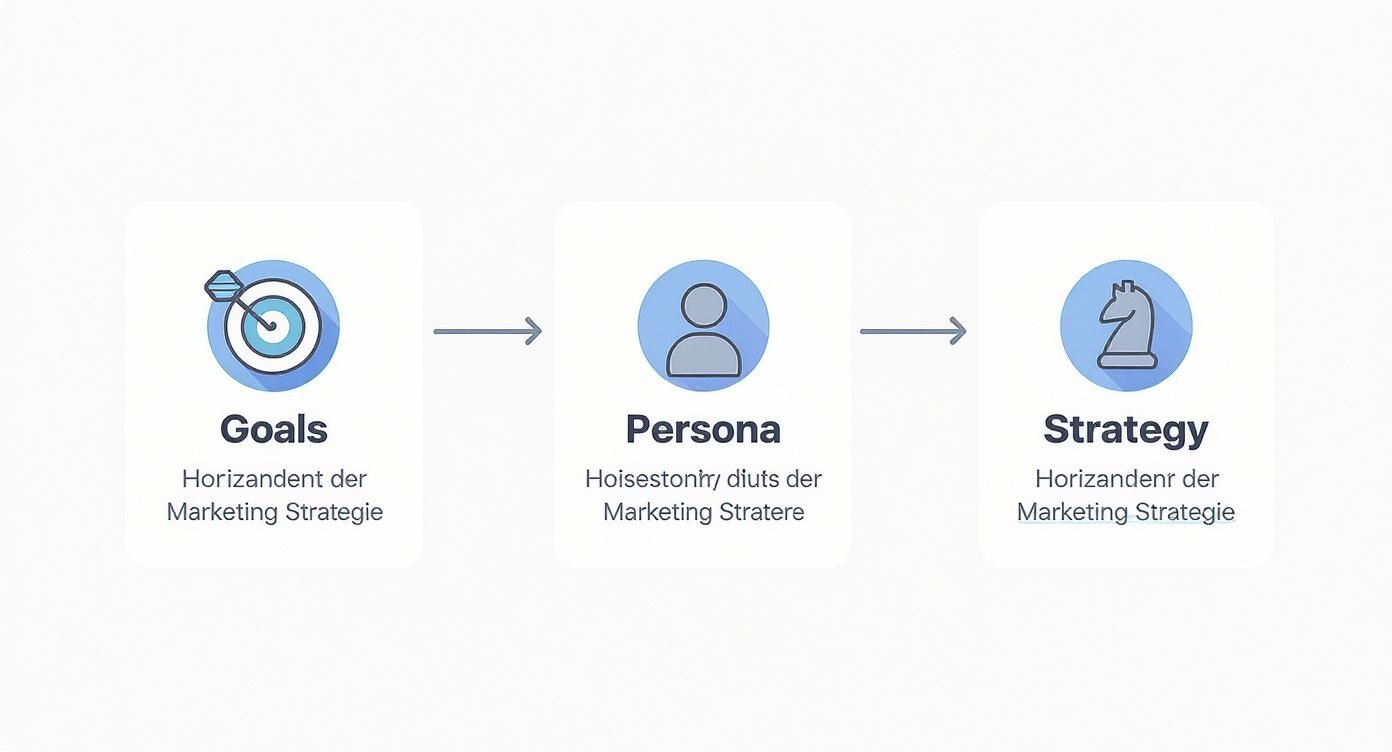
Here you can clearly see how these elements logically build upon one another. A deep understanding of your target audience is absolutely crucial in order to effectively utilize the various elements. Phases of the Customer Journey to accompany them with the right messages. Because only when you know where your ideal customer is at can you effectively guide them and lead them to the next step.
How to get found with content and SEO
Let's be honest: Potential customers don't stumble across your website by chance. Their journey almost always begins with Google. A smart approach Online marketing strategy This ensures you're present exactly where people are searching. It's not about lucky breaks, but about systematically building your visibility. The combination of top-notch content and targeted search engine optimization (SEO) is the most sustainable way to build trust and ultimately generate qualified leads.
Forget all the technical details for a moment. At its core, a good SEO strategy is about answering your target audience's questions better than anyone else. When you create content that truly helps, is relevant, and is presented in an easy-to-understand way, you not only please Google—you establish yourself as a true authority in your industry.

The foundation: keyword research and topic planning
It all starts with a simple question: "What do my ideal customers actually type into Google?" Keyword research is essentially your digital market research. It not only shows you, after which is being sought, but also Why (the search intent).
A plumber from Munich, for example, shouldn't just focus on "plumber Munich". The specific problems and questions of his customers are much more interesting:
- „"How to bleed your heating system": Someone here is looking for information and perhaps wants to solve the problem themselves.
- „"Pipe burst emergency service Munich costs": This is an urgent, transactional search – we need to act quickly.
- „"Best plumber for bathroom renovation": Someone is in the research phase and is comparing providers.
These inquiries represent very different moments in the customer journey. A well-thought-out content plan ensures that you have the right content ready for each of these phases. This allows you to build a network of helpful information that reaches potential customers at various points in their decision-making process. Those who want to delve deeper and create a comprehensive overview will find that... Develop a content strategy Anyone who wants to will find a good roadmap here to approach the whole thing systematically.
On-page optimization: Showing Google the way
Great content alone isn't enough. You need to make it as easy as possible for Google to understand what your page is about and why it's relevant. That's exactly what on-page optimization does. It sends clear signals directly on your website.
Imagine your website as a well-structured book. The most important elements are:
- Title tag: This is the headline that appears in Google results. It must contain the main keyword and entice users to click (e.g., "Pipe burst emergency service Munich – at your location in 30 minutes").
- Meta description: The small text below the title. Consider it your free advertisement. Spark curiosity and promise a clear benefit.
- Headings (H1, H2, H3): These structures organize your text logically. The H1 is the main title of the page, H2 and H3 create order within the subtopics.
- Internal linking: Link from an article to other relevant content on your own site. This not only helps users navigate your site but also distributes link equity across your entire domain.
On-page optimization isn't a one-off project. It's an ongoing process. Regularly check which pages are performing well and give those that are lagging behind a small upgrade.
Technical SEO: The stable framework of your website
Your content can be brilliant, but if your website takes forever to load or is a mobile disaster, visitors will leave faster than you can blink. And Google remembers that. Technical SEO ensures your digital house stands on a solid foundation.
The two most important pillars here are quite clear:
- Page speed: Ideally, a page should load in under three seconds. Anything longer than that costs you visitors. Tools like Google PageSpeed Insights They'll show you where the brakes are.
- Mobile usability: Far beyond 60 % Today, almost all searches take place on smartphones. Your website must not only function on mobile devices, but be a joy to use. Google primarily evaluates your site based on the mobile version anyway (keyword: mobile-first indexing).
Building authority: Why backlinks are so important
Backlinks – links from other websites to yours – are like personal recommendations to Google. The more high-quality and thematically relevant pages link to you, the more trustworthy Google considers you. This strengthens your overall domain authority and sustainably boosts your rankings.
But how do you get these valuable links?
- Create something that people will want to link to: An outstanding guide, an exciting local study, or a useful online tool attracts links almost automatically.
- Guest contributions: Write a technical article for a relevant industry blog or online magazine and include a subtle link to your website.
- Local collaborations: Ask partners, suppliers, or associations you are a member of for a link. Often, this small gesture has a big impact.
Building backlinks is definitely a marathon, not a sprint. But every single good link is a strong endorsement of your expertise and a crucial component of your overall online marketing strategy.
Selecting the right channels for your business
Okay, the goals are set and you know exactly who your customers are. Now comes the crucial question for everyone. Online marketing strategyWhere on earth do these people hang out? And more importantly: Where are they willing to listen to what you have to say?
There are countless channels, from search engines and social networks to email marketing. Anyone who simply spreads their budget indiscriminately can watch it evaporate – without achieving any significant results in the end.
The real challenge lies in finding the exact platforms where your target audience is not only online, but also actively searching for solutions or receptive to your messages. Clearly, not every channel is suitable for every business. A B2B software provider operates in a completely different arena than the local hair salon.
Search engine marketing: The direct line to the customer ready to buy.
When someone has an urgent problem, where do they end up? 99% of the time, they go to Google. This is precisely where search engine marketing comes in, which is divided into two main areas: SEO (search engine optimization) for organic, i.e., unpaid, visibility, and SEA (search engine advertising) for the paid ads at the top.
Search engine advertising (SEA) Google Ads is an incredibly powerful tool if you want to capture ready-to-buy users the moment they express their need. Imagine a homeowner whose heating system breaks down in the middle of winter. Their search will be precise: "Heating emergency service Berlin." As a heating engineer, you can use a targeted Google Ad to appear at the top of the search results for exactly that keyword and land the job. This isn't about persuasion, but about the immediate solution to an urgent problem.
The key advantage of SEA lies in its precision and speed. You can achieve visibility within hours and accurately measure the success of your ads based on clicks and inquiries. This makes SEA a powerful tool for quickly generating qualified leads.
The numbers speak for themselves: Search engine advertising is and remains the dominant format in digital marketing in Germany. With a share of 35.4 percent In 2024, it will still be the most important advertising format. Furthermore, an impressive statistic shows that the top ranking position on Google is around 39.8 percent It grabs all organic clicks, while so-called featured snippets even go so far as to... 42.9 percent can achieve this. You can find more information about these figures in the Results of the study on digital marketing from the industry association Bitkom.
Social media for community and brand loyalty
Instagram and Facebook are about something completely different. People go there to find inspiration, be entertained, or connect with friends and like-minded individuals. They rarely go there specifically to buy a product. Social media marketing is therefore perfect for building a brand, creating a genuine community, and cultivating long-term customer relationships.
A fashion retailer can use aesthetically pleasing images and videos on Instagram to showcase its latest collections, thereby arousing desire long before a purchase intention becomes concrete. A software provider, in turn, can share technical articles on LinkedIn, position itself as an expert, and forge valuable connections with decision-makers. The focus here is clearly on building trust.
How to find the right channel mix for you
The most effective strategies usually combine several channels that complement each other. What works best for you depends directly on your target audience and your business model.
Let's look at a few concrete examples:
- Local tradesman (e.g. electrician): The key is local search engine optimization (Local SEO), meaning a perfectly maintained Google Business Profile with many positive reviews. For emergencies, Google Ads (SEA) are invaluable. Social media can be used alongside to showcase completed projects and position yourself as the friendly local expert.
- National B2B software provider: Here, the music clearly plays on LinkedIn. Networking, sharing expertise, and making contacts. This is all complemented by SEO, meaning detailed blog articles and white papers that are found by decision-makers using complex search queries.
- Online shop for visual products (e.g. jewelry): Instagram and Pinterest are absolutely crucial here. The products need to be presented visually in a perfect way. Influencer collaborations can cause reach to explode. At the same time, Google Shopping ads (SEA) are essential to drive sales directly to the point of purchase.
And very importantly: your channel mix isn't set in stone. You need to regularly review what works and what doesn't. Analyze ruthlessly which channel delivers the most valuable leads or sales, and allocate your budget precisely where it will have the greatest impact.
Growth at the push of a button: Turbocharge your growth with paid advertising
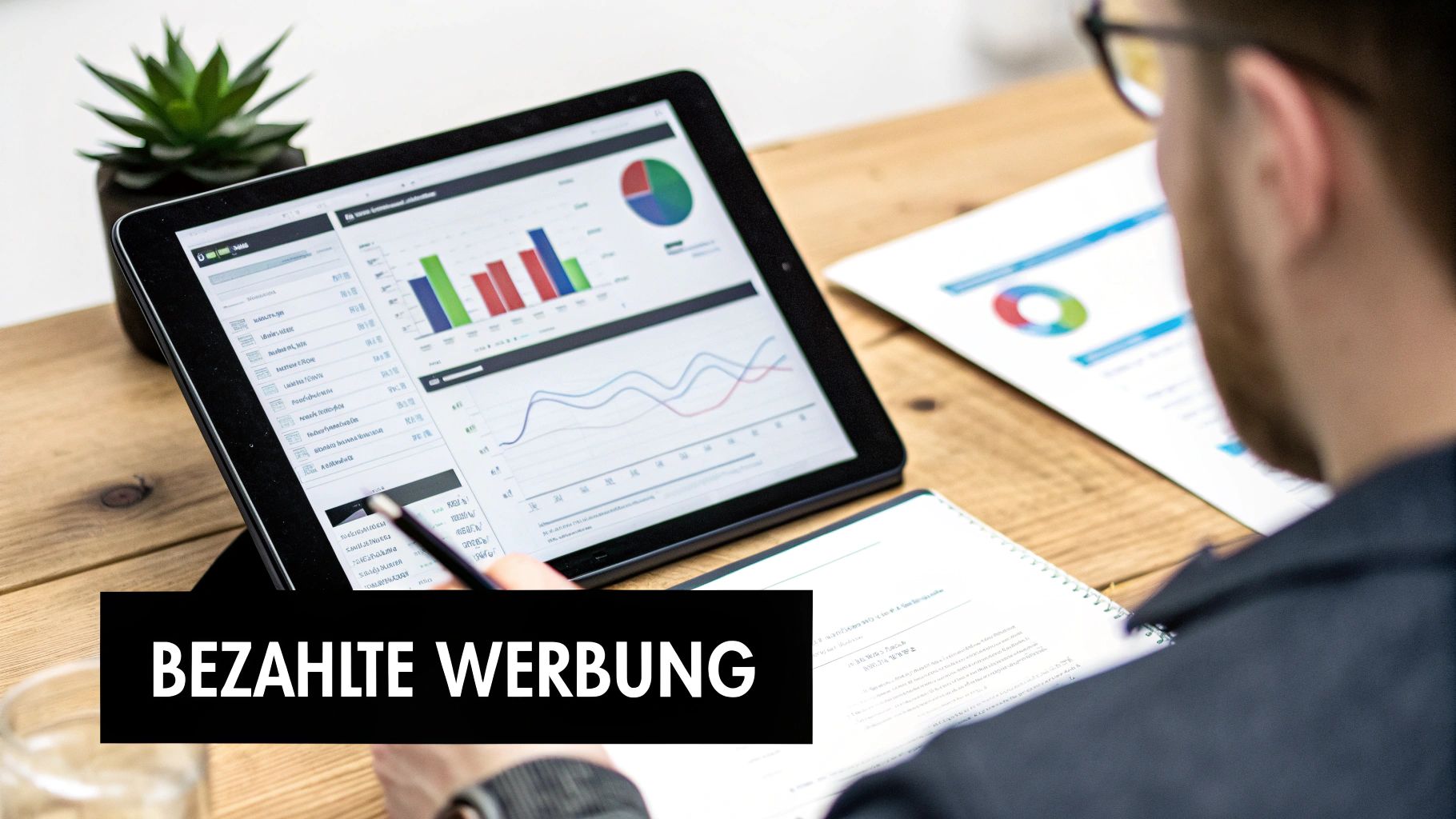
SEO and good content are the foundation for sustainable growth – essentially the endurance training for your business. But sometimes things need to happen fast. That's precisely when paid advertising, or paid media, comes into play. Think of it as the turbocharger for your business. Online marketing strategy, with which you can achieve predictable and, above all, immediate results.
While you patiently build organic reach with SEO, you can with Google Ads or strategically turn on the tap with social media advertising. You reach your ideal customers at the exact moment they are ready to buy, or discover entirely new target groups that you might never have reached organically.
Addressing target groups with surgical precision
The biggest lever for successful paid advertising lies in defining your target audience with razor-sharp precision. You don't waste money by showing ads to people who aren't interested in your offer anyway. Instead, you focus your budget precisely on the users with the highest probability of making a purchase.
Modern advertising platforms offer impressive tools for this:
- Retargeting: A true classic. Target users who have already visited your website. A typical example: Someone adds a product to their cart but doesn't complete the purchase. With a targeted retargeting ad and a small discount, you can often win them back.
- Lookalike Audiences: Do you already have a loyal customer base? Perfect. Upload a list of your best customers to platforms like... Facebook High, and the algorithm finds new users who exhibit similar characteristics and behaviors. It's essentially a digital twin search for your ideal customers.
- Interest and behavior targeting: Define your target audience based on their interests, online behavior, or demographic characteristics. A provider of vegan cooking classes can thus specifically target people interested in sustainability, healthy eating, and animal welfare.
The potential reach on these platforms is enormous and continues to grow. Facebook is expected to reach a certain market share in Germany by 2025. 24.50 million Users reached while Snapchat is on 21.7 million It's coming. The development at X (formerly Twitter) is particularly exciting: Here, the potential advertising reach has increased by a substantial amount between the beginning of 2024 and the beginning of 2025. 33.9 percent They have increased. This opens up fantastic opportunities for you to reach your target groups efficiently. More on this exciting developments in social media marketing You can read more about it at Meltwater.
Choosing the right channel: Google Ads vs. Social Media Ads
Before you get started, the crucial question is: Where can you best reach your customers? The two biggest players are Google Ads and Social Media Ads, and each has its own strengths.
Comparison of advertising channels for SMEs
This table compares Google Ads and Social Media Ads based on key factors for small and medium-sized businesses to facilitate channel selection.
| factor | Google Ads (SEA) | Social media ads (e.g. Facebook, Instagram) |
|---|---|---|
| User intent | Active (Pull): Users are actively searching for a solution or product. High willingness to buy. | Passive (Push): Users discover products while scrolling. Ideal for generating demand and building brand awareness. |
| Targeting | Based primarily on Keywords (Search terms). Very precise in capturing purchase intent. | Based on Demographics, interests & behavior. Perfect for appealing to specific lifestyles or personas. |
| Display format | Mostly text-based in search. Display and video ads on the Google network. | Strong visually (Images, videos, stories, carousels). Creativity and storytelling are crucial. |
| Cost | Often higher Cost-per-Click (CPC), because the competition for high-purchasing keywords is intense. | Usually lower CPC, but more clicks may be needed to achieve a conversion. |
| Ideal for… | Service providers (lawyers, tradespeople), online shops with specific products, B2B companies. | E-commerce (fashion, decor), local businesses (restaurant, cafe), brand-oriented products. |
For most SMEs, the question is not "either/or," but "when and for what purpose." Often, a Combination of both channels The key to success. Use Google Ads to capture high demand and social media ads to reach new audiences and build your brand.
Design ads that are memorable (and have been tested)
Your ad competes with countless other pieces of content in the news feed or search results. You only have fractions of a second to make an impact. A powerful ad has three ingredients: a captivating image or video, concise text that promises a clear benefit, and an unambiguous call to action (CTA) that encourages a click.
But how do you know what really works? The answer is as simple as it is effective: A/B testing.
Never rely on your gut feeling. Systematically test different ad versions against each other. Sometimes, even a small change to the headline, image, or button color can double the click-through rate.
Imagine you sell handmade leather bags. You could run two different ad formats against each other:
- Ad A: An elegant product photo of the bag against a neutral background. Caption: "Handcrafted leather bags. Discover them now."„
- Ad B: A lifestyle image showing a person carrying your bag in everyday life. Caption: "Your loyal companion for every day. Discover our leather bags."„
After a few days, you analyze which version generated more clicks or sales. The winner becomes the new base version, and you begin the next test. This cycle of testing and optimization is the secret behind consistently successful campaigns.
Keep an eye on the success of your investments.
The invaluable advantage of paid advertising is that almost everything is measurable. To avoid getting lost in the data jungle, you should initially focus on the most important key performance indicators (KPIs).
Start by focusing on these three crucial metrics:
- Cost-per-Click (CPC): What does a single click on your ad cost you on average? This metric helps you compare the efficiency of different campaigns or keywords.
- Conversion Rate: What percentage of users who clicked on your ad ultimately performed the desired action (e.g., a purchase, an inquiry)? A high conversion rate indicates that the ad and landing page work together perfectly.
- Return on Ad Spend (ROAS): This is the key metric. It tells you how much revenue you generate for every euro invested in advertising. A ROAS of 5:1 means that for every euro you spend, you get five euros in revenue back.
By consistently monitoring these KPIs, your advertising expenditure will transform from a mere cost factor into a calculable and profitable investment in your growth.
Measure your success and adjust your strategy
Even the most brilliant Online marketing strategy It's completely useless if you don't know whether it even works. It's not about blindly implementing random measures and then hoping for the best. The real key to long-term growth lies in making your efforts measurable and drawing the right conclusions from the data. This is where your strategy comes to life – it becomes a dynamic process that constantly adapts and improves.
Marketing without measurement is like driving with your eyes closed. Sure, you're pressing the gas pedal, but you won't know if you're on the right track until you crash. Consistent tracking transforms vague assumptions into hard facts and helps you direct your budget precisely where it will deliver the best return.
What really matters: Defining Key Performance Indicators
Before diving into the world of analytics tools, you need to answer a crucial question: What exactly does "success" mean for your company? We call these metrics... Key Performance Indicators (KPIs). These are the crucial key performance indicators that clearly show you whether you are getting closer to your goals or just wasting time.
A KPI is not just any number. It must be directly linked to one of your business goals.
- Goal: To increase brand awareness? Then take a look at the Impressions your social media posts, the direct traffic on your website (i.e., people who type your URL directly) or the number of searches for your brand name on Google.
- Goal: To generate leads? Here, hard facts like the Number of completed contact forms, the Conversion Rate your landing page or the Cost per Lead (CPL).
- Goal: To increase sales in the online shop? Their focus should be on the average order value, the Shopping cart abandonment rate and of course the Return on Ad Spend (ROAS) their advertising campaigns.
The most common mistake I see? Companies get lost in so-called "vanity metrics." A high number of followers on Instagram might stroke the ego, but if these followers never buy anything or make inquiries, this number contributes nothing to business success.
Initially, focus on a handful of KPIs that truly reflect your business. Choosing the right ones is absolutely crucial. KPIs in SEO and other areas of marketing. Only then can you assess the true value of your work, instead of just scratching the surface.
Your most important tools: Google Analytics and Search Console
To measure these KPIs at all, you need the right tools. The good news: Two of the most powerful tools on the market are completely free and come directly from Google.
Google Analytics 4 (GA4) Google Analytics is the nerve center of your website analytics. It tells you where your visitors come from (e.g., Google search, social media, paid ads), how they navigate your site, and what actions they take. Google Analytics 4 works on an event-driven basis, meaning you can define virtually any interaction—from clicking a button to playing a video—as a goal (conversion).
The Google Search Console This is your direct line to Google search and absolutely essential for any SEO strategy. Here you can see which search terms your website ranks for and how often it appears in the results (Impressions) and how often someone clicks on it (ClicksAdditionally, Search Console warns you of technical problems that could jeopardize your visibility.
From data chaos to a clear dashboard
Sure, the sheer amount of data in these tools can be overwhelming at first. The solution? Build yourself a clear dashboard that gives you the most important information at a glance. Tools like this one... Google Looker Studio (formerly Data Studio) are perfect for this. They allow you to aggregate data from various sources (such as GA4 and Search Console) and present it in a visually appealing way.
A simple dashboard for a local service provider could look like this, for example:
- Organic traffic (last 30 days): To keep an eye on SEO developments.
- Top 10 search queries: To understand what potential customers are really looking for.
- Number of contact requests (conversions): The most important KPI of all.
- Conversion rate of the contact page: To see where the problem might be.
With such a dashboard, you can feel the pulse of your online marketing strategy weekly or monthly in just a few minutes, without getting lost in endless spreadsheets.
The optimization cycle: analyze data and then act.
Collecting data is only half the battle. The truly crucial step is deriving concrete actions from this data. This optimization process is a never-ending cycle.
Imagine you see in your data that many visitors come to your site via a specific blog post, but almost no one fills out the contact form afterward. The data reveals a problem. Now the detective work begins: Is the call to action (CTA) at the end of the article too weak? Is the article's topic perhaps too far removed from your services?
Based on this hypothesis, you could [consider] A/B test Start by creating a second version of the page with a much more compelling call to action (CTA) and directing half of the visitors to it. After a few weeks, check which version has a higher conversion rate. The winning version becomes the new default.
That's exactly what data-driven optimization is in practice. You no longer rely on your gut feeling, but make well-founded decisions that benefit your... Online marketing strategy Making it better step by step.
Frequently asked questions about online marketing strategy
Even the best-laid plans raise questions in practice. That's simply part of the process. We've compiled the questions we're frequently asked in consultations – the classics, so to speak. The answers should help you gain more confidence in your own strategy.
What budget should I expect to have at the beginning?
That's the crucial question, and a blanket answer would be irresponsible. What you should invest depends entirely on your industry, the competition, and of course, your goals. But there are proven guidelines that can give you an initial orientation.
A local service provider, say a physiotherapist or a lawyer in a medium-sized city, can often already... 300 to 500 euros per month You can achieve really good results and receive qualified inquiries with local Google Ads. However, if you run an online shop and want to sell nationwide, you should rather use 10 to 20 % of your target revenue plan as a marketing budget.
Our practical tip: Start agilely and proceed cautiously. Choose a manageable budget that you're comfortable with and test one or two channels. Carefully analyze the return on investment (ROI). Only those measures that demonstrably work and generate revenue should be gradually scaled up.
Which KPIs are truly crucial at the beginning?
At the beginning, there's a high risk of getting lost in data. Instead, focus on a handful of key performance indicators (KPIs) that truly show whether your strategy is working or not.
- For SEO: Keep the organic traffic, the Clicks and the average position Keep an eye on your most important keywords. Google Search Console This is your best tool.
- For paid advertisements (SEA): This is where things get serious. The crucial points are... Click-through rate (CTR), the Conversion Rate and especially the Cost per conversion (CPA). How much does it cost you to acquire a new customer?
- On social media: In the beginning, the most important things are... Engagement rate (How much do people interact with your posts?) and the reach.
But hovering above all these figures is always one, all-important key figure: the Number of genuine inquiries or sales. This is the ultimate litmus test for your success.
When can I expect to see the first SEO results?
Patience is key here. SEO is a marathon, not a 100-meter sprint. You'll often see initial positive signals, such as improved rankings for very specific long-tail keywords, after just three to four months.
However, it usually takes time before you see noticeable, revenue-relevant results that truly impact the business. six to twelve months Consistent work is key. How quickly it happens depends heavily on the competition and the technical condition of your website. Staying on top of it is everything.
Should I focus on SEO or SEA?
It's not an either-or situation. The smartest solution is almost always a combination of both, because the channels complement each other so wonderfully.
SEA, or paid Google Ads, provides you with immediate visibility and fast, measurable results. Perfect for launching, special promotions, or testing a new product.
SEO, on the other hand, builds sustainable and long-term organic reach Once it's up and running, it's often significantly cheaper than paid advertising. A proven strategy: Start with SEA to quickly acquire your first customers and gather valuable data. At the same time, you can calmly develop your SEO strategy, which can then gradually take over.
Do you want an online marketing strategy that not only looks good on paper but delivers tangible results? With over 15 years of experience, we can help you with that. LinkITUp Helping you to become sustainably visible on Google and achieve your goals. Contact us for a free initial consultation at seobuchen.com/ and let's look together at what's possible for your company.