




„"How much does it cost to have a website built?" To be honest: The answer ranges from several hundred euros for a simple do-it-yourself solution up to over €25,000 for a tailor-made e-commerce platform.
For a professional company website implemented by a freelancer or agency, you should realistically expect a budget between €2,500 and €15,000 Calculate it. However, the final price always depends on your goals and the features required to achieve them.
What a professional website really costs
The question of how much a website costs is a classic – and it can be answered just as easily as the question: „How much does a car cost?“ Without knowing whether you are looking for a practical small car or a fully equipped sports car, any figure is just a rough estimate.
The same principle applies to websites. The price is determined by the scope, technical complexity, and degree of customization. To give you an initial, tangible overview, we'll look at typical costs for different project sizes and providers. This will help you get a feel for your own budget before we delve deeper into the individual cost drivers.
Typical price ranges at a glance
The costs depend heavily on who you hire to implement the project. Will you choose an agency, a freelancer, or tackle it yourself? A recent analysis shows that web design agencies charge high prices for simple projects with three to five pages. from €2,500 to €5,000 Freelancers are often more flexible here and operate within a range of [price range] for comparable projects. €1,000 to €3,500.
As soon as a truly individual design comes into play, perfectly tailored to your brand, the costs quickly climb. €4,000 to €8,000. More details about this pricing can be found in this document. Detailed cost analysis at wolfgegenlicht.de.
Always keep in mind: A website is not a one-time expense, but an investment in your digital presence. The price reflects not only the visible design, but also the invisible work – namely strategy, technology, and security.
The following table provides a quick overview of typical start-up costs. It is intended to serve as a guide to help you better understand the price differences between the various approaches.
Cost overview for different website types
A quick comparison of typical start-up costs for creating a website, broken down by project type and chosen service provider.
| Website type | DIY kit | Freelancer | Web design agency |
|---|---|---|---|
| One-pager / Digital business card | €50 – €300 | €800 – €2,500 | €2,000 – €5,000 |
| SME website (5-10 pages) | €300 – €800 | €2,500 – €7,000 | €5,000 – €15,000 |
| Small online shop (< 50 products) | €500 – €1,500 | €4,000 – €10,000 | €8,000 – €20,000 |
| Extensive portal / Large shop | Not suitable | from €10,000 | from €20,000 |
These figures make it clear: Your chosen partner has the greatest influence on the initial costs. While a Website builder While seemingly inexpensive, you'll quickly reach your limits when it comes to individual requirements. Agencies and freelancers, on the other hand, provide you with tailor-made solutions that are truly aligned with your business goals.
The decisive factors behind the price
The question "How much does a website cost?" is a tricky one. There's no single answer, because a website isn't an off-the-shelf product.
Think of it like building a house: The price depends not only on the living space, but also on the architecture, the building materials, and the interior design. Similarly, the price of your website is made up of various, crucial components.
Each of these elements directly impacts the effort involved – and therefore the costs. A simple bungalow (a one-pager) is logically cheaper than a villa with a pool and smart home system (a complex online shop). Let's take a closer look at the most important cost drivers so you can plan your project effectively and use your budget wisely.
Design and user experience: The foundation for success
Design is much more than just a pretty facade. It's the visible architecture of your website and determines how visitors perceive your brand and whether they can easily find their way around. Basically, there are two approaches:
- Template-based design: You take a pre-made design framework and adapt it to your brand – your colors, logo, and fonts. This is the faster and cheaper way, the prefabricated house of websites, so to speak.
- Individual design (custom design): Here, a designer creates a completely unique layout, perfectly tailored to your target audience and business goals. This costs more, but offers maximum uniqueness and optimal user experience (UX).
A well-thought-out UX design ensures that visitors intuitively find what they are looking for. They stay longer, interact more – and that often justifies the higher investment in a customized concept.
Choosing the right content management system
The content management system (CMS) is the technical heart of your website. It's essentially the operating system that allows you to manage content yourself later on. The choice of CMS not only influences the initial setup. Costs for website creation, but also ongoing maintenance and your flexibility in the future.
A good CMS gives you control over your content without having to call a developer for every minor text change. It's the key to long-term independence and the growth of your online presence.
The most popular choice by far is WordPress, known for its enormous flexibility and a huge community. For pure e-commerce projects, systems like Shopify or WooCommerce often the better choice, while large companies with very complex requirements sometimes rely on TYPO3 Each system has its own strengths and therefore a different cost structure.
The following graphic gives you a good overview of how the costs are distributed depending on whether you choose a modular system, a freelancer or an agency.
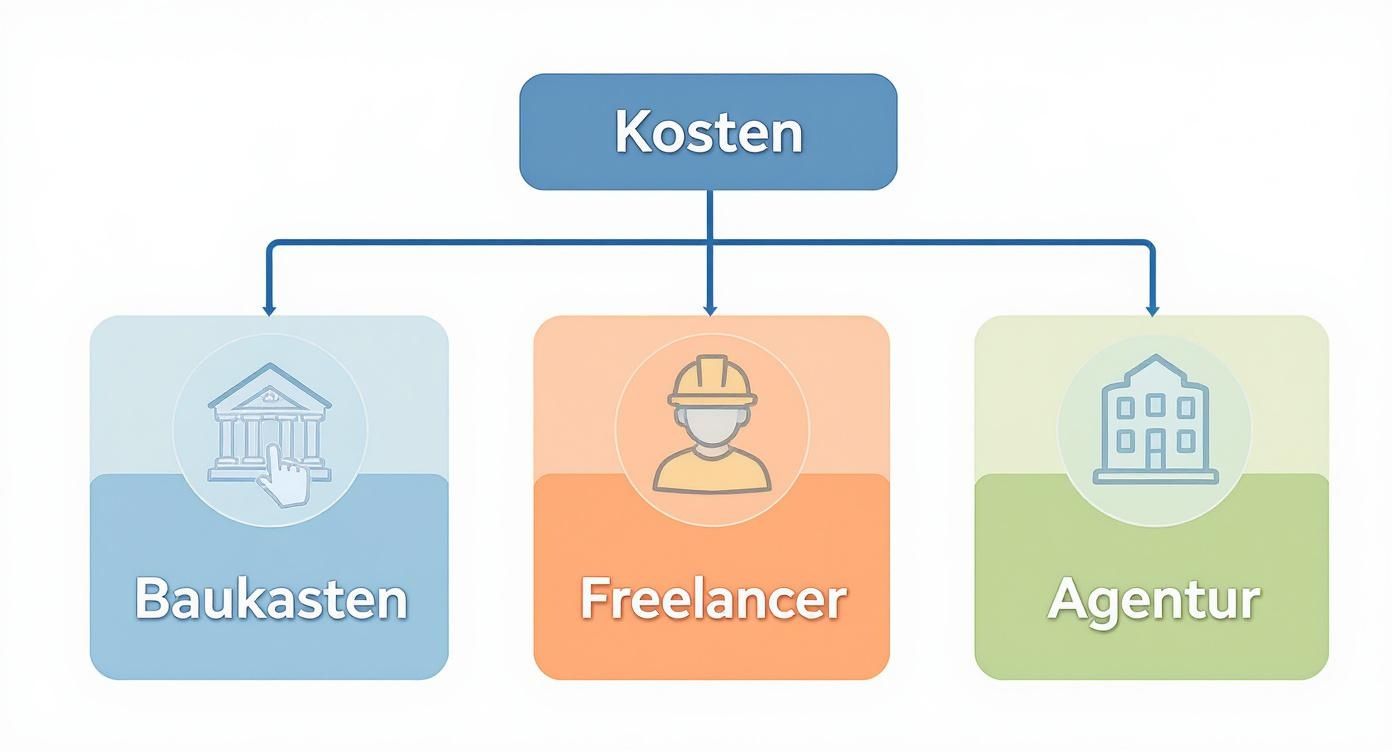
It is clear: The price increases with the degree of professionalization and the individual service that an agency offers compared to a freelancer or a pure modular system.
Scope and functionality determine the effort required.
Clearly, the number of subpages is an obvious cost factor. A simple website with five pages (home, about us, services, contact, legal notice) is significantly cheaper than a portal with 50 subpages and an active blog.
Even more crucial, however, are the functions you need – the „special features“ for your digital home:
- Contact forms: A simple form is standard. However, complex request forms with various fields, logic, and file attachments significantly increase the workload.
- Multilingualism: Each additional language means more work in terms of setup, translation, and ongoing maintenance.
- E-commerce features: An online shop with product management, shopping cart and connection to payment service providers is one of the most complex features of all.
- Booking systems: Integrating calendars for appointments, reservations, or events requires special plugins or even custom programming.
- Accessibility: Making a website accessible to everyone requires additional expertise and intensive testing. Our article explains why it's worthwhile to invest in a Create an accessible website allow.
Content creation and SEO preparation
An often underestimated but absolutely essential point: the content. Who provides the texts, images, and videos? If the agency or freelancer is to create professional advertising copy or organize a photo shoot, you will naturally incur additional costs. But remember: high-quality content is the key to success with Google and convincing your customers.
The same applies to search engine optimization (SEO). A solid technical foundation – meaning clean code, fast loading times, and good mobile display – should always be included in the service today. Further measures such as keyword research and targeted content optimization are often separate services, but they more than pay off in the long run.
As a rough guide, you can expect the costs for a medium-sized website with a custom design and CMS in Germany to often range between €2,200 and €7,700 lie. For small online shops, it usually amounts to around 3.300 € go, while complex portals also quickly up to €44,000 can reach.
Agency, freelancer or modular system – who is the right partner for your project?

When you commission a website, it's about much more than just the budget. Perhaps the most important decision in the entire process is choosing the right partner: Do you hire an agency, a freelancer, or tackle it yourself with a website builder? This decision determines not only the costs, but also the quality, speed, and future viability of your digital business card.
Let's forget rigid pros and cons lists. There isn't one perfect solution for everyone. Rather, it's about finding the right solution for your specific goals, your budget, and your available time.
The web design agency: The all-inclusive package
An agency is essentially like a general contractor when building a house. You get a well-coordinated team of specialists – from designers and developers to SEO experts and project managers. This is especially valuable when your project is complex, time-critical, or of great strategic importance.
Are you planning a multilingual company website, a sophisticated online shop, or a website that requires special interfaces to your ERP system? Then an agency is usually the best choice. You benefit from concentrated expertise, proven processes, and a single point of contact who manages everything. This comprehensive service naturally comes at a price, as an agency's higher operating costs are reflected in the... Costs for website creation low.
An agency is the right choice if you're looking for reliable processes, comprehensive expertise from a single source, and a strategic partner for long-term development. Here, you're not just buying a website, but also dependability and a proven workflow.
The freelancer: The flexible specialist
A freelancer is like a highly specialized craftsman. You speak directly with the person who will actually build your website. This often makes communication straightforward, personal, and much more flexible. Especially for small to medium-sized business websites with clearly defined requirements, this is often the ideal approach.
A good freelancer is usually cheaper than an agency because they have much lower overhead costs. The biggest advantage is the direct, personal collaboration. But there's also a downside: you're dependent on a single person. If that person is unavailable due to illness, your project comes to a standstill.
- Advantages: Direct line to the implementer, high flexibility and usually a better price than with an agency.
- Disadvantages: Risk of failure without a backup and a limited skillset – hardly anyone is simultaneously a brilliant designer, a coding pro and an SEO expert.
- Ideal for: Classic company websites, blogs, portfolios or projects with a clear focus and manageable complexity.
The website builder: The do-it-yourself solution
At first glance, construction kits seem like Jimdo, Wix or Squarespace Extremely tempting: super low costs and the prospect of launching your own online content in no time. Think of it like a piece of furniture from a certain Swedish furniture store – you get the kit and get started right away.
For very simple projects, such as a digital business card or a quick prototype to test a business idea, this can make perfect sense. However, you should be aware of the limitations. As soon as you have individual design requirements, need special functions, or want to seriously focus on search engine optimization (SEO), these systems quickly reach their limits. These limitations can become very expensive later on if you realize you need to switch to a professional system after all.
Direct comparison: Which option suits you best?
To make your decision easier, we have directly compared the three options. This way you can quickly see which criteria are most important to you.
Comparison of providers: Agency vs Freelancer vs Modular System
A comparison of the three main options for website creation, evaluated according to cost, time required, flexibility and expertise needed.
| criterion | agency | Freelancer | DIY kit |
|---|---|---|---|
| Cost | High | Medium | Low |
| Time required (on your part) | Low to medium | Medium | Very high |
| Flexibility & Individuality | Very high | High | Limited |
| Expertise & Service | Comprehensive (Team) | Specialized (individual) | Minimal (Support Forum) |
| Scalability | Very good | Good | Restricted |
| Process reliability | High (established workflows) | Depending on the person | None (personal responsibility) |
Ultimately, the choice always involves weighing risks. Those who think long-term and prioritize visibility, security, and growth are almost always better off with an agency or an experienced freelancer. Those who simply want to quickly validate an idea can start with a modular system. But the true Cost of a website They often only become apparent during operation – or in missed opportunities due to technical limitations.
What a website really costs after launch
Great, your new website is online! Many people breathe a sigh of relief at this point and mentally consider the project finished. But beware, that's a costly misconception. The launch isn't the finish line, but the starting gun. From now on, there are ongoing costs that often weren't even included in the initial quote.
The initial costs for creating the website That's only half the battle. To avoid unpleasant surprises later, you should keep an eye on the "Total Cost of Ownership"—that is, all expenses over the entire life cycle of your website. Compare it to buying a car: The price at the dealership is one thing. Insurance, fuel, taxes, and regular maintenance are the costs that will really strain your budget in the long run.
Annual fixed costs that you must factor in.
Some expenses are absolutely essential for the smooth operation of your website and occur every year. They form the technical foundation without which your online presence practically doesn't exist. Without them, the lights literally go out.
These items are easy to plan and should be a fixed part of the annual budget from the very beginning:
- Hosting: This is essentially the rent for the server on which your website resides. Prices vary enormously – from inexpensive packages for just a few euros a month to powerful dedicated servers for demanding projects.
- Domain: Your online address (e.g. www.ihr-unternehmen.deIt must be re-registered annually. The costs are low, but it's essential.
- SSL certificate: The small padlock icon in the browser address bar indicates a secure "https://" connection. It's absolutely essential for building trust and is an important signal for Google. Many hosting providers include a basic certificate, but additional certificates may be required for enhanced security.
For hosting and domain registration in Germany, you should typically use 100 to 300 euros annually Calculate. Simple tariffs or modular solutions can sometimes be lower.
Ongoing costs for maintenance, licenses and security
In addition to fixed fees, there are a number of variable costs. This is precisely where people often try to save money in the wrong place, which can backfire badly later. Ignoring these points leaves you wide open to hackers or risks your website suddenly malfunctioning.
A website is not a printed flyer, but a living system. It needs regular maintenance to remain healthy, secure, and fast. Neglecting maintenance will ultimately cost you – whether through data loss, hacking attacks, or penalties in Google rankings.
So make sure your budget covers these points as well:
- Software updates: Your CMS (like WordPress) and all installed plugins and themes need regular updates. This isn't an optional luxury; it closes critical security gaps.
- Security backups: Regular, automated backups are your life insurance. If something goes wrong, you can restore a working state with a single click.
- License fees: Many professional themes or special plugins (for example, for online shops or SEO analyses) do not require a one-time payment, but rather an annual license renewal.
- Technical maintenance: A maintenance contract guarantees you professional support. An expert takes care of updates, checks functionality, and is there when needed. Depending on the scope of services, expect the following costs: €50 to €300 per month.
Costs for further development and new content
A website that doesn't change dies a slow death. After launch, the real work begins: filling the site with content and continuously improving it. This isn't an expense, but an investment in your marketing and visibility.
This includes, for example, expenses for:
- Content creation: New blog articles, current project photos, guides or videos keep your site interesting for visitors and search engines.
- SEO measures: Search engine optimization is not a one-off project. To stay at the top of Google, you need ongoing support.
- Minor adjustments: Adding a new menu item, customizing a form, or creating a landing page for a campaign – even small tasks cost time and therefore money.
- Major relaunches: Every few years, it's time for a change. Technology and design evolve, and at some point, a complete relaunch becomes necessary. You can find out more in our guide on the topic. Website relaunch and SEO.
So, the quotes for your new website are on the table. An exciting moment, but now the real work begins. How do you pick out the truly sound offer from the pile – and how do you expose the rip-offs where the costs later skyrocket? It's not about blindly choosing the lowest price, but about understanding the underlying principles.
A good quote is much more than just a number at the end of the bill. Think of it as a detailed roadmap for your project. It creates transparency and forms the basis for a trusting partnership. The biggest warning signs? Vague wording and flat rates without any explanation. An item like "Complete web design: €5,000" is a red flag. You should immediately prick up your ears and ask questions.
What constitutes a transparent offer
A professional proposal breaks down the large, complex project of a "new website" into manageable chunks. It shows you exactly what your money is spending and what you'll ultimately receive in return. Crucially, it clearly separates the one-time costs for creation from the ongoing operating costs after launch. This is the only way to maintain a complete overview of your finances.
Make sure these points are broken down in detail:
- Concept & Strategy: Are items like workshops, wireframe creation, or a sitemap clearly named here?
- Design process: Is there a distinction made between a custom design from scratch and the adaptation of a template? And very importantly: How many revision rounds are included in the price?
- Technical implementation: What technology is used (e.g. WordPress with the Bricks BuilderAre all the features you discussed listed and priced individually?
- Content maintenance: Who will input the texts and images? Is this work included in the offer, and if so, to what extent?
- SEO basics: What exactly is being done for search engine optimization? Does it include specific measures such as setting up meta titles, clean URLs, or optimizing loading times?
A fair offer clearly defines the project scope, specifies concrete deliverables and milestones, and explains how the final acceptance process will work. If these details are missing, the project risk is quietly and discreetly shifted onto you as the customer.
This is how you compare apples to apples (and not to pears)
The best approach is to place the offers side by side and create your own comparison table. Don't just check, whether all desired functions are included, but also, How They need to be implemented technically. A simple contact form can be integrated quickly. A multi-stage inquiry form that connects directly to your CRM system is a completely different ballgame.
Ask for measurable goals. Specifically inquire about target loading times (keyword: Core Web Vitals) or how easily you will be able to manage content yourself later. A partner who can give you clear answers and commitments knows what they're doing.
Negotiate cleverly, without just focusing on the price.
Negotiating isn't always just about driving down the price. Often it's much wiser to discuss the scope of services and jointly explore where there's room for compromise.
- Customize packages: Do you really need multilingual support right from the start, or would it be sufficient in six months? Perhaps a particularly complex feature could be postponed for now? Ask how that would affect the price.
- Contribute your own labor: Could you perhaps write the texts yourself or obtain the licenses for the images? That can significantly reduce your budget.
- Set payment terms: Discuss the payment terms. Splitting the invoice amount according to achieved project milestones provides security for both parties and ensures a fair process.
The most important thing is to shift your focus from the price alone to the actual value. A cheap website that ultimately generates no inquiries or constantly suffers from technical glitches is the most expensive solution of all. Instead, invest in a partner from the Kaiserslautern region whose offer is transparent and who truly understands what will drive your business forward.
When your website becomes a money-making machine
Stop thinking of a website as just an expense. It's time to change your perspective. Think of your website as your best salesperson – one who... 24/7 is always on duty, never takes a vacation, and has what it takes to become the strongest growth engine for your company.
A strategically designed website is so much more than a digital business card. It's an active tool that attracts new customers, generates measurable revenue, and firmly establishes your brand in the market. The question is no longer just, "What will the site cost me?", but, more importantly, "What will it bring me in the end?" Key point: Return on Investment (ROI).
From cost factor to smart investment
The true value of a professional website isn't immediately apparent after launch, but unfolds over months and years. You'll see: A well-designed site often recoups its initial costs faster than you might expect, and then starts generating real profit.
This transformation happens precisely when your website not only looks good, but is optimized to turn visitors into paying customers. It attracts the right people via Google, convinces them with clear arguments, and guides them directly to a specific action – be it a concrete inquiry, a purchase in the online shop, or booking a consultation.
A website becomes a money-making machine when it stops simply informing and starts converting. Every single visitor is an opportunity. An optimized website systematically leverages this opportunity.
Success can be measured in numbers.
One of the biggest advantages of digital technology is its crystal-clear measurability. Unlike a newspaper ad or a poster, you can measure the success of your website in black and white using hard facts, the so-called metrics. Key Performance Indicators (KPIs), track down.
Here are some key figures that really matter:
- Number of leads: How many specific inquiries or calls come in directly through the website?
- Conversion Rate: What percentage of visitors do exactly what you want them to do (e.g., buy something or fill out a form)?
- Traffic via relevant keywords: How many users can you find using search terms that clearly indicate a purchase intention?
- Customer Lifetime Value (CLV): What is the value of a customer acquired through your website over the entire business relationship?
Keeping an eye on this data allows you to immediately see what's working well on your site and where there's still untapped potential. Continuously improving these metrics is key to maximizing your ROI. Our guide shows you in detail how to optimize your Optimize conversion rate and thus get more out of your traffic.
Ultimately, the calculation is simple: The long-term profit generated by a professional website far outweighs the initial costs. It's not a money pit, but rather the foundation for sustainable digital growth.
Frequently asked questions: Everything else you need to know about the costs of your website
Finally, we'll address the typical questions that repeatedly arise in consultations regarding the costs of a new website. Consider this section a short cheat sheet for the remaining open questions.
Can I deduct the costs of a website from my taxes?
Yes, that's usually possible without any problems. Investing in your company website is considered a normal business expense. The one-time setup costs are then depreciated over three years.
Ongoing expenses, such as hosting, maintenance contracts, or licenses, can even be claimed immediately in the same year. However, to be on the safe side, always consult your tax advisor to ensure everything is recorded correctly.
Why are the prices so different?
These enormous price differences are perfectly normal and reflect the different ways of working. An agency naturally has higher fixed costs – rent, salaries for an entire team of designers, developers, and copywriters. In return, however, you often get a comprehensive strategic package and well-established, reliable processes.
A freelancer, on the other hand, works more efficiently, has lower overhead costs, and can therefore often offer more competitive prices. The quality can be excellent in both cases. Ultimately, the project scope and the underlying structure determine the price – a solo expert simply calculates differently than a team of ten.
How long will it take to finish my website?
For a classic company website, let's say with 5 to 10 subpages, you should be realistic between 4 and 8 weeks Plan accordingly. A crucial factor is you: How quickly can you deliver texts and images? How promptly can you provide feedback on drafts?
A practical tip: The biggest way to save time and therefore money is preparation. If you have your content roughly outlined before the project starts, it will speed up the entire process immensely.
For larger projects, such as an online shop with many products or a website with an integrated booking system, we're quickly talking about 3 to 6 months. Here, the complexity of the desired functions primarily determines the timeline.
Your website is more than just a digital business card – it's the linchpin of your online success. We at LinkITUp We don't just build websites. We develop strategic tools perfectly tailored to your goals in Kaiserslautern and the surrounding region. Let's discuss the possibilities with you – no obligation! Contact us for an initial consultation.