





Sure, of course, Do your own search engine optimization Is that even possible? The answer is a resounding yes. For many small and medium-sized enterprises, it's actually the smartest way to gain online visibility and growth. It's about taking control of their own digital future instead of relying on expensive agencies.
Why do SEO yourself: it means keeping control.
Making SEO a top priority is far more than just a matter of budget. It's a strategic investment in your own independence and a much deeper understanding of the people you want to reach. Because let's be honest: nobody knows your business, your products, and your customers as well as you do. This knowledge is the invaluable advantage you possess.
Imagine this: Instead of paying four-figure sums every month to an agency that has to painstakingly familiarize itself with your niche, you invest that time directly in measures that actually deliver results. The biggest benefit is authenticity. You create content with substance and personality – something that externally sourced, generic blog articles rarely achieve.
Full control and manageable costs
When you handle SEO yourself, you determine the pace, the topics, and the tone. You're not bound by rigid contracts and can adapt your strategy in a flash when something changes in the market. This direct line of communication allows you to react immediately to new trends or your customers' most pressing questions.
The financial difference is enormous. While agencies can quickly... €1,000 to €3,000 per month The most important tools for getting started are often even free.
A few facts that underline this: Google dominates the German search engine market with almost 92 % Percentage. Over half of all website visitors come via organic, i.e., unpaid, search. Those who make the right adjustments here, for example through targeted on-page optimizations such as improving Core Web Vitals, can often achieve a user increase of up to... 15 % reach. You can find more information about the current figures in the search engine statistics at seranking.com.
DIY SEO or agency – the decision at a glance
Are you still finding it difficult to decide? This table compares the most important points and helps you find the right path for your company.
| aspect | Do SEO yourself | Hire an SEO agency |
|---|---|---|
| Cost | Low to no direct costs; primarily a time investment. | High monthly fees (often starting at €1,000) |
| control | Complete control over strategy, timing, and content | Strategic decisions are often made jointly or delegated. |
| Expertise | You are the expert on your business and your customers. | The agency brings broad SEO knowledge, but less industry depth. |
| flexibility | High agility in adapting to new developments | Changes are often tied to processes and coordination loops. |
| learning curve | Initial time investment is needed to learn the basics. | No learning effort required; you simply purchase expertise. |
Ultimately, the decision depends on your resources – time and budget. But having control over your own visibility and knowing exactly what works is an invaluable advantage that no agency can take away from you.
Check the technical foundation of their website
Before we dive into the world of keywords and content, we need to take care of the foundation: the technical aspects of your website. Think of it like a house – if the foundation is shaky, even the most beautiful furnishings are useless. In SEO terms, this means that even the best content remains invisible if Google can't properly read and understand your site.
Don't worry, you don't need to be a programmer. You can easily perform the most important technical checks yourself in just a few steps. It's a straightforward process: First, you gain control over the basics, then you ensure growth through targeted optimizations, and finally, you reap the rewards in the form of better rankings.
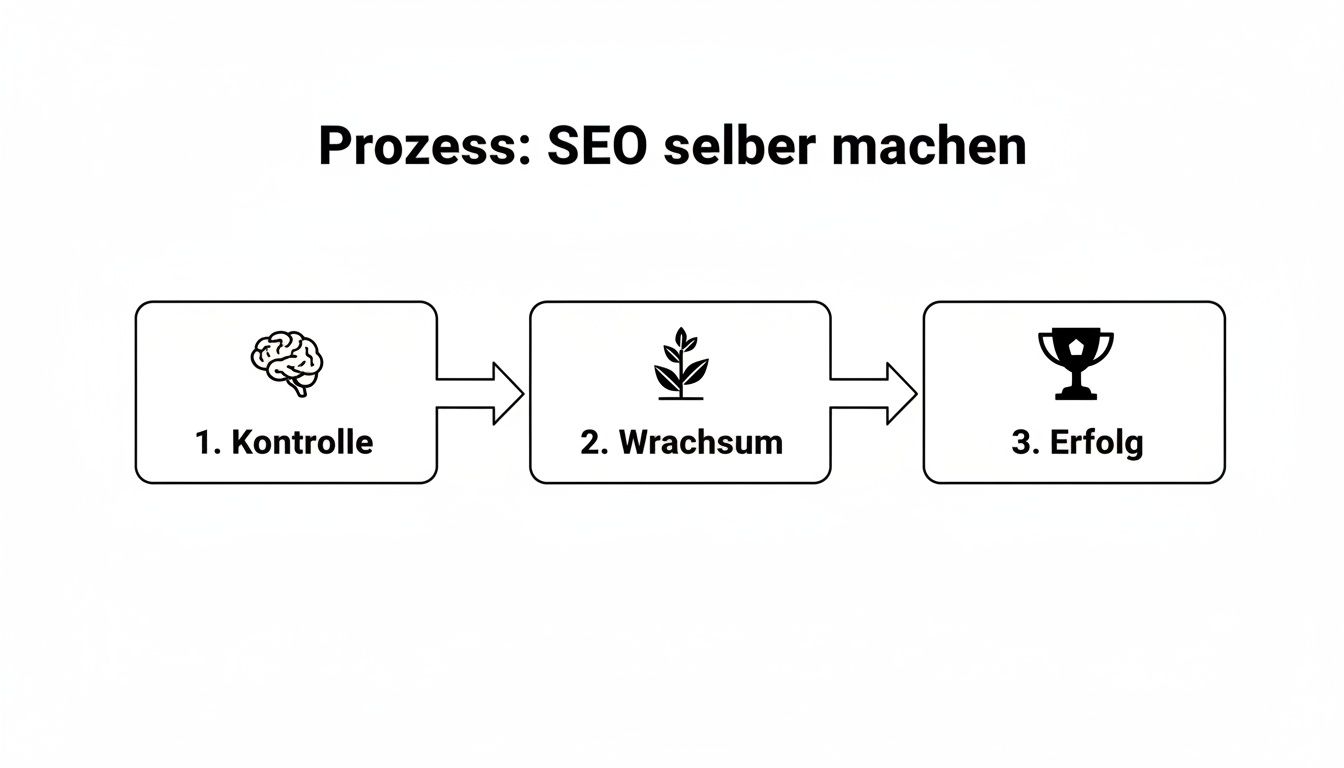
This is exactly the path that will lead you step by step to a solid foundation on which all further SEO measures can be built.
Mobile First is not an option, but a requirement.
It's a simple truth: Google primarily evaluates your website based on how it looks and functions on a smartphone. This principle is called... Mobile-first indexing. Your website might look brilliant on a desktop, but if it's a loading disaster or difficult to use on a mobile phone, you have a serious problem.
A poor mobile experience not only drives away potential customers, it also drags your rankings down.
Fortunately, there's a simple tool for checking: Use Google's free Mobile-Friendly Test. Simply enter your URL, and you'll immediately receive a clear result. If the test fails, the tool often provides initial clues as to the cause – for example, font size that is too small or clickable elements that are too close together.
Page load time: the invisible ranking brake
Did you know that the bounce rate is around 32 % Does your search engine ranking increase if a page takes three seconds to load instead of one? Nobody likes to wait. A slow website is annoying for users and a clear negative signal for Google. Optimizing loading time is therefore one of the most effective levers you can use to improve your website's performance. Do your own search engine optimization and want to see quick results.
Google also helps here with an indispensable tool: PageSpeed Insights.
The tool analyzes your site and gives you a performance score from 0 to 100, along with a list of very specific suggestions for improvement.
Often, small adjustments can have a big impact:
- Compress images: Large image files are the most common cause of long loading times. Tools like TinyPNG drastically reduce file size without any noticeable loss of quality.
- Enable browser caching: This setting saves parts of your website in the visitor's browser. If they return, not everything needs to be reloaded – this speeds up page loading considerably.
- Improve server response time: If your website consistently takes a long time to respond, the problem is often your hosting. Upgrading to a more powerful package can work wonders.
Google Search Console: your SEO cockpit
The Google Search Console Google Search Console (GSC) is your direct line to Google – and therefore an absolute must for every website owner. Here, Google reports technical errors, shows which pages have been indexed (and which haven't), and provides invaluable data on how your website performs in search.
Your first and most important step in Google Search Console (GSC): Check the indexing status. Under the "Pages" menu item, you can see exactly which URLs Google knows and why others might be ignored. Typical problems include messages like "Crawled - not currently indexed" or "Blocked by robots.txt file".
An often underestimated but crucial piece of the puzzle is the XML sitemap. Think of it as a kind of table of contents for your website for Google. It helps search engine crawlers find all the important pages and understand their structure.
Submitting a sitemap is thankfully very easy. Most modern content management systems like WordPress generate them automatically. You simply need to copy the URL of the sitemap file and paste it into the "Sitemaps" section of Google Search Console.
This simple step ensures that Google is aware of all your content and can significantly speed up the indexing of new pages. You can find more details in our guide on how to do this. To create and submit an XML sitemap.
Develop your keyword strategy and understand search intent
Good SEO has nothing to do with technical tricks, but rather with empathy. The first and most important step is to truly understand what your potential customers are thinking when they start a Google search. A simple list of keywords is far from sufficient. It's about understanding the intent – the Search intent – to crack behind every single request.
Once you have internalized this principle, your entire approach to the topic will change. Do your own search engine optimization. They stop writing content for a machine and start providing real answers for real people. And that's precisely the crucial point that Google rewards with better rankings.
The four types of search intent
Essentially, every search query can be roughly categorized into one of four groups. Knowing these categories provides a compass for your entire content planning.
- Information-oriented (Informational): The user has a question and wants to learn something. For example: "how do I prune roses correctly" or "symptoms of iron deficiency".
- Navigational: The user knows exactly where they want to go and essentially uses Google as a bookmark. Classic examples are searches like "linkitup login" or "zalando".
- Transactional: Here, the purchase intent is crystal clear. Someone wants a product or service. This looks something like this: "buy Nike Air Max 42" or "SEO agency Kaiserslautern".
- Pre-purchase investigation (Commercial Investigation): The user is about to make a decision and is comparing options. Typical searches include "best cordless lawnmower" or "Mailchimp vs. Sendinblue".
Your task now is to provide the right content for each of these intentions. Only in this way can you meet your target group exactly where they are – regardless of which stage of the decision-making process they are in.
The underestimated power of long-tail keywords
Many SEO beginners make the mistake of focusing on large, general search terms with high search volume, the so-called "short-tail keywords." A gardener from Kaiserslautern, for example, would try to rank for "gardener." The problem: The competition is cutthroat, and the search intent is completely unclear. Is the person looking for a job? A job description? Or a service provider nearby?
It is much smarter to focus on Long-tail keywords to focus. These are longer, very specific search phrases. Although they have lower search volume, they reveal an incredible amount about the user's intent.
Someone searching for "professional garden maintenance cost per hour" is not a random find. This person has a specific need, is likely close to making a purchase decision, and is therefore a highly valuable lead.
These niche queries are much more likely to lead to contact or a purchase because you provide a tailored answer to a very precise question. And the chance of ranking highly for such terms is many times greater.
A practical approach to keyword research
Okay, so how do you find these gold nuggets? You don't have to guess. There are proven methods that anyone can use.
A fantastic and free starting point is the Google Autocomplete function. Simply type a term that's important to you into the search bar and see what Google suggests. These aren't made-up phrases, but real searches from real people.
Equally valuable: Scroll all the way to the bottom of the results page. Under "Related searches," Google lists further terms that can give you brilliant ideas for new content.
If you want to dig deeper, free tools like the Google Keyword Planner (Requires a Google Ads account) or the free versions of Ubersuggest or Seobility are a great starting point. They give you a feel for the monthly search volume and the competition. For those who want to know all the details, our guide to professional keyword analysis even deeper insights to find the perfect terms for your business.
Create your personal keyword map
Once you have a good list of potential keywords, the most strategically important part comes: the Keyword mapping. This sounds complicated, but it simply means that you assign each important keyword to a specific page on your website.
This kills two birds with one stone: it prevents you from competing for the same keyword with multiple pages of your own (keyword cannibalization), and gives your website a crystal-clear structure that both users and Google love.
A simple keyword map might look like this, for example:
| Page | Main keyword (primary goal) | Secondary Keywords (Supporting) | Search intent |
|---|---|---|---|
| Homepage | Gardener Kaiserslautern | Horticulture, landscaping | Transactional |
| Performance page | Professional garden maintenance | Lawn care, hedge trimming | Transactional |
| Blog article | Lawn scarifying instructions | When to scarify and aerate the lawn | Informational |
| Blog article | Garden maintenance costs | How much does a gardener cost per hour? | Commercial Inv. |
This simple table is the strategic heart of your on-page optimization. It's your roadmap. You know exactly what content to create and which keywords you need to optimize each individual page for. Without such a plan, SEO is pure guesswork. With it, you steer towards better rankings and more relevant visitors.
How to write content that users and Google will love
Now that the technical foundation of your website is in place and your keyword strategy is clear, we come to the heart of all successful SEO work: content. Truly excellent content is the fuel that catapults your site to the top of the search results. It's not just about placing keywords in a text. It's about solving real problems, answering your customers' most pressing questions, and delivering tangible added value.
If you Do your own search engine optimization, You have an invaluable advantage: your personal expertise and passion. You bring an authenticity that an external agency can hardly replicate. And that's precisely what Google rewards with its EEAT framework: expertise, experience, authority, and trustworthiness.
First impressions count: page title and meta description
Think of your page title (title tag) and meta description as your personal advertising sign in Google search results. They are the very first point of contact and often determine in fractions of a second whether a potential customer clicks on your link or simply scrolls on. Here, you need to grab attention and simultaneously signal relevance.
A strong page title should:
- Contain your main keyword, preferably as far forward as possible.
- Arouse curiosity and promise a clear benefit. What's in it for the user?
- Be under 60 characters long, so that it is not cut off in the search results.
The meta description is your elevator pitch. While it doesn't directly affect your ranking, it has a huge impact on your click-through rate. It should include the keyword, a clear call to action, and... 155-character mark do not exceed.
A real-world example:
A local electrician is being sought for "retrofitting smart heating control".
- Previous (weak): Title: Services | Meta: We offer smart home solutions.
- Afterwards (strong): Title: Retrofit Smart Heating Control | Save up to 30% | Electrician Meier | Meta: Upgrade your heating system to smart! Lower heating costs and enjoy greater comfort. Get a free consultation from Electrician Meier now.
Do you see the difference? The second entry is a direct invitation and promises a clear advantage. This can significantly increase the click-through rate.
Structure creates clarity: the power of headings (H1, H2, H3)
Would you read a long text without any paragraphs or subheadings? Probably not. Headings are the guideposts for your readers and for Google. They break your content down into logical, easily digestible chunks.
The hierarchy is quite simple:
- H1 heading: Each page has exactly an H1. This is the main heading that sums up the topic of the page and contains your most important keyword.
- H2 headings: This allows you to structure the content into major topic blocks. Perfect for including secondary keywords or related questions.
- H3 headings: These subdivide the H2 sections even more finely and go into greater detail.
A clean heading structure not only helps Google to understand the context of your page in a flash, but also makes the text much more pleasant to read for your human visitors.
The common thread running through their website: internal linking.
Internal links – that is, links from one page of your website to another – are an incredibly powerful, yet often underestimated SEO tool. They are essentially your website's navigation system, for both users and Google. They determine how authority (the so-called "link juice") flows through your pages.
For example, if you link from a detailed blog article to an important product or service page, you send Google a clear signal: "Hey, this landing page is particularly relevant and important for this topic!" This strengthens the authority of the linked page and can sustainably improve its ranking.
A key aspect of on-page optimization is visibility in search results. Data shows that the first three organic results on Google in Germany are... 68,7 % all clicks are received. Reaching these top positions is therefore crucial, as only 0,78 % whether the user even clicks on the second page. Learn more about the Importance of ranking factors on seoagentur-hamburg.com.
Making images speak: optimizing alt tags
Images break up texts and make complex topics easier to understand. But for a search engine, they're just pixels. Here's where the... ALT tags (Alternative text) comes into play. The ALT tag is nothing more than a short, concise description of what can be seen in the image.
This short description serves two important purposes:
- Accessibility: Screen readers read this text aloud to visually impaired users, making your content accessible to everyone.
- SEO: Google uses the ALT text to understand the content of the image. This helps not only in the context of the page, but also for a good ranking in Google Image Search.
A good ALT text is therefore short and descriptive and includes your keyword where thematically relevant. So instead of "IMG_8765.jpg", it's better to write "Man installs a smart heating control in the living room". A small effort with a big impact.
On-page SEO checklist for every piece of content
To ensure you don't forget anything important when creating new pages or blog posts, I've compiled a short checklist for you. Use it as a guide to make sure all crucial on-page factors are taken into account.
| element | Optimization goal | Important for |
|---|---|---|
| Page title (Title Tag) | Main keyword at the beginning, < 60 characters, click incentive | Ranking, click-through rate (CTR) |
| Meta description | Includes keyword, < 155 characters, call to action | Click-through rate (CTR) |
| H1 heading | Only one per page, contains main keyword | Ranking, user guidance |
| H2/H3 headings | Secondary keywords, logical structure | Readability, context |
| Keyword density | Distribute the main keyword naturally throughout the text | Relevance signal |
| Internal links | Link to relevant subpages | User guidance, authority |
| Image ALT tags | Descriptive, keyword if appropriate | Image search, accessibility |
| URL structure | Short, understandable, contains keyword | User-friendliness, SEO |
This list is your reliable guide to perfectly optimized content. Simply go through the points with each new publication, and you'll soon see how your work pays off in search results.
How to become an authority through clever link building
Have you ever wondered why some websites consistently rank at the top of Google while others disappear into obscurity? One crucial factor is... Backlinks. Think of them simply as endorsements, much like citations in science. Every single link pointing to your website from another, trusted site sends a strong signal to Google. Essentially, this link is saying, "Hey, this content is so good that we vouch for it!"„
Especially if you Do your own search engine optimization, Link building can seem like a daunting task. Many people immediately think of expensive agencies or dubious tactics. But that's precisely the wrong approach. Good, sustainable link building has nothing to do with trickery; it's based on the value of your content and building genuine relationships. It's about earning those recommendations honestly.
The golden principle: Quality always beats quantity.
Forget the old idea that it's all about the quantity of links. That's long outdated. Today, quality is the only thing that matters. A single backlink from a reputable website in your industry is infinitely more valuable than a hundred links from random spam sites. Google is now incredibly good at recognizing the context and authority of a linking page.
Your focus should therefore be crystal clear: Collect links from websites that are thematically relevant to you and have a good reputation within their niche. This will not only protect you from potential Google penalties, but also bring you visitors who are genuinely interested in what you do.
A good backlink is far more than just an SEO factor. It's a bridge to new customers and tangible confirmation of your expertise. Quality isn't just important here – it's everything.
Realistic link building strategies for getting started
The key to success is to start small and smart. Instead of dreaming that the big news portals will link to you, look around in your immediate surroundings and your niche.
Here are three proven strategies you can use to get started right away:
- Writing guest articles for niche blogs: Specifically search for blogs in your industry that offer a platform for guest authors. Write a truly excellent, helpful article that provides real added value to the readers. As a thank you, you'll almost always receive a small author box with a link back to your website.
- Use reputable business directories: Every industry has its important directories, whether digital or traditional. A listing in portals like the "Yellow Pages" or specialized industry directories not only provides you with a solid backlink, but also strengthens your local SEO profile.
- Cultivate local partnerships: Talk to other local businesses whose services complement yours. For example, a tax advisor could recommend a friendly lawyer on their website – and vice versa. These are authentic, useful links that Google loves.
Creative methods for advanced learners
Once you've mastered the basics, it's time for the next step. Two methods are somewhat more complex, but incredibly effective: "broken link building" and the creation of so-called "linkable assets".
This is how broken link building works in practice:
- Research: Search for relevant websites in your niche.
- Analysis: Install a browser extension like "Check My Links" and scan these pages for broken links – that is, links that lead to an error page (404).
- Have the content ready: Have you found a dead link on a topic you already have a good article about, or could quickly write one about? Perfect, this is your chance!
- Knock politely: Write a short, friendly email to the website operator. Point out the broken link and suggest your own high-quality content as a suitable replacement.
This tactic works so well because you're solving a real problem for someone. You help the webmaster keep their site up-to-date and, in return, receive a valuable backlink. A classic win-win situation.
A Linkable Asset In contrast, "ingenious" content is content that is so brilliant, useful, or entertaining that other people almost instinctively want to link to it. This can be many things:
- An extremely comprehensive guide or a free e-book
- A small independent study or survey using fresh data
- A practical online tool (e.g. an industry calculator)
- A stylish infographic that makes complex data understandable.
Sure, creating something like this is a lot of work at first. But the reward is often a steady stream of organic backlinks that will solidify your authority in the industry for years to come.
Measure SEO success and adjust the strategy
Anyone who thinks the work is done after the content goes live and the initial link building is complete is sorely mistaken. If you Do your own search engine optimization, Now begins perhaps the most crucial part: the constant measuring, analyzing, and readjusting. SEO isn't a project you finish once – it's a cycle in which data-driven decisions make the difference between stagnation and real growth.

Fortunately, Google itself provides you with the two most powerful tools for this free of charge: Google Search Console and Google Analytics. Think of them as your dashboard, from which you can see exactly what's working and where untapped potential still lies.
Google Search Console – Your direct line to Google
The Search Console (GSC) is essentially your direct line to Google headquarters. The "Performance" report is an absolute goldmine. It reveals not only how many clicks and impressions your pages receive, but also – and this is the crucial point – for which search terms your pages are actually appearing.
Here, you often stumble across long-tail keywords for which you're already ranking without ever realizing it. A typical scenario: You discover a page languishing at position 12 for a relevant term. Perfect! That's a clear signal. With a targeted content overhaul, the leap to the all-important first page is often just a small step away.
Google Analytics – Understanding what the user really wants
While the GSC shows you what before Google Analytics tells you what happens after you click. thereafter Here you can see in black and white how your organic traffic develops over time and which content really attracts people.
My tip: Always take a close look at the "time spent on page." A long time spent on page is an incredibly strong signal to Google that your content fully meets the user's search intent. Find out which pages captivate your visitors and use their structure and tone as a blueprint for future content.
SEO remains the most important driver for website visitors. Current statistics predict that organic traffic will still be the most important factor in 2025. 54.25 percent which will be the main source for German websites. Since almost 65 percent Since all searches end without a single click, optimizing for featured snippets (position zero) is becoming increasingly crucial. More exciting SEO statistics can be found at aioseo.com, to refine your strategy.
Keeping an eye on the most important KPIs
To avoid judging your success solely by gut feeling, you should focus on a few, but truly meaningful key performance indicators (KPIs).
- Organic sessions: How many visitors actually come via unpaid search? A steady increase here is the best sign that your efforts are paying off.
- Keyword rankings: Track the positions of your 10–20 of the keywords. Are they climbing continuously upwards?
- Conversion rate (organic): How many of the visitors who come via Google ultimately perform a desired action – be it an inquiry, a phone call, or a purchase? That is the ultimate proof of the business success of your SEO efforts.
Regularly monitoring these figures is essential. Whether you use a simple spreadsheet or specialized tools is a matter of personal preference. You can find a good overview of helpful and free tools in our guide to... free SEO analysis tools. This is how you transform raw data into smart decisions and ensure that your hard work bears fruit in the long term.
Should you find at this point that the analysis and the strategic derivation of measures are becoming too complex, it is a good moment to consider professional support from LinkITUp.
Frequently asked questions about DIY SEO
When you delve into the world of search engine optimization, the same questions almost always come up. Don't worry, that's perfectly normal. Here I've compiled the answers to the most pressing questions that I encounter time and again in my practice, to make it easier for you to get started.
How long does it take to see initial SEO results?
I hear this question all the time, and the honest answer is: SEO is a marathon, not a sprint. It's a long-term investment in your visibility.
You can usually expect to be able to do this after about three to six months With consistent effort, you'll start to see noticeable improvements in your rankings and organic traffic. For very niche markets or a strong local focus, it can sometimes happen even faster. The key to success here truly lies in patience and continuous, persistent optimization.
Which free tools are essential for beginners?
Good news: The most important tools for getting started don't cost a cent. They are absolutely essential: Google Search Console and Google Analytics.
The Search Console is essentially your direct line to Google. It shows you how Google sees your site, reports technical problems, and provides insights into which search terms you rank for. Analytics, on the other hand, tells you what your visitors are doing. on to do on your site. For keyword research, the Google Keyword Planner or even the free versions of tools like Ubersuggest a great starting point.
Can incorrect SEO damage your website?
A resounding yes! Methods that deliberately violate Google's guidelines – so-called "black hat SEO" – can completely remove your website from the index.
Examples include purchased links, keyword stuffing, or hiding content from search engines.
However, if you adhere to the user-oriented methods described here, you're on the safe side. This will build a sustainable foundation that Google will reward in the long run.
Should you find that you lack the time or that the complexity is greater than anticipated, that's not the end of the world. In such cases, it can be beneficial to bring an experienced partner on board so that you can fully concentrate on your core business.
We at LinkITUp We help you achieve your SEO goals faster and with the necessary expertise. Why not stop by and learn more at [website address]? https://seobuchen.com/.