





Imagine your competitors are acquiring customers day after day with topics that aren't even on your radar yet. This is precisely where the Content Gap Analysis It's like a spotlight, illuminating the dark corners of your content strategy and revealing hidden potential. It systematically identifies the gaps through which valuable traffic, and therefore real money, is slipping through your fingers.
Why your content strategy without gap analysis is a gamble
Many companies create content based on gut feeling. suspected, You try to guess what your target audience might be interested in and hope for the best. The result is often a guessing game with an uncertain outcome. A content gap analysis puts an end to this. Instead of relying on assumptions, you make data-driven decisions. You find out in black and white what your potential customers are really looking for – and where they can currently find it.
At its core, the process is strikingly simple: You overlay the topics your competitors rank for in search results onto the topics you already cover. The gaps that become visible are your content gaps. And these aren't problems, but rather tangible opportunities just waiting to be seized.
It's about more than just copying keywords.
Let's be clear from the outset: This isn't about blindly copying the competition's strategy. Rather, we use analysis to understand which topic clusters work in your market. Your task is then to explore these topics more effectively, comprehensively, and from your unique perspective. The goal is always to provide the best answers to users' questions.
A content gap analysis is essentially rigorous market research for your content. It not only shows you, What people are looking for, but also, where how to find it at the moment – and how you can create a more convincing alternative.
A practical example: an e-commerce shop
Imagine an online pet supply store. The team diligently writes blog posts about dog food and the latest toys, but the traffic just won't grow. Frustrating, right?
A content gap analysis would quickly shed light on this. It could reveal that several direct competitors are achieving top rankings with guides on the topic of "first aid for dogs"—a high-volume search topic that the shop has completely ignored so far.
This gap is a goldmine. If the shop now creates a truly comprehensive guide – with symptoms, immediate action, and prevention tips – it can reach a completely new, highly relevant target group.
This one new piece of content contributes to several goals simultaneously:
- Tap into new traffic sources: The shop suddenly becomes visible for keywords that previously seemed unattainable.
- Building expert status: Those who help in an emergency situation are perceived as trustworthy authorities.
- Emotionally engage customers: A user who has been helped in a stressful situation will remember your brand.
Such targeted action is the direct result of gap analysis. It shows you how to focus your budget and time precisely on the content that has a proven track record of working and delivering results. To understand how this step fits into the bigger picture, read our guide on how to conduct a comprehensive gap analysis. Develop a content strategy.
The right preparation for a successful analysis
Before you delve deep into the data, you need the right tools. A successful Content gap analysis It doesn't start with searching for keywords, but with clear goals and the right tools. Without this foundation, you risk getting lost in a flood of data instead of discovering real opportunities.
It's about taking a strategic approach. Ask yourself: What exactly do we want to achieve with the new content? More demo requests? A fuller email list? Or simply more visibility for our brand? A clear goal is your compass for the entire process.
Mindset makes the difference
The most common mistake I see in gap analysis is trying to simply copy the competition. Your goal shouldn't be to create an exact copy of a successful article. Instead, it's about understanding which topics resonate with your target audience – and then addressing them better, more helpfully, and from your unique perspective.
Imagine a competitor has a successful article about "installing a balcony power plant." Instead of replicating the same article, you could create a more detailed piece that specifically addresses tenants, explains legal pitfalls, and provides a checklist for registering with the grid operator. This way, you not only fill a gap but also create real added value.
This graphic illustrates how a concrete content idea can emerge from simply observing the competition.
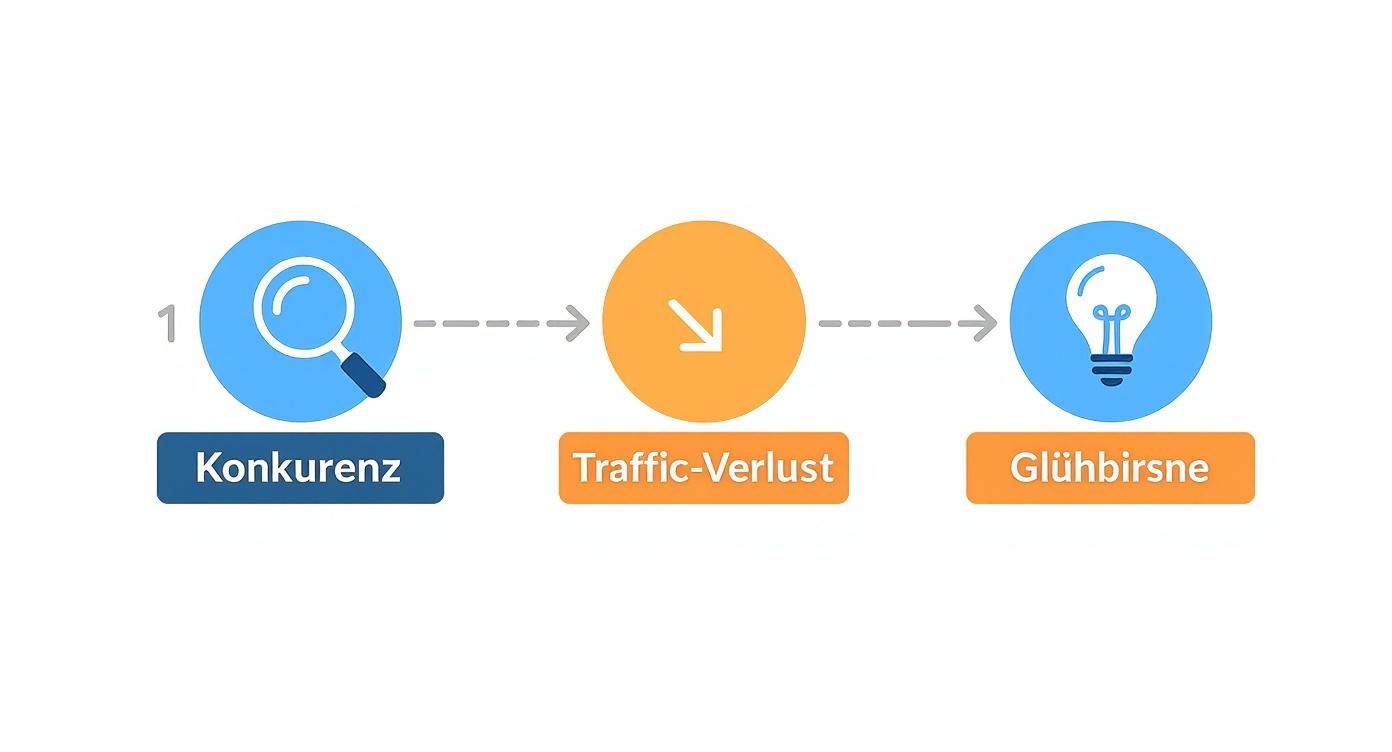
This clearly shows that analyzing competitor rankings leads directly to the identification of untapped potential and thus to fresh ideas.
Selecting the right tools for analysis
Choosing the right tool depends heavily on your budget and ambitions. Fortunately, there's a wide range of resources available, from free must-haves to professional SEO platforms.
This table provides a quick overview of the most important tools, their core functions for gap analysis, and the ideal use cases for SMEs.
| Tool | Core function for gap analysis | Ideal for | Price range |
|---|---|---|---|
| Google Search Console | Analyze your own performance data | Every company (free must-have) | For free |
| Ahrefs | Keyword gap, content gap | Detailed competitive analysis | Medium to high |
| Semrush | Keyword gap analysis | Comprehensive SEO strategies | Medium to high |
| Ubersuggest | Competitive Analysis, Keyword Gap | Beginners & smaller budgets | Low to mid-range |
Each of these tools has its strengths, but for getting started and basic analysis, GSC and Ubersuggest are often sufficient to find valuable initial gaps.
A closer look at the tools
Google Search Console (GSC): This free tool is indispensable. It shows you which keywords your site is already ranking for. The comparison function is particularly useful: Analyze different time periods and find out which terms your visibility is declining for. This is often a clear indication that a competitor has filled a gap.
Ahrefs & Semrush: These all-in-one platforms are the gold standard for in-depth analysis. They offer special "keyword gap" or "content gap" features that allow you to directly compare your domain with multiple competitors. At a glance, you can see which keywords your competitors are ranking for, but you aren't.
Pro tip: Be sure to use the filters in Ahrefs or Semrush. Initially, focus on keywords with a low search volume. Keyword Difficulty (KD), where your competitors are on the Positions 5-20 Rank. Here you have the most realistic chance of seeing results quickly.
For any in-depth analysis, it is essential to master the fundamentals of keyword research. If you would like to refresh your knowledge, you will find a comprehensive guide here. Keyword Research Guide, which helps you identify the best terms for your strategy.
A practical example from the B2B software sector
A project management software provider wanted to increase the number of sign-ups for its free trial version. The content gap analysis was geared towards this clear goal from the outset. Instead of searching for general blog topics, the team focused on commercially relevant gaps.
The analysis showed that competitors ranked highly for comparison keywords such as "best project management tools for agencies" or "Trello alternative for development teams." The company's own website? Nowhere to be found.
Based on this insight, targeted comparison articles and landing pages were created that specifically addressed these search intents. The result: Sign-ups for the trial version increased by [number] within three months. over 40 %. This example shows how a clear objective directs the analysis straight to the most valuable gaps and leads to measurable results.
Who is really playing the online game? Identifying competitors and gaps in their expertise.
Now things get exciting – the real detective work can begin. To build a powerful Content gap analysis To carry this out, we first need to find out who your real opponents are in the digital arena. Often, these aren't the companies you consider your direct competitors offline. Instead, they might be blogs, niche websites, or specialized portals that are grabbing the attention of your target audience.

Unmask your true digital competitors
Your digital competitors are simply all the domains that rank for the keywords most important to your business. A local bike shop in Munich might not only be competing online with the shop around the corner, but also with major cycling magazines that publish test reports, or with travel bloggers who write about the best cycling tours in the Alpine foothills.
To track down these competitors, it's best to proceed systematically:
- Start with your gold keywords: Grab 5 to 10 Your most important search terms – those for which you already rank or absolutely want to rank.
- Go to Google: Perform a quick Google search for each of these terms. Note the domains that made it to the first page. Ignore large marketplaces if they are not relevant to you.
- Let the tools do the work: Enter your domain into an SEO tool such as Ahrefs or Semrush One. There, under "Competing Domains" (or a similar function), you will find a list of the pages that have the greatest keyword overlap with yours.
Following this procedure, you will quickly have a concrete list with 3 to 5 Main competitors, which serve as the basis for deeper analysis.
The simple workflow to find gold mines in content.
Once you know who you're dealing with, the specialized "content gap" or "keyword gap" features of SEO tools come into play. The process is strikingly similar across most tools, and the results are often a real eye-opener. You enter your own domain and add the domains of your newly identified competitors.
The tool then provides you with a list of precisely the keywords for which one or more of your competitors rank – but your own site does not. This is the core of content gap analysis. This is where the hidden gems lie.
The results list is a treasure trove. It provides you not only with individual keywords, but entire topic clusters that you may have completely overlooked before.
The point is not to blindly copy every single term. Look for patterns. What overarching themes are your competitors covering that you're still missing? Are they detailed instructions, product comparisons, case studies, or perhaps local guides?
Practical tip: Filter the results to isolate the most valuable opportunities. Initially, focus on keywords where at least two of your competitors are ranked. This is a strong signal that this topic is truly relevant to your target audience and is ranked as important by search engines.
A real-life scenario: How a travel provider discovered a niche
Imagine a small, specialized travel provider for tailor-made trips to Southeast Asia. On paper, its direct competitors are the large tour operators. However, a content gap analysis revealed something quite different.
The real digital competitors for the target group's attention were not only other event organizers, but above all travel blogs and magazines on the topic of sustainability.
The analysis with Ahrefs painted a clear picture:
- The competition ranked extremely well for keywords related to the topic of "„Sustainable travel with children“.
- Topics such as „plastic-free on vacation“" or "„ethical elephant reserves thailand“Attracted a huge amount of traffic.”.
- The travel provider's own blog had previously only touched upon these important topics superficially.
This realization was a turning point. It opened up a completely new content field that perfectly aligned with the brand's philosophy. Instead of simply writing about travel destinations, the company created in-depth guides on sustainable travel. This not only attracted more organic traffic but also a highly engaged target audience that shared the very values the company stood for.
Identifying this gap led to a strategic realignment of the content and sustainably strengthened the brand positioning. In a changing environment, this precision is crucial. Studies show that the growth of social media usage in Germany is leveling off and will continue until 2025 only increases by a few percentage points. This suggests saturation in established formats and underscores the importance of precise... Content gap analysis Finding new, relevant topics to continue reaching target audiences. Learn more about the You can learn about changing usage patterns in the ARD/ZDF media study..
Separating the wheat from the chaff: How to prioritize the right content potential
Congratulations! After a thorough Content gap analysis You probably now have a long list of keywords and topics in front of you. That's a fantastic starting point, but that's all it is: a starting point. It's incredibly easy to get lost in the countless possibilities.
Now comes the truly crucial step. We need to transform this long list into a powerful strategy and focus on the content gaps that offer the greatest leverage for your business goals.
The temptation is huge to simply jump on the keywords with the highest search volume. But that's often a fallacy. In the end, you invest a lot of work in content that generates traffic but no customers. Strategic prioritization is your shield against wasted resources.
A simple framework for clear priorities
To make this process tangible, I've developed a pragmatic framework over the years, resting on three simple yet powerful pillars. Every single content gap you identify must pass this check before it makes it onto your to-do list. This ensures that every minute you invest in content directly contributes to your business goals.
The three pillars are:
- Business relevance: How directly does this topic help you sell your products or services?
- Ranking potential: How realistic is it to actually achieve a top position for this keyword? (Keywords: competition and your own domain authority)
- Search intent & customer journey: At what stage of his journey is the seeker, and does that align with our goals?
By putting every idea through this grid, a data dump becomes a plan that is based not just on numbers, but on a clever business strategy.
Assess the business relevance
Not every website visitor is equally valuable. A blog post that attracts thousands who are only looking for free information is less valuable to a company than an article that... 50 Highly qualified leads generated. So ask yourself ruthlessly with every topic: How close is the person behind the search query to a purchase decision?
Prioritize topics that demonstrate a clear commercial interest. A keyword like „Tax advisor costs for GmbH“ is worth its weight in gold, even if „What does a tax advisor do?“"Perhaps ten times the search volume. The former signals a need for action, the latter merely curiosity.".
Imagine a financial services provider. The analysis reveals a gap in their offerings regarding "ETF savings plans for beginners." This is a classic example. Awareness topic High search volume – great for building trust.
But the analysis also finds a gap in the "Comparison of brokers for ETF savings plans". This is a Consideration topic. People searching for this have done their homework and are close to making a decision. Although the search volume here may be significantly lower, the chance of a conversion is many times higher. Therefore, the priority must clearly be on the comparison article if the goal is short-term growth.
Realistically assess the ranking potential
Now is the time for honest self-reflection. Trying to compete against established banks and comparison portals for a keyword like "credit card" with a new blog or as a small business is often a suicide mission. It would be a pure waste of resources.
Take a look at the Keyword Difficulty (KD) Use your SEO tool, but don't stop there. Always analyze the top 10 results manually.
- Who's ranking there? Are these huge brands with an authority you won't reach for years?
- What kind of content is there? Is it blog articles, product pages, videos, or forums?
- And the most important question: Do you see a real chance of one 10x better content To create one? One that is more comprehensive, up-to-date, helpful, or simply better presented?
Specifically search for the "sweet spots": topics with solid search volume, a manageable keyword difficulty, and competitors whose content you can beat.
The Customer Journey as Your Compass
Each keyword can be assigned to a phase of the customer journey. This categorization is invaluable, as it helps you develop a balanced content strategy that engages and guides users at every stage of their journey.
Let's take a local bicycle shop as an example:
| Phases of the Customer Journey | Example keyword | Content goal |
|---|---|---|
| Awareness (recognizing the problem) | Back pain while cycling | Building trust, positioning oneself as an expert |
| Consideration (finding a solution) | best ergonomic bicycle for commuters | Show features and benefits of your own products |
| Decision (purchase decision) | Buy Cube Touring Pro in Kaiserslautern | Break down barriers to purchase, encourage direct buying |
What you focus on depends entirely on your current situation. Do you urgently need more brand awareness? Then dive into awareness topics. Do you want to boost sales in the short term? Then prioritize decision topics.
This strategic perspective is becoming increasingly important, especially as more and more people use AI tools for their research. Current data shows that in Germany, the use of ChatGPT is already at 14,5 % in the health sector and 14,0 % in the financial sector. This is a clear signal of the enormous need for in-depth, trustworthy content. A well-made Content gap analysis This helps you answer precisely the questions your potential customers are asking about these systems. You can find out more about these exciting developments in the... current AI usage data and its implications.
Once you've completed this prioritization process, you'll hold the result in your hands: no more unwieldy pile of data, but a crystal-clear, actionable content plan. A plan based on real business goals that gives you a decisive edge over the competition.
Create excellent content and measure success
The analysis is complete, the plan is in place – now comes the part that really counts. It's no longer just about uncovering gaps, but about filling them with content that makes your competitors look outdated. The goal is ambitious, but clear: you don't just want to... another Not to write an article on the topic, but to find the best one available online.

The key? A first-class content brief. Think of it as the blueprint for your copywriters, or for yourself. It ensures that all success factors are considered from the outset and that the finished text doesn't miss the mark with the search intent.
The blueprint for superior content
A tried-and-tested content brief is far more than a simple keyword list. It's a strategic blueprint that ensures the finished content is simply unbeatable in its depth, clarity, and usefulness.
These elements are indispensable:
- Primary keyword & search intent: What is the core concept, and what does the user really want to achieve with it? Are they looking for information, do they want to buy something, or compare options?
- Secondary & Semantic Keywords: Which related terms and questions absolutely must be included in the text to ensure that the topic is truly covered comprehensively?
- Competitor analysis: Links to the Top 3 articles. What do they do really well? Where are their weaknesses that you can exploit?
- Outline & Structure: A clear guideline for H1, H2s, and H3s. This not only provides a logical structure but also makes the article much easier to read.
- The unique twist: What is your "twist" that sets you apart? An expert opinion, an exclusive case study, up-to-date data, or a practical checklist that no one else offers?
Those who have mastered the art of creating content that is relevant to people and Convincing search engines equally will pay off in the long run. If you want to delve deeper into the subject, you'll find valuable techniques for writing top-notch texts in our guide: Writing SEO text.
Making success truly measurable
Producing excellent content is only half the battle. To maximize your return on investment (ROI), you need to... Content gap analysis To be able to substantiate your success, you need to measure it systematically. But beware: Don't get lost in the KPI jungle. Focus on the metrics that truly tell you something about your business success.
Instead of monitoring dozens of metrics, focus on these three crucial areas:
- Visibility and ranking changes: Keep an eye on the ranking of your main keyword and the most important secondary keywords. Even a jump from position 25 to position 8 is a huge success.
- Organic traffic growth: Monitor the number of clicks on the new page using Google Analytics or a similar tool. Of particular interest is the increase in new users who find you through organic search results.
- Conversions and business goals: This is the most important metric of all. Count the leads, sales, newsletter sign-ups, or demo requests that are directly generated by the new content. This is the only way to concretely demonstrate the monetary value of your work.
An often overlooked aspect is knowledge transfer. The digital skills gap in Germany shows that content often misses the mark with the target groups' needs. Only 29 percent People with low levels of education have sufficient digital skills, compared to... 64 percent with a high level of education. Their content gap analysis can help close precisely these gaps by presenting complex topics in an understandable way. Learn more about the Background to this digital divide.
By regularly monitoring these KPIs, you transform your content strategy from a mere cost factor into a demonstrable growth driver. They prove beyond doubt that systematically identifying and addressing content gaps is one of the most effective methods for sustainable online success.
Your questions about content gap analysis – answered briefly and concisely
Over the years, a few questions have repeatedly emerged when it comes to content gap analysis. Here, I've compiled the most frequently asked questions and answered them practically, so you can confidently overcome any remaining hurdles.
How often should I conduct a content gap analysis?
Don't view content gap analysis as a one-off project, but as an ongoing process. The digital world is simply too fast-paced.
I recommend one two-track approach:
- One major strategic analysis per year: Here you really take the time to review the big picture. Is your strategy still appropriate? Have fundamental market conditions or competitors changed? This forms the basis for your annual planning.
- Small, topic-specific checks per quarter: Keep an eye on your top competitors and key topic clusters. This will allow you to discover new trends early and react quickly to new content opportunities without having to go through the entire process each time.
What is the difference to classic keyword research?
A very good and important question! The boundaries are indeed fluid, but the approach is different.
Traditional keyword research often starts with an idea and searches for suitable keywords that have volume and relevance. You essentially work your way from the inside out.
A content gap analysis turns the whole thing on its head. It's fundamentally competition-oriented. It specifically examines what's already working for your competitors and derives your opportunities from that. This often makes it more efficient because you're focusing on topics whose potential has already been proven.
Do I absolutely need expensive SEO tools for this?
Not necessarily, especially at the beginning. If your budget is tight, you can achieve surprisingly good results with what you already have. The Google Search Console, combined with a manual analysis of the SERPs for your most important keywords, often reveals the first valuable gaps.
But it's also clear: Professional tools like Ahrefs or Semrush They make the process significantly faster and more data-driven. For larger websites or in highly competitive markets, they are virtually indispensable for maintaining an overview and truly delving into the details.
What if my competitor has much more authority?
Fight smarter, not harder. You'll likely lose a direct battle for the big, prestigious keywords against an overwhelmingly powerful competitor. That's like trying to compete in Formula 1 with a go-kart.
The trick lies in the specialization.
Focus on niche and long-tail topics that the big players might only touch upon. Where is their content superficial, outdated, or incomplete? This is precisely your opportunity! With a truly excellent, in-depth contribution to a specific problem, even a smaller company can score points and gradually build its own authority.
A professionally conducted content gap analysis is one of the fastest ways to achieve sustainable visibility. LinkITUp We specialize in uncovering precisely these untapped potentials and developing a content strategy that delivers tangible results. Learn more about our SEO services at seobuchen.com/.