





A successful E-commerce optimization It's far more than just tweaking the technology or finding a few new keywords. It's the strategic interplay of lightning-fast technology, truly compelling content, and a completely seamless buying experience. At the end of the day, it's not just about attracting more visitors to the site, but reliably converting them into paying – and ideally, returning – customers.
Why holistic optimization is crucial
Many online shop owners repeatedly fall into the same trap: they optimize individual areas but lose sight of the bigger picture. They might invest heavily in expensive advertising campaigns to attract visitors, but completely ignore the fact that product pages take forever to load. Or they spend months fine-tuning their technical SEO but only offer uninspired, generic product descriptions that don't motivate anyone to buy.
This piecemeal approach almost always leads to frustration and poor results. A truly effective E-commerce optimization It's more like a well-rehearsed orchestra. Every single instrument – from server response time and keyword strategy to the color of the "Buy" button – must play together perfectly. Only then can a harmonious and compelling customer journey be created.
A typical real-world scenario
Imagine a medium-sized retailer of sustainable home accessories. At first glance, the shop looks fantastic, with a great design, but sales figures are sluggish. A quick analysis reveals: Traffic is actually quite good, but the bounce rate on the product pages is alarmingly high. 70 % and people simply leave their full shopping baskets unattended.
What would be an isolated, short-sighted measure now? Right, simply pumping even more money into Google Ads. But a holistic strategy digs deeper:
- Technical analysis: It turns out that the huge, high-resolution product images increase the loading time to over four seconds. On a mobile phone, it's a disaster.
- Content analysis: The product descriptions? Short, boring, a mere list of materials. They lack any emotion, any application examples that would make the concept of sustainability tangible.
- UX analysis: The next stumbling block lurks at checkout. Mandatory registration and shipping costs are only displayed at the very end – a definite conversion killer.
Only when you put these puzzle pieces together does the problem become clear. The expensively acquired traffic does arrive, but is so frustrated by the experience that it leaves the shop before it can even seriously consider making a purchase.
The building blocks of sustainable success
A well-thought-out strategy addresses all aspects simultaneously. Consistent image compression halves loading times. New product descriptions that tell a story create an emotional connection with the customer. Guest checkout is enabled, and shipping costs are communicated transparently from the outset. The result is a positive chain reaction: the bounce rate decreases, the time spent on the site increases, and the conversion rate climbs noticeably.
An online shop is not a static structure, but a dynamic ecosystem. Technical excellence, compelling content, and intuitive user navigation are not separate disciplines, but inextricably intertwined. Only their interplay leads to sustainable growth.
The German e-commerce market is growing relentlessly, and the competition is fierce. According to a forecast by the German Retail Federation (HDE), online sales in Germany will reach approximately [amount missing]. 92.4 billion euros estimated, powered by almost 65 million Users. Anyone who wants to survive in this shark tank has to offer more than just a product – they have to create a shopping experience that is convincing from start to finish. An exciting insight into the webstollen.de is experiencing impressive growth in German e-commerce..
Ultimately, it's about looking at the right numbers. Pure traffic is often just a vanity metric. What really counts are conversion rates, average order value, and customer retention rates. Holistic optimization ensures that you not only attract visitors but also turn them into loyal fans of your brand. In our guide, you'll learn which KPIs in SEO really matter and how you can finally make your success measurable.
Laying the technical foundation for your online shop
Before we even think about stylish product photos or snappy advertising copy, we need to delve into the inner workings of your shop. Every truly successful one E-commerce optimization It all starts right there: with a sound technical foundation. Neglecting this area is like building a luxury penthouse on quicksand – trouble is inevitable.
The technology determines whether search engines can properly understand, crawl, and index your shop. Without this solid foundation, even the most creative marketing campaigns will be wasted.
The anatomy of a perfect URL structure
Think of URLs as the GPS for Google and your customers. Cryptic, parameter-stuffed addresses like shop.de/cat?id=123&filter=blue They are a dead end. Nobody can remember them, nobody wants to share them, and for Google they are pure gibberish.
A clean URL structure is the exact opposite: logical, hierarchical, and human-readable. It should reflect the architecture of your shop.
- Here's how to do it right:
shop.de/herrenmode/hemden/leinenhemd-weiss - And please don't do it like this:
shop.de/p/product_1102987a?variant=4
The first URL is self-explanatory. It contains relevant keywords ("men's fashion", "shirts") and tells both the user and the search engine at a glance what the page is about. A small but significant difference with a big impact on search engine ranking. E-commerce optimization.
The following infographic illustrates the enormous market potential in German e-commerce and why it is so important to be technically top-notch in order to succeed in this growth market.
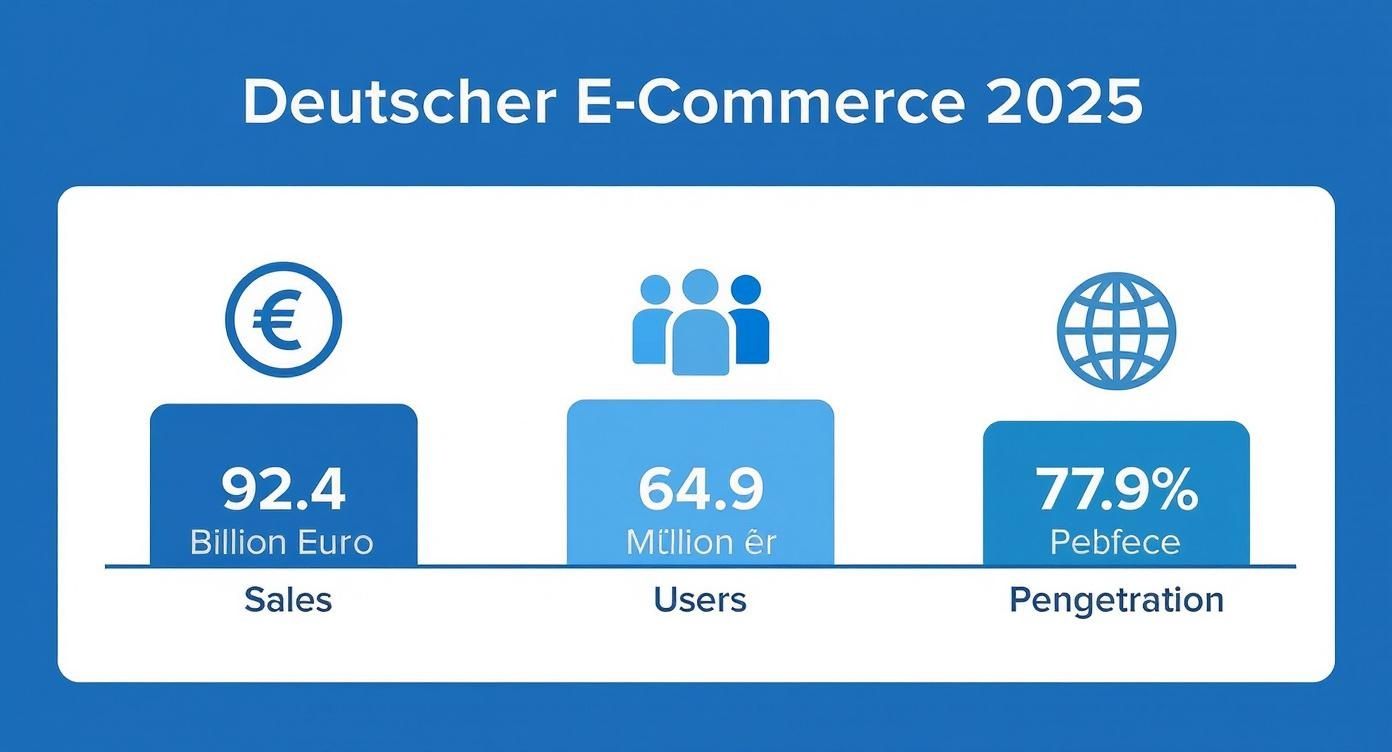
The numbers speak for themselves: Expected sales of over 92 billion euros High user penetration also means intense competition. Here, technical advantages can tip the scales.
Stand out from the crowd with structured data
Structured data, mostly via Schema.org Once implemented, they act like a simultaneous translator for search engines. They feed the crawler with crystal-clear information: This is a product, it costs amount X, has so many reviews, and is in stock.
What's in it for you? The highly sought-after rich snippets in Google search results. These are the star ratings, price information, or the small green "In Stock" indicators directly below the link. Shops that use these rich snippets immediately catch the eye and often achieve a significantly higher click-through rate (CTR) – even if they don't rank in first place.
A product without schema markup is like a book without a table of contents to Google. The search engine will find its way around somehow, but structured data provides it with a clear outline. The result is a better and much more eye-catching presentation of your products.
Intelligent internal linking as a guide
Internal links are the lifeblood of your online store. They distribute link authority (often called "link juice") from strong pages, such as your homepage, to important category and product pages. At the same time, they guide your visitors logically and intuitively through your product range.
Please avoid generic anchor text like "Click here." Instead, always link using relevant keywords from the context. For example, in a short guide on your "Running Shoes" category page, you could naturally link to your "Waterproof Trail Running Shoes." This strengthens the thematic relevance of both pages and helps users find exactly what they're looking for more quickly.
Remove duplicate content using filters
A true classic among e-commerce problems: filter and sort functions. Every combination of color, size, and brand generates a new, indexable URL. The result? Thousands of pages with almost identical content. A nightmare for your crawl budget and an invitation to duplicate content penalties.
The solution to this chaos lies in the clever use of canonical tags and the robots.txt-File.
- Canonical Tags: For each filtered URL, set a canonical tag pointing back to the original category page without the filter. This tells Google: "Hey, this is the original; the others are just variations and you can ignore them."„
robots.txt: For very complex filter structures, you can completely prevent the crawling of specific URL parameters via therobots.txtBlock them. This way, Google doesn't waste its crawl budget on unimportant page variations, but concentrates on your revenue-relevant pages.
A solid technical foundation isn't a one-off project, but an ongoing process. However, the effort pays off. In the long run, it secures better rankings, more qualified traffic, and ultimately, higher revenue. It's the stable base upon which your entire e-commerce success is built.
Product and category pages that actually sell
Your product and category pages are the heart of your shop. This is where it's decided whether a visitor becomes a customer. Therefore, forget generic, uninspired content. To be truly successful, these pages must do two things: impress search engines and emotionally engage customers.
The real challenge lies in bridging the gap between pure information and genuine storytelling. A strong product page doesn't just answer questions, it awakens desires.
More than just product descriptions
The most common mistake I see in practice is simply copying the manufacturer's specifications. This is not only pure poison for your SEO (keyword: duplicate content), but also incredibly boring for your customers. Your task is to transform dry facts into tangible benefits.
So instead of writing "Material: 100% % Merino wool," tell a story: "Feel the incredible softness of pure Merino wool against your skin. Breathable in summer, cozy and warm in winter – this sweater will be your new year-round favorite, never itchy or losing its shape." Do you see the difference? This creates an emotional connection and instantly sets you apart from the competition.
- Speak the language of your customers: Use the words that your target audience understands and feels.
- Focus on the benefits: Don't explain, What the product is, but what it does for the customer.
- Structure with bullet points: Highlight the key benefits. Perfect for anyone who scans quickly.
The power of visual persuasion
People buy with their eyes – that's not a cliché, it's a fact. High-quality, crystal-clear product images are therefore not a "nice-to-have," but absolutely essential. Show your product from all angles, zoom in on details, and, most importantly, show it in action (lifestyle images).
Product videos are the icing on the cake. A short video explaining the function or showing a garment in action can noticeably boost the conversion rate. It reduces uncertainty and gives the customer the feeling of almost holding the product in their hands.
Trust through genuine social proof
Nothing is more convincing than the honest opinions of other buyers. Customer reviews are an incredibly powerful tool for building trust and dispelling any lingering doubts. Place genuine reviews prominently on the product page.
The integration of authentic customer reviews This is a real lever for building trust and significantly increasing your website's sales figures. Don't shy away from showcasing constructive criticism – that's what truly makes you credible.
Customers trust other customers more than any advertising message. Genuine, unfiltered reviews are the strongest social proof you can integrate into your shop. They answer questions you might never even ask yourself.
Category pages as strategic guides
Don't just think of your category pages as simple product galleries. They are key guides within your shop and have enormous SEO potential. Instead of simply cramming the page with products, create real added value with short, concise how-to articles.
This content serves two purposes: It helps your users orient themselves and make decisions, and gives you the opportunity to place important long-tail keywords.
An example from the category page "Hiking Backpacks":
A short text at the top of the page could answer questions like: "What should I look for when buying a hiking backpack?", "What volume is suitable for which tour?", or "How do I find the right fit?". From there, you can then link directly to subcategories such as "Daypacks" or "Trekking Backpacks".
This tactic not only improves the user experience, but also massively expands your thematic authority on Google & Co.
Be aware: Concentration in German e-commerce is enormous. The top 1,000 online shops together generate around 80.4 billion euros. What's alarming is that the top 100 alone already 70,7 % to claim this revenue for themselves. This underscores the enormous market power of the major players. To survive in this cutthroat environment, smaller and medium-sized shops must stand out through excellent content and a perfect user experience.
By transforming your product and category pages from mere product lists into valuable sources of information and inspiration, you lay the foundation for longer dwell times, better rankings and – ultimately – more revenue.
Winning the battle for loading time and mobile users
In e-commerce, speed isn't a luxury, it's a hard currency. Every millisecond your page loads faster can mean the difference between a satisfied customer and a lost sale. Mobile users, in particular, have an extremely short fuse – studies consistently show that loading times exceeding three seconds result in a bounce rate of over [number missing]. 50 % can provoke.
These numbers don't lie. A comprehensive E-commerce optimization Anything without an almost fanatical focus on page speed and mobile usability is incomplete from the outset. It's about removing every obstacle and making the purchasing process as smooth as possible, regardless of the device the customer is using.
Immediate measures for faster loading times
Often, it's not the highly complex server configurations that make the biggest difference, but the fundamentals. Focus first on the "quick wins"—the measures that have an immediate impact and lay the foundation for everything else.
Three areas have proven to be absolute levers in my practice:
- Lossless image compression: Sure, you need high-resolution product images. But they shouldn't slow down loading times. Tools like TinyPNG or modern image formats like WebP reduce file size by up to... 70 %, And all this without any visible loss of quality. An absolute must.
- Intelligent browser caching: Tell your visitors' browsers to simply store static elements like logos, CSS files, or fonts locally. When the user returns, everything doesn't need to be reloaded. This dramatically improves the perceived speed.
- Minimize code: Every unnecessary line of code and every whitespace character in your CSS and JavaScript files wastes valuable time. Minification removes this excess, allowing the browser to process the files much faster.
Rethinking the mobile shopping experience
A mobile-optimized website is far more than just a scaled-down version of the desktop version. It requires a complete rethink of navigation, readability, and interaction. A positive mobile experience is a crucial pillar of any successful website. E-commerce optimization.
Imagine a customer who wants to quickly buy a T-shirt on the subway. They don't have time for tiny buttons or cumbersome two-finger zooming.
A first-class mobile shopping experience doesn't feel like work. It's intuitive, lightning-fast, and respects the user's limited attention span. Every click must be worthwhile and move the customer closer to their goal, not further away.
To achieve this, you should definitely pay attention to a few key points:
- Readable font sizes: Don't force your users to zoom. A font size of at least... 16px for running text has established itself as the gold standard.
- Generous clickable elements: Buttons and links need a decent touch surface (at least). 48×48 pixels), to avoid incorrect entries and frustration.
- One-thumb navigation: Position key elements such as the navigation and the "Add to Cart" button so that they are easily accessible with the thumb.
- Simplified checkout: Reduce form fields to the absolute minimum. Offer mobile payment options like Apple Pay or Google Pay to avoid the tedious entry of address and credit card details.
These adjustments aren't just a service for your customers; they also directly impact your ranking. Since the mobile-first indexing, Google primarily evaluates the mobile version of your website. A poor mobile experience therefore directly harms your visibility. How well your site performs in terms of usability and speed is largely determined by... Google Core Web Vitals measured – and these have become a key ranking factor.
Therefore, companies that consistently optimize loading times and mobile user experience not only gain satisfied customers, but also create a stable foundation for better rankings and sustainable growth.
5. Consistently optimize the checkout process
The shopping cart is the last hurdle before a successful sale – and unfortunately, also the point where most online shops unnecessarily lose a lot of revenue. A customer who adds products to their cart has already signaled a clear intention to buy. Losing them at this point through a cumbersome or opaque process is one of the most expensive mistakes in online retail. E-commerce optimization.

This is no longer about fundamental conviction, but solely about making the closing process as smooth and trustworthy as possible. Every click, every form field, and every piece of unclear information can be the deciding factor that causes the customer to abandon the purchase.
The most common reasons for termination and how to eliminate them
To effectively improve the checkout process, we need to understand the psychological stumbling blocks that cause customers to hesitate. The reasons for abandoned shopping carts are surprisingly consistent and can be specifically addressed.
- Unexpected costs: The number one conversion killer: If shipping costs or fees only appear on the last page, customers feel cheated and abandon their purchase. Be transparent from the start.
- Account requirement: Nobody wants to create a full user account for a one-time purchase. Always offer a guest checkout option.
- Complicated process: Too many steps, countless form fields, and unclear navigation lead to frustration. An ideal checkout is short, clear, and intuitive.
A clear progress indicator (e.g., "Step 1 of 3: Address") helps users orient themselves and motivates them to complete the process.
Radically reduce form fields
Every single field a customer has to fill out is a potential obstacle. For each field, ask yourself mercilessly: Is this information necessary to complete the order? now Is it really absolutely necessary? You can often omit the company name or a second phone number.
An optimized checkout is like an express checkout at the supermarket. It only asks for the essentials to get the customer to their goal quickly and efficiently. Every additional question is a delay that can lead to abandonment.
Utilize modern technologies like address autocomplete to minimize typos and speed up the process. A well-thought-out approach to the Optimize conversion rate, often begins with the radical simplification of the checkout form.
Building trust through seals and transparent communication
Especially with new customers, trust plays a crucial role. They enter sensitive data and need to feel secure. Place well-known trust seals (such as Trusted Shops) and payment provider logos prominently in the checkout process.
Trust-building elements in the checkout process:
- Security certificates: An SSL certificate is mandatory, but also display it (e.g. with a small padlock symbol).
- Transparent shipping information: Clear information about delivery times and costs directly in the shopping cart, not only at the end.
- Easy ways to contact us: A visible phone number or chat link indicates that a contact person is available in case of problems.
- Clear calls to action: Buttons with clear labels like "Pay securely now" are more effective than a vague "Continue".
These elements may seem small, but in total they significantly strengthen the customer's sense of security and lower the barrier to completing the purchase.
The psychology of payment options
The payment methods offered have a direct impact on the conversion rate. Not every customer wants to enter their credit card details online. Therefore, offer a mix of different options that are popular with your target audience.
In Germany, this typically includes:
- Purchase on account: Very popular, as customers only pay after receiving the goods.
- PayPal: Widely used and perceived as very safe and uncomplicated.
- Credit card: An international standard that should not be missing.
- Instant bank transfer/Giropay: Direct bank transfers for customers who do not use PayPal.
The variety of options reduces the likelihood that a customer will abandon a purchase because their preferred method is missing. This is a crucial point in the... E-commerce optimization, which is often underestimated. Consumer behavior in Germany shows how important a smooth process is. Approximately 46 % German consumers regularly shop online, with an average of 4.9 purchases per month. To fully realize this potential, the final step must be seamless. Learn more about the Current purchasing behavior and strategies in German e-commerce at magnalister.com.
By consistently viewing the checkout process from the customer's perspective and eliminating any potential friction, you will convert more shopping carts into actual orders and sustainably increase your sales.
Frequently asked questions about e-commerce optimization
When optimizing online shops, the same questions keep arising. Shop owners are looking for clear, actionable answers to overcome typical hurdles and keep their strategy on track. Here are practical solutions for the most common challenges I encounter in my work.
Which platform is best for SEO?
I hear this question all the time. The honest answer? There is no single perfect platform. Whether Shopify, Magento or WooCommerce for WordPress – they all come with a solid SEO basic setup.
The crucial point is not the platform itself, but how well it allows you to adjust the key settings. That's what really matters:
- Clean URLs: Can you create clear, meaningful URL structures for your products and categories?
- Title & Meta Descriptions: Can these important elements be easily customized for each individual page?
- Structured data: Is there an easy way to integrate Schema.org markup for products to get rich snippets in search results?
- Charging time: Does the system offer built-in tools for caching and code optimization, or do you have to solve everything using external tools?
Shopify often shines with its ease of use and is great for beginners. Magento, on the other hand, is a powerhouse that truly shines with huge, complex shops containing thousands of products. Your choice, therefore, depends entirely on your technical skills, the size of your product range, and, of course, your budget.
Is SEO even worthwhile for e-commerce?
A resounding yes! SEO is not an expense, but one of the best and most sustainable investments you can make for your online store. While paid advertising like Google Ads only brings visitors as long as your budget lasts, SEO builds a steady stream of organic, highly relevant traffic that stays with you.
Think of it this way: Paid advertising is like a rented apartment. As soon as you stop paying, you're out. SEO, on the other hand, is like building your own house. It takes time, it requires work, but in the end, it belongs to you, creating long-term value and security. Visitors who come via organic search also often have a higher purchase intent because they were actively searching for a solution and weren't "persuaded" by an ad.
SEO in e-commerce is not a sprint, but a marathon. One that can catapult you to the top of the competition. It's the most cost-effective method for achieving long-term visibility and building a brand that customers trust.
How quickly can I expect results from e-commerce optimization?
Patience is required here. Unlike pay-per-click campaigns, which deliver clicks almost instantly, a comprehensive approach requires... E-commerce optimization Simply put, it takes time for the changes to have their full effect. Google first needs to register, analyze, and evaluate the changes to your website.
- First signs (1-3 months): Minor technical corrections, targeted on-page optimization of your most important product pages, or a noticeable improvement in loading time can often send the first positive signals in the rankings after just a few weeks.
- Noticeable results (3-6 months): If you persevere, regularly create good content, build initial high-quality backlinks, and strategically improve your internal linking, you will often see significant jumps for important keywords during this period.
- Sustainable Authority (6-12+ months): To truly establish yourself at the top for highly competitive search terms and to be perceived as an authority in your niche, you need a strategic, continuous approach over many months.
It's important to have realistic expectations. SEO isn't a project with a fixed end date, but an ongoing process. Continuously analyzing and adapting your strategy is the key to lasting success in search results.
Do you want to ensure that your e-commerce optimization is built on a solid foundation and bears fruit sustainably? LinkITUp is your experienced partner. With over 15 years With our expertise and tailored strategies, we will increase your visibility on Google in a targeted and sustainable way. Find out now how we can bring your online shop to the top using proven methods – on https://seobuchen.com/.