




Imagine you ask someone for the best Italian restaurant in Kaiserslautern. What influences their answer? Probably the quality of the food, the service, the ambiance, and how often other people praise the restaurant. Google works on a very similar principle.
Google ranking factors are precisely these. criteria. It is the checklist that Google uses to decide which website is the best, most relevant, and most trustworthy answer to a search query like "best Italian restaurant Kaiserslautern".
What are Google ranking factors really?
Essentially, it's about convincing Google that Her This page is the best answer to a specific question. Forget the often-cited, rigid list of over 200 factors. This is more of an academic figure and not very helpful in everyday life.
A much better approach is to imagine a recipe. There isn't one single recipe. one The secret ingredient that secures a top ranking. It's the interplay of many small things that, in total, make all the difference. A perfect steak needs not only good meat, but also the right heat, perfect timing, and the right seasoning.
The four pillars of SEO success
To maintain an overview and focus on making targeted adjustments, it has proven effective to categorize the countless factors into four main areas. I call them the four pillars of SEO success. This model helps you prioritize – whether you run a local business or an online shop.
- Technology: This is the foundation of your house. Is your site fast, mobile-friendly, and can Google easily "read" it?
- Contents: This is the facility. Do you offer valuable, unique information that truly answers your visitors' questions?
- Authority: This is your reputation in the neighborhood. Do other reputable websites recommend you through links (backlinks)?
- User experience: These are the guests at your party. Do they stay long, have a good time, or leave after five minutes?
These four areas interlock like gears. The following infographic illustrates this interplay very well.
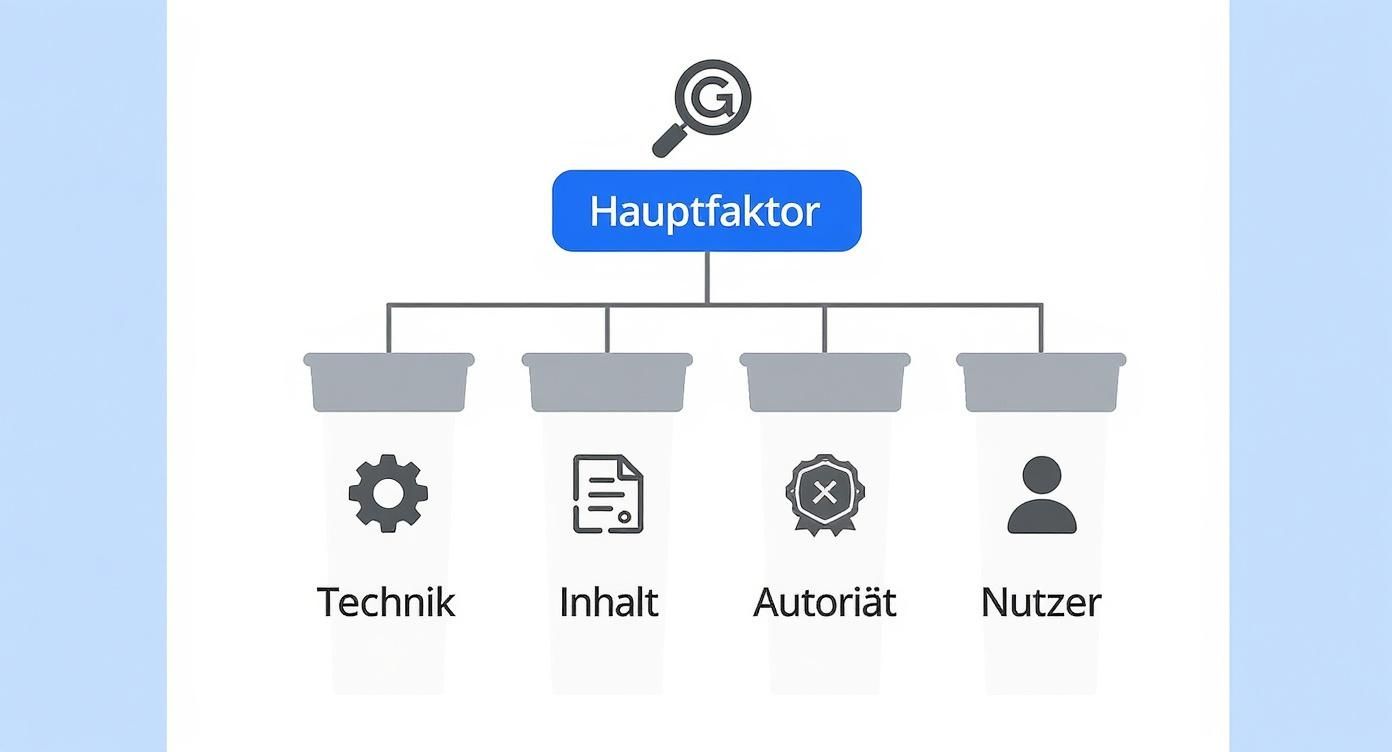
It's immediately clear: No area stands alone. Real and, above all, sustainable success on Google only arises when all four pillars are stable.
To make the whole thing more tangible, this table summarizes the four pillars and their tasks.
An overview of the four pillars of Google rankings
This table summarizes the most important categories of ranking factors and their central function for search engine optimization.
| Ranking pillar | Main goal | Examples |
|---|---|---|
| Technology | Provide a fast, secure website that is easy for Google to read. | Loading time, mobile friendliness, SSL encryption, clean URL structure |
| Contents | Perfectly meet the user's search intent and provide comprehensive answers. | Keyword research, high-quality texts, images, videos, clear page structure |
| authority | Building trust and reputation on the internet to be considered an expert. | High-quality backlinks from relevant websites, positive mentions |
| User experience | Keep visitors on the page and engaged for as long as possible. | Intuitive navigation, low bounce rate, high dwell time, click-through rate (CTR) |
This overview shows how the individual parts work together to send a strong signal to Google.
A common mistake I see all the time: Someone frantically optimizes their text with keywords (content pillar), but the website loads agonizingly slowly (technical pillar). That simply won't work. Google always evaluates the entire package.
That's precisely why we'll examine each of these pillars individually and in detail in the following sections. I'll show you exactly what you can do to improve in each area and boost your visibility on Google step by step. Let's start with the technical foundation – because without a stable foundation, the whole house wobbles.
Laying the technical foundation for top rankings
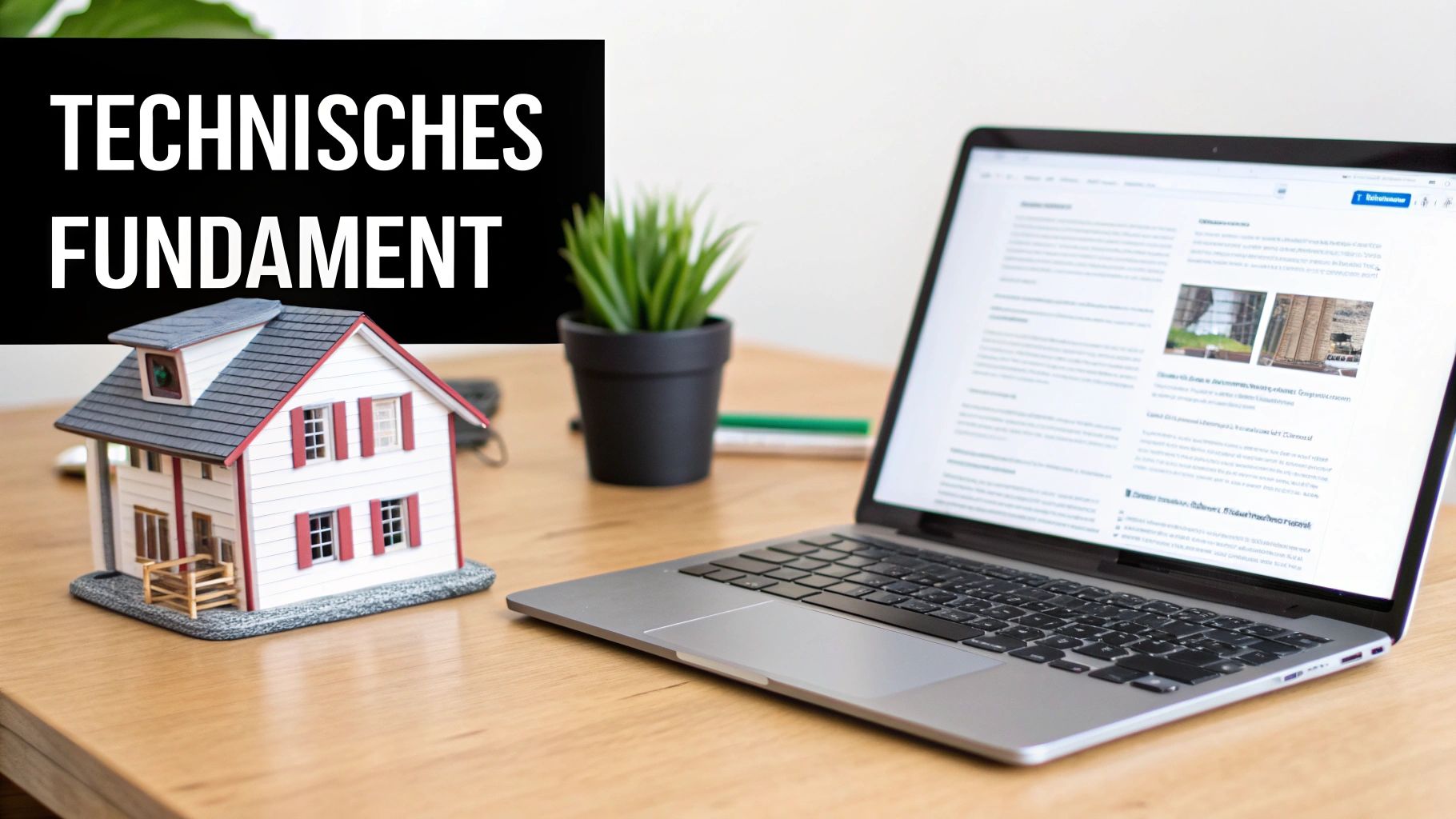
Imagine your website like a house. You can have the most stylish furniture (your content) and throw the best parties (your marketing) – but if the foundation has cracks, all the effort is for nothing. It's exactly the same with technical search engine optimization. Even before Google reads a single line of your text, it checks the technical health of your site.
A solid technical foundation is absolutely essential. It ensures that Google can find, understand (or, in technical terms, crawl) your content and include it in its massive index. Without this solid foundation, you're fighting a losing battle for top rankings from the very beginning.
Core Web Vitals: How Google measures user experience
Google wants to deliver not only relevant results to its users, but also a pleasant browsing experience. Slow, choppy, or unstable websites are, of course, a nuisance. It is precisely for this reason that the Core Web Vitals They were introduced and are now a tangible ranking factor.
These metrics translate dry technical data into a feeling that every user knows: Is the site "fast" or "frustratingly slow"?
- Largest Contentful Paint (LCP): This is essentially the perceived loading time. It measures how long it takes for the largest visible element – usually an image or a large block of text – to appear on the screen. A good value is below 2.5 seconds.
- First Input Delay (FID): This is about responsiveness. How quickly does your site react when a user clicks for the first time, for example, on a button? All of this is covered below. 100 milliseconds is great.
- Cumulative Layout Shift (CLS): Measures visual stability. You know that feeling when you're about to click a link and everything shifts at the last moment? A low CLS value (below 1000) 0,1) prevents exactly that and ensures a stable layout.
These metrics are therefore not abstract numbers, but directly reflect your visitors' satisfaction. Poor scores lead to high bounce rates and clearly signal to Google: This page does not offer a good user experience. If you would like to delve deeper into this topic, you can find detailed information about Google Core Web Vitals in our article.
Mobile First – Your smartphone is now in charge.
The rules of the game have fundamentally changed. Previously, Google primarily evaluated the desktop version of a page. Those days are over. Today, the principle of [missing information] applies without exception. Mobile-first indexing.
In concrete terms, this means that Google first looks at the mobile version of your website to understand its content and rank it accordingly. If your site is cluttered, slow, or difficult to use on a smartphone, Google penalizes this directly with lower rankings – even in desktop search! With over 70 % Mobile search queries in Germany quickly make it clear how crucial perfect mobile optimization is today.
An analysis from 2024 backs this up with figures: Websites that load in under 2 seconds generate up to 58 % More organic traffic than pages that take over 4 seconds to load. More details about These and other ranking statistics can be found here at Optimerch..
Security and structure as a sign of trust
Two other technical aspects are essential for Google to assess trust in your website: a secure connection and a logical structure.
HTTPS encryption: SSL/TLS encryption (the small padlock symbol and the "https" in the address bar) is no longer optional, but mandatory. It protects the data exchanged between your visitors and your website. Google officially classifies pages without HTTPS as "not secure"—a clear negative signal for your ranking.
Logical page structure: A well-designed website architecture not only helps your visitors navigate your site, but also makes it much easier for Google crawlers to find all your subpages and understand the thematic hierarchy of your content. Clear URLs, logical internal linking, and a sitemap are the most important tools for this.
You can easily check your website's technical performance yourself. A great tool for this is the free Google PageSpeed Insights, which provides you with a detailed analysis.
The following image shows a typical Google PageSpeed Insights report.
The report not only shows you the overall performance for mobile devices and desktops, but also the specific values for the Core Web Vitals. Best of all, it also gives you actionable tips for improvement. Use these insights to uncover initial technical weaknesses and lay the foundation for better rankings.
Content that delights users and convinces Google

Once the technical foundation of your website is in place, it's time to get down to brass tacks. We'll focus on the area that goes beyond mere visibility and creates real added value: your content. Content is the heart of every good SEO strategy. It's the reason visitors come to your site in the first place – and why Google rewards you for it.
One thing must be clear: the old tricks of simply sprinkling keywords into a text are long gone. Today, the winner is the one who provides the best answer to a user's question. Google is constantly improving its understanding of the intent behind a search query and rewards precisely those pages that perfectly fulfill that intent.
First understand the search intent, then convince.
Behind every Google search lies a clear intention. Someone wants to know something, buy something, or navigate to a specific page. If your content misses this fundamental purpose, it will never rank well—no matter how optimized the rest of the site is.
Imagine it like in a restaurant: If a guest orders a steak, you can proudly serve him the best salad in town – he will still be dissatisfied.
We broadly distinguish between three types of search intentions:
- Informative: The user has a question and is looking for an answer. ("how do I tie a tie", "symptoms of vitamin D deficiency")
- Commercially: The user has a clear intention to buy. ("buy men's running shoes", "seo agency Kaiserslautern")
- Navigational: The user wants to go to a very specific website. ("facebook login", "seobooking")
Also in the year 2025 Content quality and relevance remain a key factor for Google in Germany. Data shows that substantial 70 % All search queries are informational in nature. This underscores how hungry users are for helpful, well-presented information. Websites that deliver exactly that achieve noticeably better click-through rates, especially if they make it into the featured snippet. You can find out more at the Current SEO statistics from SE Ranking.
Your first step is always to look at the search results for your most important keyword. What's already ranking there? Are they long blog articles, concise product pages, videos, or perhaps local directories? Google's analysis already tells you what kind of content it considers the best answer for this query.
EEAT: The seal of approval for your content
To assess the quality of content, Google uses a concept called EEAT: Eexperience, Eexpertise (specialized knowledge), Aauthoritativeness and Ttrustworthiness.
EEAT isn't a switch you can simply flip. Think of it more as a framework Google uses to assess the credibility of your entire website. This is especially critical for topics involving people's money or health (also known as "Your Money or Your Life" or YMYL).
Ask yourself: When you're looking for investment advice, whom do you trust more? An anonymous blog or an article from a certified financial advisor with years of experience? Google is looking for exactly these signals of trust.
Here's how to strengthen your EEAT profile:
- Demonstrate experience: Share case studies and personal insights. If you're a tradesperson from Kaiserslautern, show pictures of your projects on site. Nothing is more convincing than real-world proof of your work.
- Demonstrate your expertise: Provide in-depth, thoroughly researched content that goes beyond superficial knowledge. Cite reputable sources and support your claims with data.
- Build authority: Position yourself as the go-to resource in your niche. High-quality backlinks and mentions from other relevant sites are invaluable here.
- Build trust: Be transparent. A complete legal notice, a clear privacy policy, and genuine customer reviews are not optional, but mandatory.
From keyword research to the perfect structure
Excellent content invariably begins with solid keyword research. It's about finding the exact words and phrases that your target audience types into Google every day.
A thorough keyword analysis not only helps you find the right topics but also deciphers the underlying search intent. It forms the foundation of your entire content strategy. For a deeper understanding of the process, we recommend our Comprehensive guide to keyword research to the heart.
Once the keywords are chosen, structure becomes crucial. A disorganized text without a clear narrative will neither be read by people nor ranked well by Google.
Proven methods for a clear content structure:
- A strong H1 heading: It must contain the main keyword and immediately pique the reader's interest.
- Logical structure: Use H2 and H3 headings to divide your text into easily digestible sections. This is a boon for readability.
- Short paragraphs: Keep paragraphs short, ideally only one to three sentences. This makes reading easier, especially on a smartphone.
- Visual break: Nobody likes walls of text. Include images, videos, infographics, or lists to hold attention and make complex information more accessible.
- Targeted highlights: Set Greases Use this to highlight the most important terms and key messages. This makes your text easily scannable for readers in a hurry.
If you follow these principles, you'll create content that's not only optimized for search engines, but above all, offers real added value to your readers. And that's precisely the most sustainable way to reach the top of Google – and stay there.
How backlinks shape your digital reputation and thus your ranking
Now that we've optimized the content, we come to the third pillar for sustainable SEO success: authority. Imagine the internet as a huge, bustling city. Every website is a shop. So how do visitors know which shop they can trust? Quite simply: they pay attention to which well-known and reputable businesses are recommended.
That's exactly what backlinks are. Every single link from another website to yours is one. Recommendation. For Google, these recommendations are one of the strongest. Google ranking factors Ultimately, it's about assessing the credibility and authority of your site. A solid backlink profile is therefore nothing other than your digital reputation.
Quality over quantity – the immutable law.
The most persistent myth in link building is that sheer quantity of links is what counts. Those days are definitely over. Today, without exception, the quality and relevance of the page linking to you is the only thing that truly matters.
A single link from a respected trade magazine in your industry is infinitely more valuable to Google than a hundred links from low-quality, completely irrelevant websites. It's just like in real life: A recommendation from an industry expert carries more weight than the fleeting praise of a hundred random passersby on the street.
What makes a high-quality backlink? It's primarily these criteria:
- Thematic relevance: The link comes from a page whose topic matches yours or complements it meaningfully. A link from a food blog to your Italian restaurant in Kaiserslautern? Perfect.
- Domain authority: The page linking to you enjoys a high reputation with Google. It already has a strong link profile and is known for its excellent content.
- Link placement: A link that appears naturally within the body text of an article is much more powerful than one that is hidden somewhere in the footer or in an endless list of links.
The importance of strong recommendations cannot be overstated. Data from 2025 paints a clear picture: 66 % Websites in the German market have no backlinks at all. In contrast, pages with strong, trustworthy backlinks achieve a higher ranking. 3.5 times higher visibility in the search results. If you want to delve deeper into the numbers, you will find more. Current insights into SEO statistics at SEO.com.
Sustainable strategies for a strong link profile
Okay, but how do you get these valuable recommendations? The key is to "earn" these links, rather than trying to trick the system. It's about creating something so good that other people can't help but link to it.
One of the most effective methods for this is the creation of so-called Link Assets. These are content items on your website that are so outstanding that they offer real added value to others – whether because they solve a problem, represent a comprehensive resource, or provide unique data. Think, for example:
- Comprehensive instructions and detailed guides
- Useful online tools such as calculators or configurators
- Original studies or surveys with fresh data from your niche
- Visually appealing and easy-to-understand infographics
Such content often attracts links all by itself. For example, if you create a detailed infographic about the most beautiful hiking trails around Kaiserslautern, there's a high probability that local tourism blogs or hiking clubs will link to it themselves.
The best way to get links is not to think about links. Focus on creating the best content on a topic on the entire internet. The links will then follow naturally.
In addition, you can, of course, actively and ethically strengthen your authority. Guest posts on relevant blogs, collaborations with other local businesses, or interviews are fantastic ways to demonstrate your expertise and simultaneously gain valuable links. For a more in-depth look at how to approach this strategically, see our guide on the topic. Build backlinks and increase your authority.
The dark side of link building: Please avoid it!
Where effective strategies exist, shortcuts also lurk that sound tempting but are extremely dangerous. So-called Black-hat techniques They attempt to blatantly manipulate the Google algorithm. This includes practices such as buying links, participating in organized link exchange networks, or indiscriminately posting links in forums and comments.
Be warned: Google is getting better and better at recognizing such unnatural patterns. The result is often a manual penalty that can cause your rankings to plummet overnight. Getting rid of such a penalty is an extremely tedious and lengthy process. Therefore, focus on clean and sustainable methods from the very beginning. This is how you build your authority in the long term and, above all, securely.
Local SEO: How to become unmissable locally

For businesses that greet their customers personally, a completely different set of rules applies online. A tradesperson in Kaiserslautern, a café in Berlin, or a law firm in Hamburg – they aren't competing with the entire world, but rather for the attention of people right on their doorstep.
Google is aware of this, of course. Search queries like "hairdresser near me" or "Italian restaurant Kaiserslautern" are therefore evaluated completely differently. Specific local factors are what count here. Google Ranking Factors. It's less about who has the biggest website, but rather who is most relevant, well-known, and simply closest locally. Their goal must therefore be to clearly signal to Google: "For this search in this city, I am the best answer."„
Your digital storefront: The Google Business Profile
The core of every local SEO strategy is and remains the Google Business Profile (formerly known as Google My Business). Think of it as your digital storefront, appearing directly in Google Search and on Google Maps. For many potential customers, this is their very first point of contact with you – often even before they've seen your actual website.
A completely filled-out and actively maintained profile is your ticket into the so-called „"Local Pack"“. This is that unmissable box with three local results and a map that consistently ranks at the top of most local searches. Landing here means you've practically won the battle for local attention.
An incomplete or outdated Google Business Profile is like a dirty, unlit shop window on a busy shopping street. People simply walk past it without a second glance.
Optimizing your profile is by far the most important lever for achieving local rankings on Google. Go through these points meticulously:
- Completeness is key: Please fill in every single field. From the exact business category and opening hours to special features such as "Wi-Fi available" or "barrier-free access".
- Show what you've got: Upload high-quality, up-to-date photos and videos. Images of your team, your premises, or your work instantly build trust and spark interest.
- Signaling activity: Use the post feature to share news, special offers, or events. This shows Google that your business is active and relevant.
Building trust through consistency and reviews
Two of the most effective factors in local ranking are absolute consistency in your company data and a steady flow of positive customer feedback.
NAP consistency: NAP stands for Nname, Adress, PYour business name, address, and phone number must be exactly the same on your website, in your Google profile, and in all major online business directories (such as Yellow Pages, Yelp, etc.). Any slight discrepancy—whether it's "Straße" instead of "Str." or a different spelling of the name—confuses Google and weakens your local trust signal.
Customer reviews: Reviews are the word-of-mouth marketing of the digital age. For Google, they are an extremely strong indicator that your business exists, is valued, and trustworthy. The number of reviews, the average rating, and the regularity with which new reviews arrive all play a role. Actively encourage satisfied customers to leave a review and—crucially—respond professionally to all feedback, whether positive or critical. This demonstrates to both customers and Google that you take the dialogue seriously.
Setting local signals on your own website
Finally, your website must clearly communicate your location. This can be achieved by naturally incorporating local keywords into your text.
A painting company from Kaiserslautern shouldn't just write generally about "painting work." Dedicated subpages for "painting work in Kaiserslautern" or "facade painting Kaiserslautern" are much better. Mention specific districts or surrounding towns to further clarify your geographic reach.
Embed a Google Maps map showing your location and ensure your address and phone number are clearly visible in the footer of every page. These on-page signals create the crucial link between your website and your physical location. This completes the picture for Google and establishes you as an undeniable local authority.
Your roadmap to better Google rankings
You've now learned about the key factors for achieving good Google rankings – from a solid technical foundation and strong content to building genuine authority. But all this theory is useless if you don't put it into practice. So don't think of this section as a simple summary, but rather as your concrete roadmap to success.
SEO is a marathon, not a sprint. The key is to prioritize your efforts wisely and stay consistent. Don't try to tackle everything at once, or you'll quickly lose focus.
The prioritized checklist for your success
First, pour the technical foundation: Before you write a single line of new text or even think about links, the foundation must be solid. Check the Core Web Vitals, ensure your site functions perfectly on mobile devices, and that it's secured with HTTPS. Tools like... Google PageSpeed Insights We will give you a first, quick diagnosis here.
Then create content with real added value: Once the technical aspects are running smoothly, your full attention should be on the content. Find out what your target audience is really looking for and answer those questions better than anyone else. This is how you gradually build a reputation as a trusted source (keyword: EEAT).
Simultaneously build authority: Simultaneously with content creation, you can begin to signal your authority to the outside world. Cultivate your Google Business Profile Meticulousness is invaluable, especially for a local business in Kaiserslautern. Also, try to acquire some thematically relevant backlinks from other important websites.
Always remember: Every single step you take today is an investment in your visibility tomorrow. Start with point one and work your way through the list systematically.
This plan provides you with the necessary structure to take control and achieve sustainable, visible results.
Practical questions: What you always wanted to know about Google rankings
In my daily work with SEO, I encounter the same questions again and again. Understandably so, as the topic is complex and constantly evolving. That's why I've summarized the most common points of confusion for you here – without any technical jargon.
SEO is a marathon: How long do I have to wait for results?
Probably the most frequent question I hear. And the honest answer is: SEO isn't like flipping a light switch. It's more like planting a garden. You sow seeds, tend to them, and you have to be patient.
We often see the first positive signs, i.e., small upward jumps, after three to six months. This, of course, depends heavily on how fierce the competition is in your niche and the initial state of your website. For truly stable top positions that also generate sustainable traffic, you should rather focus on... six to twelve months Don't do the math. Google needs to build trust in your site first – and that simply takes time.
Which ranking factor is king?
This question is tempting, but it leads in the wrong direction. There is no single right answer. a The decisive factor. Imagine a car: What's more important – the engine, the tires, or the brakes? You see, the question is pointless. For a safe and fast drive, you need everything.
That's exactly how modern search engine optimization works. It's the interplay of the major pillars that makes the difference:
- Relevant, top-notch content: Your content must perfectly answer the question behind the search query.
- Strong backlinks: These are recommendations from other websites that signal your authority to Google.
- A top user experience: A fast, easy-to-use website is no longer a bonus, but a basic requirement.
So instead of chasing after the one holy grail, you should focus on doing a rock-solid job in all core areas.
DIY or outsource: SEO for my business?
This is purely a question of resources and depends on three things: your time, your budget, and your know-how.
Self-directed SEO This is a good option if your budget is tight and you're willing to delve deeply into the subject. There's a ton of good, free information available. But be warned: the learning curve is steep and requires a lot of discipline and patience.
One SEO agency Bringing them on board is the right approach if you want to focus on your core business and see professional results quickly. A good team brings not only years of experience and proven strategies, but also access to expensive tools that are often not cost-effective for a single company to purchase.
Is AI reshuffling the ranking factors?
Absolutely. AI is already fundamentally changing Google Search. Google has long used systems like RankBrain to understand search queries much better. Future concepts like the "Search Generative Experience" (SGE) will personalize results even further and deliver answers directly within the search results.
This isn't the end of SEO, but rather its evolution. Concepts like EEAT (Experience, Expertise, Authority, Trust) are becoming even more important. Content created by true experts and offering unique insights will always stand out from mass-produced content—regardless of whether it's created by humans or machines. Their task remains the same: to provide the best and most helpful answer for the searcher.
Do you want to ensure your website is optimally positioned for the important ranking factors and finally gets the visibility it deserves on Google? The team at LinkITUp is available to you with over 15 years of practical experience and tailored strategies to support you. Learn more about our SEO services now and let's get started together.