


If you want to be found more easily on Google Maps, there's no way around a perfectly maintained website. Google Business Profile (GBP) That's it. Think of it as your digital calling card: the more complete and accurate it is, the more trust Google and your potential customers will place in you.
A perfect Google business profile as the foundation for your local success
Every good local SEO strategy starts here. Your Google business profile is usually the first point of contact for customers in the area and the most important data source for Google to understand your business. A complete and accurate profile is therefore a strong signal of relevance and trustworthiness.
The importance of this digital storefront can hardly be overstated. In Germany, around 86 % of the people Google Maps, to find out about local businesses. A local search query like „Window cleaning services near you“This shows how important accurate data entry is. Studies show that between 46 % and 52 % of all Google searches Having a local connection is a huge opportunity for every local business.
An incomplete or even contradictory profile, on the other hand, only creates confusion, both for Google and your customers. This severely damages your ranking.
More than just name and address
Many business owners make the mistake of only entering the absolute basics: name, address, and phone number (NAP). A truly optimized profile can offer so much more. Remember: every single field in your profile is an opportunity to tell Google more about your business and stand out from the competition.
A well-maintained Google business profile isn't a project you create once and then forget about. It's an ongoing process. It shows Google that your business is active, relevant, and customer-focused – precisely the three pillars needed for a high ranking in local search.
The optimization lies in the details. From the company description to your specific services and the exact opening hours, everything should be correct and always up-to-date.
Choosing the right categories
Choosing the right categories is one of the most important levers. It tells Google exactly what kind of business you run. Always choose the most precise option available as your main category. An Italian restaurant, for example, should choose "Italian Restaurant" and not just the generic "Restaurant".
In addition to the main category, you can and should use subcategories. This will allow you to cover the full range of your offerings. For example, a restaurant could add "Pizzeria," "Delivery Service," or "Bar" if applicable. This will make you visible to many more search queries.
This makes NAP data more consistent
The consistency of your NAP data (Name, Address, Phone) Across the entire internet, consistency is a fundamental trust factor for Google. Inconsistencies – such as different spellings of your company name or an old phone number in a business directory – immediately undermine this trust.
The optimization process can be neatly divided into three core areas: First, complete the profile, then strategically select the categories, and finally ensure absolutely consistent NAP data.
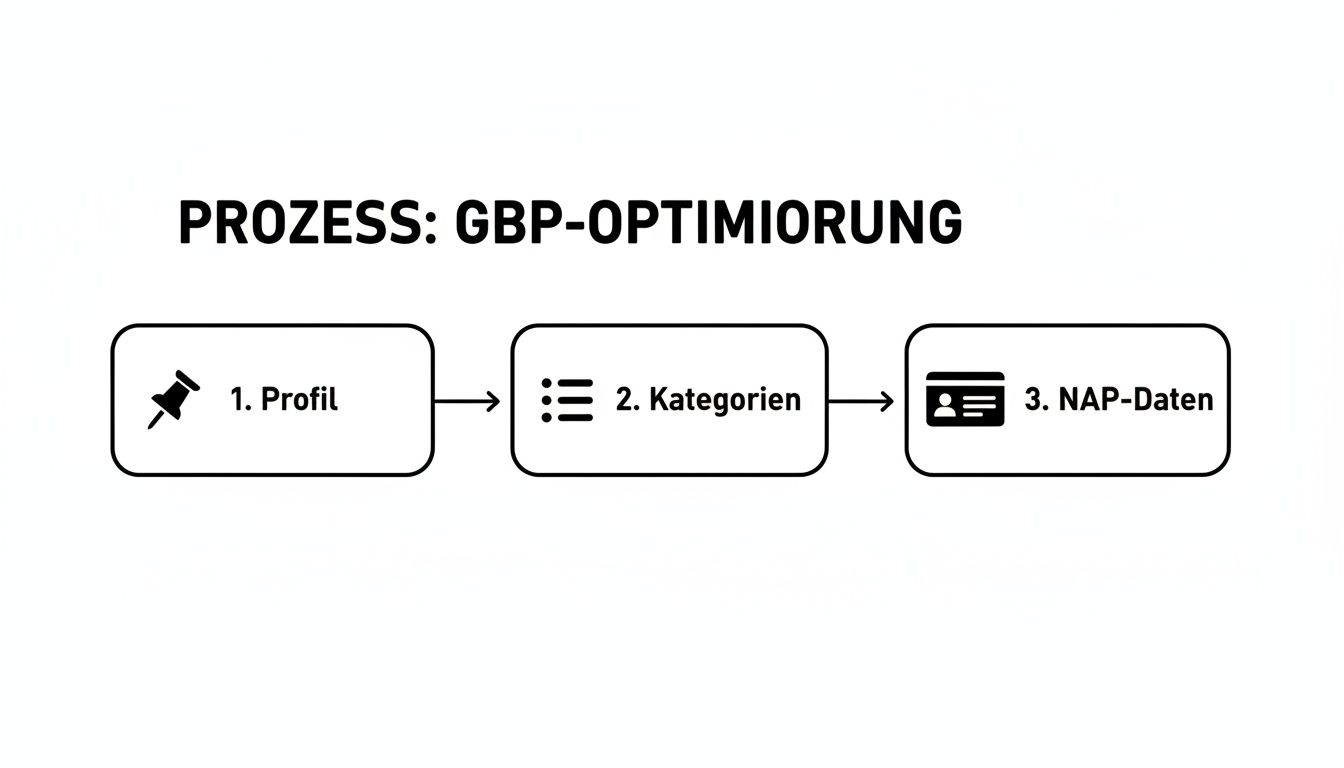
Each of these steps builds on the previous one, thus creating a stable foundation for all further SEO measures.
To ensure you get everything right from the start, we've prepared a detailed guide for you. Here you'll learn how to create a step-by-step guide. Create an entry on Google Maps and avoid the typical beginner mistakes. A clean start is half the battle for a better ranking.
Before we continue, here's a quick overview of the most important factors that directly influence your ranking.
An overview of the most important ranking factors in Google Maps
This table summarizes the key factors that influence your ranking in Google Maps and explains their importance for your local visibility.
| Ranking factor | Importance for Google Maps |
|---|---|
| GBP completeness | A fully completed profile provides Google with all the necessary information. |
| Primary business category | The most important factor in telling Google what your core business is. |
| Keywords in the company name | It can give a strong ranking boost, but only if it's natural. |
| Proximity to the seeker | The distance between the company and the user's location is crucial. |
| Quality & Number of Reviews | Many positive reviews signal trust and popularity. |
| Consistent NAP data | Consistent company data across the web builds trust with Google. |
| Local backlinks | Links from other local websites strengthen your regional authority. |
These factors form the foundation of your local SEO. If you have these points under control, you're already a huge step ahead of most of your competitors.
How customer reviews can boost your ranking and trust
Customer reviews are much more than just a few stars next to your company name. In the world of local marketing, they are pure gold and a crucial lever when it comes to your business. Improve your Google Maps ranking want. Every single review is a direct signal to Google and tells potential customers a story about your company.
People often trust the experiences of others more than even the cleverest advertising message – this is called social proof. Google is well aware of this and rewards companies that regularly collect positive feedback with better visibility. It's not just the average star rating that counts, but also the total number of reviews, their recency, and how consistently new reviews are received.
Strategies to actively get more reviews
The easiest way to get more reviews? Ask for them. It sounds simple, but many satisfied customers simply don't think to write a review on their own. The key is to make it as easy as possible for them.
A direct link to your Google review form is the best tool for this. You can cleverly place this link in various locations to ensure a steady flow of fresh feedback.
Here are a few tried and tested methods for spreading the link:
- QR code directly in the store: Place a QR code that leads directly to the review form in a clearly visible location at the checkout, on tables, or in the waiting area. A customer who has just had a great experience is most likely to leave you a few kind words at that moment.
- Follow-up emails: After a purchase or service, send a friendly email requesting feedback. A personal touch and emphasizing how valuable their opinion is to you will work wonders.
- On invoices or business cards: A small note with a QR code or short link on your business documents is a subtle but effective reminder.
An important tip from practical experience: Google strictly forbids paying rewards for reviews or selectively asking only satisfied customers for reviews. The process must be authentic. Simply ask for honest feedback – this is allowed and works best.
The sheer number of reviews, by the way, has a massive influence. A study has shown that companies with at least 50 reviews On average, they appear significantly more often in the local "Map Pack". Profiles with fewer than 10 reviews had an estimated [missing information - likely a percentage]. 40–60 % Profiles with over 50 reviews have a lower chance of achieving a top ranking. Those who want to delve deeper into the data will find interesting information here. Insights into Google Maps ranking.
The art of responding to each individual review
Collecting reviews is only half the battle. Responding to them is at least as important. Every response you give is a public demonstration of your customer service. You're signaling not only to the reviewer, but to all potential customers reading along, that you take feedback seriously.
When it comes to positive reviews, it's simple: thank the reviewer personally and perhaps mention a small detail from the review. This shows that you actually read the review and didn't just use generic, pre-written text.
A 5-star rating without text is good. A detailed, positive review to which you personally respond is pure gold for your business. Google Maps Ranking.
Handling negative feedback with confidence
Don't worry, negative reviews happen to everyone and aren't the end of the world. Instead, see them as an opportunity to showcase your professionalism and problem-solving skills. A quick, thoughtful, and public response can not only appease the dissatisfied customer but also demonstrate to everyone else that you're there to help when problems arise.
This simple scheme will help you overcome any critical voice:
- Keep calm and be professional: Never answer impulsively. A rational response requires a cool head.
- Thanks for the feedback: Show appreciation for someone taking the time – even if the words hurt. This signals openness.
- Understanding and apology: Even if you consider the criticism unjustified, apologize for the negative experience The customer. That immediately takes the wind out of their sails.
- Offer a solution in the background: Move the discussion out of the public sphere. Ask the customer to contact you directly by email or phone to find a solution.
- No public justifications: Under no circumstances should you start discussing details or assigning blame. This will appear unprofessional and only prolong the matter unnecessarily.
A well-handled negative review can ultimately build more trust than a dozen unanswered positive reviews. It proves that there are real people behind your business who care about their customers.
Stand out from the crowd with visual content
In today's visual world of local search, first impressions often matter. A Google business profile without appealing images is like a shop window without any display – people simply walk right past it without noticing.
High-quality photos and videos are therefore no longer just a nice extra. They are a key lever for your To improve Google Maps ranking and hit the bullseye with potential customers. Images tell your company's story long before anyone reads a single line of text.
Imagine the situation from the customer's perspective: Someone searching for a "cozy café nearby" is much more likely to be convinced by pictures of inviting seating areas and steaming coffee than by a purely textual description. Google knows this perfectly well and rewards profiles that score points with rich visual content with better visibility. The numbers speak for themselves: Listings with photos receive significantly more clicks and requests for directions as profiles without pictures.

Choosing the right image for maximum impact
But beware: not every image is equally suitable. To truly stand out from the crowd, you need a well-thought-out mix of different photo types that together paint an authentic and complete picture of your business.
- Exterior shots: Showcase your business in the best possible light. A well-lit photo of the entrance in daylight will help customers find you immediately.
- Interior shots: Give a taste of the atmosphere. Whether it's the modern furnishings of a law firm or the warm ambiance of a restaurant – these images create a direct connection.
- Team photos: Introduce the people behind the company. Real, engaging photos of your team build trust and give your brand a face. Stay away from stiff stock photos!
- Products & services in action: Don't just photograph the finished product, show it in use. A craftsman at work or a chef plating a dish is far more captivating.
Hiring a professional photographer is an investment that often pays off. But high-quality smartphone photos can also work wonders. The most important things are good lighting, clear focus, and an interesting perspective. Authenticity almost always trumps clinical perfection.
Technical optimization: fine-tuning for your images
Before you upload your images, you can use a few simple tricks to help Google understand and categorize them even better. These are small but significant signals that noticeably boost your local ranking. A crucial part of this is the technical preparation of the files. To delve deeper into this, we recommend reading our guide on... Image SEO optimization.
A very simple trick: Name your image files meaningfully before uploading them. Instead of IMG_1234.jpg is hairdresser-kaiserslautern-ladies' haircut.jpg Much better. This gives Google a direct indication of the image content and strengthens local relevance.
Additionally, you can customize your photos Geotags Add location data. This is location data that is stored in the image file and tells Google exactly where the photo was taken. Many cameras and smartphones do this automatically nowadays, but there are also tools to add this information afterwards.
Google posts as a sign of a vibrant company
Google Posts – often simply called Google Posts – function like a mini-blog directly within your business profile. They are a fantastic tool for promoting current offers, news, or events, while simultaneously signaling to Google: This business is active and engaged!
Every single post sends a positive signal. Google considers profiles that publish regularly to be more relevant and up-to-date, which can directly impact their ranking. Therefore, use this feature strategically.
Ideas for effective Google Posts:
- Offers: Advertise a discount with a clear call to action.
- Events: Announce a workshop, webinar, or open day.
- News: Inform about new products, employees, or awards.
- Insights: Share a behind-the-scenes look or introduce a project.
A good post consists of an appealing image, a short, snappy text (approx. 100-300 words), and a clear call to action such as "Call now" or "Learn more." Consistency is crucial – one post per week is a good guideline for consistently sending positive signals.
The untapped potential: videos
Videos are the undisputed king when it comes to engagement. A short 30-second tour Including a business listing, an interview with the owner, or a time-lapse video of a service can massively increase the amount of time users spend on your profile.
This interaction is a strong ranking signal for Google, as it shows that your profile is genuinely interesting to users. Upload short, authentic videos directly to your Google Business Profile. These don't have to be Hollywood productions – a well-made smartphone video is often perfectly sufficient to leave a lasting impression.
Use your website as fuel for Maps ranking
A top-optimized Google business profile is the launchpad, no doubt. But the real driving force for your Google Maps ranking? That almost always comes from your own website. Google sees your business as a single entity. What's on your website and how it's structured directly influences how prominently you appear in local search results and on the map. The two are inextricably linked.
Google uses your website as a kind of source of truth to verify and substantiate the information in your business profile. A professional website optimized for local search signals authority and relevance. This strengthens Google's trust in your business and almost always leads to a better ranking.
Structured Data: How to Talk Plainly with Google
Have you ever wondered how Google manages to display such precise information as opening hours, addresses, or ratings directly in the search results? The magic behind it is called... structured data, often also referred to as schema markup.
Think of them as invisible labels that you attach to the information on your website. You translate your content into a language that search engines understand at a glance. Instead of Google having to guess what a particular sequence of numbers is, you tell it directly: "This is our phone number." Or: "Attention, this is our exact address."„
For local businesses, this is „"Local Business" scheme Pure gold. With it you can clearly mark the following information:
- Your company name
- Exact address (street, postal code, city)
- Telephone number
- Opening hours
- Geographic coordinates (latitude and longitude)
By embedding this code snippet in the background of your website (e.g., in the header or footer), you create a rock-solid connection between your website and your Google business profile. This consistency is an extremely strong trust signal and a real lever to boost your How to improve Google Maps ranking.
Local keywords: Speak the language of your local customers.
To appear in local search results, your website must accurately reflect those search queries. Simply including your company name isn't enough. Weave local keywords naturally into your text, headings, and meta descriptions.
A practical example: A lawyer in Hamburg shouldn't just write "Traffic Law Attorney" on their website. A much smarter approach is to use a phrase like "Your experienced Lawyer for traffic law in Hamburg Altona“This targeted combination of service and location makes it immediately clear to Google which search queries your site is relevant for.”.
Integrate such terms at important points, such as:
- Page title (Title Tags)
- Headings (H1, H2)
- Running text on the start and performance pages
- Image descriptions (ALT text)
But be careful: Avoid keyword stuffing. The terms must feel natural and offer the reader genuine added value.
A small tip with a big impact: Create a "Contact" or "How to find us" page on your website. There, not only embed an interactive Google Map showing your location, but also list your complete NAP data (name, address, phone number) below it. This creates another, extremely strong connection.
Dedicated location pages for companies with multiple branches
For businesses with multiple locations – think of a bakery chain or a law firm with several offices – a single contact page is far from sufficient. Each branch competes for visibility in its own local environment. The best strategy for this is clearly dedicated [website/page name]. Location pages (also called Location Pages).
Each of these pages should function like a kind of mini-website for the respective branch and offer unique, location-specific content.
What matters when creating an optimized location page:
- Unique URL: For example
their-website.de/locations/berlin-mitte. This is clean and easily readable for Google. - Full NAP data: Name, address and telephone number specifically for this location.
- Specific opening hours: The exact opening hours of each branch are given, not general information.
- Embedded Google Map: A map that is centered exactly on this location.
- Local content: Introduce the local team, mention local specialties, or include customer testimonials from the immediate neighborhood.
- Photos of the location: Show authentic pictures of the exterior and interior. This builds trust.
- Local Schema Markup: Implement the "LocalBusiness" scheme for each individual site page.
Creating a dedicated, meticulously optimized page for each location sends clear signals to Google. It demonstrates that each of your branches is a relevant anchor point in its respective market. This can significantly improve the ranking of each individual branch in Google Maps.
Strengthen local authority through quotes and backlinks
To truly rank higher in Google Maps, simply maintaining your website and Google business profile isn't enough. Google wants to see that your business also plays a role in other important places online. Think of it like digital word-of-mouth: Every mention in the right place strengthens your local authority and signals to Google that your business is relevant and trustworthy.
Two absolute heavyweights in this game are local citations and backlinks. Although they are often mentioned in the same breath, they fulfill very different, but equally important, functions for your local SEO.
The subtle difference: Quotes vs. backlinks
A local quote This is essentially nothing more than an online listing of your company name, address, and phone number. We're talking about what are called [missing information]. NAP data (Name, Address, Phone). These mentions don't even have to be clickable links. Google systematically scours the web for this data to match it with your business profile. The more consistent references the search engine finds, the more convinced it is of the accuracy of your information and the legitimacy of your business.
A Backlink In contrast, a "real," clickable link is one that leads from another website to yours. While citations primarily confirm the existence and accuracy of your company's data, backlinks convey genuine trust and authority. Think of it this way: A link from a reputable local news site is like a personal recommendation from a key player in your city – and therefore has a significantly greater impact on your ranking.
NAP consistency: The be-all and end-all for local citations
If there is a golden rule for structuring quotations, it is this: absolute and meticulously precise consistency. Even the slightest discrepancy in your company data will raise doubts with Google. Therefore, always use the exact same spelling and formatting everywhere.
Even the smallest mistakes can cause damage:
- Incorrect: „Müller GmbH“ on one side, „Müller GmbH“ on the other.
- Incorrect: Once „Hauptstr. 1“ and then again „Hauptstraße 1“.
- Incorrect: The number „(0631) 12345“ alternating with „+49 631 12345“.
Such inconsistencies are poison for your local ranking. They confuse the algorithms and undermine trust in your profile. My tip: Take an honest inventory of your existing listings and systematically correct every error.
Start with the most important directories in Germany. A spotless listing in portals like "Das Örtliche", "Gelbe Seiten" or industry-specific sites (e.g. Jameda for doctors or Anwalt.de for lawyers) lays a rock-solid foundation of trust.
Targeted building of valuable local backlinks
While citation building is a meticulous task that prioritizes accuracy, link building requires a more strategic approach. It's not about quantity, but quality. A single strong, relevant link from a local source can be more valuable than dozens of links from irrelevant directories. See our comprehensive guide on the topic. Building backlinks Let's go into much more detail.
Here are a few tried-and-tested methods you can use to get started right away:
Local partnerships: Find allies! Cooperate with other local businesses that aren't direct competitors. For example, a florist could recommend a local wedding photographer on their website – and vice versa. This creates real added value for customers and generates highly relevant links.
Sponsorships & Events: Get involved in your local community. Support the local sports club, the next town festival, or a charitable cause. Sponsors are almost always mentioned by name and with a link on the organizer's website. This not only benefits SEO but also establishes a positive presence within the community.
Guest articles in local media: Position yourself as an expert. Offer a specialist article to the local newspaper or a regional blog. You can share valuable knowledge and in return receive a valuable link to your website in the author biography.
Memberships in associations: Become a member of the Chamber of Industry and Commerce (IHK), the Chamber of Skilled Crafts, or relevant industry associations. These organizations often list their members in public directories – naturally with a direct link to the company website.
By consistently maintaining your citations and strategically building local backlinks, you send Google unmistakable signals. You demonstrate that your business is an established, recognized, and important part of local life. And that is precisely one of the most powerful levers for sustainably improving your ranking in Google Maps.
Your most pressing questions about Google Maps ranking – answered briefly and concisely.
When it comes to getting to the top of Google Maps, the same questions always seem to come up. How long do I have to wait for results? What do I do if I get a bad review? And do I even need a physical storefront?
Here you'll find the answers, straight from practical experience. No dry theory, but clear guidance to help you have realistic expectations and make the right decisions to achieve your goals. How to improve Google Maps ranking.
How long will it take for my ranking to improve?
This is probably the most frequently asked question – and the answer has two parts. After you've spruced up your Google business profile, meaning all the information, categories, and photos are neatly entered, you often look for... two to four weeks First positive signs. Your profile may then appear more frequently for very specific searches.
But to truly compete at the top of the coveted "Map Pack," you need staying power. Real authority isn't built overnight. Gathering top ratings, building local citations, and securing strong backlinks—it's a marathon, not a sprint. Plan realistically. three to six months continuous work is needed to see truly significant and, above all, stable ranking improvements.
Will a negative review lower my ranking?
Not necessarily. A single bad review isn't the end of the world and will hardly affect your ranking as long as the overall picture is positive. Google knows that mistakes happen. A profile with only flawless 5-star reviews quickly appears untrustworthy to many users anyway.
The crucial point is not the criticism itself, but your reaction to it. Respond quickly and professionally, and demonstrate that you offer a solution. This proves to potential customers that you take feedback seriously and are there for them even when things go wrong. This often builds more trust than a flawless record.
Never let negative feedback go unanswered. See it as an opportunity to showcase your outstanding customer service.
Do I need to have a physical store with an address?
Yes, a real, physical address is the absolute prerequisite for a classic Google Maps ranking. Google wants to be sure that your business actually exists at that location and usually verifies this by sending a postcard to that address.
For service providers who travel to their customers – think of tradespeople, mobile hairdressers, or gardeners – there is a special solution. They can add a so-called "delivery time" option to their profile. catchment area Specify your address. Then, your exact home address will be hidden on the map to protect your privacy. However, it still needs to be registered and verified with Google. It won't work without a verified address in the system.
Do you want to ensure that your local visibility strategy is sound and that your Google Maps ranking grows sustainably? LinkITUp is your partner with over 15 years of practical experience and develops tailor-made SEO solutions. Find out how we can support you at seobuchen.com/., and let's work together to take your presence in Kaiserslautern and the surrounding area to the next level.