




To your To improve search engine ranking, There's no magic switch. Instead, it's about focusing on the three core areas that form the foundation of any successful SEO strategy: impeccable technical execution, truly helpful content, and credible authority backed by backlinks. It's hard work, but it's worth it.
Why your search engine ranking really matters
A top ranking on Google is far more than just a nice business card these days – it's a crucial economic factor. Almost every purchasing decision begins with an online search. If you're not visible there, you simply don't exist for many potential customers. After all, the competition is just a click away.
The days of simply stuffing a website with keywords are long gone. Google has become smart and evaluates hundreds of signals to deliver the best results. It's not just about..., What on your side, but also, How how it's presented. Does the page load quickly? Is it easy to use on a mobile phone? And very importantly: Are other trustworthy websites talking about you?
The three pillars of SEO at a glance
To climb to the top of Google's rankings sustainably, you need to work on three fronts simultaneously. These three pillars form the framework of your entire strategy. If one of them collapses, the whole structure wobbles.
This table summarizes the core areas of search engine optimization and shows which measures are crucial in each area to improve your ranking.
| column | focus | Important measures |
|---|---|---|
| Technology | The foundation of your website. Without sound technology, search engines won't even be able to find your content properly. | Loading times, mobile-friendliness (mobile-first), clear page structure, HTTPS encryption, clean indexability. |
| Content | The quality and relevance of your texts, images, and videos. The content must answer the questions of your target audience. | Keyword research, fulfillment of search intent, unique and valuable content, good readability, internal linking. |
| Authority | The trust Google has in your site. This is primarily built through recommendations from other websites. | High-quality backlinks from relevant pages, mentions (citations), positive user signals. |
Ultimately, all three areas must work together to ensure a consistently strong position in the search results.
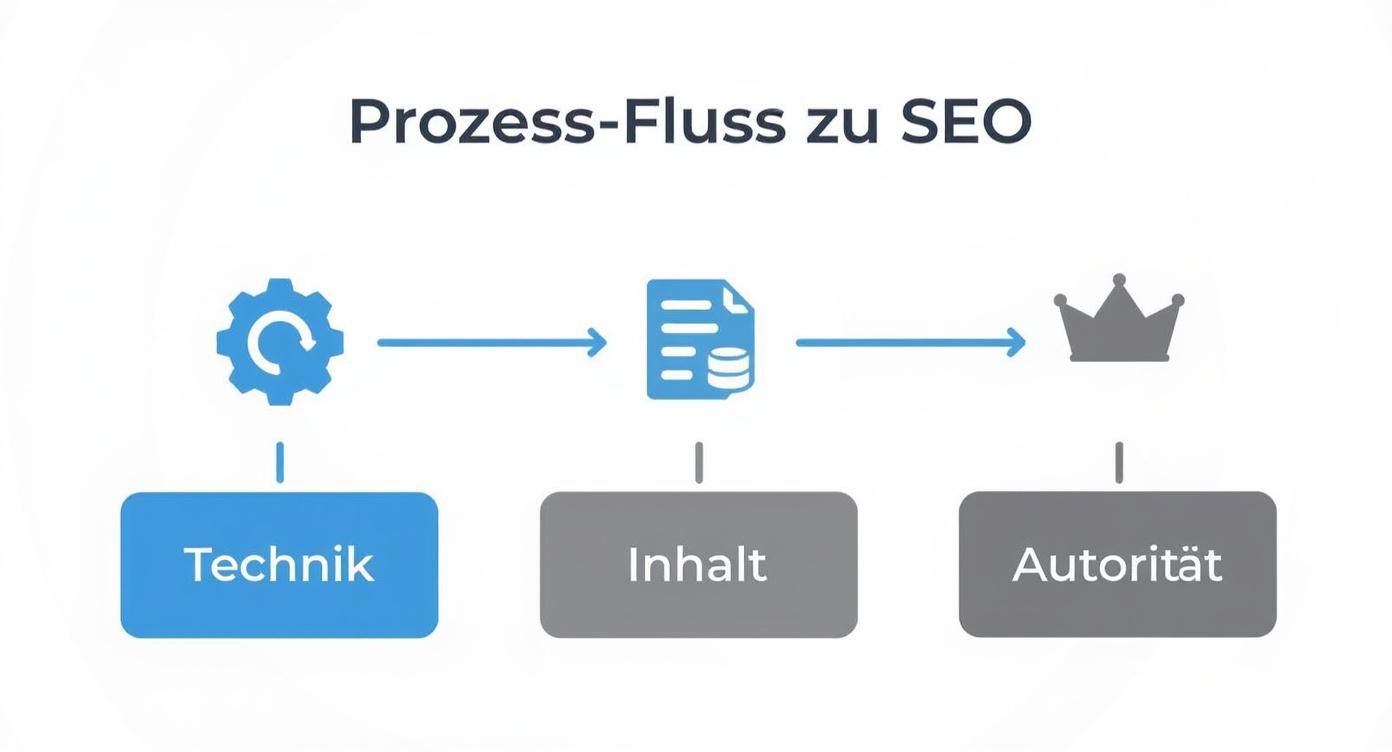
The graphic makes it clear: technology, content, and authority are not separate disciplines. Only their interplay leads to success.
A top ranking is not a matter of chance. It is the result of a well-thought-out strategy that combines technical perfection, outstanding content, and recognized authority. Only those who master all three areas can maintain their position at the top in the long term.
The numbers speak for themselves: With a market share of approximately 91,98 % Google is and remains the undisputed number one in Germany. About 54 % Almost all website visits come from organic search. And most importantly: almost all of them. 70 % The clicks land on the first three results.
This data clearly demonstrates how crucial good positioning is. If you want to delve deeper, you can learn more about the decisive factors in our article. Google Ranking Factors. Further exciting insights are also offered by the Search engine statistics on seranking.com.
Laying the technical foundation for top rankings
Before we spend even a minute on keywords or new blog posts, we need to talk about the foundation of your website. Think of technical SEO like the framework of a house: if it's shaky, the most beautiful facade is useless. Without a solid technical foundation, search engines simply can't find, understand, and evaluate your website properly.
A technical SEO audit is therefore not a nice extra, but the absolute starting point for any serious strategy to improve your To improve search engine ranking. He uncovers the invisible obstacles that sabotage all your efforts – often without you even realizing it.
Uncovering invisible barriers
The first step is to look at your website through the eyes of a search engine. An indispensable tool for this is the... Google Search Console. It is essentially a direct line to Google, revealing which pages have been indexed and where the problems lie.
But for the right depth, you need a tool like Screaming Frog. It crawls through your website, just like Googlebot, and spits out a brutally honest report about technical errors. The key questions you need to answer are:
- Indexability: Can Google actually find and index all the pages that are supposed to rank?
- Crawl efficiency: Is the Googlebot wasting its limited budget of time on unimportant or broken pages?
- Duplicate Content: Are there identical contents under different URLs that confuse Google and weaken your rankings?
- Website speed: How fast does the page load, especially on a mobile phone?
These points are non-negotiable. A page that cannot be indexed does not exist for Google. Period.
Practical example: The invisible brake
I once encountered a case involving a local craft business that produced fantastic, custom-made furniture. Great products, excellent descriptions – but entire categories of their website simply didn't appear in Google search results. Traffic was stagnant, and nobody knew why.

The cause? A single, incorrectly placed line in the robots.txt file. This small text file tells search engines what they are allowed to crawl and what they are not. An ill-advised "Disallow" command had made the entire product folders invisible to Google.
The error was fixed in less than five minutes, but the negative effects were felt for months. This shows how brutally a clean technical foundation can determine success or failure.
After we fixed that, Google finally started crawling the blocked pages. It only took a few weeks for the rankings for important product keywords to improve noticeably and for inquiries through the website to pick up again.
Loading time as a merciless ranking factor
Another aspect that is often neglected is loading time. Users have no patience. A page that takes longer than three seconds Websites that take a long time to load lose a large portion of their potential customers. Google is well aware of this and prioritizes fast, user-friendly websites in its rankings.
The Core Web Vitals These are the hard facts. They measure how quickly a page loads, how quickly it responds to clicks, and how stable the layout is. Poor metrics can directly drag your ranking down, even if your content is the best on the market. We explain exactly how to manage these metrics in our guide. Google Core Web Vitals.
Prioritized troubleshooting checklist
After an audit, you'll likely be left with a long list of technical issues. The trick now is not to panic and tackle everything at once, but to prioritize wisely. Not every mistake is the end of the world.
Sort the identified problems according to urgency and effort. A simple matrix is extremely helpful for this:
| priority | Impact on SEO | Implementation effort | Examples |
|---|---|---|---|
| P1 – Fix immediately | Critical | Low to medium | Faulty robots.txt file, important pages not indexable, 404 errors on key pages. |
| P2 – Implement promptly | High | Medium to high | Slow loading times (poor Core Web Vitals), no HTTPS, lack of mobile optimization. |
| P3 – Optimize as a secondary priority | Moderate | Small amount | Missing alt text for images, messy URLs on subpages, improve internal linking. |
Work your way systematically from P1 to P3. This technical foundation is the basis for everything that follows. Only with this foundation in place can you sustainably improve your search engine ranking.
So, the technical foundation of your website is in place. Perfect. Now we get down to brass tacks, to the heart of every successful SEO strategy: a genuine understanding of your target audience. It's practically useless to just know the words people type into Google search. If you... Improve search engine ranking If you want to, you must Why Understanding what lies behind this – the so-called search intent.
Search intent is simply the actual purpose someone has with their search query. Are they just looking for quick information? Do they want to buy something? Or are they comparing different offers before making a decision? The answer to this is absolutely crucial for the success of your content.

Always remember: Google has only one goal – to deliver the best and most relevant result to the user. If your content perfectly matches the search intent, it sends a clear signal to Google: This page is the best answer. The result? A better ranking for you.
From a general buzzword to a valuable key concept
Most companies start with very general terms, the so-called "short-tail keywords." A tax consultancy in Berlin, for example, could optimize for "tax advisor." The problem? This keyword is not only extremely competitive, but its search intent is also completely unclear. Is someone looking for the definition of the profession, a job, or actually a service provider?
Much, much more valuable are the Long-tail keywords. These are longer, very specific search queries. While they often have a lower search volume, they have a significantly higher conversion rate because they tell us exactly what the user is trying to achieve.
Let's take a look at this:
- Short-tail (very general): „"Tax advisor"“
- Mid-tail (already better): „"Tax advisor Berlin"“
- Long-tail (absolutely right): „"Tax advisor for freelancers in Berlin Charlottenburg"“
Someone entering a long-tail query isn't just browsing aimlessly. This is a potential customer who's close to making a decision. You need to tailor your content precisely to these kinds of queries. By the way, I'll show you step-by-step how to identify these terms in our [website/course/etc.]. Comprehensive keyword research guide.
Keywords are the currency of Google search. But understanding search intent is the true art. Those who grasp the purpose behind a query not only gain a higher ranking, but ultimately a customer.
The four types of search intent
Conveniently, almost every search query can be assigned to one of four categories. When analyzing your keywords, you should always assign them to one of these intents. This will greatly help you create the right kind of content.
| Search intent | Description | Typical keywords | Relevant content |
|---|---|---|---|
| Informational | The user wants to know something, is looking for an answer to a question. | ""What is…", "How does…", "Instructions"" | Blog articles, tutorials, white papers |
| Navigational | The user wants to go to a very specific website or brand. | ""seobuchen login", "facebook"" | Homepage, Brand Page, Login Page |
| Commercial | The user weighs up and compares products or services before making a purchase. | ""best…", "comparison…", "experiences"" | Product comparisons, test reports, case studies |
| Transactional | The user already has the wallet in their hand and wants to buy. | ""buy", "offer", "price"" | Product pages, landing pages, online shop |
So, if you use a keyword like "tax return deadlines" (clearly informational) with a purely sales-oriented (transactional) page, you will fail. Users want information, not an intrusive sales pitch. It's that simple.
Tools for your keyword strategy
Fortunately, you don't have to read these keywords from a crystal ball. There are some really powerful tools that can help you speak your customers' language.
- Google Keyword Planner: A solid, free tool from Google itself. Perfect for gathering initial ideas and getting a feel for search volume.
- Ubersuggest: In addition to keyword suggestions, it also offers exciting insights into your competitors' strategies.
- AnswerThePublic: My personal favorite for understanding search intent. The tool visualizes questions that users ask about a keyword – an absolute goldmine.
These tools provide you with the raw data. Your task is then to interpret this data and develop a content strategy that precisely meets the needs of your target audience. Never forget that the competition out there is fierce. Analyses show that The first three organic results together 68.7 % to capture all clicks, with the first result alone being almost 40 % claimed for itself. These figures clearly demonstrate how crucial a precise keyword strategy is for your visibility.
Build topic clusters for more authority
Instead of simply publishing individual blog posts on random topics, you should in Topic clusters Think of it this way: You create a central main page (a so-called "pillar page") that comprehensively covers a broad topic. Around this, you group several supporting articles ("cluster content"), each addressing specific long-tail keywords related to that topic.
For our tax office, this could look something like this:
- Pillar Page: An ultimate guide to "taxes for freelancers".
- Cluster Content: Individual, detailed articles on topics such as "VAT return for freelancers", "How to avoid bogus self-employment" or "Properly deducting home office expenses from taxes".
Each of these cluster articles naturally links back to the pillar page. This clever structure signals to Google that you are a true authority in this field. This not only strengthens the ranking for all related keywords but also improves your search engine ranking sustainably.
On-page SEO that actually works
Okay, the technical foundation of your website is in place, and you now know what your customers are really searching for on Google. Now it's time to get down to brass tacks: on-page optimization. This is the area where you have complete control to optimize your website. To improve search engine ranking. Here, we polish your content so that both Google and your visitors immediately understand what it's about and why you're the best choice.
This isn't about hammering keywords into your texts. Quite the opposite, in fact. It's about the art of combining relevance with a pleasant reading experience. Every single page of your website is an opportunity to rank for a specific topic – we just need to give it a little boost.
Title tags and meta descriptions that generate clicks
The Title tag The headline is the face of your page in Google search results. It's the most important heading and a massive ranking factor. It must contain the main keyword, pique interest, and encourage clicks – all within a concise format. 55-60 characters.
The Meta description This is essentially your advertising copy directly below the title. While it doesn't directly influence the ranking, it's often the deciding factor in whether someone clicks or scrolls on. Here's an example: 155 characters A space to promise users: "Hey, you'll find the answer with me!"„
Think of the title and meta description like the cover and blurb of a book. If they don't grab attention, nobody will open the book – no matter how brilliant the content is.
The power of a clean heading structure
A clear hierarchy in your headings (H1, H2, H3, etc.) is not only invaluable for readability. It provides Google with a kind of table of contents, allowing the search engine to quickly grasp your content.
Simply follow these basic rules:
- Only one H1 per page: This is the absolute main heading. Your primary keyword must go here.
- Logical structure: Use H2 headings for the main sections and H3 headings for the sub-points within them. Never jump directly from an H2 to an H4.
- Use keywords effectively: Your keywords and relevant synonyms naturally belong in the subheadings as well. This signals pure relevance.
Content that people enjoy reading
Let's be honest: Nobody wants to wade through endless walls of text. For visitors to stay on your site and for Google to send positive user signals, your content needs to be easily digestible. This is an often underestimated lever for sustainably improving your search engine ranking.
Therefore, focus consciously on:
- Short paragraphs: A maximum of 2-3 sentences per paragraph is ideal.
- Enumerations and lists: They break up the text and make information easily grasped at a glance.
- Greases: Highlight important terms or key statements so that they are immediately visible when skimming.
- Images and graphics: A picture is often worth a thousand words and wonderfully livens up any text.
And very important with pictures: never forget the Alt text. It describes what can be seen in the image for search engines and visually impaired users – and is also a perfect place to include relevant keywords.
Internal links as a strategic tool
Internal links are the signposts on your own website. They connect thematically relevant content and help Google understand your site's structure. At the same time, they allow you to strategically distribute "authority" (the so-called link juice) to your most important pages.
A practical example: A blog article about "changing summer tires" should naturally link to your product page for summer tires. A link to a guide like "How to correctly check tire pressure" might also be appropriate. This way, you build a strong, thematic network on your own website.
A practical example: Before vs. After
Imagine a blog post from a local bike shop. The title was "Our new blog post" and the text was a lackluster product description for a new e-bike.
Previously:
- H1: Our new blog post
- Contents: A long, unstructured block of text.
- Pictures: No alt text.
- Ranking: Virtually non-existent.
Afterwards (optimization for "buy e-bike Kaiserslautern"):
- Title tag: Buying an e-bike in Kaiserslautern | Your expert guide
- Meta description: Looking to buy an e-bike in Kaiserslautern? Discover our top models and what to consider when making your purchase. Get expert advice now!
- H1: The ultimate guide to buying an e-bike in Kaiserslautern
- H2: What should you pay attention to when buying?
- H2: Our top 3 e-bikes for the city
- Contents: Short paragraphs, a checklist of buying criteria, and images with appropriate alt text.
The result? A massive improvement in visibility for this important local search query. It's often these small but targeted adjustments that make the biggest difference in practice. The competition for top spots is fierce. As early as 2015, the average... 60 % of all clicks to the first three search results, with first place alone a whopping 33 % swept the board. More details about this click distribution can be found in the Statistics on the world's most used search engines at Statista.
Building authority through links and local signals – the finishing touch for your ranking
Imagine your website is technically sound and your content is perfectly tailored to your customers. That's a fantastic foundation. But to truly reach the top of Google, one crucial ingredient is still missing: authority. Google wants to see that your site is trustworthy. The strongest signal for this is recommendations from other websites – i.e., backlinks.
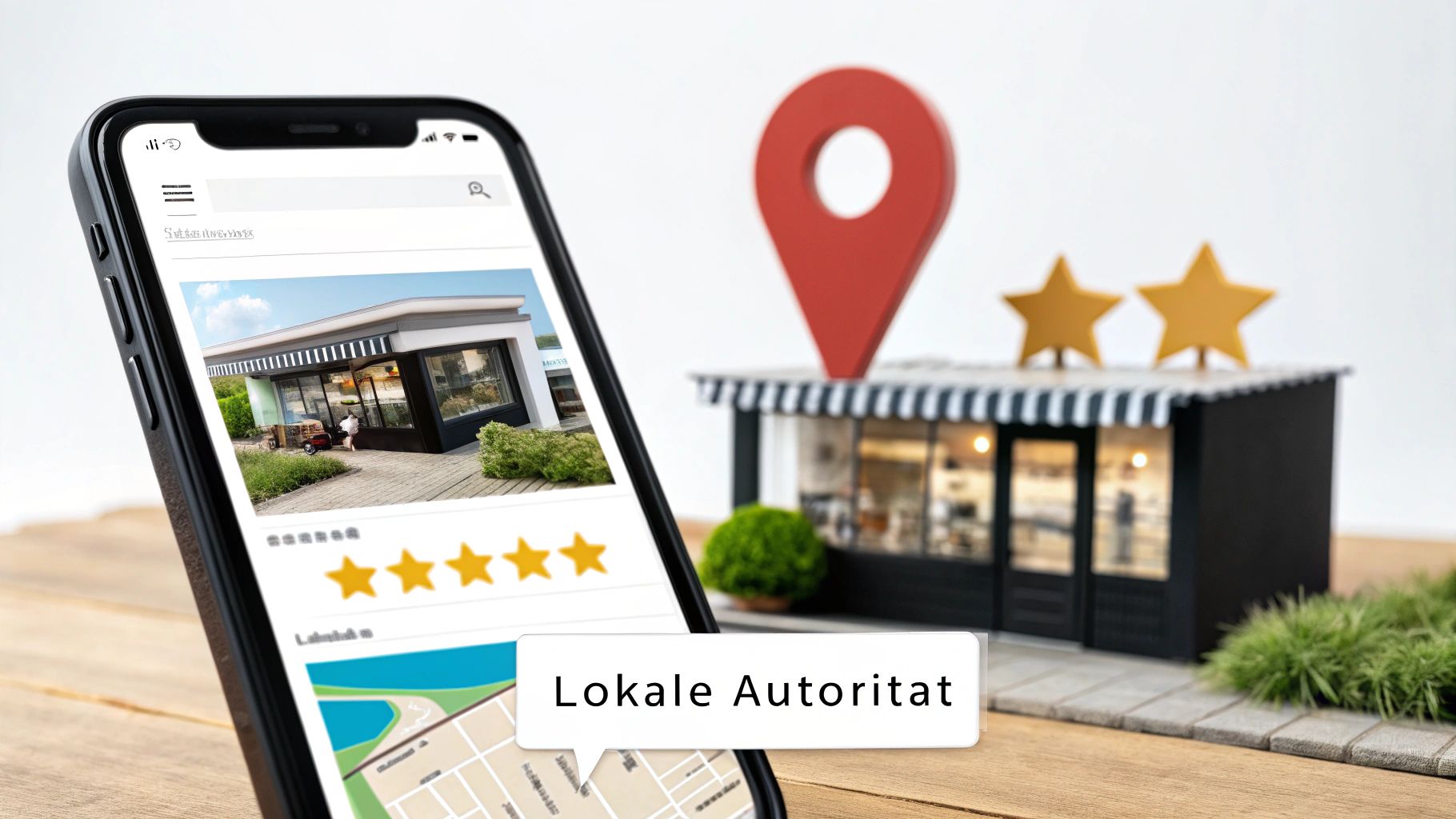
For local businesses, there's a second, equally important factor: local signals. These show Google that you're not just an expert, but also a well-established presence in your city or region. Strong link authority and a clear local presence together are an unbeatable combination for boosting your business. Improve search engine ranking to be able to.
Why not every backlink is the same
Unfortunately, link building often still carries the taint of purchased, low-quality links from the Stone Age of SEO. Modern, sustainable link building, however, has absolutely nothing to do with that. Today, it's about earning links naturally by creating something so good that others link to it willingly.
A high-quality backlink is like a personal recommendation from a reputable website to Google. The more relevant and credible the linking page, the more weight this recommendation carries. In other words: A single link from a well-known industry magazine is worth a thousand times more than a hundred links from some small, irrelevant blogs.
Sustainable strategies that actually work
Stay away from dubious link packages and instead focus on methods that create real value in the long term.
- Create content that attracts links: This is and remains the best approach. Create something that doesn't yet exist. This could be a unique data analysis, a comprehensive study, a useful online tool, or the ultimate guide to a complex topic. Such content is naturally shared and linked to because it genuinely helps others.
- Targeted guest contributions: Identify reputable blogs or online magazines in your niche and offer to contribute a high-quality article. This will not only position you as an expert but also earn you a valuable backlink.
- Utilize local partnerships: Collaborate with other local businesses or organizations. For example, a local tradesperson could get a link from their material supplier's website, or ask an architecture firm they frequently work with to link to them.
Effective link building is not a sprint, but a marathon. It's about building genuine relationships and establishing a reputation as an expert. Every earned link is a sign of trust that sustainably strengthens your ranking.
To help you plan your activities, here is a table that ranks different link building methods according to effort and impact.
Prioritizing link building measures
This table helps you evaluate link building strategies based on effort and expected impact, in order to use your resources effectively.
| measure | Effort (time/costs) | Expected effect | Ideal for |
|---|---|---|---|
| Creation of "link magnets"" | High (research, creation) | Very high, sustainable | Companies with specialist expertise who are willing to invest in top-quality content. |
| Strategic guest contributions | Resources (research, writing) | High | Experts who want to build their personal brand and authority. |
| Local partnerships | Low to medium (networking) | Medium to high (very relevant) | All local businesses, to strengthen regional relevance. |
| Entries in industry directories | Small amount | Low to medium | A fundamental step for every local business to create a foundation. |
| Building relationships with journalists | High (continuous) | Very high (PR effect) | Companies that have innovative products, data, or stories to tell. |
Use this overview to decide which measures are most suitable for your company and your current resources. A combination of quick wins and long-term strategies is often the best approach.
Local SEO: The key to local dominance
For any business with a physical store or a defined catchment area, local SEO isn't optional, it's essential for survival. When someone searches for "hairdresser Kaiserslautern" or "restaurant near me," Google wants to deliver the best local result. That's precisely where you come in. Google Business Profile (formerly Google My Business) comes into play.
This profile is by far your most important tool for local search. It's your digital storefront, appearing directly in Google search results and on Google Maps. A half-heartedly maintained profile is a huge missed opportunity.
Get your Google Business Profile in shape
To rank highly in local search results, you need to nurture your profile like you would your own front garden. These are the absolute basics:
- Completeness is mandatory: Do you really fill each individual field Include your name, address, phone number (NAP), exact opening hours, website, services offered, and a concise description.
- Select categories precisely: Choose the most specific main category that describes your business (e.g., "Italian Restaurant" instead of just "Restaurant"), and add any relevant subcategories.
- Photos, photos, photos: Showcase your business from the inside out, your products, and your team in action. Studies show that profiles with more than 100 pictures up to 520 % more calls can obtain.
- Actively ask for reviews: Positive reviews are an incredibly strong signal for Google. Actively encourage satisfied customers to leave a review. And even more importantly: Respond to them. every Review – including the critical ones. This shows that you care.
From practice: The power of an optimized profile
A small restaurant in Kaiserslautern had a neglected Google profile. Its rankings were abysmal, and most calls came through other channels.
We completely revamped the profile: uploaded professional photos of the dishes and the ambience, added the digital menu, included all services (such as "outdoor terrace", "delivery service") and implemented a simple strategy for collecting reviews.
The result after only three months was astonishing: Requests for directions via the profile increased by over 40 %. Direct calls via the "Call" button in the profile have almost doubled. This example demonstrates the enormous potential of an optimized profile, not only to improve search engine ranking but also to directly bring more customers to the business.
Done! Now what? Measure success and continuously adapt the strategy.
You've put in a lot of work: the technical foundation of your website is in place, your content is spot on, and the first backlinks are starting to come in. But here's the hard truth: SEO isn't a sprint you win once. It's a marathon, a constant cycle of optimizing, measuring, and adapting. To succeed in the to consistently play a top role in Google rankings, You need to understand exactly what works – and what doesn't.
Without data, you're groping in the dark. Only when you have the right key performance indicators (KPIs) in view does your gut feeling transform into a solid, data-driven strategy. It's about celebrating successes, ruthlessly uncovering weaknesses, and investing your budget precisely where it will have the greatest impact.
What really matters: The crucial KPIs
Don't get lost in the data jungle. At the end of the day, four key metrics tell the true story about your visibility on Google.
- Organic traffic: Quite simply: How many people find their way to your site via a regular, unpaid Google search? A steady increase here is probably the best indication that your efforts are paying off.
- Keyword rankings: For which search terms do you appear and – more importantly – in what position? Above all, keep an eye on the rankings of your "money keywords," i.e., the ones that bring you customers.
- Click-through rate (CTR): How many people who see your result on Google actually click on it? A poor click-through rate (CTR) can be a clear indication that your page title or description is simply boring and doesn't impress anyone.
- Conversions: What do visitors do once they arrive? Do they fill out a form? Do they call? Do they buy something? That's the ultimate currency for your SEO success.
Your tools for clarity
You don't need expensive professional tools for this task. Two free tools from Google itself provide you with everything you need to know – directly from the source.
The Google Search Console It's essentially your direct line to Google. It whispers to you which keywords you rank for, how often you're clicked, and whether there are any technical problems that are bothering Google about your site. Google Analytics It takes over as soon as a visitor lands on your site. It tells you how people behave: Which subpages are popular, how long do they stay, and do they ultimately become customers?
SEO without regular analysis is like sailing without a compass. You might make some progress, but are you on the right course to reach your destination? No idea. Only data gives you the orientation you need.
The monthly SEO cycle in practice
Make it a habit. Once a month, sit down, look at the numbers, and derive concrete steps from them. It's not rocket science.
Let's imagine a very specific scenario: You're a tax advisor in Berlin. In Search Console, you see that your ranking for the extremely important keyword "tax advisor for freelancers Berlin" is stable at position 3. Great, right? Well, not quite. A closer look reveals that the click-through rate (CTR) last month was... 4 % on 2 % has fallen. That's a warning sign.
So even though you're ranked highly, people still prefer to click on your competitors' results. Why is that? Mostly it's the so-called "snippet," the preview in the search results. Perhaps a competitor has crafted a more clever title, for example, with a clear value proposition like "Secure your free initial consultation for freelancers now.".
The consequence is crystal clear: you need to revise your page title and meta description. Be more direct, highlight your advantage, and pique people's interest! That's exactly how adapting your strategy based on hard facts works. This way, you not only secure good rankings but also the clicks that ultimately grow your business.
Typical practical questions about Google ranking
Finally, I'll answer a few questions that I frequently encounter in practice. Hopefully, they will help you avoid common pitfalls and approach your SEO strategy with a clearer head.
How long does it really take to see results?
The honest answer: It depends. SEO isn't like a light switch you can flip. It's more like planting a garden.
Minor technical fixes, for example a problem with the robots.txt Fixing these issues can sometimes have a noticeable effect after just a few weeks. But when it comes to the really important things – namely good content and building trust through backlinks – then we're realistically talking about... three to six months. Only then will you typically see stable, measurable improvements in your rankings.
The biggest mistake I see time and time again? Giving up too soon. Sustainable SEO success comes from continuous, patient work. You have to constantly show Google that your site is relevant and trustworthy.
Is it possible to do SEO without a budget?
Yes, to a certain extent. You can definitely handle many of the basics yourself. Especially with on-page optimization and creating content for your blog or local pages, you can achieve a lot. An indispensable and free tool for this is... Google Search Console.
However, one must be realistic. As soon as things get more technical or you seriously want to build links, time and expertise become the bottleneck. This is where investing in a good agency or specialized tools like [example tool name] can be beneficial. Ahrefs or Semrush make the crucial difference. For most small and medium-sized enterprises, a mix of in-house effort and targeted external support has proven effective in achieving their goals. To improve search engine ranking.
Isn't SEO eventually "finished"?
A resounding no. That's a widespread misconception. Search engine optimization is a dynamic process that never ends.
Imagine this: Google updates its algorithms hundreds of times a year. Your competitors are also constantly optimizing their websites. And the search behavior of your potential customers is constantly changing. A strategy that delivers top rankings today can be outdated in six months. That's why regular analysis, strategic adjustments, and continuous content maintenance are absolutely crucial to staying ahead.
Do you no longer want to leave your ranking to chance? At LinkITUp We will develop a strategy based on over 15 years Based on practical experience and precisely tailored to your company, we ensure sustainable visibility and measurable success. Start now and improve your ranking with us..