



To your To increase brand awareness, It's about more than just loud advertising. The real leverage lies in this:, genuine trust To build trust with your customers, you can achieve this by sending a clear, consistent message through the right channels and establishing yourself as the go-to expert in your niche.
Why brand awareness is so crucial, especially for SMEs
Many owners of small and medium-sized businesses often dismiss the topic of brand awareness. They consider it an abstract concept relevant only to global corporations like Apple or Coca-Cola. But that's a misconception. A strong brand isn't a luxury to be indulged in later, but rather the foundation for sustainable success. It builds trust long before the first euro changes hands.
Let's imagine two craft businesses from the same town. Both deliver top-notch work. But one of them has a real presence in the community. Everyone recognizes their company vehicles, they sponsor the local sports club, and regularly post pictures of completed projects on Facebook. Now, if someone in your circle of friends asks for a recommendation, whose name will likely come up first? Exactly.
From mere recognition to genuine trust
Brand awareness is so much more than just a snazzy logo that people recognize. It's about potential customers not only knowing your company, but instinctively trusting it. This trust is the most valuable currency in today's competitive landscape and the foundation of any long-term customer relationship.
A company that is already known doesn't need to constantly prove itself. Customers who are already familiar with your brand tend to:
- to accept higher prices, because they already have the value and reliability of your work in mind.
- Minor mistakes are more easily forgiven, because a positive basic attitude is present. A proactive and well-managed Online reputation management This also helps to reinforce that trust.
- To actively recommend your company, which gives you the most valuable marketing of all: word-of-mouth advertising.
More than just a name on the bill
A strong brand sets you apart from the crowd and protects you from being perceived solely on price. When customers associate your name with quality, reliability, or exceptional service, price naturally fades into the background. This emotional advantage is often more valuable in the long run than any short-term discount offer.
A strong brand is a promise to your customers. Brand awareness ensures that this promise is fulfilled. This is how passive observers become interested inquiries and ultimately loyal, repeat customers.
Incidentally, brand perception doesn't end at the city limits. Even for regional SMEs, it's an advantage if their reputation extends beyond their immediate surroundings. The major German brands impressively demonstrate this. Six of them – including Telekom, SAP, Siemens, and Adidas – are among the most valuable global brands. This was the finding of a survey of over 11,000 consumers more than 2,000 brands (More on the methodology of the Kantar BrandZ ranking from 2025). The lesson for SMEs? A good reputation that is also recognized beyond the region strengthens trust directly in your local area.
Building digital visibility – your foundation for greater brand awareness
Anyone who wants to be noticed as a brand today can't ignore the internet. Simply having a website is no longer enough. The crucial point is that potential customers find you precisely when they are actively searching for a solution. And that's exactly where SEO and strong content come into play.
SEO is much more than a technical gimmick or simply distributing keywords. It's about aligning your entire digital presence so that search engines like Google recognize you as a true expert in your field. Your most powerful tool for this? Content that truly offers added value.
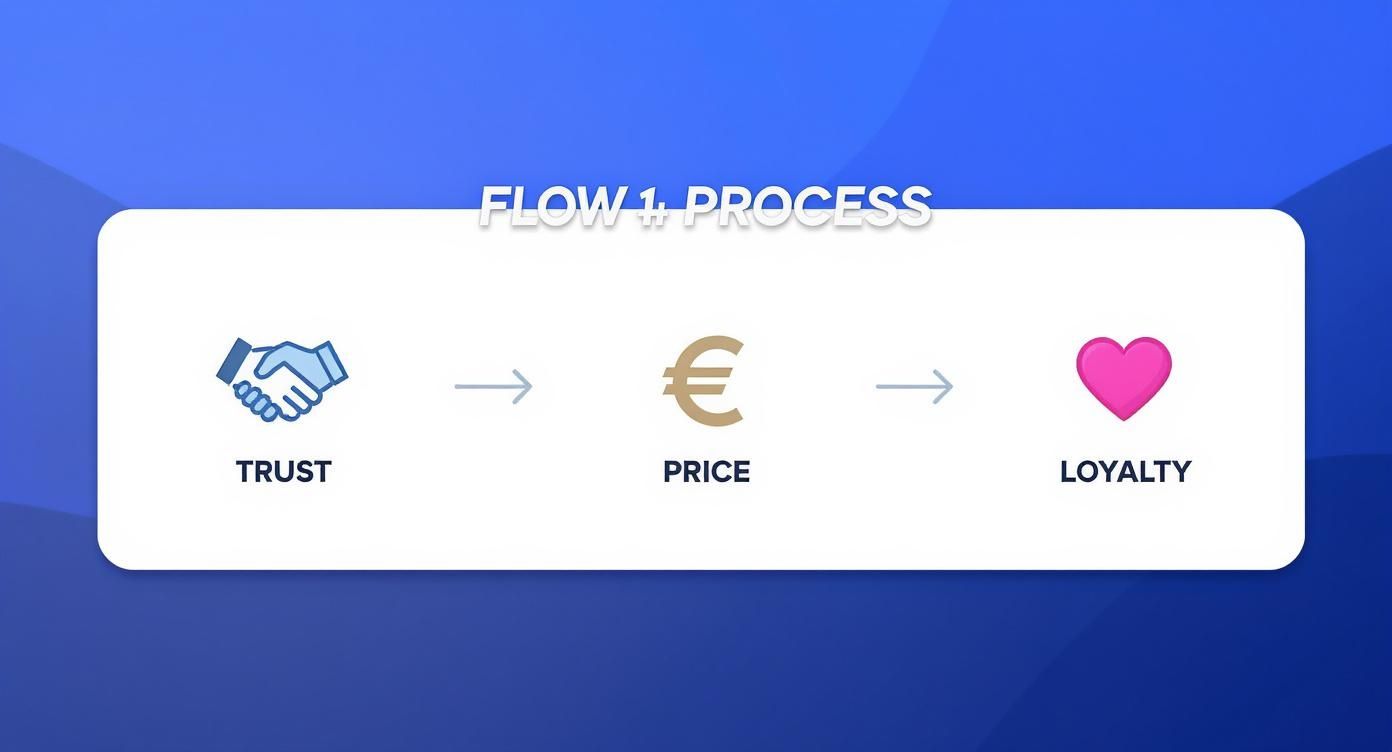
This graphic illustrates it nicely: Trust is the beginning of everything. From this grows the willingness to pay fairly for good service, which ultimately leads to loyal customers who keep coming back.
Become an authority with the right content.
To be considered an expert, you need to demonstrate your knowledge. Produce content that directly addresses the most pressing questions and problems of your target audience. A local IT service provider shouldn't just write generally about "IT support." Concrete assistance is much more engaging.
Here are a few ideas of what this IT service provider could do:
- Practical instructions: How SMEs can effectively protect their company data from ransomware.
- Comparison check: The best cloud solutions for local craft businesses.
- Case study: A look behind the scenes: This is how we completely modernized the IT system of a doctor's office.
Each of these contributions helps to establish the company as a competent problem solver. Over time, this creates a thematic authority. Google recognizes that your website is the go-to resource for a specific subject area and rewards this with better rankings in search results.
Of course, this shouldn't be done haphazardly. To find the topics that truly resonate and to develop them strategically, a well-thought-out plan is essential. Developing a content strategy.
Understanding search intent – more than just keywords
The real key to successful content is... Search intent to understand what someone wants. really, if he or she types a specific term into Google?
Imagine someone searching for "slow company computers." This person doesn't want a scientific treatise on processor clock speed. They have an urgent, annoying problem and need a solution. Now.
A compelling article wouldn't beat around the bush here, but would get straight to the point. It could include a simple checklist that employees can work through themselves, or provide clear indicators of when it's truly time to call in a professional. That's the kind of content that sticks in people's minds.
Don't just optimize your content for search engines, but above all for the people searching. If you solve their problems, good rankings will almost follow automatically.
Collect high-quality backlinks as digital recommendations
Backlinks – links from other websites to yours – are like a personal recommendation from a colleague to Google. Each link signals: "Hey, the content here is so good, it's worth sharing." But be careful: not all links are created equal.
A backlink from a well-known industry portal naturally carries far more weight than one from an obscure forum. Therefore, focus on... Quality over sheer quantity.
Three proven methods to get strong backlinks:
- Guest articles in specialist media: Search specifically for relevant blogs or online magazines in your niche. Offer to write a high-quality article on an interesting topic. In return, you'll usually receive a link in the author's bio.
- Publish unique data: Conduct a short survey among your customers or analyze your own company data anonymously. Publish the interesting results in a blog post or infographic. Journalists and bloggers love exclusive data and are happy to link to the source.
- Utilize local partnerships: Network with other local businesses that serve your target audience but aren't direct competitors. For example, the IT service provider could collaborate with a tax firm and publish a guest article on their website about security in digital accounting.
Imagine if our IT service provider wrote a guest post like this for the website of the regional Chamber of Industry and Commerce. They would not only reach hundreds of relevant business owners at once, but also gain an extremely valuable backlink. It's a true win-win situation that will sustainably strengthen your brand and generate real business.
Want to conquer the local market? Local SEO is key.
For every local business, visibility right on its doorstep is absolutely crucial. Simply put: if someone in your neighborhood is searching for exactly what you offer, you need to be on their radar. This is precisely where Local SEO comes in – a discipline that specializes in making your business visible at that decisive moment.
The subtle but crucial difference to "normal" search engine optimization is the geographical component. A search like "bakery Hamburg Eimsbüttel" sends a clear signal to Google: the searcher is looking for something in the immediate vicinity. Google reacts instantly and displays the so-called Local Pack an – this striking map with the three top entries, which usually reigns supreme over all other organic results.
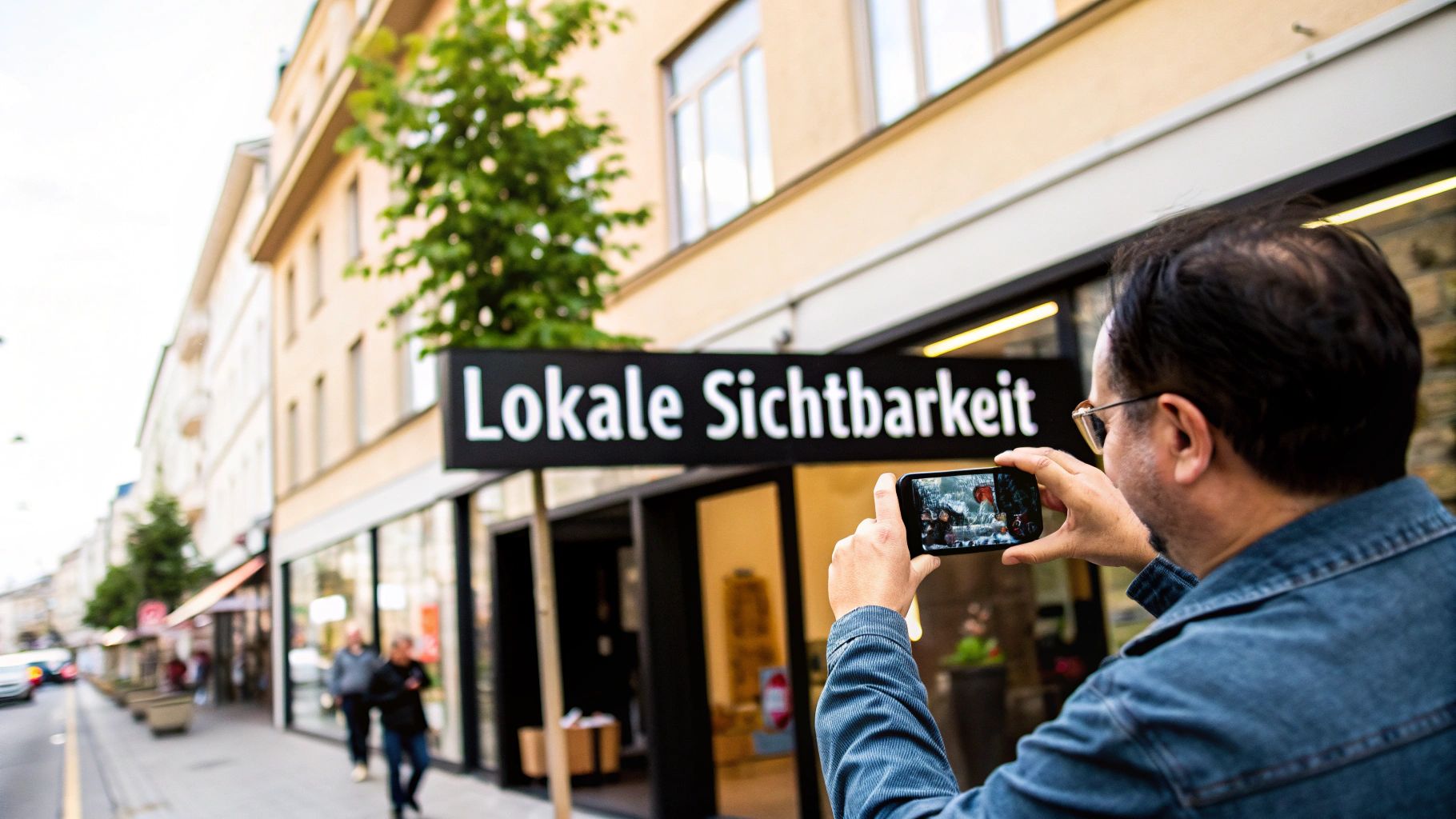
Right here, in the local pack, it's often decided who gets the customer. Your most important tool for getting there and cementing your local presence is a perfectly maintained [product/service/etc.]. Google Business Profile (formerly known as Google My Business).
Your Google Business Profile: More than just a listing
Don't think of your Google Business Profile as a boring business listing. See it as your digital storefront. It's often the very first point of contact a potential customer has with your brand. A complete and professionally maintained profile immediately builds trust and provides all the essential information at a glance.
Here are the details that really matter:
- The correct categories: Choose the most specific main category that describes your business. An Italian restaurant is not simply a general "restaurant." Use secondary categories to cover everything else, such as "delivery service" or "catering.".
- Strict NAP consistency: Name, address, telephone number (Nname, Adress, P(hone). These three pieces of information must be identical everywhere online – on your website, in your Google profile, and in every other directory. No variations, not even "Str." instead of "Straße".
- Meaningful photos: Show what you've got! Upload high-quality photos of your premises, your products, and your team. Up-to-date photos demonstrate that your store is vibrant and authentic.
A vibrant profile through posts and reviews
A static profile is a boring profile. Google rewards activity and interaction. This means you should use the post feature for current offers, news, or events. These short posts appear directly on your profile and keep it fresh.
Equally important is handling customer reviews effectively. Respond to every single one, not just the critical ones. A personal reply to positive feedback reinforces the good impression and signals to other potential customers that you value their opinion.
A quick, personal response to a customer review can turn a dissatisfied customer into a loyal fan. Don't see negative reviews as a disaster, but rather as a public platform to demonstrate excellent service.
The power of local references and backlinks
Besides the Google profile, so-called Citations a major role. These are simply mentions of your NAP data in relevant online directories such as Yellow Pages, Yelp or industry-specific portals. Every consistent entry is another trust signal for Google.
Local backlinks are equally valuable. Try to get links from other businesses and organizations in your region:
- Local media: Send a short press release to the local newspaper if something special happens in your area.
- Organizer: Are you sponsoring the city festival? Ask for a link on the event website.
- Partner companies: Do you collaborate with other businesses? Then why not link to each other?.
Create content with a sense of home
To be found for searches like "tax advisor Kaiserslautern city center," your website needs relevant content. Therefore, create pages or blog articles that have a clear local focus.
A real-world example: A painting company from Munich could write a blog post titled "Facade Paints That Withstand Munich's Weather." This not only provides valuable tips but also positions them as an expert on local conditions. Mention neighborhoods, well-known places, or report on your participation in local festivals. This demonstrates to both your customers and search engines that you are firmly rooted in your region, thus increasing your local brand awareness.
Social Media and PR: How to authentically get your brand talked about
Social media and public relations (PR) are no longer separate silos. When cleverly integrated, they become an extremely effective tool for raising brand awareness – in a way that comes across as genuine and credible. It's no longer about simply being present on every platform or sending out press releases indiscriminately. The real key to success lies in telling authentic stories that resonate with your target audience.
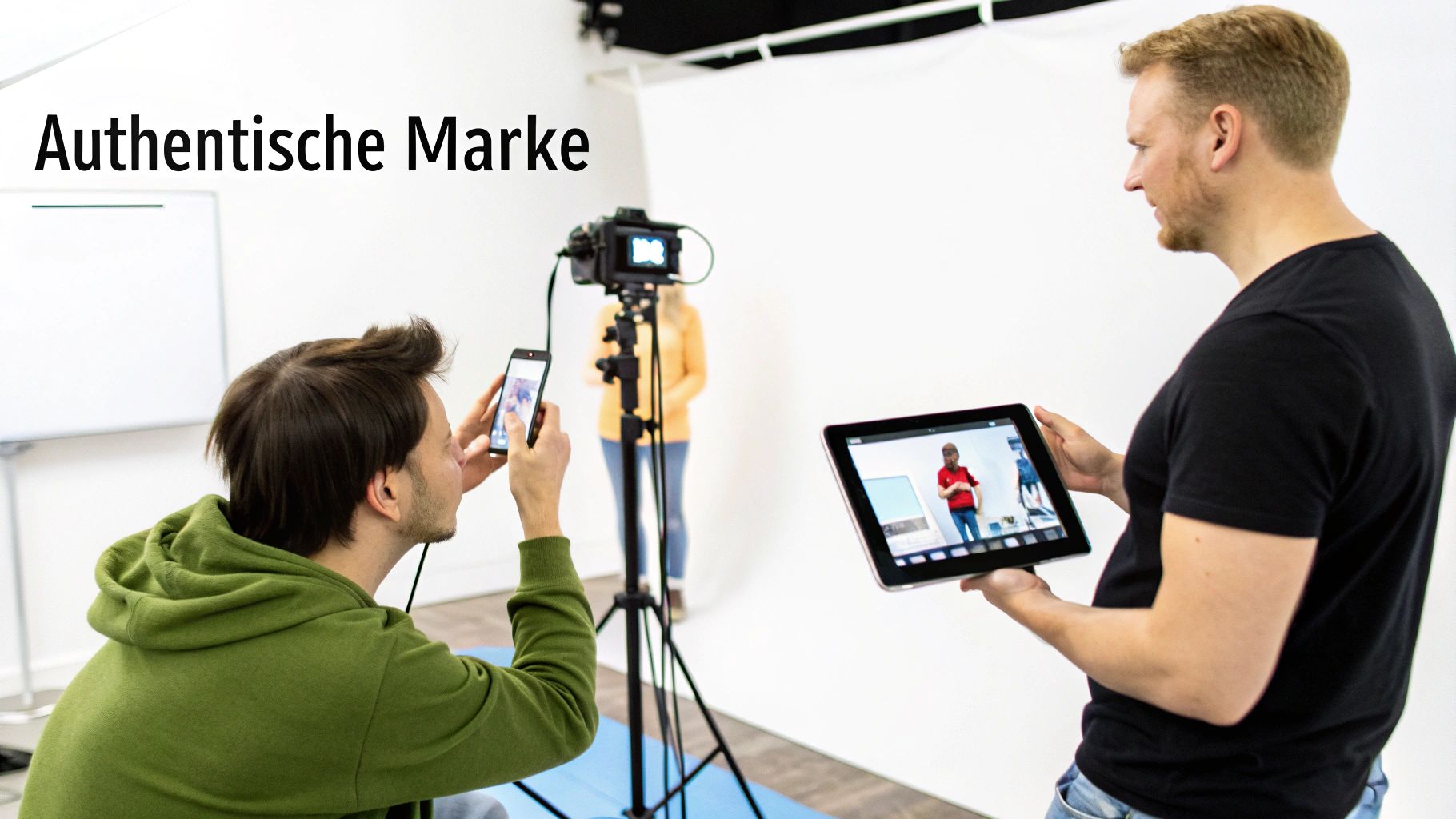
Building a loyal community that truly stands behind your brand is so much more valuable than simply chasing follower counts. People don't follow you because of perfectly staged product photos, but because they sense the personality and values your company represents.
Selecting the right channels strategically
To be honest: Not every company needs to go viral on TikTok. Choosing the right social media channels depends solely on where your target audience is and what kind of content they expect to find there. A B2B management consultancy will achieve significantly more on LinkedIn, while a local café can naturally tell its visual story best on Instagram.
The numbers speak for themselves. An analysis of approximately 2.4 million social media mentions Studies in Germany have shown that brands that are active and promote positive interactions have measurably higher brand awareness. This study analyzed not only text but also emojis and likes to paint a realistic picture of public perception.
Sometimes it can also be useful to put the entire brand perception to the test. Effective Rebranding strategies They can bring a breath of fresh air here and open new doors.
Forget the pressure to be everywhere at once. Instead, focus your energy on one or two channels, but manage them exceptionally well with authentic content. Quality always trumps quantity here.
Comparison of social media channels for SMEs
Choosing the right platform can be overwhelming. This table helps SMEs decide which social media platform best suits their goals and target audience.
| platform | Main target group | Content focus | Ideal for |
|---|---|---|---|
| Broad demographics (30+) | Community building, events, local information | Local businesses, service providers, community projects | |
| Younger demographics (18-35), visually oriented | High-quality images & videos, storytelling, lifestyle | Gastronomy, fashion, design, tourism, creative professions | |
| B2B, Specialists & Managers | Industry insights, company news, networking | B2B companies, consultants, IT, human resources | |
| Predominantly female, with high purchasing power | Inspiration, instructions, visual product catalogs | E-commerce, DIY, decoration, recipes, wedding industry | |
| X (Twitter) | News & trend oriented | Short messages, real-time updates, discussions | Media, tech companies, public figures, customer service |
Each platform has its own dynamics. Choose wisely and focus your resources where you can have the greatest impact.
More than just an editorial plan – tell stories
An editorial calendar is a great tool for organization, but it should never become a rigid framework that stifles all creativity. The best social media content is often that which arises spontaneously and offers a genuine, unfiltered glimpse behind the scenes.
Here are a few ideas that go far beyond the usual "deal of the week":
- Employee spotlights: Introduce your team. Who are the people who bring your brand to life? This creates a personal connection and makes your company more tangible.
- Making-of content: Show how your products are made or how you prepare a service for a customer. This transparency builds enormous trust.
- Customer features: Give your customers a platform! Share their stories (always with their consent, of course). Nothing is more convincing than the voice of a satisfied customer.
- Question and answer sessions: Go live and answer your community's questions directly. This shows that you are listening and genuinely interested in a dialogue.
Pragmatic PR tactics for small budgets
Good PR isn't just for large corporations. Even with modest resources, you can achieve considerable media attention. The trick is to think creatively, strategically, and above all, locally.
Build real relationships
Identify relevant journalists at the local newspaper, city magazines, or regional blogs. Follow them on LinkedIn or Twitter, engage meaningfully with their posts, and make your presence known—long before you send them a press release. A personal relationship is often invaluable and opens doors that an anonymous email never could.
Create news, not ads.
Journalists are always looking for a good story, not bland advertising messages. So before you send out a press release about your new product, ask yourself: What's the compelling hook behind it?
- Example of a craft business: Instead of saying "We now offer roof renovation," you could launch a campaign: "We are donating a free roof repair to a local social institution." That's a heartfelt story that the media loves to pick up.
- Example of a restaurant: Organize a small, exclusive cooking class for local food bloggers. Their authentic reporting often has a much wider reach and greater credibility than an expensive advertisement.
Of course, a well-written press release remains an important tool. Keep it concise, write a compelling headline, and get straight to the point in the first paragraph. Always include a clear contact person with their contact details and a link to your website. This will make it as easy as possible for media representatives to report on you.
Make the success of your brand strategy measurable
A strategy without solid data is nothing more than a shot in the dark. To ensure your to truly increase brand awareness, You need to know exactly what works and what doesn't. Only then can you be sure that your budget and time are invested where they will have the greatest impact. Forget superficial figures like mere website visitors – it's about the KPIs that demonstrate real brand growth.
Without clear key performance indicators (KPIs), you're groping in the dark. You might run social media ads that have no effect, or produce content that no one associates with your company. Real progress only becomes visible when you have the right data at your fingertips.
What really matters when it comes to key performance indicators (KPIs)
Break free from typical vanity metrics. The following KPIs will give you a much better insight into how deeply your brand is already anchored in the minds of your target audience.
Direct website traffic (direct traffic): These are the people who type your URL directly into their browser or access your site via a bookmark. An increase here is the gold standard. It means that people know your name and are specifically searching for you without going through Google.
Search for your brand name (Branded Searches): Monitor in Google Search Console how often your company name is searched for, for example, "Müller Painting Company Hamburg". If this number increases, it's a clear sign: your brand is becoming the first choice in the minds of potential customers.
Reach and interaction on social networks: Don't just look at the number of followers. What's far more important is how many people actually see your posts (reach) and interact with them (engagement). Comments and shares are pure gold because they show that your message is getting through and generating discussion.
A steady increase in direct traffic is one of the strongest signals of growing brand awareness. It proves that your brand is not just a random search result, but a deliberate destination.
To analyze these and other key figures in more depth, it is crucial to understand the most important ones. KPIs in SEO to understand precisely and evaluate regularly.
Keep track of things with free tools
You don't need expensive software to get started. The most effective tools for measuring your brand awareness are free and incredibly insightful.
Google Analytics 4 (GA4)
Here you can keep an eye on direct traffic. Create a simple report that shows you the development of the "Direct" source over the past few months. Do you see a significant increase after launching a PR campaign? Perfect, then the campaign was a success.
Google Search Console (GSC)
The Search Console is your direct window into Google Search. Under the "Performance" tab, you can easily filter for terms containing your brand name. Observe how clicks and impressions develop for these terms. This is the most direct proof that your SEO and content efforts are paying off.
An interesting aspect of this comes from Germany: A study by handelsblatt.com The study showed that private label brands often match or even surpass traditional brands in terms of perceived quality, with Aldi taking first place in the brand ranking for 2025. This perfectly underscores how a strong, well-positioned brand can sustainably increase customer acceptance.
By regularly reviewing these data points – ideally monthly – you transform vague assumptions into solid facts. This allows you to identify trends, evaluate the success of individual campaigns, and optimize your strategy based on data to gradually increase brand awareness.
What you've always wondered: Answers about brand awareness
In conversations with small and medium-sized enterprises, the same practical questions repeatedly arise. It is precisely these concerns that often determine whether a company even dares to tackle the topic of brand building. Here you will find honest answers, straight from real-world experience.
How long does it really take to see results?
Perhaps the most frequent question we get asked is: "When will we see results?" The honest answer is: It depends. Real brand building isn't a sprint, but rather a marathon. You can achieve quick wins, but truly sustainable brand awareness simply takes time.
In most cases, results can be obtained within three to six months Recognize the first positive signals. This could be an increase in direct visits to your website or more people specifically searching for your brand name, which you can see in Google Search Console. These are the first signs that your work is paying off and your name is slowly starting to register with your target audience.
Genuine, deeply rooted brand awareness – the point at which customers see you as the first choice in your niche – is a realistic goal for 12 to 24 months. It's about building trust through consistent quality and visibility. And that doesn't happen overnight.
What are the biggest mistakes that SMEs make?
Many companies start out full of enthusiasm, but stumble along the way over avoidable mistakes that slow everything down or even cause it to fail. Knowing these pitfalls is the first step towards elegantly navigating them.
The three most common mistakes we observe time and time again:
- Inconsistency in the message: One day this, the next day completely different. If your website speaks a different language than your social media posts or a local ad, it dilutes your brand. A consistent tone, a cohesive look, and clear core messages across all channels are essential.
- Impatience and constant changes of strategy: Are the results not overwhelming after three months? That's the moment many throw in the towel and try something completely new. Give your strategy time to breathe. Focus on optimizing details instead of constantly starting from scratch.
- Focus on the wrong metrics: Thousands of new Instagram followers look great on paper. But they're completely useless if they don't belong to your target audience and never become customers. Instead, focus on metrics that demonstrate genuine business interest – for example, qualified leads or an increase in searches for your brand name.
How can you increase brand awareness with a very small budget?
Here's the good news: Brand awareness isn't solely a matter of money. A healthy dose of creativity, strategic thinking, and hard work can often more than compensate for a small budget. Instead of expensive advertising campaigns, simply focus on smart, organic tactics.
Why not start with measures that cost more time than money?
- Content that truly helps: Write blog articles, tutorials, or checklists that solve a very specific problem for your target audience. Really good content gets shared easily and will automatically make you an expert.
- Local collaborations: Partner with other local businesses that have a similar target audience but a different product or service. Joint promotions, mutual recommendations, or a guest post on each other's blogs cost nothing and can easily double your reach.
- Excellent customer service: Enthusiastic customers are your best and most credible brand ambassadors. Resolving every issue quickly, fairly, and personally generates word-of-mouth advertising that money can't buy.
- Optimized Google Business Profile: A fully completed and actively maintained profile is free and one of the most effective weapons in Local SEO.
Each of these methods directly contributes to building your brand without breaking your marketing budget. This proves once again: A well-thought-out strategy is often more valuable than a bulging advertising budget.
Do you no longer want to leave your brand awareness to chance? At LinkITUp For over 15 years, we've been developing customized SEO strategies that sustainably increase your visibility. Let's work together to ensure your brand gets the attention it deserves. Learn more about our individual solutions at [website address]. https://seobuchen.com/.