




A professional Keyword research This is the first and most important step if you truly want to increase your website's visibility. It's the foundation upon which everything else is built – because it's the only way to create content that your target audience is actually searching for and that Google considers relevant.
Why a smart keyword strategy is your foundation

Before we look at the practical steps, we need to answer a crucial question: Why is keyword research so much more than just collecting a few search terms? The answer is simple: It's the strategic heart of your entire online presence. Without it, you're groping in the dark.
A well-thought-out keyword strategy sets the direction for almost all of your digital marketing. It determines which blog articles you write, how you structure your product pages, and even which topics you address on social media.
A practical example from Kaiserslautern
Imagine an electrician in Kaiserslautern. Without proper keyword analysis, he'll probably optimize his website for the generic term "electrician." The problem? The competition is fierce, and large, nationwide directories often dominate the search results. He'll simply get lost in the crowd.
However, targeted research would reveal entirely different search queries: "Emergency electrician Kaiserslautern," "Wallbox installation Kaiserslautern," or even "Photovoltaic system consultation Kaiserslautern." While these terms have a lower search volume, they attract precisely the right people—people with a specific, often urgent need right in their region. The difference is enormous: from digital invisibility to local market leadership.
A good keyword strategy is like a compass. It shows you not only where your customers are, but also what they truly need. By speaking their language, you build trust before the first contact even takes place.
It's about the right kind of traffic, not just any kind.
The goal is not simply to attract visitors to the site, but to... suitable Visitors. Behind every keyword lies a specific search intent. Someone searching for "What is a residual current circuit breaker?" is at a completely different point than someone who enters "electrician to connect electric stove cost" into Google.
The real art lies in building a balanced portfolio of keywords that reflects the entire journey of your customers:
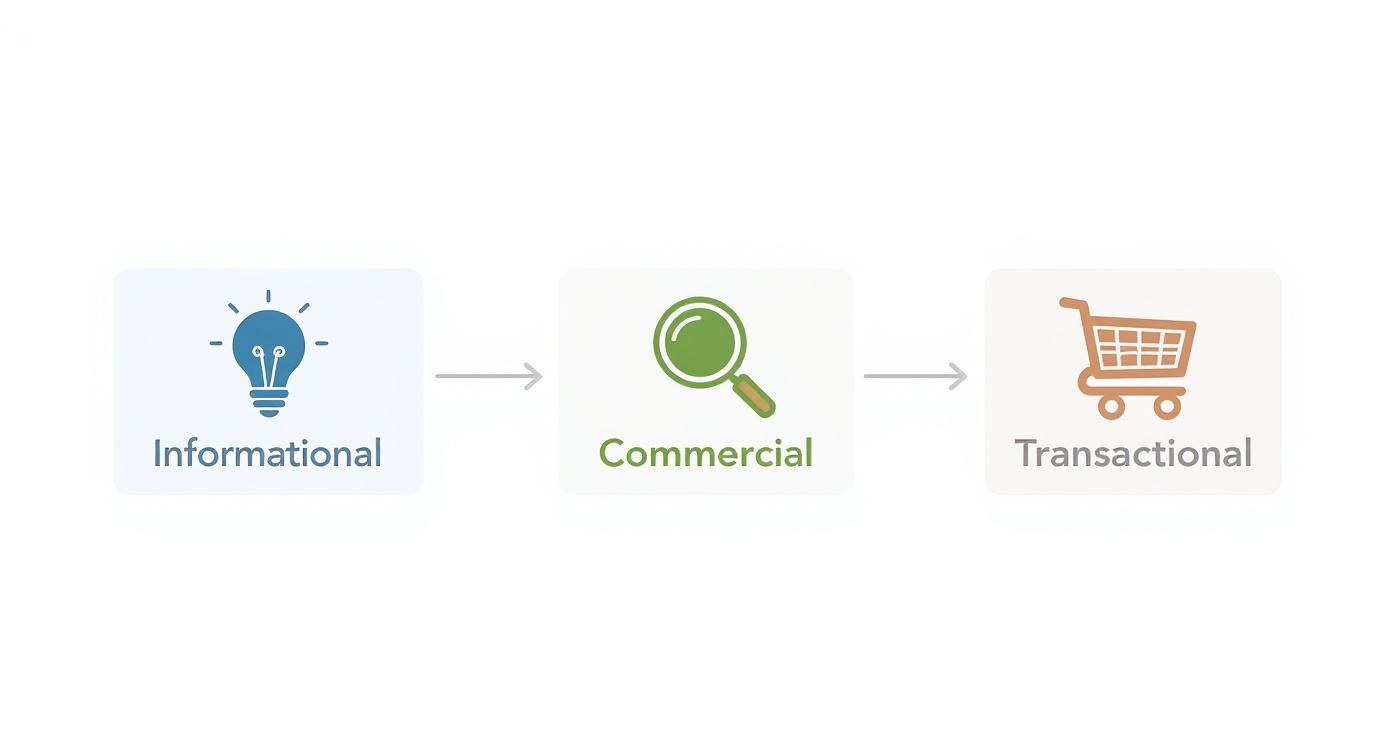
- Information-oriented keywords: Here you build trust and authority by answering questions and explaining complex topics simply.
- Commercial keywords: This allows you to capture users who are already comparing different products or services.
- Transactional Keywords: These are aimed directly at users who are about to make a purchase decision or make contact.
A well-thought-out approach to keyword research is an absolutely crucial step in improving your Google ranking. For a more comprehensive strategy, see this. Guide to improving your Google ranking many more valuable tips.
This understanding is a crucial building block for truly mastering the fundamentals of SEO and securing long-term success. If you'd like to delve deeper into the subject, our article on this topic offers further insights., what SEO is and how you can implement it immediately, an excellent basis.
Deciphering the search intent of your target audience
A huge keyword list is a good start, but it's really only half the battle. The true key to success lies in understanding the intent behind the search. Ask yourself: Why is someone typing these exact words into Google? What is the underlying need, problem, or question?
If you can't answer these questions, you're essentially optimizing for nothing. You might create content that attracts visitors, but that traffic won't convert. Why? Because the content simply doesn't resonate with users at their current stage of the customer journey. It's like offering a marathon runner an energy bar just before the finish line when they're really just looking to cross it.
The four types of search intent
In practice, almost every search query can be assigned to one of four main categories. Knowing these categories is crucial for creating the right content for the right people.
Informational (informative): The user is thirsty for knowledge. They want a question answered, to learn something, or to understand a problem. Classic searches include "what is a residual current device (RCD)" or "how to build a garden pond".
Navigational: Here, the user knows exactly where they want to go – they're just using Google as a springboard. Typical examples are "linkitup login" or simply "facebook" to go directly to the page.
Commercial: The user is in buying mode, but still in the research and comparison phase. Keywords like "best cordless screwdriver test" or "SEO agency Kaiserslautern comparison" fall precisely into this category.
Transactional: Now things are getting serious. The user is ready to take action – be it a purchase, a registration, or contacting the company. Search queries like "buy Nike Air Max 43" or "request a free SEO audit" are a clear indication of this.
The key is not just to know, What someone is looking for Why. A user who googles "coffee machine test" needs a well-founded comparison article, not a clumsy product page. Someone who enters "buy Delonghi Magnifica S," on the other hand, wants to get to the shopping cart as quickly as possible.
Why this is so crucial
This distinction is far more than just abstract theory. It determines whether your content is perceived as helpful or simply annoying. In our experience, German users employ very different formulations depending on their intention. Some studies by SEO experts even suggest that up to 70 % of the traffic potential The growth of an online shop can be achieved through content precisely targeted at transactional keywords. If you would like to delve deeper into the topic, this [link to relevant information] Detailed keyword research guide on wambo.com More exciting insights.
In short: The correct allocation of your keywords has a direct impact on your sales.
The following table shows some typical examples of how this manifests itself in practice.
Practical examples of search intent
This table shows how keywords differ depending on user intent and which content format best suits each.
| Search intent | Keyword example | User intent | Suitable content format |
|---|---|---|---|
| Informational | „"How does a heat pump work?"“ | The user wants to understand the principle without wanting to buy immediately. | Blog article, advice page, explainer video |
| Commercial | „"Best heat pump for old buildings"“ | The user compares options for a specific situation. | Comparison article, test report, case study |
| Transactional | „buy heat pump [brand name]“ | The user has made a decision and is looking for a provider. | Product page, landing page with purchase option |
| Navigational | „[Manufacturer Name] Login“ | The user wants to access their customer account. | The login page itself |
It's immediately clear: Every intention requires a completely different kind of content.
Finding your customers' language
To truly master search intent, you need to delve deep into the world of your target audience. How do these people talk about their problems? What questions do they ask in everyday life? Tools like AnswerThePublic Or the simple "Similar Questions" box in the Google results is an absolute goldmine for this.
Simply enter one of your main keywords there, for example "photovoltaics". You'll immediately be presented with a wealth of real user questions:
- How does it work A photovoltaic system? (Informational)
- Which Photovoltaic system for a single-family home? (Commercial)
- What costs A photovoltaic system with storage? (Commercial)
- Photovoltaic system where to register? (Informational)
These are precisely the perfect templates for your content strategy. Each of these points can form the basis for a blog article, an FAQ section, or a video that perfectly meets the needs of your potential customers.
So stop optimizing solely for the main keyword "photovoltaics." Instead, build an entire topic cluster around these specific questions. This way, you cover the entire customer journey, build trust, and position yourself as the expert people turn to when research turns into a purchase decision.
A tried and tested workflow with the right tools
Theory is all well and good, but in the end, only a process that works in practice and can be repeated counts. Let's get started: We're now going to build a comprehensive keyword list. I've developed a workflow for this that cleverly combines free and professional tools. This way, we get the most out of it without getting lost in data chaos.
It always starts with good old brainstorming. We need a solid foundation of so-called „Seed keywords“ These are the key terms that perfectly encapsulate your business. Let's take an electrician in Kaiserslautern as an example: Terms like "electrical installation," "fuse box replacement," or "wallbox installation" immediately come to mind.
The first reality check: Google Keyword Planner
Once this initial collection of ideas is complete, we need hard data. Gut feeling alone isn't enough. Here comes the Google Keyword Planner into play. Even though it's actually intended for Google Ads, it's invaluable for organic research – and it's free.
He gives us two crucial key figures:
- Average monthly search volume: How often is a term actually searched per month? That's the best indicator of demand.
- Competition: Although the rating (low, medium, high) refers to paid advertisements, it gives a good initial idea of how competitive a topic is organically.
It is no coincidence that over 80 % German SEO professionals use the Keyword Planner as an integral part of their strategy. It not only provides reliable data for the German market but also helps to accurately assess potential. Studies indicate that German companies that consistently use the tool increase their organic traffic by an average of [amount missing]. 25 % can increase this. More on this You can find effective use of the Google Keyword Planner on netspirits.de.
This is what the interface looks like when you want to find new keyword ideas:
You feed the tool your own ideas and in no time you get a list of related search queries, including important data on search volume and competition.
Unlock hidden potential: the Google Search Console
Now things get really exciting. We're turning to one of the most powerful, yet often neglected, tools: the Google Search Console (GSC). It shows you exactly which search queries your website is already appearing for in Google results – including impressions and clicks.
This is a real goldmine. Here you'll find keywords for which Google already considers your page relevant, but for which you might only rank in positions 5 to 20. These are the famous ones. „Quick Wins“. By strategically optimizing the relevant page, you can often push these terms to the first page relatively quickly. This method is particularly effective for WordPress sites, where adjustments can be implemented rapidly. Read more about this in our guide on... targeted WordPress SEO optimization.
The Google Search Console doesn't show you what you're ranking for. want, but for what you already be seen. This is the most honest way to find untapped potential and to specifically improve existing content.
Spying on the competition: How to uncover keyword gaps
After analyzing our own data, let's look beyond our own horizons. What are our competitors ranking for when we're not even visible yet? To find out, we need a professional SEO tool like... SISTRIX, Ahrefs or Semrush.
These tools allow you to analyze any domain and obtain a detailed list of all the keywords it ranks for. This helps you quickly uncover gaps in your strategy and discover valuable ideas you might never have considered.
Pay particular attention to Long-tail keywords. These are longer, very specific search queries consisting of three or more words, for example, "cost of wallbox installation underground parking Kaiserslautern". While the search volume is lower, the search intent is crystal clear. Those searching this way have a specific problem and are often close to making a purchase decision – the conversion rate is usually significantly higher.
The master list: All threads come together
Finally, we bring order to the chaos. All the keywords we've gathered from brainstorming, the keyword planner, Search Console, and competitor analysis are fed into a central master list.
A simple table (e.g., in Google Sheets) is best suited for this. These columns have proven useful in practice:
- Keyword: The exact search term.
- Monthly search volume: The data from the keyword planner or your professional tool.
- Keyword Difficulty: A value from your SEO tool that estimates how difficult it is to rank for this term.
- Search intent: Your assessment (e.g., informational, commercial, transactional).
- Priority: A simple rating (e.g. 1-3) of how important the keyword is to your business.
This tried-and-tested workflow will give you a data-driven and comprehensive keyword list. This is the perfect foundation for your content strategy, ensuring you no longer have to guess, but can make informed decisions that bring you greater visibility and the right visitors.
Evaluate keywords and find the real potential
A long list of potential keywords is a great start, but the real work is just beginning. The trick is to filter out the true gold nuggets from this flood of data. Now it's a matter of deciding where to best invest your valuable resources – namely, time and budget.
This step often feels like sorting a giant jigsaw puzzle. You have hundreds of pieces in front of you, but which ones will ultimately form the picture you want? We find the answer with a systematic evaluation based on four key pillars.
The four pillars of keyword evaluation
To make an informed decision, we need to put each keyword through a strategic filter. Each of the following metrics gives us a crucial indication of a search term's true potential.
- Search volume: This is the most obvious metric. How many people search for this term each month? A high volume promises a lot of traffic, obviously. But be careful: it's far from the only factor that matters.
- Keyword Difficulty (KD): How strong is the competition? SEO tools like Ahrefs or SEMrush rate on a scale (often 0-100), how difficult it will be to land on the first page of Google. A high value usually means that established websites with strong authority claim the top positions for themselves.
- Cost-per-Click (CPC): How much are advertisers willing to pay for a single click on Google Ads? A high CPC is a strong signal of high purchase intent. Even if you don't run ads yourself, this metric tells you that there's often a paying customer behind the search.
- Relevance: This is the most important and, at the same time, the most subjective metric. Does the keyword truly fit your product, your service, your business model? A keyword can have a huge search volume – but if it doesn't match what you offer, you'll only attract the wrong visitors.
Keyword research is a fundamental component of search engine optimization (SEO) in Germany, and its importance is measured by search volume data. A keyword like "perennials" not only has a specific search volume for Germany, but often also differs for Austria and Switzerland. This data is crucial because it determines how many potential users search for a term each month, making it a key metric for prioritization. Learn more about... Strategic application of keyword data on sistrix.de.
How to develop your own keyword potential score
To make all these metrics tangible and comparable, developing your own "keyword potential score" has proven effective in practice. This sounds more complicated than it is. Essentially, you create a simple formula in your keyword spreadsheet (e.g., in Google Sheets) that weights the different values for you.
A simple but effective approach could look like this:
Potential score = (search volume / keyword difficulty) * relevance factor
The Relevance factor is a scale that you define yourself, for example from 1 to 5. A keyword that perfectly matches your core business gets a 5. A thematically related term, but less direct, perhaps a 2. This ensures that your business goals always remain the focus.
This score allows you to sort your entire list and objectively identify the keywords with the highest overall potential.
Distinguishing quick wins from strategic goals
Once you have prioritized your list in this way, you will quickly find that the keywords fall into two main categories:
- Quick Wins: These are the "low-hanging fruit." They typically have moderate search volume, low keyword difficulty (KD), and high relevance. With manageable effort, you can see initial success and improve your rankings fairly quickly.
- Strategic goals: These are the big fish – keywords with high search volume and fierce competition. Ranking for these terms is a marathon, not a sprint. They require excellent content, well-thought-out internal linking, and often the targeted building of backlinks. A solid Domain Authority is crucial in this regard., in order to prevail against the strong competition.
A balanced SEO strategy always considers both categories. Start with quick wins to gain momentum quickly, but work in parallel on the strategic goals that will bring you the greatest long-term growth.
Think in thematic clusters (pillar content structure)
The last, but absolutely crucial, step in prioritization is organization. Don't look at your keywords in isolation, but group them into thematic categories, the so-called keywords. Clusters. Here you summarize search terms that pursue a similar user intent.
Imagine you sell coffee machines. Instead of writing 50 individual articles for keywords like "best coffee machine", "coffee machine review" or "portafilter machine for beginners", take a more strategic approach:
- Pillar Page: You create a comprehensive main page, a large "coffee machine guide". This page covers the topic in its entirety and targets the main keyword (e.g., "buy coffee machine").
- Cluster Content: Around this, you create specific blog articles that target related long-tail keywords. For example, "Maintaining an espresso machine" or "Difference between Arabica and Robusta".
- Internal linking: Each of these specific articles then links back to the central pillar page.
This structure clearly signals to Google that you are a true authority in this field. You're not just building visibility for individual keywords, but for an entire topic area. This is sustainable SEO work that ultimately pays off.
Local keywords: How to get found in Kaiserslautern
For a local business – whether a tradesman, restaurant, or law firm – regional search is not a side issue. It's the decisive playing field. If someone in Kaiserslautern Googles "heating repair," they don't want to find a service provider from Hamburg or Munich. They need immediate help, right there in their own neighborhood.
This is precisely where local keyword research comes into play. It's about linking your services to specific locations to reach the people who are in your catchment area and are looking for a solution right now.
What makes a keyword "local"?
The simplest formula is clear: services plus city. But there's much more to it than that. To fully exploit the potential, we need to think in a much more granular way.
- Service + City: „"Tax advisor Kaiserslautern"“
- Service + District: „"Physiotherapy Kaiserslautern-Erlenbach"“
- Services + well-known places: „"Restaurant near the garden show"“
- Service + „near me“: „"Bike shop near me" (Google understands what is meant here based on the location)
These small additions are invaluable because they reveal a crystal-clear local search intent. Someone searching for "best Italian restaurant Kaiserslautern" is almost certainly planning their evening. A perfect opportunity to draw their attention to your pizzeria.
Here you'll find the best local search terms.
You don't have to guess what your customers are searching for. There are some real goldmines that will tell you which terms people in your region are actually typing.
One source that many overlook is the Suggestion feature in Google Maps. Simply enter your main service into the Maps search and take a close look at what Google suggests. These aren't random results, but are based on real, frequent search queries from users in the area.
My practical tip: Also take a look at local business directories like the "Yellow Pages" or niche portals for your industry. The categories and filters they offer often reflect how customers think and search for services. These terms should go straight onto your keyword list.
Understanding what customers really want
Local visibility is crucial for small businesses, especially for survival. The right keywords are key. A solid understanding of how to reach your local target audience online is the foundation for your success. This guide will show you how. SEO for small businesses It really works and you win over local Google search.
This strategic work helps you not just to get any traffic, but the right inquiries from customers ready to buy.
One tool you absolutely must not ignore is your own Google Business Profile (formerly Google My Business). The Performance data (or InsightsThis section is a treasure trove. Google shows you in black and white which search queries led users to your profile.
Take your time and analyze this list. You'll often find long-tail keywords and phrases that you would never have thought of yourself. For example, do you notice that many people search for "emergency [your service] Kaiserslautern"? Perfect, then create a dedicated subpage on your website that covers exactly this type of emergency.
This data doesn't show you what would theoretically be possible, but rather what your potential customers... right now Type in your search term to find a business like yours. Use these direct insights to refine your website copy, blog posts, and even the descriptions in your Google Business Profile. This will help you bridge the gap between what customers are searching for and what you offer.
Frequently asked questions about keyword research
Finally, I'd like to answer a few questions that I frequently encounter in practice. Consider this section a kind of cheat sheet, providing you with quick, practical answers to the typical hurdles in keyword research.
How often should I actually check my keywords?
Keyword research isn't a project you can complete once and then forget about. It's an ongoing process, because markets, your customers' search behavior, and of course Google's algorithms are constantly changing.
However, there are a few key moments where thorough research is essential:
- When launching a new website: This is the absolute foundation. Here you define the complete structure and content strategy.
- Before the kick-off of a new content campaign: Every new pillar page or topic cluster needs its own sharply focused keyword analysis.
- Quarterly or semi-annually as a routine check: Regularly reviewing the data helps you identify new trends, evaluate the performance of your current keywords, and refine your strategy.
As a rule of thumb, at least twice a year Schedule a comprehensive review of your entire keyword strategy. If you're in a very fast-paced industry, it can even be beneficial to review it monthly to truly stay on top of the latest trends.
High search volume or low competition – what should I focus on?
This is a classic SEO question, and the honest answer is: it depends. A truly effective strategy needs both.
Keywords with huge search volume are often very general terms, the so-called "head terms." Competing here is a marathon, not a sprint. It requires a lot of authority and truly outstanding content. Consider these terms as your strategic long-term goals.
On the other hand, we have keywords with manageable competition, mostly Long-tail keywords. These phrases may have lower search volume, but the search intent behind them is crystal clear. Users who enter such phrases are often much further along in the buying process, and the probability of a conversion is significantly higher. These are your "quick wins.".
The best tactic is a smart mix. Start with "quick wins" to see initial successes quickly and drive targeted traffic to your site. Then use these early successes to gradually build your website's authority and work your way towards the large, highly competitive keywords.
What do I do with these "zero-click searches"?
Zero-click searches have become the norm. These are searches where Google displays the answer directly in the search results, for example in a featured snippet or an AI-generated overview. Many informational queries therefore no longer necessarily lead to a click on a website.
Should you therefore ignore these keywords? Absolutely not.
- Visibility is pure branding: Even if no one clicks, being featured in a snippet positions your brand as an expert. Your name is directly associated with the solution to the problem.
- Relevance for voice search: Many of these direct answers are used by voice assistants like Siri or Alexa for their responses.
- The second click: Often, the answer in the snippet raises a new question, which then leads to a click on your page to delve deeper into the topic.
The trick is to structure your content so that it's optimized for snippets. Use clear questions as subheadings and provide a concise, direct answer in the first few sentences below.
What is more important: search volume or relevance?
There is no two opinions on this: relevance. Always.
A keyword can 100,000 monthly searches If the traffic isn't relevant to your product or service, it's worthless. Visitors will leave your site immediately. This drives up your bounce rate and signals to Google that your page obviously doesn't provide the right answer for this search query.
Relevance must be your decisive filter at every stage of keyword research. A keyword with perhaps only 50 monthly searches, A keyword that precisely describes the problem your product solves is infinitely more valuable than a generic, high-volume term. Always focus on acquiring traffic that is highly likely to convert into a customer – not just any traffic.
As you can see, professional keyword research is a complex process, but with the right knowledge and a clear strategy, it's absolutely achievable. If you want to accelerate this process and benefit from over 15 years of SEO expertise, then... LinkITUp Your partner. We develop a tailor-made strategy to sustainably increase your visibility. Start now with a free keyword check at seobuchen.com/.
Article created using Outrank