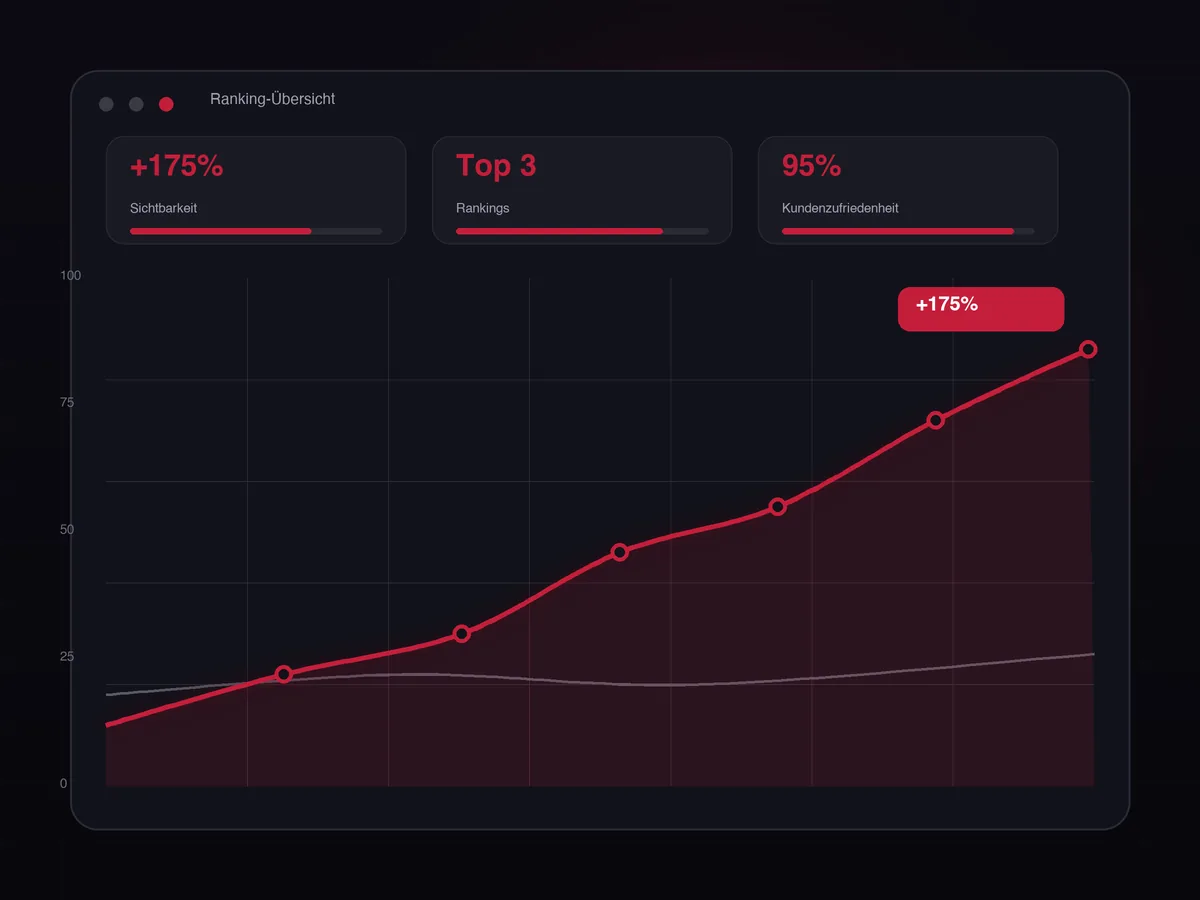
With a professional off-page strategy, you can sustainably strengthen the authority and credibility of your website. We build high-quality backlinks, develop strategic partnerships, and position your brand through content placements, thereby increasing your domain authority and improving your long-term Google ranking.
Contact us for a free, no-obligation analysis of your website.
We analyze the condition, structure, and backlinks of your website to identify problems and opportunities.
We find and analyze high-quality keywords to develop a targeted search strategy that will impact your industry.
We optimize content, meta tags, internal links and the page structure to improve relevance and readability for search engines.
We build high-quality white-hat backlinks through outreach, partnerships, and content placements to strengthen your domain authority.
Off-page strategy (also called off-page SEO) encompasses all measures taken outside of your own website that aim to strengthen your authority and trustworthiness in the eyes of search engines like Google. In contrast to OnPage-Optimization, which focuses on internal website elements, OffPage SEO focuses on external signals such as backlinks, brand mentions and social signals.
Link building is the cornerstone of any off-page strategy. High-quality backlinks from trustworthy websites act as endorsements, signaling to Google that your content is valuable and relevant. It's not just the quantity of links that matters, but above all, their quality: links from authoritative domains with high domain authority (DA) and thematic relevance carry significantly more weight.
A professional off-page strategy ensures that your website is perceived as trustworthy and influential. The result: higher domain authority, better rankings for competitive keywords, and sustainable organic traffic growth.
Backlink quality: Not all backlinks are created equal. Google evaluates links based on quality, not just quantity. High-quality backlinks come from trusted domains with high domain authority (DA), thematic relevance to your website, and organic traffic. A single link from an authoritative site like Spiegel.de or an industry-leading website can be worth more than hundreds of links from low-quality directories.
Thematic relevance: Links from websites in your industry or related subject areas carry significantly more weight than links from thematically irrelevant sites. Google recognizes the context and evaluates backlinks accordingly. A backlink from a marketing specialist website to your SEO agency is more valuable than a link from a completely unrelated website.
Anchor text optimization: The anchor text (the clickable text of a link) gives Google clues about the content of the linked page. Natural anchor texts with variations of brand names, keywords, and generic terms like "click here" appear authentic. Over-optimized anchor texts with exact keywords can be perceived as manipulative and lead to penalties.
Link diversity: A natural backlink profile consists of various link types: guest posts, directory listings, press releases, infographic placements, partnerships, and organic mentions. One-sided link sources (e.g., only comment links) appear unnatural.
The cost of an off-page strategy depends on the competitive landscape, the target keywords, and the quality of the desired backlinks. Targeted link building with high-quality, thematically relevant links is possible even with a manageable budget. More comprehensive off-page strategies involving guest posts, digital PR, and brand signals require a greater ongoing investment.
👉 You can find more details about structured link building on our Link Building & Backlinks page.
Off-page optimization measures don't work immediately. Initial effects are usually visible after a few weeks, while stable ranking improvements typically occur after 2–4 months. Consistency, link quality, and a sound technical foundation for the website are crucial.
👉 This requires solid on-page optimization, which we will check beforehand.
Yes. High-quality backlinks remain among the strongest ranking factors. The decisive factor is not the number, but the relevance, naturalness, and thematic fit of the linking pages. Inferior or artificial links, on the other hand, are counterproductive.
👉 That's why we focus exclusively on high-quality, sustainable link building.
Off-page SEO is usually essential for local service providers, e-commerce shops, and highly competitive keywords. However, for new websites, off-page optimization should only begin once the content and technical aspects are properly set up.
👉 Have your website checked in advance or contact us for an honest assessment.
Particularly effective off-page techniques include high-quality guest posts on relevant blogs, digital PR campaigns with placements in trade magazines and news portals, and broken link building, where broken links are replaced with your own content. The relevance and quality of the target pages are crucial.
👉 You can find more information about sustainable link building on our Link Building & Backlinks page.
To measure the success of an off-page strategy, monitor key metrics such as ranking improvements for your target keywords, increases in organic visitors and referral traffic, and the number and quality of new backlinks. Metrics like Domain Authority and Trust Flow also help with the evaluation.
👉 For an individual performance evaluation, please feel free to contact us.
Guest contributions (Guest PostingGuest posts on thematically relevant blogs and specialist portals are one of the most effective white-hat link-building strategies. They not only provide valuable insights but also... Backlinks, But also position yourself as an expert in your industry. Focus on high-quality landing pages with organic traffic and genuine readership – not link farms.
Digital PR & Online Press Releases: Professional Digital-PR Place your brand in trade magazines, news portals, and industry publications. Press releases about product launches, studies, or events generate high-quality backlinks from authoritative news sites. Tools like HARO (Help A Reporter Out) connect you with journalists seeking expert opinions.
Broken Link Building: Identify broken links on thematically relevant websites and offer your content as a replacement. This win-win strategy helps webmasters improve their pages while you gain valuable backlinks. Tools like Ahrefs and SEMrush help you find broken links.
☑ Analyze backlink profile (check existing links, identify toxic links)
☑ Research competitor backlinks (where do competitors get their links?)
☑ Create link-worthy content (comprehensive guides, studies, infographics)
☑ Identify guest post opportunities (relevant blogs, specialist portals)
☑ Create an outreach list (contacts to webmasters, bloggers, journalists)
☑ Compose personalized outreach emails (not mass emails)
☑ Perform Broken Link Building (find defective links, offer replacements)
☑ Launch digital PR campaigns (press releases, HARO, journalist outreach)
☑ Create and distribute infographics (visually appealing, shareable)
☑ Apply the skyscraper technique (create better content than competitors)
☑ Contact resource pages (link placement on topic-relevant lists)
☑ Use industry directories (reputable, thematically relevant directories)
☑ Build partner and supplier links (use business relationships)
☑ Generate social signals (social media shares, engagement)
☑ Monitor brand mentions (turn unmentioned brand mentions into links)
☑ Submit testimonials and reviews (receive a link from the provider's website)
☑ Podcast appearances and interviews (backlinks from show notes)
☑ Host webinars and online events (backlinks from participant websites)
☑ Strengthen EAT signals (Expertise, Authority, Trustworthiness)
☑ Maintain a disavow file (reject toxic backlinks in Google)
☑ Pay attention to link velocity (natural link growth, no spam signals)
☑ Ensure anchor text diversity (mix brand, keywords, and generics)
☑ Use link building tools (Ahrefs, SEMrush, Moz for monitoring)
☑ Measure backlink performance (referring domains, domain authority, traffic)
Successful off-page SEO requires continuous monitoring and analysis. The right tools and metrics help you measure the ROI of your link-building strategy, identify opportunities, and detect toxic links.
Ahrefs: Ahrefs is one of the most powerful backlink analysis tools. It offers detailed insights into your backlink profile, shows new and lost links, assesses domain authority (DR), and identifies competitor backlinks. The Site Explorer feature shows exactly which pages receive the most backlinks.
SEMrush: SEMrush offers comprehensive off-page metrics such as Authority Score, referring domains, and backlink types. The backlink audit tool identifies toxic links and helps create disavow files. The link building tool finds potential link sources.
Moz Link Explorer: Moz evaluates websites using Domain Authority (DA) and Page Authority (PA). The Link Explorer displays spam score, anchor text distribution, and the quality of your backlinks. Moz's MozBar browser extension enables quick, on-the-fly analysis.
Google Search Console: Google's free tool shows your most important backlinks and identifies problems. The links report displays top linking sites, most frequently linked pages, and anchor text data directly from Google.
Majestic SEO: Majestic specializes in historical backlink data using Trust Flow and Citation Flow metrics. The tool shows the development of your link profile over time and identifies thematic relevance.