




Online marketing is no longer optional for SMEs, but essential. It's the engine that drives growth and visibility. Instead of throwing money at expensive ads and hoping someone will bite, you can reach the exact customers who are actively searching for you in a targeted and cost-effective way. And the best part? The results are measurable.
Why online marketing is indispensable for SMEs today
Imagine having a sales representative who never sleeps. They work 24/7 for your company, precisely targeting the right people, answering their initial questions, and directing them straight to you. That's exactly what modern online marketing for small and medium-sized enterprises (SMEs) is all about.
Previously, huge advertising budgets were needed just to get noticed – often with enormous wastage. Today, the playing field has completely reversed. Thanks to digital channels, even businesses with smaller budgets can target their audiences with a precision that was previously unimaginable.
The new reality for small and medium-sized enterprises (SMEs)
The way customers shop has fundamentally changed due to digitalization. Potential buyers Google solutions, compare offers on their smartphones, and read reviews before spending a single cent. Those who aren't visible at these crucial moments simply don't exist for a large part of the market.
This isn't a threat, but a huge opportunity. Online marketing for SMEs is key to being present at these digital touchpoints and positioning yourself as the best solution. It's not about doing everything at once, but about finding the right levers that will make the biggest difference to your success.
Specifically, this means for you:
- Targeted customer approach: You reach exactly the people who are interested in your products or services – based on their hobbies, where they live, or what they are currently looking for.
- Measurable successes: Every euro invested is traceable. You can see in black and white which measures are working and where there is still room for improvement.
- Cost efficiency: Compared to traditional methods like print ads or radio spots, you can often get significantly more out of your budget online. The return on investment (ROI) is simply better.
The true strength of online marketing lies not in shouting louder than the competition, but in having smarter conversations with the right people.
A necessity, not a luxury
Recent figures also demonstrate the importance of a strong digital presence. A Bitkom study shows that while SMEs have recognized the value of online marketing, they often hesitate to implement it. Yet they are making significant strides. 99 % of all companies in Germany! For these businesses in particular, advertising that addresses genuine customer needs is not a gimmick, but an economic necessity to maximize results with limited resources. Those who want to delve deeper will find fascinating information. Findings from the Bitkom study.
The decision to invest in online marketing is therefore no longer a question of "if," but only of "how." It is the foundation for remaining competitive, acquiring new customers, and building strong, lasting relationships with them.
The most important building blocks of your online marketing strategy
Online marketing can quickly seem overwhelming, like a giant puzzle with countless pieces. The good news for you as an SME is: you don't need to know every single piece to be successful. It's perfectly sufficient to focus on the four crucial building blocks that lay the foundation for solid growth.
These four pillars are not lone wolves, but a team. Understanding how they work together allows you to make informed decisions, use your budget wisely, and develop a strategy that truly fits your business.
This diagram illustrates how the core objectives of online marketing – greater visibility, the right target audience and ultimately more revenue – directly contribute to the success of your business.
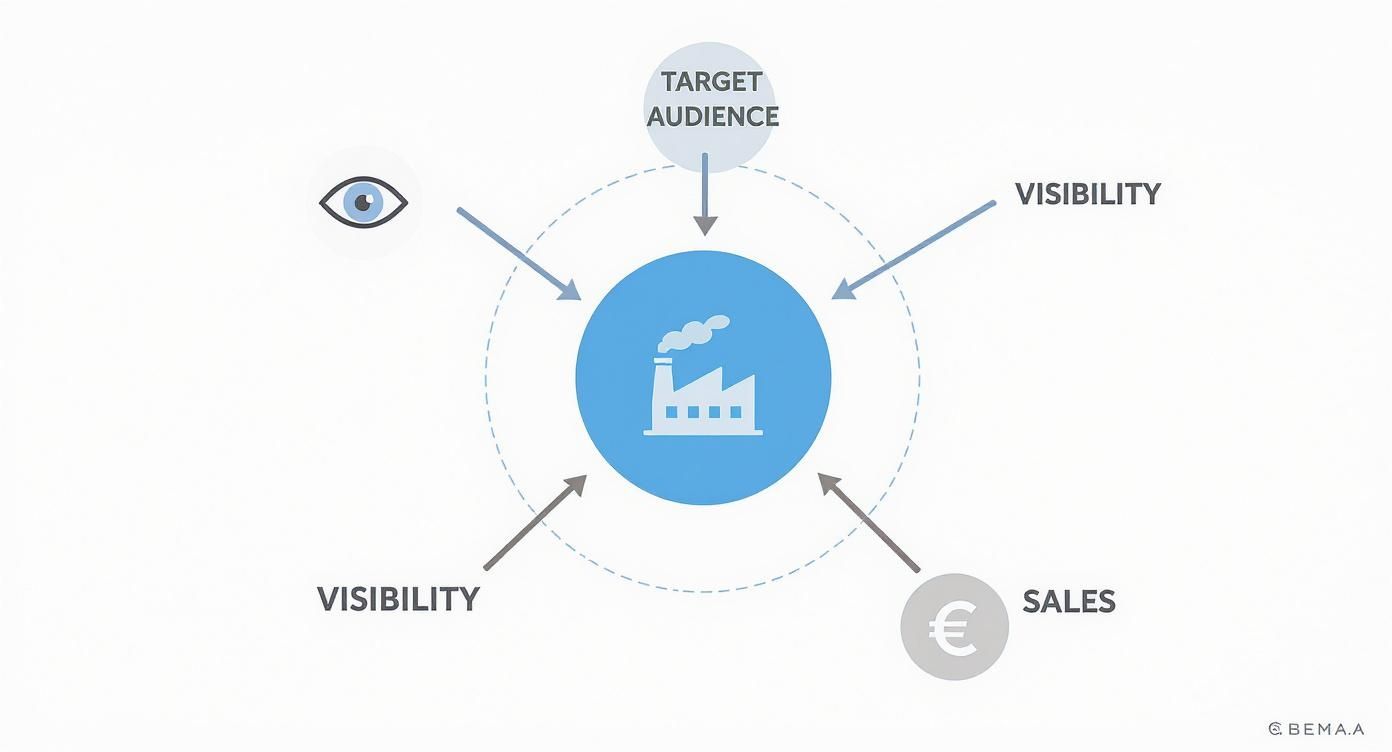
Each of the following building blocks contributes in its own way to achieving these central business objectives.
Search Engine Optimization (SEO): The Marathon
Think of search engine optimization (SEO) as building an excellent reputation in your industry. This doesn't happen overnight. It's a long-term process based on trust, quality, and consistency. You invest time and effort to make your website as relevant and helpful as possible for your customers.
The goal? When someone searches Google for "tax advisor Kaiserslautern" or "bathroom renovation contractor," your website should appear in the top, organic search results. This process requires patience; it often takes time. three to six months, until you see clear results. But the effort is worth it a thousand times over, because a good ranking brings you a steady stream of free, highly relevant visitors to your site.
SEO is the marathon in Online marketing for SMEs. It creates sustainable visibility and builds a stable foundation that will secure valuable customer inquiries for you for years to come.
Search engine advertising (SEA): The sprint
In direct contrast to this is search engine advertising (SEA), usually in the form of Google Ads. This is the sprint. Imagine it as a perfectly placed advertisement on the city's busiest shopping street. You pay for your ad to appear at the exact moment someone is actively searching for your product or service.
With SEA (Search Engine Advertising), you can become visible within hours or a few days. You set a budget, choose your keywords, and specifically target potential customers who already have a high purchase intent. The average click-through rate (CTR) across all industries is... 3,17 %, which shows how effective these ads can be.
SEA delivers immediate visibility and fast, measurable results. It's the perfect tool for generating leads in the short term, testing new offers, or managing seasonal demand peaks.
The catch is: as soon as you stop paying, your ad disappears. That's precisely why SEA works best hand in hand with a long-term SEO strategy.
Social media marketing: Building relationships
Social media marketing is less about direct sales and more about building a community and strengthening your brand. Platforms like Facebook, Instagram, LinkedIn, and XING are essentially like a local marketplace or club meeting – a place where you can easily connect with potential customers.
Here you can showcase the human side of your company, share behind-the-scenes glimpses, offer helpful tips, and build a loyal following. Social media is ideal for building trust and emotionally connecting your target audience to your brand.
It's about cultivating authentic relationships. An active and engaging presence on social media can significantly boost customer loyalty and expand your reach organically if your content is shared willingly.
Content marketing: Demonstrate expertise
Content marketing is the glue that holds all the other building blocks together. It's the art of creating valuable, relevant, and consistent content to attract and retain a clearly defined target audience in the long term. Think of helpful blog articles, tutorials, videos, or case studies of your successful projects.
Good content answers your customers' questions, solves their problems, and subtly positions you as an expert in your field. This content fuels your SEO strategy, provides material for your social media channels, and can be perfectly reused in email newsletters.
A professional online presence is the cornerstone of any digital strategy. Here's an example of a minimalist website for consulting firms, which can serve as an important building block for service providers. Such sites truly come alive and become compelling through high-quality content. Content marketing, therefore, isn't a separate discipline, but rather the heart of your entire digital presence.
To give you a better overview of how these channels could work for you in practice, we have summarized the most important points in a table.
Overview of the most important online marketing channels for SMEs
A comparison of the central channels with regard to their main objectives, time horizon for results and typical use cases for small and medium-sized enterprises.
| channel | Main goal | Time horizon | Ideal for SMEs that… |
|---|---|---|---|
| SEO | Sustainable, organic visibility & trust | Long-term (3-12 months) | …want to build a stable foundation for continuous inquiries. |
| SEA | Rapid lead generation & targeted sales | Short-term (hours to days) | …need immediate results, want to promote campaigns or test new markets. |
| Social Media | Brand awareness & community building | Medium to long term | …want to build a personal relationship with their target audience and promote brand loyalty. |
| Content | Demonstrate expertise & inform target audience | Medium to long term | …to position themselves as thought leaders and create the basis for all other channels. |
Each of these channels has its strengths, but the true magic unfolds only when they are strategically combined.
Targeted acquisition of regional customers through local marketing
For many small and medium-sized businesses, business doesn't take place anonymously somewhere on the internet, but right on their doorstep. Whether bakery, craft business, or law firm – they all depend on customers from the immediate vicinity. This is precisely where local marketing comes in. It's the most powerful tool for reaching these ready-to-buy consumers.
Think of it like a digital lighthouse: when someone in your city searches for your services, local marketing ensures your business shines brightly and is impossible to miss. The goal is clear: to appear at the top of Google search results and on maps like Google Maps when someone makes a local search query – for example, "hairdresser in Kaiserslautern".
The heart of local visibility: the Google Business Profile
The most important and free building block for your local success is this. Google Business Profile (formerly known as Google My Business). It's your digital business card directly in Google Search and on Google Maps. For many potential customers, a well-optimized profile is the very first point of contact with your business.
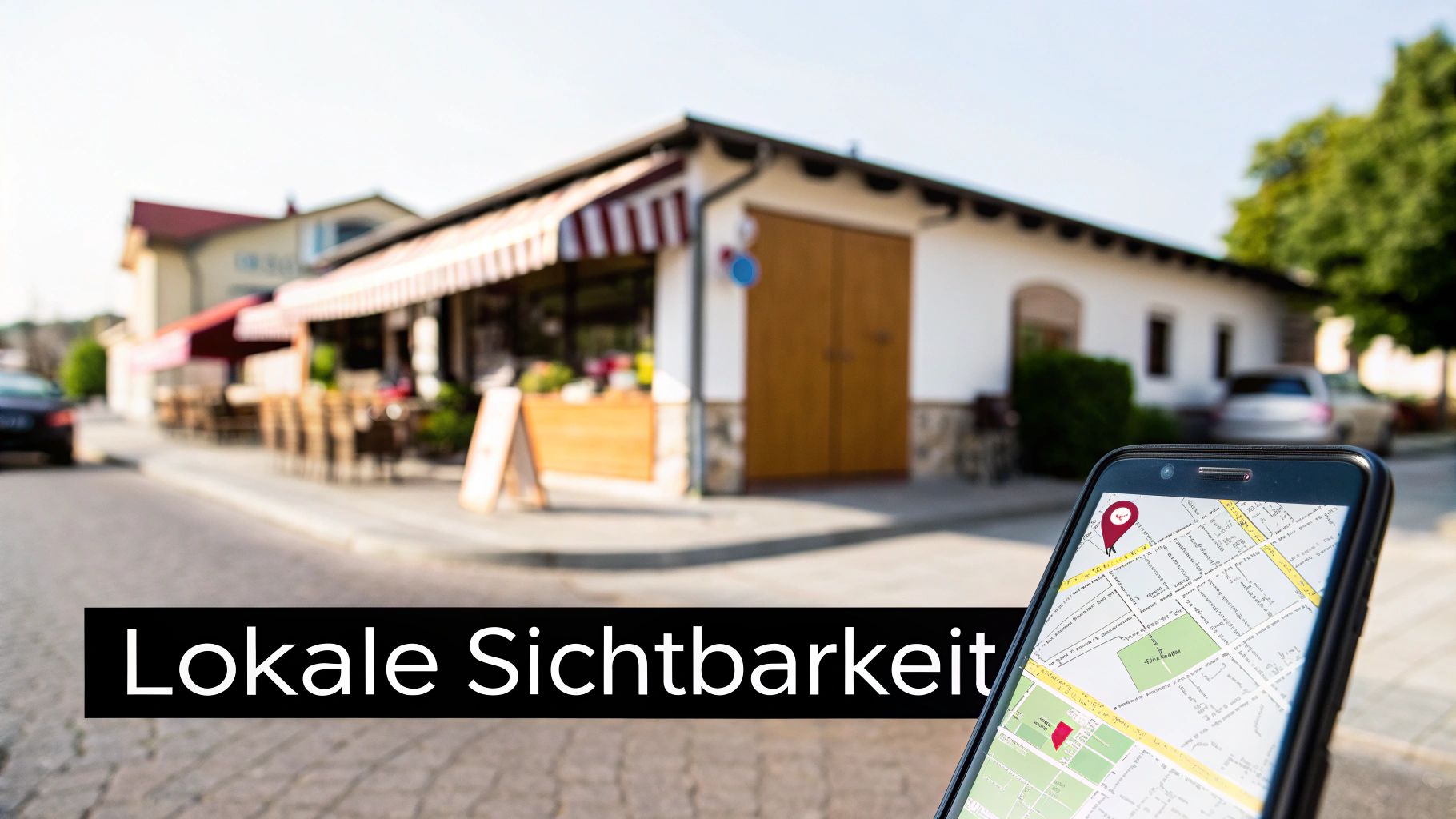
This profile provides customers with all the crucial information at a glance: address, opening hours, telephone number and, of course, the all-important customer reviews.
To fully exploit its potential, simply creating the entry is not enough. It must be actively maintained.
- Complete and accurate data: Enter your current opening hours, the exact address, and a correct phone number. Nothing is more frustrating for a customer than outdated information.
- Meaningful photos: Show pictures of your business, your team, and your products or services. This builds trust and gives your company a face.
- Actively manage customer reviews: Positive reviews are pure gold. Actively ask satisfied customers for a review and respond professionally to all feedback – even critical feedback.
A well-maintained Google Business Profile is not a nice extra, but the absolute foundation for any small or medium-sized enterprise (SME) with a local customer base. It is the simplest and most effective way to be found in local search results.
If you would like to delve deeper into the subject, you will find detailed steps on how to do this in our guide. Register your business on Google Maps and set it up optimally.
Local SEO as a growth engine
In addition to your Google profile, optimizing your website for local search terms is also part of local SEO. This means clearly communicating the region you operate in on your website. Use place names in headings and text, for example, "Bathroom renovation in Berlin" instead of just "Bathroom renovation".
This targeted approach is paying off. The economic importance of digital marketing is growing rapidly, and local businesses are a crucial part of this. Current analyses show that for every euro invested in digital marketing, there is a revenue of approximately... 2.50 euros This generates [value/efficiency]. This significantly increases the efficiency and competitiveness of German SMEs.
By combining a strong Google profile with targeted local SEO, you ensure that you are visible precisely when customers in your area are searching for a solution. This gives you a decisive advantage over the competition.
Plan and use your marketing budget intelligently
The budget question – for many small and medium-sized enterprises, it's the biggest hurdle on the road to online marketing. Understandably so, because the fear of investing large sums without a guarantee of success runs deep. But here's the good news: Successful Online marketing for SMEs It doesn't have to cost the earth. It just needs to be intelligently planned.
Don't see your budget as a rigid cost block, but rather as a flexible tool. It's about directing every euro precisely where it will have the greatest impact. Instead of blindly throwing large sums of money around, a strategic, step-by-step approach is the true key to success.
So, how much budget is enough?
There's no one-size-fits-all answer, but there is a clear method to determine the right amount for your company. A recent digitalization study reveals a major challenge for small and medium-sized enterprises (SMEs): 84 % of the SMEs They indicate that the costs of digitalization are higher than expected, and alarming. 72 % They haven't even budgeted for it. You can find out more in the Results of the 2024 Digitalization Study.
Don't let such numbers discourage you. Instead, start small and focus.
- Set yourself a clear, manageable goal: For example, do you want to receive ten new inquiries through your website in the next 30 days?
- Select a measurable channel: Google Ads or a highly targeted Facebook campaign are perfect for getting started. Even small daily budgets can help you achieve results. 10 to 20 € get started.
- Measure what happens: Track very closely how many clicks, inquiries, or even sales your small test budget ultimately generated.
This approach transforms your marketing expenses from a difficult-to-calculate risk into a tangible, plannable investment.
Use the Pareto principle for your marketing
The Pareto principle, better known as the 80/20 rule, This is the perfect model for SMEs with limited resources. At its core, it states that often already 20 % of the effort for 80 % of the results What does this mean for your marketing? Identify the few channels and measures that have the greatest impact on your business.
Instead of trying to be everywhere at once, focus your budget and time on the truly promising activities. Is it local SEO that brings you the best customers? A perfectly targeted ad for a niche market? Or perhaps that one informative blog post that consistently attracts new leads?
The key to an efficient marketing budget isn't spending more money. It's allocating the available funds more wisely – specifically to the few activities that truly matter.
Once you've identified these "winners," scale your budget accordingly. This ensures that every extra euro you invest makes the maximum contribution to your business success.
Keep a close eye on the return on investment (ROI).
The most important compass for the success of your marketing expenditures is the Return on Investment (ROI). He answers the one crucial question: How much revenue did you generate for every euro invested? If the ROI is positive, your marketing efforts are profitable. It's that simple.
The calculation is simpler than it sounds. You simply compare the profit a campaign generated to its costs. This way, you see in black and white which activities are worthwhile and which are just a waste of money. To use your budget effectively, you also need to be smart about procuring tools and services. A little tip: Learn how to... Shop online like the pros – at great prices!, in order to conserve resources.
A deep understanding of ROI helps you make data-driven decisions and continuously optimize your budget. If you'd like to learn more about how to calculate and leverage this key metric, we recommend reading our comprehensive article on ROI. Return on investment in marketing. This ensures that your money is not simply spent, but invested profitably.
Making the success of your online marketing measurable
Marketing without clear figures is like driving in thick fog – you vaguely hope to reach your destination, but you're really just groping in the dark. That's precisely why measuring key performance indicators (KPIs) is so important. Online marketing for SMEs Not a complicated luxury, but your absolutely essential compass. This is how you transform pure guesswork into a strategy based on hard facts.
The goal is not to drown in an ocean of data. The real art lies in focusing on the handful of key performance indicators (KPIs) that clearly show you what works and what doesn't.
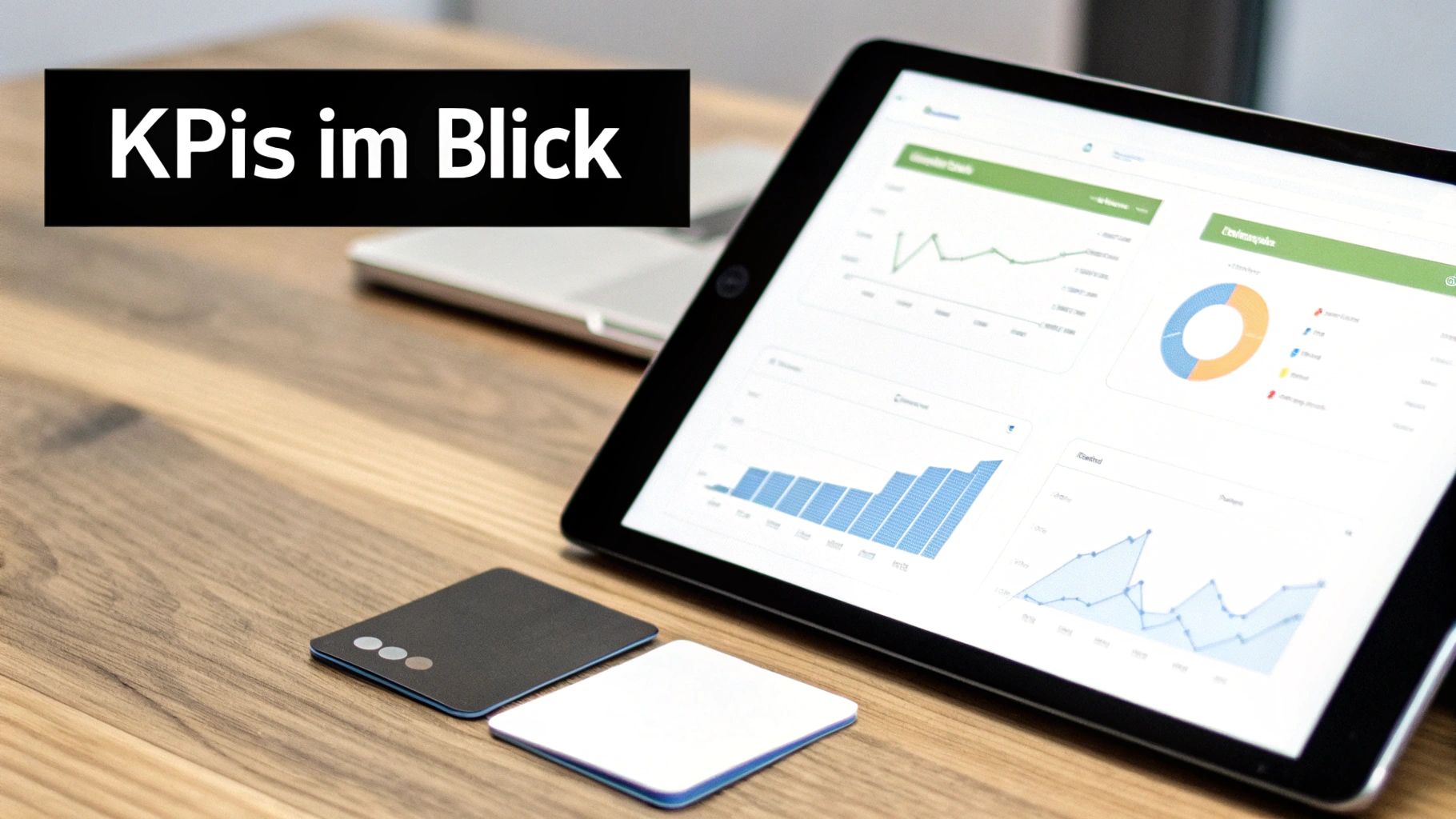
These so-called Key Performance Indicators (KPIs) are the pulse of your marketing. They help you to use your budget intelligently and to improve your strategy step by step.
Understanding the most important KPIs for each channel
Every marketing channel operates differently and has its own key performance indicators (KPIs). Instead of struggling with endless lists, we focus on the 3-5 most important KPIs per channel that truly matter to you as an SME.
For your website and SEO:
- Website traffic (number of visitors): How many people find their way to your site? A steady increase is the best sign that your visibility is growing.
- Conversion rate: What percentage of visitors do exactly what you want them to do (e.g., call, fill out a form)? This is the ultimate measure of your website's persuasiveness.
- Keyword rankings: For which search terms do you rank on the first page of Google? That's direct proof of the success of your SEO work.
KPIs are far more than just numbers on a screen. They tell you the story of whether your investments are paying off or whether it's time to correct course.
For paid advertising (SEA/Google Ads):
- Cost per click (CPC): On average, what does it cost you when someone clicks on your ad? This figure is crucial for monitoring the efficiency of your campaigns.
- Click-Through Rate (CTR): How many people who see your ad actually click on it? A high CTR (across all industries) 3,17 % (a solid value) shows that your message is getting through.
- Cost per acquisition (CPA): What is the bottom line cost for a new customer inquiry or a sale? This is the most important metric for assessing the profitability of your advertising.
If you would like to delve deeper into this topic, take a look at our article which covers the most important points. KPIs in SEO Explained in detail.
Build a simple dashboard with free tools
You don't need expensive specialized software to keep track of everything. A powerful and, above all, free tool like... Google Analytics This is perfectly sufficient to get started. It allows you to monitor most of the mentioned KPIs in one central location.
Set up a simple dashboard that shows you the most important developments at a glance.
- Link your website using Google Analytics to analyze visitor traffic and user behavior.
- Define goals in Analytics. A "goal" could be submitting a contact form or clicking on your phone number. This makes your conversion rate measurable.
- Use the Google Search Console. This tool is essential for tracking your keyword rankings and click-through rates from organic search.
With a dashboard like this, you'll no longer make decisions based on gut feeling. You'll see in black and white which blog articles attract the most readers, which ads bring in the best customers, and where it's truly worthwhile to increase your budget. This makes performance measurement your most powerful tool for sustainable growth.
Internal team or external agency – which is the right way for you?
Once your strategy is in place, the crucial question arises: Do we handle our online marketing ourselves or bring in professionals? This decision is one of the most important turning points for your SME. It involves your budget, your time, and how quickly you'll actually see results. There's no one-size-fits-all solution, but by honestly weighing the pros and cons, we'll find the right path for your business.
You can think of it a bit like building a house: Do you build it yourself or hire an architect and a construction company? Both lead to the goal, but the path there couldn't be more different – in terms of know-how, time required, and of course, costs.
Building your own marketing team
Building your own team often feels like the right thing to do. You directly integrate knowledge into the company and have people on board who know your products, your culture, and your customers inside and out. This close connection is invaluable because it leads to authentic campaigns that truly hit the mark.
In the long run, a well-established in-house team can be extremely effective. Communication channels are short, and decisions are made quickly. But the path to achieving this is often arduous and involves considerable costs.
- High initial investment: Finding, hiring, and training good people costs not only money but also an enormous amount of time. Salaries, social security contributions, and the necessary technical equipment are fixed costs that tie you up long-term.
- Limited specialized knowledge: Let's be honest, there's no such thing as a jack-of-all-trades in marketing. One person can't possibly be an SEO expert, a Google Ads specialist, a social media guru, and a gifted copywriter all at once. So you'd either have to make compromises or hire several specialists.
- The curse of continuous learning: The digital world is moving incredibly fast. What works today is outdated tomorrow. To stay ahead, continuous training is essential – and that costs time and money.
Collaboration with an external agency
Bringing a specialized agency on board is often the shortcut to professional results. You essentially gain overnight access to an entire team of experts who have mastered their craft for years and bring proven processes to the table. A good agency also thinks outside the box and brings valuable experience from your or similar industries.
This approach offers you one thing above all: flexibility. You book exactly the services you need at any given time and can adjust the scope at any time.
Working with an agency is like a turbocharger for your marketing. You get concentrated expertise and efficient processes that immediately translate into more horsepower on the road.
The biggest advantages at a glance:
- Access to an entire team of experts: You benefit from the expertise of a wide range of specialists – from SEO tinkerers to SEA strategists and social media managers.
- Cost and time savings: You save yourself the entire effort of recruiting employees and the ongoing costs of salaries and training. Often, the complete package is cheaper than a single, full-time marketing manager.
- The valuable outside perspective: An agency brings a fresh perspective, asks the right questions, and discovers potential that one is often blind to.
Ultimately, the decision depends on your goals, your budget, and the people you already have on board. Carefully consider which path will not only get you to your destination faster, but also more sustainably.
Frequently asked questions about online marketing for SMEs
Getting started with online marketing often raises a lot of questions, especially for small and medium-sized businesses. This is perfectly normal. To make your first steps easier and clear up typical uncertainties, we have summarized the answers to the most important questions here in a clear and understandable way.
How much budget should I, as an SME, allocate?
Unfortunately, there's no single golden rule here, but the best approach is: start small and grow smartly. Begin with a manageable test budget for a channel that promises quick results. For example, you could consider... Google Ads or targeted advertising on social media.
Then take a close look at what this initial test run yielded. Did it generate clicks, inquiries, or even sales? Great. Then gradually invest more in the measures that deliver the best return on investment (ROI). Ultimately, it's not the size of your initial budget that matters, but how cleverly you use it based on real data.
Which online marketing channel is best for my business?
The "best" channel is always the one where your target audience is active. So don't ask yourself what's currently trending, but rather: Where do my ideal customers spend their time online and where are they looking for exactly what I offer?
Two common scenarios help with orientation:
- Business-to-Business (B2B): If you want to acquire other companies as customers, professional networks like LinkedIn and solid search engine optimization (SEO) is often worth its weight in gold.
- Business-to-Consumer (B2C): When it comes to end customers, visual platforms such as Instagram and Facebook their full effect. Also, strong local visibility via the Google Business Profile This is usually a real lever.
Analyzing your target audience is therefore the very first step. It's the key to avoiding scattershot spending and instead investing strategically where it will have the greatest impact.
The right channel is not the most popular one, but the one where your customers are already waiting for you.
How long will it take before I see initial results?
It depends entirely on the chosen method. It's similar to gardening: some plants sprout immediately, while others need time to develop strong roots.
Paid advertising (SEA), such as Google Ads, is like a sprint. You often see initial results within days or even hours – more visitors to your website, more calls, more inquiries.
Other measures, such as SEO or building a loyal readership through good content, are a marathon. These are long-term investments in sustainable growth. Here, it can be quite challenging. three to six months It may take longer before you see noticeable and, above all, lasting results. However, the patience is worthwhile, because in the end you'll have a steady stream of qualified customers that won't cost you anything.
Are you ready to approach your online visibility strategically, instead of leaving it to chance? LinkITUp We are your partner for finding the exact customers on Google who are actively searching for your solutions. We develop customized SEO strategies that will enable your SME to grow sustainably. Start your SEO analysis now at seobuchen.com/