





A strategic Search engine optimization keyword analysis SEO is so much more than just blindly collecting keywords. Think of it as the foundation of your entire SEO strategy. It's about truly understanding your target audience's language and creating content that solves their problems. This way, you won't just attract any traffic, but precisely the visitors who will later become customers.
Why a smart keyword analysis is your SEO foundation

Let's be honest: Would you build a house without a blueprint? Probably not. The result would be chaotic, unstable, and hardly serve its purpose. The same applies to SEO without a proper keyword analysis. It's the blueprint that ensures every one of your marketing efforts contributes to a clear goal.
In-depth analysis helps you answer crucial business questions. It reveals how your potential customers search for solutions, what problems truly drive them, and what keywords they type into the search bar. These insights are pure gold for your digital presence.
Deciphering the search intent of users
Behind every search query lies an intention. Does someone simply want to quickly find information, buy a product, or access a specific website? This is precisely where good keyword analysis comes in: it helps you identify this search intent. Understanding what a user is searching for is crucial. really If you want, you can create content that hits the mark.
The key to success lies not only in knowing, What is being sought, but also Why. Only in this way can you build a bridge between a user's problem and your solution.
This data-driven approach is at the heart of what makes a sustainable business model. Develop an SEO strategy want to ensure a long-term supply of qualified visitors.
Understanding the market situation in Germany
Especially in the German market, it quickly becomes clear how important a well-thought-out strategy is. Search engine optimization keyword analysis Google dominates here with a market share of approximately... 91,98 % The search landscape completely. In plain terms, this means your keywords must be perfectly aligned with Google's ranking factors if you want to succeed. 54,25 % They want to capture data from all website visitors who come via organic search.
Especially for companies with a regional focus, targeted keyword analysis is essential. This is the only way to improve your visibility and succeed in the market. Local SEO To be truly successful, a precise analysis ensures that you don't optimize in vain, but rather reach exactly the customers who are actively searching for your products or services in your area.
The right toolbox for your keyword research

At a Search engine optimization keyword analysis Having the right tools makes the difference between blind guesswork and a strategy based on hard facts. Without reliable data, you're navigating in the fog.
The market for SEO tools is huge and can quickly become overwhelming. That's why I've compiled a tried-and-tested toolkit here, offering suitable solutions for every phase and budget. It's not about..., each It's not about owning the right tool, but about finding the right combination for your goals.
The starting point: Free tools
Especially for beginners or those on a tight budget, there are surprisingly powerful tools that don't cost a cent. They're perfect for gathering initial ideas and getting a feel for your target audience's questions – a solid foundation before investing in expensive software.
You always have one of the best tools in front of you: the Google Search itself. The autocomplete suggestions, the "Related Questions" box, and the related search queries at the very bottom are a goldmine. Here you'll find long-tail keywords and phrases straight from the mouths of your potential customers.
Another classic is the Google Keyword Planner. Sure, it's primarily designed for Google Ads and often only provides rough ranges for search volume. Nevertheless, it offers an initial, important indication of the popularity of search terms and the level of competition.
Practical tip: I always combine the qualitative insights from Google search with the quantitative data from the Keyword Planner. This way, you not only get numbers, but also a real understanding of the intentions and language of your target audience.
To round out the free arsenal, I'd like to take a look at AnswerThePublic. This tool visualizes search queries related to a keyword as questions, comparisons, or with prepositions. This allows you to decipher your users' specific information needs and instantly find dozens of ideas for truly helpful content.
For professionals: All-in-one solutions
If you're serious about your keyword analysis, sooner or later you'll need a professional SEO suite. These tools offer a level of data depth and analytical capabilities that free tools can only dream of.
Platforms such as Ahrefs or SEMrush SEO tools are essentially the Swiss Army knife for anyone who earns their living with SEO. They not only provide much more precise data on search volume and keyword difficulty (KD), but also allow for a ruthlessly honest competitive analysis. You can see exactly which terms your competitors are ranking for and which of their pages are attracting the most traffic.
Such data is invaluable for realistically assessing the feasibility of a ranking. It's not just about search volume.
Furthermore, these tools offer advanced features that save you a tremendous amount of work:
- Content Gap Analysis: Find keywords that your competitors rank for, but that you have completely overlooked.
- SERP analysis: See at a glance what type of content (blog articles, videos, product pages) Google prefers for a keyword.
- Keyword clustering: Automatically group thematically related keywords to help you plan your content structure cleanly.
The investment in such a professional tool usually pays for itself quickly through time savings and strategic advantages.
Comparison of essential tools for keyword analysis
Choosing the right tool depends heavily on your individual needs and budget. The following table should help you make an informed decision.
This table provides an overview of leading SEO tools and compares their core functions, pricing models, and ideal areas of application to help you choose the right tool.
| Tool | Core functions | Pricing | Ideal for |
|---|---|---|---|
| Google Keyword Planner | Search volume estimates, competitor data, keyword suggestions | Free (with a Google Ads account) | Beginners, budget-oriented projects, initial market analysis |
| AnswerThePublic | Visualization of W-questions, prepositions and comparisons | Freemium (limited free searches) | Content ideas, understanding user intent, finding blog topics |
| Ahrefs | Precise keyword data (KD, clicks), backlink analysis, competitor analysis | Subscription (from approx. 99 $/month) | SEO professionals, agencies, companies with high SEO requirements |
| SEMrush | Comprehensive keyword research, competitor analysis, on-page audits | Subscription (from approx. 129 $/month) | All-rounders, marketing teams that want to cover more than just SEO |
In the end, there isn't that one Perfect tool. The art lies in knowing the strengths of the different tools and cleverly combining them to get a complete picture.
It's all about the right combination.
In my experience, the best results Search engine optimization keyword analysis Not through the use of a single super-tool, but through the intelligent linking of different data sources. No tool is omniscient.
A proven workflow that I often use looks like this:
- Idea generation & brainstorming: First, I use Google Search and AnswerThePublic to cover a broad range of topics and understand the language of the users.
- Initial data collection: Then I throw the collected ideas into the Google Keyword Planner to get a rough idea of the search volume.
- In-depth analysis & validation: Finally, I move on to Ahrefs or SEMrush. Here I get the precise metrics, analyze the competition in detail, and pick out the truly profitable keywords.
This hybrid approach combines the creative, user-centric perspective of free tools with the rigorous, data-driven precision of professional suites. This ensures your keyword strategy rests on a solid and multifaceted foundation.
Uncover hidden keyword potential
The tools are ready, the database is in place. Now it's time to get down to business, to the real detective work of yours. Keyword analysisWe delve deep beneath the surface of obvious search terms and unearth the real treasures. This is less a rigid process from A to B, but rather a creative cycle where one discovery often leads directly to the next.
It all starts with your so-called Seed keywords. These are the 2–5 Basic terms that succinctly describe your business or topic. Let's take an online shop for sustainable running shoes. The seed keywords here would be quite clear: "sustainable running shoes," "eco-friendly sports shoes," or "vegan jogging shoes.".
Sure, these terms are usually highly competitive. But they are the master key that unlocks the door to countless promising niche keywords.
From seed to bountiful harvest: Finding long-tail keywords
Now you can feed these seed keywords into your SEO tools. But the real magic happens when you think beyond the first, obvious suggestions and specifically search for longer, more specific search phrases – the Long-tail keywords.
These phrases usually consist of three or more words. While they have a lower search volume on their own, they have a very specific search intent.
So instead of just looking for "sustainable running shoes", we are looking for gems like:
- „Buy sustainable running shoes for wide feet“
- „"Best vegan running shoes for marathon preparation"“
- „"Eco-friendly trail shoes without plastic"“
Each of these search queries reveals so much more about the user. No one is searching out of pure curiosity anymore. These people are often close to making a purchase decision. To uncover these valuable insights, a combination of clever tool usage and human logic is needed. Take a look at the "Related Questions" boxes in Google Search or use tools like... AnswerThePublic, to find entire question clusters. A good guide can show you how to systematically Finding long-tail keywords and thus take your content strategy to a new level.
Decipher the intention behind the request
A gigantic keyword list is absolutely worthless if you don't understand the intent behind it. Every single search query can be assigned to one of four main categories. Recognizing these categories is the game-changer for creating content that both Google and your users love.
- Informational: The user wants to know something. ("how often to change running shoes")
- Navigational: The user wants to go to a specific website. ("Zalando running shoes")
- Transactional: The user wants to do something, usually to buy something. ("Buy Asics Gel-Kayano 30")
- Commercial Investigation: The user wants to buy, but is still comparing. ("best running shoe test 2024")
By sorting your keyword list according to these intents, you lay the foundation for your entire content structure. Informational keywords are pure gold for blog articles and guides. Transactional terms, on the other hand, belong on your product or category pages.
The three pillars of keyword evaluation
Okay, you now have a comprehensive list of long-tail variations and the corresponding search intents. Now comes the critical part: evaluation. This is where the wheat is separated from the chaff. It's important never to consider the following three metrics in isolation, but always in combination.
Search volume: How often is the term searched per month? High volume looks great, but doesn't automatically mean valuable traffic. A keyword with only 50 searches per month It can be more profitable than one with 5,000 if the intention to buy is crystal clear.
Keyword Difficulty (KD): How difficult is it to rank on page one of Google for this term? Tools like Ahrefs or SEMrush They provide a score for this. A high KD (Keywords Percentage) means that the top positions are occupied by established websites with a large number of strong backlinks. As a new or smaller company, you should focus on keywords with a lower KD – here you have a realistic chance of quick success.
Cost-per-Click (CPC): How much are advertisers willing to pay for a single click on Google Ads? A high CPC is a rock-solid indicator of high commercial relevance. Even if you're not running ads, this metric tells you that there are customers with purchasing power behind the keyword.
A keyword with moderate search volume, low difficulty, and a high CPC is often the "sweet spot." It signals a profitable niche with manageable competition.
All the effort is worth it, because the click distribution in the search results is brutal. The first three organic results on Google together rake in around 68,7 % all clicks. A thorough analysis that considers these three pillars is the only way to find the keywords that will get you exactly where you need to go.
Semantically related terms: The salt in the soup
Modern search engine optimization (SEO) is no longer about simply repeating a single keyword. Google now understands thematic connections. That's precisely why it's so important to also... semantically related terms (sometimes also called LSI keywords) to include in your analysis.
If your main keyword is "running shoe cushioning", then Google expects a really good article to also contain terms like:
- Pronation support
- Blasting
- midsole
- Running analysis
- Heel cap
- Rolling behavior
These terms signal to Google: "Hey, this content covers the topic in depth. The author here is an expert!" Many SEO tools provide you with these related terms directly. Integrate them naturally into your texts, especially in subheadings and paragraphs. This not only strengthens your traditional rankings but also makes your content more suitable for new features like Google AI Overviews.
Strategically group and prioritize keywords
A long keyword list is a good start, but it's not a strategy. It's like having all the best ingredients for a gourmet meal on the table, but no recipe. Perhaps the most important step in any professional strategy is developing a strategy. Search engine optimization keyword analysis The goal is to turn this raw data collection into a clear, actionable roadmap.
Without this step, you risk misallocating your valuable resources. You could spend months optimizing for an extremely competitive keyword with low business relevance, while the real "quick wins" go unused.
A scoring model for clear priorities
To bring order to the keyword chaos, a simple yet extremely effective scoring model has proven successful in practice. Instead of rigidly focusing on a single metric like search volume, we combine three crucial factors. This allows for a much better assessment of a keyword's true potential.
You award points for each keyword on your list. 1 (low) until 5 (to the power of) in these three categories:
- Business relevance: How directly does this keyword contribute to your business goals? A term like "buy sustainable running shoes" is worth its weight in gold (score: 5), while "history of running" is interesting but generates hardly any sales (score: 2).
- Search volume: This is about the hard numbers – what is the demand according to your SEO tools?
- Ranking potential (low competition): How realistic is it to actually reach the first page here? Look at the Keyword Difficulty (KD). Low competition means high potential, so it gets a high score.
Finally, add up the three values for each keyword. The keywords with the highest total score are your top priorities. They simply offer the best mix of relevance, demand, and feasibility.
The principle of keyword clustering
Once the priorities are clear, the next step is the thematic structuring. This is where the... Keyword clustering into play. The basic idea: Instead of desperately optimizing each page for a single keyword, we group semantically related terms into logical groups – so-called clusters.
This method is much closer to how modern search engines understand content today. Google hasn't ranked pages for individual keywords for a long time, but rather for entire topic clusters. Such a cluster usually consists of:
- A pillar keyword: This is the central, often somewhat broader theme of the cluster (e.g., „running shoe cushioning“).
- Multiple cluster keywords: These are the more specific long-tail variations and user questions that delve deeper into the main topic (e.g., "best cushioning for heel spurs", "soft sole running shoes test").
By grouping related keywords on a single, comprehensive page, you signal enormous thematic authority to Google. The result? You not only strengthen the ranking for the main keyword, but also for countless long-tail variations.
The following pyramid illustrates quite well the different levels of keyword potential that come together in such a cluster – from general questions to very specific long-tail terms.
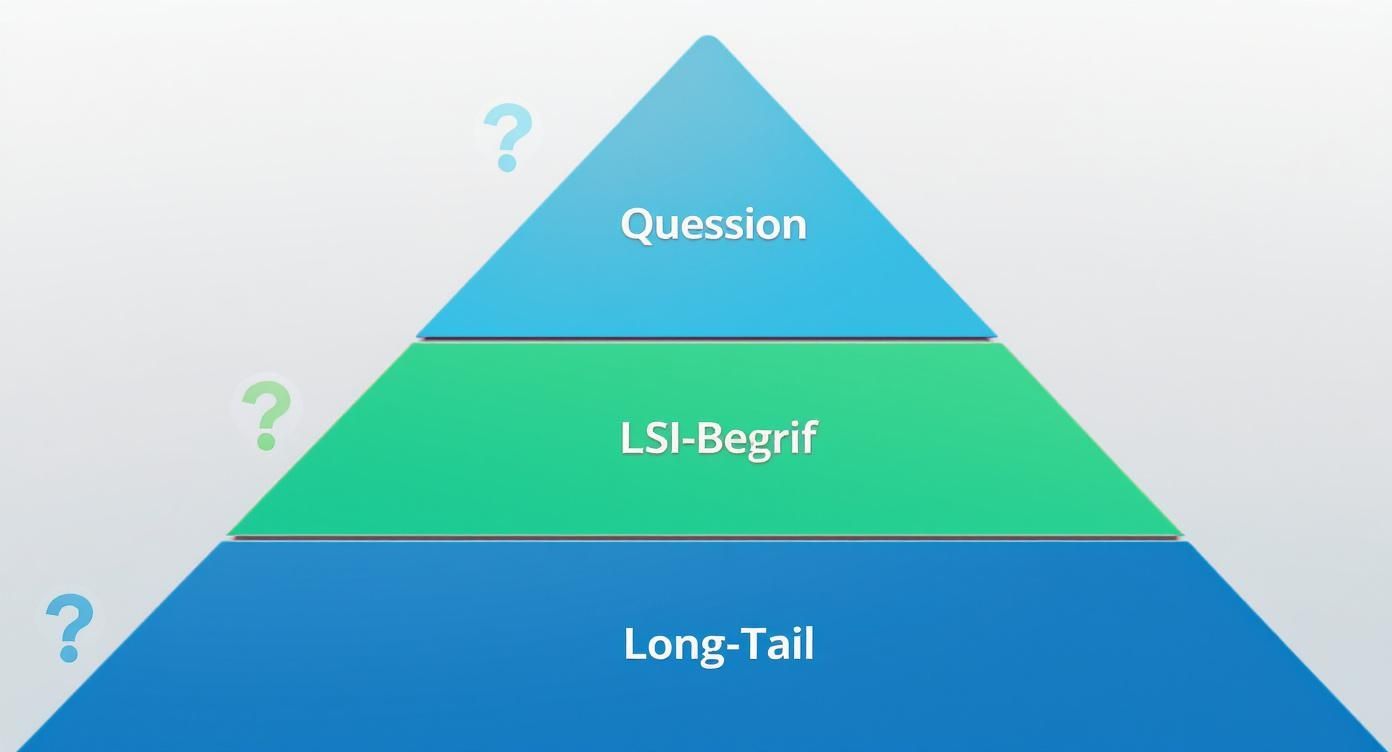
This clearly illustrates that a stable keyword strategy is built on a foundation of specific long-tail keywords. These are supported by semantically related terms (LSI) and rounded off by answering specific user questions.
A practical example of keyword clustering
Imagine you run an online shop for coffee accessories. The classic, but outdated, approach would be to create separate, often quite thin pages for "French Press Instructions", "Grinding Coffee for French Press", and "Best Coffee Beans for French Press".
Keyword clustering is a much smarter approach. You identify "French Press" as your pillar keyword and create a single, comprehensive resource – an ultimate guide on the topic.
This guide would then cover all relevant subtopics:
- What is a French press? (Information search)
- Step-by-step instructions for preparation (Directions)
- The correct grind for a French press (Specific user question)
- Comparison: French Press vs. Filter Coffee (Buying advice)
- Our top 3 coffee beans for French press (Transactional, with direct links to your products)
The result is a page that not only has the potential to rank for dozens of search queries, but above all offers enormous added value for your visitors. They find all the answers in one place and don't have to frustrately jump back and forth between ten different search results. And Google rewards precisely this positive user experience.
Putting your keyword strategy into practice

A brilliant Search engine optimization keyword analysis That's only half the battle. The real excitement begins now: we need to take these insights and use them to strategically optimize our website. After all, what good are the best keywords if they're just gathering dust in a spreadsheet?
Now we bridge the gap between theory and practice. We take our researched primary and secondary keywords and use them so effectively that search engines and users immediately recognize the value of our content. This is precisely where it's decided whether traffic ultimately translates into conversions.
Place keywords strategically, without overdoing it.
The days of blatant keyword stuffing are thankfully long gone. Today, it's all about thematic relevance and natural language. Search engines are smart enough to understand the context of a page. Our job is to send them the right signals.
The key is to strategically place keywords in the most important on-page locations. Each individual element helps Google understand the core content of your page.
Here is a short checklist for the most important areas:
- Title tag: This is your calling card in the search results. Place your main keyword as high up as possible to immediately stand out.
- Meta description: Even though it's not a direct ranking factor, it significantly influences the click-through rate. Naturally integrate your keyword here and formulate a clear call to action that sparks curiosity.
- H1 heading: Each page should have exactly one H1 heading. This heading must contain the main keyword and clearly state the topic of the page.
- H2 and H3 headings: Use subheadings to logically structure your content. They are the perfect place for long-tail keywords and semantically related terms.
- Running text: Your main keyword should be prominently featured in the first paragraph. After that, you should naturally weave it, along with synonyms and variations, throughout the rest of the text.
- Image alt text: Briefly describe what is shown in the image and take the opportunity to include a relevant keyword. This not only helps with image searches but also makes your page more accessible.
By consistently optimizing these elements, you create a crystal-clear thematic focus for each individual page.
The key lies in balance. A website should never feel like it was written for a machine. The focus must always be on readability and genuine added value for the user.
Building a bridge to content marketing
Your keyword analysis is the foundation, but the real blueprint for your success only comes from smart content planning. To bring your strategy to life, a strong content marketing strategy Essential. This is the only way to ensure that you not only use the right terms, but also create content that truly captivates and inspires your target audience. By the way, our comprehensive guide explains how to create the perfect Writing SEO text, which convinces both users and search engines.
Focus on mobile and local search
One aspect that can no longer be ignored is the consistent focus on mobile search behavior. Mobile search already accounts for over [number] searches in Germany. 65 % all search queries. At the same time, we know that 75 % Users never look beyond the first page of search results. For us, this means we need to find keywords with a high potential for the top 3 positions.
This is a huge opportunity, especially for local businesses, because they are impressive 28 % All local mobile searches result in a purchase within 24 hours. This demonstrates the importance of targeted optimization for "near me" or location-based search terms.
What does that mean for your practice?
- Prioritize local keywords: Integrate city names, districts, or phrases like "near me" into your keywords (e.g., "sustainable running shoes Kaiserslautern").
- Optimize questions: Mobile users often ask entire questions via voice input. Optimize your content to answer these questions directly and precisely.
- Ensure loading times: Mobile users are impatient. A slow website can ruin even the best keyword strategy.
By implementing these on-page measures, you will transform your careful keyword analysis into visible results and lay the foundation for sustainable SEO success.
Frequently asked questions about keyword analysis
To conclude this guide, I'd like to answer a few questions that I frequently encounter in practice. Consider this a kind of FAQ from everyday SEO work, designed to help you avoid common misconceptions and gain more confidence in your strategy.
One of the most frequently asked questions is whether a single, comprehensive analysis at the beginning is sufficient. The answer is a clear and decisive no. Search behavior and markets are constantly changing. A keyword strategy that is defined once and then never touched again is doomed to failure.
How often should I conduct keyword analysis?
For a truly comprehensive, in-depth analysis, you should at least once a year Take your time. This is your strategic check-up. Here you look at the big picture: Are your target groups still relevant? Are there any new competitors? Do you see any major shifts in search trends?
But that's not all. SEO isn't a one-off action, but an ongoing process. Therefore, regular checks are also necessary in between:
- Quarterly: Take a look at your most important keyword groups. Are there any new long-tail opportunities you might have overlooked? Have the search volumes for seasonal topics developed as expected?
- Monthly: Keep a close eye on your top 10 keywords. If a ranking suddenly drops or a new competitor appears out of nowhere, you need to be able to react quickly.
This rhythm ensures that your SEO strategy remains agile and that you don't miss out on valuable potential. Those who stick with it will ultimately have the edge.
A static keyword strategy is an outdated strategy. Consider keyword analysis as an ongoing cycle of observation, evaluation, and adjustment – this is the only way to stay ahead in the long run.
High or low search volume – which should you focus on?
The perfect answer is: both. This question is a classic, but it's phrased incorrectly. Keywords should never be evaluated solely based on their search volume, but always within the context of competition, search intent, and potential business value.
Sure, keywords with a huge search volume (the "fat head" keywords) offer enormous reach. But they are often extremely competitive. Competing against the established market leaders can be an expensive and lengthy undertaking.
On the other hand, we have long-tail keywords with low search volume. Their real strength lies in their precision. Someone searching for "waterproof running shoes for men with wide feet" is much further along in the buying process than someone who simply Googles "running shoes" in general. Conversion rate The odds are often many times higher here, and the rankings are significantly easier to achieve.
My practical tip: Start with a niche. Secure initial successes there, build authority, and use this foundation to then gradually tackle the larger, more competitive terms.
Does keyword density still play a role today?
To put it simply: No. The idea of a rigid keyword density – that is, including a keyword x times in the text – is a relic from the old days of SEO. Google's algorithms are much smarter today. They understand the thematic context of a page and recognize synonyms and related terms.
Instead of compulsively repeating a keyword (which reads terribly anyway), focus on natural language. The main keyword should, of course, be prominently placed, for example, in the H1 heading and the first paragraph. After that, however, the goal is to cover the topic comprehensively. Use synonyms, answer the questions users actually have, and write for people, not for machines.
The readability and the User Experience These are the decisive factors today. A good text that truly helps the reader will always rank better in the end than one that is artificially over-optimized.
Do you want to ensure that your keyword analysis is based on real data and leads to measurable success? LinkITUp With over 15 years of expertise, we support you in finding the perfect keywords for your business and bringing your website to the top of Google results. Start your individual SEO check now at seobuchen.com/