




Choosing the right SEO software is often the first and most important lever for online success. A quick SEO Software Comparison makes clear: All-in-one platforms such as Semrush or Ahrefs While they cover a huge range of tasks, specialized niche tools are often unbeatable for truly in-depth insights into technical details or content optimization. Ultimately, what's right for you depends entirely on your goals, budget, and company size.
Finding the right way through the software jungle
The question of the "best" SEO software is quickly misleading. There simply isn't one. There's only the solution that perfectly suits your unique strategic goals. A startup with a tight budget has completely different requirements than a large SEO agency juggling dozens of client projects simultaneously. Therefore, a systematic comparison isn't a "nice-to-have," it's essential.
The SEO market never sleeps. About 86% of all search queries in Germany go through Google., and since more than 99 % users If you're only looking at the first page of results, precise data and sharp analysis are vital. At the same time, the playing field is shifting: Over 65 % of the search Today's events are taking place on a mobile basis. More information can be found in the latest reports. Search engine statistics on firstpage.at.
A good SEO tool is like a compass. It not only shows you where you currently stand, but also points the way to achieving your goals and leaving the competition behind.
An overview of the most important software categories
To make a truly informed decision, you need to understand the different tool categories. Each type has a clear focus and excels in different scenarios. The right mix of tools not only increases efficiency but also helps you set the most important priorities. It's best to define your key priorities beforehand. KPIs in SEO, so that you can accurately measure the success later.
Quick overview of leading SEO software types
This table summarizes the most important software categories and shows which users they are best suited for.
| Software type | Main focus | Ideal for | Exemplary providers |
|---|---|---|---|
| All-in-one platforms | Comprehensive coverage of all SEO areas | SMEs, in-house teams, all-rounders | Ahrefs, Semrush, SE Ranking |
| Keyword research tools | Detailed keyword analysis & discovery | Content marketer, blogger | KWFinder, AnswerThePublic |
| Technical SEO tools | On-page optimization, site audits, crawling | SEO specialists, web developers | Screaming Frog, Sitebulb |
| Backlink analysis tools | Link profile analysis, competitor monitoring | Link builders, agencies | Majestic, Moz Pro |
As you can see, there are suitable solutions for every task and every team profile. The trick is to find the tools that offer the greatest leverage for your own strategy without exceeding the budget.
What really matters when choosing your SEO software
A simple feature comparison only scratches the surface. The true strength of SEO software only becomes apparent in practice – in the quality of the data, its ease of use in everyday work, and its ability to grow with your ambitions. Making the wrong choice here could, in the worst-case scenario, lead to investing in a tool that causes more headaches than it solves.
To avoid this, let's look at the criteria that differentiate between a useful helper and an expensive dust collector.
Data quality and timeliness: The basis for every decision
In SEO, trust is the most important currency. More precisely: trust in the data on which you base far-reaching decisions. A tool that provides you with outdated keyword data or an incomplete backlink profile will lead you directly astray. The result is incorrect priorities and wasted budget.
Therefore, pay close attention to how often the software updates its databases. Daily rank tracking is practically standard these days. But how up-to-date are the backlink indices or the competitor data? If a tool lags behind in these areas, you're operating blindly.
The data must also be relevant to the German market. Google dominates here with a market share of approximately 73.9 % on the desktop and even 93.79 % on mobile devices. A good tool must reflect this reality and apply its data to Google's algorithms and the corresponding Google Ranking Factors align. A good overview of the Current search engine market share distribution can be found at luna-park.de.
Features: What do you really need?
The range of functions must match your goals, not the other way around. Not every software needs to be a Swiss Army knife. What's far more important is that it performs the tasks that are necessary for you. She The crucial aspects were absolutely brilliantly accomplished.
It is important to clearly distinguish between the core functions that every good tool should master and specialized features for very specific use cases.
- Keyword research: Is this only about search volume? Or does the tool also provide deeper insights such as keyword difficulty, click-through rate (CTR), and the actual search intent behind a query?
- Rank tracking: How accurate is the position query? Can you monitor rankings for local, mobile, and desktop searches separately and keep an eye on your main competitors?
- Technical SEO & Site Audit: How thorough is the website crawler? Does it also find complex errors, such as incorrectly set canonical tags, performance bottlenecks in the Core Web Vitals, or "orphaned" pages without internal links?
- Backlink analysis: How comprehensive is the backlink index? Can the tool realistically assess the quality of links and reliably identify potentially harmful links?
- Competitive analysis: Is it possible to analyze the competition's strategy? This includes knowing which keywords they use to rank well, which content performs best, and how they build their links.
An overloaded tool with dozens of features you never use is often less valuable than a focused solution that perfectly supports your daily work.
Usability and scalability: Does the tool grow with you?
The best software is useless if it's a pain to use. A clean interface and intuitive menu navigation aren't a luxury, but a necessity for you and your team to use the tool efficiently. Complex data must be presented in clear dashboards and understandable reports; otherwise, you'll quickly lose track.
Scalability is equally important. Your business is growing, and your SEO software needs to be able to grow with it. Check the pricing structure beforehand: Can you upgrade later without costs skyrocketing? Will the tool handle a growing number of projects, keywords, and team members? A solution that seems perfect today might reach its limits in a year.
Leading SEO tools in direct comparison: Where are the real differences?
Anyone who looks at the feature lists of the major SEO platforms might think they're all the same. "Keyword research," "rank tracking," "site audit"—these terms are everywhere. But that's only half the story. In practice, there are worlds of difference between the individual tools, and the real value lies in the details.
That's why we're taking a closer look. Instead of just ticking boxes, whether We will examine the function of a tool., how well It actually implements these principles. Instead of dry pros and cons lists, I'll show you concrete examples of how the leading solutions differ in the crucial disciplines and which tool is best suited for which job.
Keyword research under the microscope
Keyword research is and remains the heart of any good SEO strategy. It quickly reveals which software only scratches the surface and which delves deeper. Almost every tool provides search volume and a difficulty rating – but the accuracy and significance of these figures vary enormously.
Ahrefs For example, it's known for its gigantic keyword database. The "Keyword Difficulty" score here is heavily based on the number of referring domains. This is extremely useful if you want to realistically assess the pure effort required for link building. Ahrefs even goes a step further and displays click metrics – that is, how many users actually click on a result. In times of "zero-click searches," this is a goldmine of information.
Semrush Semrush takes a slightly different, broader approach. Its "Keyword Magic Tool" is unbeatable when it comes to finding thematically related keywords and entire sets of questions. This greatly simplifies the planning of content clusters. Semrush's "Keyword Difficulty" score is more holistic, as it considers not only backlinks but also on-page factors and the overall authority of the ranking domains. This often provides a more complete picture of the actual chances of success.
One often overlooked point is the timeliness of data, especially for the German market. Tools like [tool name] have a significant impact here. Semrush and SE Ranking They often have the edge because they provide very granular and up-to-date data that is precisely tailored to German Google search. This is a crucial advantage for local businesses and German-language projects.
For a detailed Keyword Research Guide You can also read our follow-up article. There, we show you step by step how to find the most profitable terms for your business. Those who need to watch their budget will find alternatives such as... KeySearch a solid foundation, even if the data depth doesn't quite match that of the major players.
Technical SEO and site audits: What really matters?
A technical site audit is so much more than just checking off missing meta titles. It's about examining the technical health of a website down to the smallest detail. That's the foundation on which everything else is built.
For in-depth analyses Screaming Frog As a desktop tool, it remains the gold standard for many technical SEOs. Its level of detail in analyzing crawling errors, internal linking, JavaScript rendering, and Core Web Vitals is unmatched. It can be flexibly configured for custom queries, enabling the detection of even complex problems.
But all-in-one platforms have made massive strides. Ahrefs Site Audit It impresses with an incredibly intuitive interface. It not only shows, What is broken, but also explains, Why it is important and How You can fix it. That makes it perfect for teams where not everyone is an SEO tech nerd.
Semrush The site audit goes a step further, grouping problems into thematic reports. This allows users to identify, for example, all pages with slow page speed or thin content at a glance, greatly simplifying strategic decisions. Integration with Google Analytics even allows users to directly link technical errors to traffic losses.
SE Ranking has established itself here as a strong alternative with a fantastic price-performance ratio. Their site audit is comprehensive, covering all important areas from indexability to speed, while remaining budget-friendly.
Competitive analysis and the quality of the backlink index
Knowing what the competition is doing is a huge advantage in SEO. The key to this is the size and up-to-dateness of a tool's backlink index.
Here has Ahrefs Traditionally one of the largest and fastest indexes on the market. The platform often finds new links in record time. Its strength lies in the sheer volume of data and the depth with which it can, for example, dissect anchor text or outbound links of competitors.
Semrush It also boasts a very strong backlink index and additionally shines with its "Backlink Audit Tool." This allows users to not only thoroughly examine their own link profile but also detect potentially harmful links and directly create a disavow file. The visualization of link networks is often clearer and more understandable here than with other providers.
Detailed evaluation matrix of the top SEO tools
A direct comparison of leading SEO software based on critical criteria such as data quality, range of functions and price-performance ratio.
| criterion | Ahrefs | Semrush | SE Ranking |
|---|---|---|---|
| Backlink Index | Extremely large and up-to-date. Perfect for in-depth link analysis. | Very comprehensive, with a strong focus on audit functions and link quality. | A solid index that is sufficient for most analyses, often at a better price. |
| Keyword data | Excellent difficulty score, heavily based on link data. | Comprehensive thematic grouping and a more holistic difficulty score. | Good coverage, especially strong in rank tracking and local data. |
| Technical Audit | Very user-friendly, with clear recommendations for action for all skill levels. | In-depth analysis with thematic reports and analytics integration. | Comprehensive audit with excellent value for money. |
| Ideal for | SEO professionals, agencies, and anyone pursuing a data-driven link strategy. | Generalists, content marketers and teams who need a holistic overview. | SMEs, agencies and startups looking for a cost-effective all-in-one solution. |
This comparison clearly shows that there is no single "best" tool. The choice depends entirely on your goals. Those who engage in aggressive link building and need precise data about their competitors will find what they need with... Ahrefs Absolutely perfect. Teams looking for a balanced, one-stop solution for content, technology, and backlinks will find it here. Semrush a strong partner. And for price-conscious companies or startups that still don't want to forgo the most important functions, it is SE Ranking an excellent choice.
The role of AI in modern SEO software
Artificial intelligence is no longer just an empty buzzword, but the very engine driving modern SEO software. It's completely revolutionizing the way we approach search engine optimization. Instead of manually sifting through mountains of data for hours, AI algorithms perform complex analyses in fractions of a second, delivering insights that can be used immediately.
This development is no longer a thing of the future; it's already commonplace. When comparing SEO software today, it's often precisely these intelligent features that distinguish a good solution from an outstanding one.
Intelligent content creation and semantic analysis
One of AI's greatest strengths is its understanding of language and context. Modern SEO tools leverage this to take content creation to a whole new level. Instead of focusing solely on individual keywords, they help to analyze entire websites and contexts. Topic clusters to build up authority. This signals to search engines a comprehensive authority in a specific area.
AI-powered algorithms scan the top-ranking pages on a given topic and identify semantically related terms, relevant user questions, and important subtopics. From this analysis, they generate detailed content briefings. This gives authors clear guidelines on which aspects they need to cover to perfectly address the search intent. The result: content that is valuable not only for search engines but, above all, for people.
The following screenshot of the German Wikipedia page on "Artificial Intelligence" clearly shows how complex and multifaceted such a topic can be.
This structure clearly shows how AI tools learn to recognize connections between concepts such as machine learning, neural networks and knowledge representation – and then use this knowledge for SEO analysis.
More precise keyword research through intent recognition
Traditional keyword research, which only considers search volume and competition, is outdated. AI is revolutionizing this process by... Search intent It analyzes the "intent" behind a request. It can distinguish whether someone is simply looking for information (informational), wants to buy something (transactional), or wants to access a specific website (navigational).
This capability allows for a much more strategic approach. An AI tool can suggest keywords that may have lower search volume but signal extremely high purchase intent. This way, you can identify niches your competitors are overlooking and use your marketing budget much more efficiently.
AI translates raw data into strategic intelligence. It doesn't just tell us, What people are looking for, but also, Why They are looking for it. That is the decisive advantage in today's competition.
Automated technical audits with clear priorities
A technical SEO audit used to be a real chore for specialists. Today, AI systems crawl entire websites with thousands of subpages in just a few minutes. They find not only standard errors like broken links or missing meta tags, but also truly complex problems.
These include, for example:
- Performance bottlenecksThe AI identifies elements that slow down loading times and negatively impact Core Web Vitals.
- Problems with indexabilityIt senses misconfigured
robots.txt-files or canonical tags that prevent important pages from even appearing in Google's search results. - Internal linking structureIt analyzes the link architecture to find orphan pages and optimally distribute link juice across the page.
The real kicker, however, is that the AI can identify the errors it finds. automatically prioritized. It assesses which problem has the greatest negative impact on the ranking and provides clear, step-by-step instructions on how to fix it.
This trend is already clearly noticeable in Germany. AI-supported tools increase the efficiency of SEO audits by up to... 67 %, because they can analyze huge amounts of data in real time. No wonder, then, that already 75.7 % of the German marketing specialists increasingly rely on AI technologies to develop targeted and personalized SEO strategies. Learn more, Find out how AI will shape SEO trends by 2025 at ki-erfolgsformel.de. providers such as Semrush or SE Ranking have already integrated advanced AI features that help you make data-driven decisions faster and more confidently.
Use cases for different company sizes
Finding the right SEO software is a bit like buying a car: A sleek sports car is unbeatable on the racetrack, but completely impractical for the weekly grocery shopping with the family. It's a very similar story in... SEO Software Comparison The best solution doesn't necessarily have the most features, but rather fits your goals, your team, and your budget perfectly.
A freelancer managing their own projects has completely different requirements than a growing e-commerce company or an established SEO agency. That's why it's so important to always evaluate tools from the perspective of your own daily work. Only then will you invest in software that truly simplifies your work instead of unnecessarily complicating it.
Startups and SMEs with limited resources
For small and medium-sized enterprises (SMEs) or startups, efficiency is paramount. Budgets are usually tight and teams are often small. Complex professional tools with countless specialized functions quickly become overkill and simply too expensive.
The ideal solution for this segment is a streamlined, all-in-one platform that focuses on the essentials and delivers fast results. That's what matters:
- Solid keyword research: To identify search terms with real potential and manageable competition.
- Reliable rank tracking: To keep an eye on one's own rankings and those of the most important competitors.
- Beginner-friendly site audit: To quickly find and fix basic technical errors on the website.
- Clear backlink analysis: To understand your own link profile and discover initial opportunities for link building.
For SMEs and startups in particular, an intuitive user interface is invaluable. The tool must work without weeks of training so that the team can get started immediately instead of getting lost in menus.
Providers such as SE Ranking or KeySearch are often an excellent choice here. They pack a considerable range of features into a package that costs only a fraction of the market leaders. This allows even small teams to implement a professional SEO strategy without exceeding their budget.
In-house SEO teams in larger companies
As soon as a company grows and builds its own in-house SEO team, the rules of the game change. It's no longer just about the basics, but about scalability, seamless collaboration, and in-depth data analysis.
Such teams need a robust platform that can grow with the company. Crucially, other characteristics are key here:
- Enhanced collaboration features: Different user accounts with tiered access rights are a must so that content managers, developers and SEOs can work hand in hand.
- API access: An interface to pull SEO data into internal dashboards (such as in Looker Studio) or other marketing tools is often essential for centralized reporting.
- Detailed, customizable reporting: The ability to create meaningful reports for different target groups – from the marketing manager to the executive management – is crucial here.
- In-depth competitive analysis: In-house teams need to understand the competition's strategies in detail in order to hold their own in the market.
Platforms such as Semrush or Ahrefs They demonstrate their true strengths in this league. They provide the necessary data depth and collaborative tools needed to implement complex, data-driven SEO strategies internally.
Specialized SEO agencies and freelancers
SEO agencies and freelancers operate in an extremely dynamic environment and often juggle dozens of client projects simultaneously. Their requirements for SEO software are therefore particularly high and fully geared towards efficient client management.
This decision tree shows how AI-powered workflows can be used in a modern SEO strategy, from content creation to technical analysis.
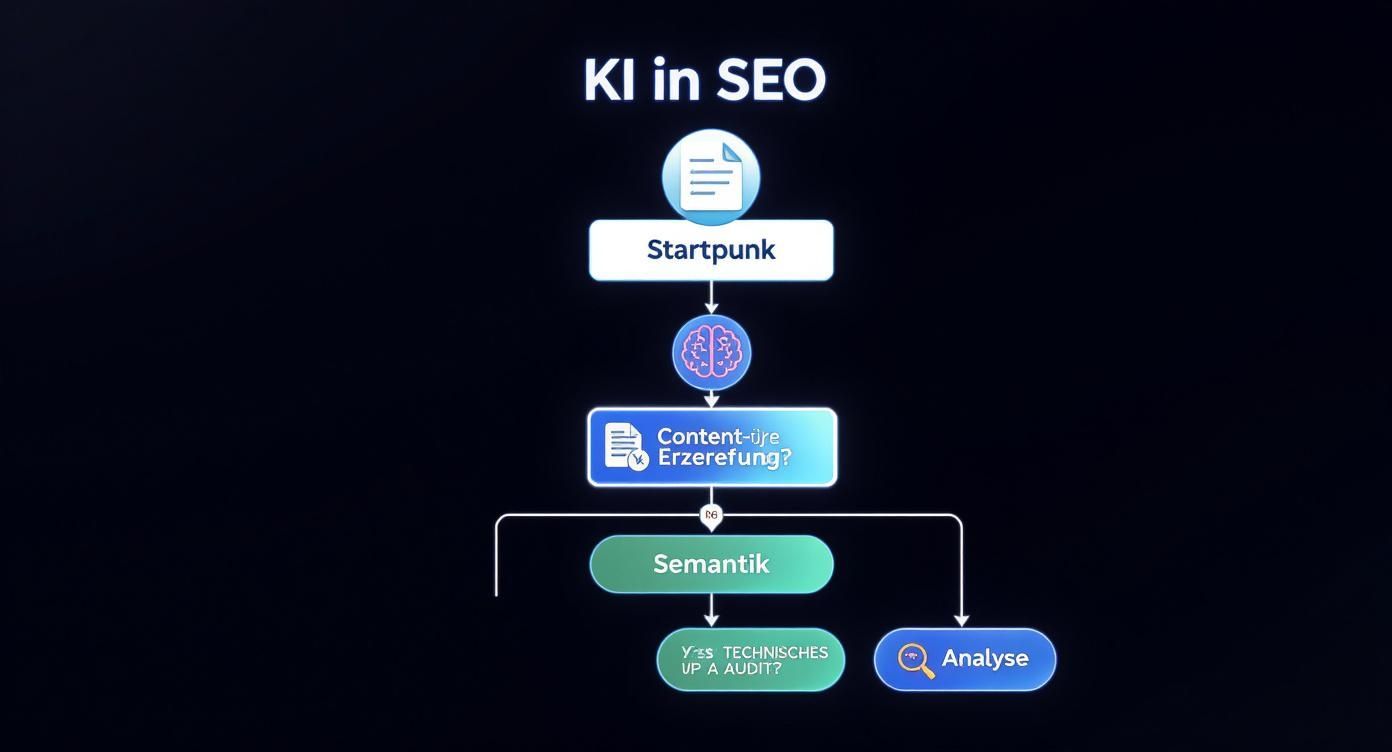
The graphic makes it clear: Tools that automate such processes are particularly valuable for agencies to scale their work.
For these professionals, the following features are absolutely essential:
- Multi-client management: The ability to organize all customer projects cleanly separated from each other in a single dashboard.
- White-label reporting: Customizable reports that can be branded with your own agency logo and sent directly to clients are an absolute must.
- High query limits: Agencies need generous limits for keyword tracking, crawling, and API requests to meet the needs of all their clients.
- Agency-specific features: Practical extras such as lead generation tools or special dashboards for customer acquisition provide real added value.
Whether you run a large company or as a self-employed blogger To get started, the right SEO software is a crucial lever for your success. Tools like SE Ranking They often offer special agency rates, while the industry giants Ahrefs and Semrush which are considered standard at many agencies due to their enormous data depth.
When an SEO agency is the better choice
Acquiring powerful SEO software is an important step – but only the first. A comprehensive SEO Software Comparison While it shows you what the tools can theoretically do, the real work only begins afterwards. Herein lies the crucial question: Is the tool alone sufficient, or does it require an experienced craftsman to use it?
Many companies underestimate what professional search engine optimization (SEO) truly entails. SEO isn't a project you can start once and then check off the list. It's a marathon that demands in-depth expertise, a strategic compass, and above all, time. Without these resources, even the best software remains an expensive, unused tool.
Lack of resources as a decisive factor
The most common reason for choosing an agency is simply a lack of internal resources. By this, I don't just mean a lack of know-how, but also simply a lack of personnel. If an employee is expected to do SEO "on the side," they will hardly deliver the same results as a well-coordinated team of specialists.
A professional agency not only brings the necessary manpower, but also experience from countless projects. They know the typical pitfalls, can correctly assess trends, and work with proven processes. This usually leads to visible success much faster than if an internal team first has to painstakingly familiarize itself with the complex subject matter.
Choosing an SEO agency is not a surrender to complexity. It's a strategic investment in speed and expertise. You're not just buying a service, but above all, valuable time and a knowledge advantage.
A realistic cost-benefit analysis
At first glance, the monthly costs for an agency might seem daunting. However, upon closer inspection, this investment can quickly pay off. Consider the costs of a premium software license, the salaries of qualified staff, and the opportunity costs resulting from slower progress. This total often far exceeds the agency fee.
Seriously consider using an agency if:
- The team lacks the necessary expertise: SEO is a highly specialized discipline that is constantly changing.
- Time is short for implementation: Agencies can usually implement strategies faster and more efficiently.
- They want to compete in highly competitive markets: Here, an agency's experience is often the decisive advantage.
- An external, objective perspective is desired: Agencies bring fresh perspectives and break through the often unavoidable tunnel vision.
Ultimately, the choice between software and agency is a strategic decision that depends on your internal strengths and goals.
Frequently asked questions about SEO software comparison
Finally, we'd like to address a few questions that frequently arise when choosing the right SEO software. These answers come directly from practical experience and should help you dispel any remaining doubts and make an informed decision for your business.
How much should I spend on good SEO software?
The price range is huge – from free tools for simple analyses to enterprise solutions that can quickly cost several thousand euros a month. But don't worry: most small and medium-sized businesses can find excellent all-in-one platforms within a manageable budget. €100 to €300 per month.
Ultimately, the "right" price always comes down to return on investment (ROI). If more expensive software helps you generate so much more organic traffic and revenue that it more than pays for itself, then it was the right decision. So, first define what you need, and only then set your budget.
A tip from experience: Be sure to take advantage of the free trial periods. This is the only way to determine whether the usability and range of functions are truly worth the price before you sign a long-term contract.
Is a single all-in-one SEO software sufficient?
For the vast majority of companies, the answer is a resounding yes. A powerful all-in-one platform like Semrush or SE Ranking covers all the key disciplines – from keyword research and technical audits to competitor analysis. This ensures you are ideally equipped.
SEO specialists or agencies operating in extremely competitive markets often use a combined approach. They utilize a central platform and supplement it with targeted, specialized tools. This could be a desktop crawler like Screaming Frog for ultra-detailed technical audits or a specialized database for link building.
However, for a start, it is almost always the best strategy to focus entirely on a Focus on one central tool. This way you avoid spreading yourself too thin and learn to truly unlock the potential of your software, instead of only superficially exploring multiple tools.
How quickly will I see results after using SEO software?
SEO software is a powerful tool, but it's not a magic wand. The results depend solely on how consistently you interpret the data and implement the resulting actions.
- Quick results: Technical corrections to your website, such as fixing crawling errors or optimizing loading time, can already within a few weeks Send initial positive signals to Google and lead to better rankings.
- Long-term strategies: Sustainable success through high-quality content and targeted link building takes time. Be realistic about this. three to six months, ...until significant and, above all, stable improvements become apparent. SEO is a marathon, not a sprint.
Do you realize that you lack the time or in-depth know-how for implementation? LinkITUp is your experienced partner who transforms data from any SEO software into measurable success. Book your appointment now. free initial consultation and let's achieve your goals together.