





Structured data SEO
Structured data provides your website with a clear compass that search engines can easily decipher. This not only increases the visibility of your offers but also boosts the chance of clicks directly in the search results.
For example, those who clearly mark up important product details, opening hours or FAQs will land faster in the so-called Rich Results – the visual highlights of Google & Co.
How structured data works for SEO

Imagine a librarian who sorts each book by subject, author, and year of publication. Sort in the same way. JSON-LD and Microdata Your website content in a structure that is wonderfully easy for search engines to understand.
This offers several advantages at a glance:
- Faster understanding through clear markings for events, products, or FAQs
- More Rich Results with star ratings, pictures or additional information
- Increase in CTR, because your results will stand out visually in the search results
Even a simple JSON-LDImplementation can increase your click-through rate by up to 20 % You can increase your chances by marking the right fields.
Brief overview of structured data SEO
Here you will find important facts at a glance:
| Expression | Brief description |
|---|---|
| JSON-LD | Recommended JSON-based format for structured data |
| Microdata | Markup with HTML attributes directly in the code |
| Rich Results | Improved display in search results |
This table shows which formats are most commonly used and why they are essential.
Structured data is the guide through the information jungle and significantly increases your chances of getting clicks.
Next Steps
- Clarify the basics: Choose the appropriate format and create a test page.
- Implementation: Add the JSON-LD-markup in your HTML code
- Validation: Check with the Rich Results Test and the Structured Data Testing Tool on errors
In the next chapter, we'll show you how to integrate structured data into your CMS and work practically with LocalBusiness and HowTo schemas. This will lay the foundation for long-term SEO success.
Understanding the basics of structured data for SEO

Imagine structured data like carefully labeled jars in a pantry. Each description – from Price until Evaluation – is clearly labelled and ready so that search engines can see at a glance what's inside.
Your opportunities are built on this foundation Rich Snippets and Featured Snippets That's when it really comes into its own. Precise markup makes all the difference.
Why use JSON-LD
At its core, it JSON-LD The data markup is kept separate from pure HTML. This keeps your code clear, even as the website grows.
Microdata sticks labels directly into HTML attributes – this quickly becomes confusing. RDFa offers deeper semantic possibilities, but requires a steeper learning curve.
- Clean separation of content and structure for uncomplicated care
- Increased maintenance effort for microdata due to close integration with HTML
- RDFa enables detailed relationships, but it's more complex
That's why most SEO professionals rely on it today. JSON-LD.
Important JSON-LD elements
A good JSON-LD snippet always starts with the parameter @context. It determines which vocabulary your data uses. With @type Define, for example, whether it is a Product, a Event or a How-To This concerns other properties such as name, description and offers fill the basic framework of your markup.
Example JSON-LD Markup
{"@context":"https://schema.org","@typeProductnameExample product"}
Key InsightDefine @context Always start at the beginning. This way you avoid parsing errors and ensure clean results.
This creates a clear data structure and paves the way for rich snippets.
You can find more information about creating an XML sitemap in the Guide to creating an XML sitemap.
Next Steps
In the next section, we will integrate JSON-LD into your CMS step by step. You will learn:
- Property and ItemType to define precisely
- Validate your markup with the Google Rich Results Test
- @id to use effectively to clearly identify authors, brands, or events
This creates a clean data graph that search engines can easily process.
Structuring complex datasets
If your content needs to depict nested relationships, sub-objects can help. How-To For example, it can identify each individual step as a separate object. This creates a continuous graph.
- Clear @type-Specifications for each object to avoid ambiguities
- Reusable entities with @id link
- Group properties logically to keep the code maintainable.
This approach minimizes errors and facilitates later adjustments.
Validation and testing
No markup goes live without thorough testing. Use the Google Rich Results Test and the Schema Markup Validator.
A green result indicates that everything is correct. Warnings point to optional fields – please check these as well to ensure your data is as complete as possible.
Correct all errors and revalidate. This is the only way to ensure that your structured data is always ready for rich snippets.
With these fundamentals, you have a solid foundation for structured SEO. Get started with JSON-LD today.
Advantages and impact of structured data on SEO
Structured data acts like a guide for search engines. It precisely identifies content and opens doors to... Rich Results, Featured Snippets and Knowledge Panels.
In the DACH region, we see that well-implemented Schema.org types – such as FAQ, HowTo, or Product – can increase click-through rates by up to… 42,9 % Increase. More clicks mean more traffic and a stronger brand presence compared to competitors.
An appealing preview in the search results motivates Google to visit your site more often. This often improves your average position in the search results.
Local businesses benefit particularly from the LocalBusiness scheme. 65 % They appear directly in all mobile searches with Maps integration – this facilitates calls or directions in no time.
Especially in Germany, the organic traffic share is declining continuously, most recently by 3.65 % to 46.98 % In 2025, it's all the more important to stand out with structured data. Keep an eye on the Core Web Vitals as well. You can find current SEO statistics and best practices at [website address]. SE Ranking.
- Faster indexing thanks to a clear structure
- Higher CTR through eye-catching snippets
- Improved click paths via Knowledge Panels
- Targeted local visibility with map integration
Furthermore, forecasts show that rich snippets are gaining momentum. Since 2022, their use in Germany has increased by 15 % grown and could reach 2026 25 % climb. E-commerce sites achieve high rankings with product schemes. 20–30 % More visibility because Google gives them preferential placement.
Knowledge panels strengthen brand authority and, according to studies, deliver 10–15 % More direct clicks to the company website. Combined with FAQs and how-to guides, this creates interactive elements. Featured Snippets, which offer users quick answers and increase the time spent on the site.
Ultimately, this interplay also pays off in the conversion rate.
Graphical representation of traffic growth
The following table shows the increase in organic traffic before and after the schema implementation:
| Period | Previous Visits | After Visits | change |
|---|---|---|---|
| Q1 (without scheme) | 10.000 | – | – |
| Q2 (with product schema) | – | 12.500 | +25 % |
| Q3 (with FAQ format) | – | 14.200 | +42 % |
These figures clearly demonstrate how structured markup specifically expands reach.
Practical examples of successful implementations
A regional online shop improved its CTR by [percentage] within three months. 22 %. Furthermore, it moved up from 7th to 3rd place in important product keywords.
A restaurant used an FAQ scheme and recorded 18 % More table reservations via Google snippets.
„"Thanks to LinkITUp and precise schema markups, we were able to significantly increase our visibility and are gaining new customers every day."“
– Owner of a local pizzeria
- Select the relevant scheme (Product, FAQ, LocalBusiness)
- Correctly include and validate JSON-LD
- Monitor results with the Rich Results Test
- Ensure maintenance every three months
Structured data is not just a technical update. It serves as a strategic tool to improve click-through rates (CTR) and rankings in the long term and to ensure sustainable growth.
Select important schema.org types for SEO
Not every markup scheme is suitable for every project. In this section, I will introduce four key types and show, using concrete examples, how you can save time and increase your ROI with targeted markup.
Make decisions with schema.org
Imagine a signpost: Do you primarily want to generate more clicks on your results or additional traffic?
- Local Business It is suitable for local visibility and attracts customers to your store.
- Product Highlights prices, availability and reviews – ideal for online shops.
- FAQ Provides answers directly in the search results, saves clicks and engages users.
- How-To It brings step-by-step instructions to the snippets and increases discoverability for detailed questions.
This initial distinction lays the foundation for rich results and a better future. CTR.
LocalBusiness schema for local visibility
If you want to be visible in Google Maps and local search results, LocalBusiness is the tool of choice. A small example demonstrates the effect: A hair salon in Kaiserslautern was shown in Maps thanks to the schema markup. 65 % displayed more frequently.
The markup works quickly: more calls, more route planning, and real business customers. A pure JSON-LD implementation only requires a few lines in your page header.
„"LocalBusiness scheme has doubled our local discoverability and reduced calls by 42 % "Increased."“
Key areas at a glance:
- streetAddress, addressLocality, postal code for precise location information
- Opening Hours Specification for opening hours
Product schema for product details
Product schema is standard practice for e-commerce platforms. This markup allows users to see price, stock levels, and ratings directly in the search results. Many shops report... 20–30 % More impressions and clicks.
Simply insert this into the head section:
- @type = Product
- Properties such as name, offers, aggregateRating
Key points:
- priceCurrency makes the currency clear
- availability Google signals the stock levels
- aggregateRating Builds trust through user reviews
Comparison of important schema.org types
Here's a compact overview to help you find the right type at a glance:
Comparison of important schema.org types
| Schema type | Area of application | Advantages |
|---|---|---|
| Local Business | Local presence & maps integration | Increased visibility and calls |
| Product | E-commerce & pricing information | More impressions and clicks |
| FAQ | Customer service & knowledge transfer | Increased CTR and user retention |
| How-To | Step-by-step instructions | Improved discoverability of tips |
This table helps to estimate the effort required and quickly decide which scheme type will deliver the best results for your strategy.
FAQ format for frequently asked questions
An FAQ format brings questions and answers into the SERPs – perfect for displaying quick information directly and saving clicks.
Best Practices:
- Any question with title and acceptedAnswer award
- Unambiguous @id to ensure search engines can correctly categorize the entries
Infographic decision-making aid on SEO benefits
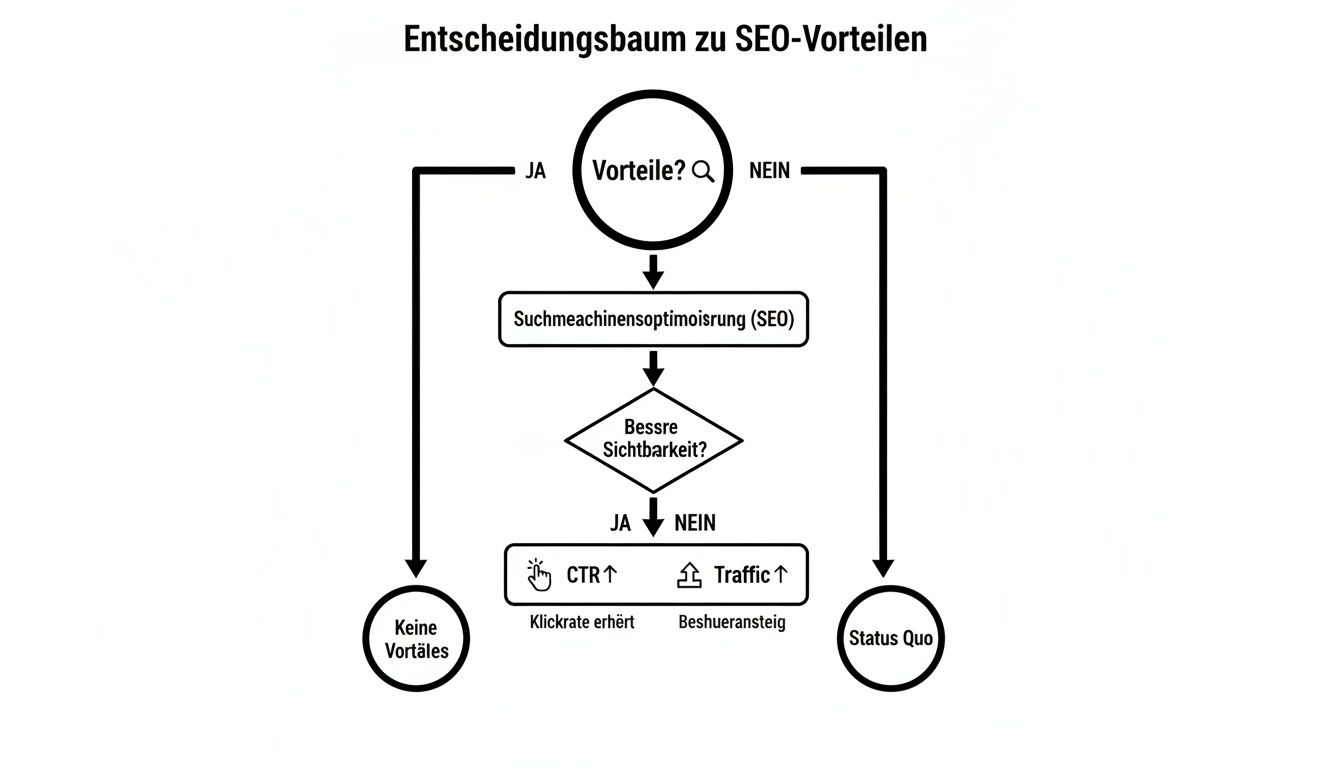
The graphic clearly shows: CTR↑ and Traffic↑ These are the most important results of structured data.
How-to schema for instructions
How-to markup is ideal for tutorials and instructions. An example from the DIY industry: Furniture assembly instructions appeared directly in the SERPs, increasing visibility by [number of times/numbers]. 15–20 %.
Structure overview:
- Everyone step as a separate sub-object with name, image, duration
- Images and timestamps help users understand the process more quickly.
- A clear order increases the chance of a direct result.
Consider implementation and testing
Place the JSON-LD in the HEAD or via a template and test regularly to rule out errors.
Use the Google Rich Results Test and the Schema Markup Validator. Fix all errors, check for warnings, and revalidate.
Practical tips:
- Plugins or modules simplify the creation of markup.
- Quarterly audits keep your data up to date.
- Document changes for better traceability.
- Automated testing in the CI/CD Pipeline for consistent quality
- Keep an eye on Schema.org versions, as types evolve.
This process ensures rich results in the long term and minimizes downtime in your SEO routine.
Next Steps
Start by defining your objective and then select the appropriate templates:
- Step 1: LocalBusiness for local businesses
- Step 2: Product for online shops and price information
- Step 3: FAQ to answer frequently asked questions directly.
- Step 4: How-to to offer visual instructions
This will lay a solid foundation for your structured data strategy and sustainably improve your search results. Good luck!
JSON-LD implementation and validation
Correct JSON-LD implementation is essential for structured data to function reliably and for rich results to appear cleanly in search results. A clear definition in the markup minimizes parsing errors and lays the foundation for enhanced search result displays.
If you place your script clearly in the HTML head, the source code remains maintainable and traceable. A simple example shows this from @context up to offers, how you can proceed step by step:
{
“@context”: “https://schema.org”,
“@type”: “Product”,
“name”: “Example product”,
“image”: “https://example.com/image.jpg”,
“description”: “Short description of the product”,
“offers”: {
“@type”: “Offer”,
“priceCurrency”: “EUR”,
“price”: “49.99”,
“availability”: “https://schema.org/InStock”
},
“aggregateRating”: {
“@type”: “AggregateRating”,
“ratingValue”: “4.7”,
“reviewCount”: “24”
}
}
Structure of the JSON-LD markup
A valid snippet always starts with @context, which defines the vocabulary.
Then comes @type, to determine the Schema.org class – for example Product or FAQ Page.
Properties such as name, offers and aggregateRating They then provide your core data. Nested objects help with more complex structures: A How-To for example, defines each individual step with name, image and text. This creates a clear graph that Google can use directly for featured snippets.
Clean markup minimizes errors and makes your pages resistant to schema changes.
In the next section, you will learn how to use testing tools effectively.
Read our detailed analysis of these findings. More insights into CTR and traffic development
Use of test tools
The following has proven useful for validation: Google Rich Results Test. Alternatives include the Schema Markup Validator or that Bing URL Inspector. These tools provide:
- Error reports with precise line numbers
- Warnings optional properties
- Results, whether rich results appear

The screenshot shows green checkmarks for successful checks. This allows you to see at a glance whether your markup is complete and which fields are still missing.
Tip: Automate these tests in your CI/CD pipeline. This way, you can identify whether new deployments introduce unwanted markup errors even before release.
| Tool | function | Special feature |
|---|---|---|
| Google Rich Results | Rich Result Eligibility | official Google source |
| Schema Markup Validator | Standard-compliant testing | supports the latest types |
| Bing URL Inspector | Google-like test | integrated into Webmaster Tools |
Best practices for long-term management
After the initial implementation, regular audits help to keep track of schema changes or CMS updates.
Learn how to apply for indexing in our article.
Maintain your schemas centrally:
- Keep @id Consistently linked throughout to uniquely link entities
- Document all changes in a changelog.
- Use templates or plugins to automatically incorporate recurring structures.
- Check for new types and properties with every Schema.org release.
Continuous maintenance ensures stable rich results and reliable visibility in the SERPs.
This ensures a high level of long-term security. Scheme quality and avoid unexpected technical SEO hurdles. Combined with regular CTR analyses, this creates a closed feedback loop.
Implement next steps
Start with a test page to test your JSON-LD without risk. Then gradually add more schema types as soon as the first snippets go live. This will keep your project clear and error-free.
- Insert JSON-LD into the HTML head
- Perform validation with Google Rich Results test
- Immediately correct warnings and errors.
- Establish periodic audits and version control
This setup ensures your structured data remains up-to-date and compliant. This increases your chances of achieving rich results and promotes stable rankings in the long term. Good luck with the implementation!
Practical examples for local businesses
Local businesses often achieve rapid success through structured data. Using case studies from the trades, gastronomy, retail, and healthcare sectors, we demonstrate how visibility and ROI can be measurably increased.
Example from the trades
In Mainz, a carpentry workshop has the Local Business-Schema implemented. After just four weeks, it recorded 30 % more phone inquiries and 25 % More website visits.
- Route planning clicks changed 45 %
- Bookings shifted 15 % to
Practical tip
- Use Opening Hours Specification for exact opening hours
- Add geoAdd coordinates to specify the location precisely.
- Set aggregateRating for customer reviews
Local JSON-LD snippet
{
“@context”:”https://schema.org”,
“@type”:”LocalBusiness”,
“name”:”Schreinerei Mustermann”,
“address”:{
“@type”:”PostalAddress”,
“streetAddress”:”Main Street 1”,
“addressLocality”:”Mainz”,
“postalCode”":"55116”
},
“telephone”:”+491234567890″
}
Example from the restaurant industry
A café in Cologne has that FAQ-The same scheme was used for opening hours and menu questions. The bounce rate decreased by 12 %, while table reservations around 18 % increased.
- Place the FAQ section in the footer
- Questions with title and acceptedAnswer award
- Update content quarterly
Practical tip
- Manage Q&A pairs centrally in the CMS
- Combine FAQs with Local Business-attributes
- Monitor snippet impressions in Search Console
Recommended FAQ structure
{
“@context”:”https://schema.org”,
“@type”":"FAQPage”,
“mainEntity”:[
{
“@type”":"Question”,
“name”:”When is it open?”,
“acceptedAnswer”:{
“@type”":"Answer”,
“text”:”Mon-Fri 8am-6pm”
}
}
]
}
Example from the retail sector
A fashion store in Hamburg used the Product- Scheme for prices and availability. The result was growth in Impressions to 25 % and an increase in the click-through rate of 20 %.
| Key figure | Before scheme | According to the scheme | change |
|---|---|---|---|
| Impressions | 8 000 | 10 000 | +25 % |
| Click-through rate (CTR) | 2,4 % | 2,9 % | +21 % |
| Purchase transactions | 120 | 145 | +21 % |
Practical tip
- Declare priceCurrency and availability correctly
- Link product pages with offers.url
- Use thumbnailUrl for appealing images
Learn how to do this in our guide. Register your business on Google Maps.
Example from the healthcare sector
A physiotherapy practice in Freiburg integrated the How-To-Schema for exercise instructions. Users clicked 35 % They increasingly switched to video tutorials and appointment requests. 22 %.
- Embed step-by-step instructions as snippets
- duration specify for each exercise
- image-Use properties for visual support
Further industry-specific ideas
Whether it's a craft business, café, shop or medical practice – the flexible combination of schema types increases local conversions and strengthens your online presence.
Statistical substantiation
In Germany, Google covers over 80 % market share in the search engine market. At 65 % Structured data plays a role in mobile searches, which on average increases the CTR by 42,9 % increases. Data from SE Ranking 2025 shows: 54,6 % the websites meet Core Web Vitals and 17 % Struggling with faulty sitemaps. Schema markup can address this issue directly and increase the proportion of organic clicks received. 46,98 % further expansion is planned. Read more about it at SEO Nest.
„"Through structured data, we have significantly expanded our local reach and increased traffic by double-digit percentages."“
– SEO manager of a craft business
Next Steps
- Identify local locations and define appropriate schema types.
- Integrate JSON-LD snippets into the HTML head
- Check markups with the Google Rich Results Test
- Continuously monitor impressions, clicks, and conversions.
- Regularly optimize and adapt to current data
Implementation and validation
For clean code, rely on JSON-LD, which keeps the HTML source code clear.
- Include the script in
<head>via your CMS template - Test markups with the Google Rich Results Test and the Schema Markup Validator.
- Address warnings promptly to ensure snippet quality.
- Maintain version control in Git or CI/CD pipelines
Regular audits prevent unwanted changes and ensure the availability of your data.
Integrate structured data firmly into your SEO strategy and continuously optimize for sustainable success.
Good luck!
Frequently asked questions about structured data SEO
This FAQ section provides concise answers to the most important questions about structured data in SEO. You'll learn why markups are indispensable today, which schema types deliver the fastest results, and how to ensure clean data in the long term.
Here you will find a structured overview of the topics:
- Basics and functionality at a glance
- Schema.org types for quick success
- Test tools and validation
- Maintenance intervals for long-term stability
What are structured data SEO and how do they work?
Think of structured data as a shield that helps search engines categorize your content in a flash. JSON-LD Equip elements such as titles, ratings, or prices with clearly defined fields (Property and ItemType). This creates a precise data package that crawlers can understand directly.
Key InsightPrecise markup can help CTR around 20 % or increase it further, as Rich Results are displayed directly.
Which schema.org types should you implement first?
Clear prioritization helps to achieve measurable success quickly. A quick start is possible with:
- FAQ format for frequently asked questions
- Product schema in online shops
- LocalBusiness scheme for local providers
In many cases, you will see noticeable improvements in click-through rate and visibility after just a few weeks.
Practical tip
- Choose the appropriate scheme for your business model
- Add the JSON-LD in the
<head>Your side - Test and validate the markup immediately.
How do I correctly test my structured data?
Error-free markups increase the chance of rich results. Three tools should be in your arsenal:
| Tool | Purpose |
|---|---|
| Google Rich Results Test | Check for Rich Results |
| Schema Markup Validator | Check for schema conformity |
| Bing URL Inspector | Alternative perspective |
Regular checks ensure that your Rich Results remain visible long-term.
How often should structured data be updated?
Structured data thrives on being up-to-date. Establish a regular update schedule in your CMS – ideally quarterly or after major content updates. This ensures you reliably capture new content and changes to page structures.
A clear maintenance plan prevents breakdowns and ensures your visibility in the long term.
Boost your online visibility with LinkITUp. Secure yours now! individual SEO consulting.