





Writing successful SEO texts today has little to do with the old keyword stuffing. It's much more about creating content that establishes a genuine connection with your target audience, builds trust, and... Incidentally It must also meet the technical criteria of search engines like Google. A strategic approach is key here.
Why good SEO texts make the difference
Think of your SEO content as the foundation of your digital visibility. In a world where almost every question starts with a Google search, texts written for people are crucial. and Algorithms are no longer a nice extra – they are a necessity. Thankfully, the days when you could simply stuff a page with keywords to rank well are long gone. Today, users and search engines demand depth, relevance, and genuine added value.
The numbers speak for themselves. In Germany, Google dominates with 73,9 % market share on the desktop and fabulous 93,79 % Searching on mobile devices makes the platform the most important venue for anyone who wants to be found online.
But mere visibility is only half the battle. The average click-through rate (CTR) for the number 1 result is... 39,8 %, while second place has dramatically dropped to just 18,7 % The rankings are falling. This shows how brutal the fight for the top positions is. You can find even more exciting facts about this in these [articles/documents]. Google search statistics on wpbeginner.com.
The three pillars of success: trust, connection, ranking
To conquer these coveted top spots, your content must meet three essential criteria. These build logically upon one another and create a cycle that ensures consistently good rankings.
- Building trust: Your content must be absolutely credible and well-founded. With well-researched facts, genuine expert knowledge, and clear language, you signal to users and Google alike: This is a reliable source of information.
- Establish a connection: Speak the language of your target audience. Understand their concerns, needs, and questions. Text that demonstrates empathy and offers real solutions creates an emotional connection. The result? People stay on your site longer.
- Achieve a ranking: When trust and connection are established, Google almost automatically rewards this with better rankings. Positive user signals such as long dwell time, low bounce rates, and interactions clearly demonstrate to the algorithm that your content is relevant.
The process is therefore clear: first trust, then connection, and from that comes ranking.
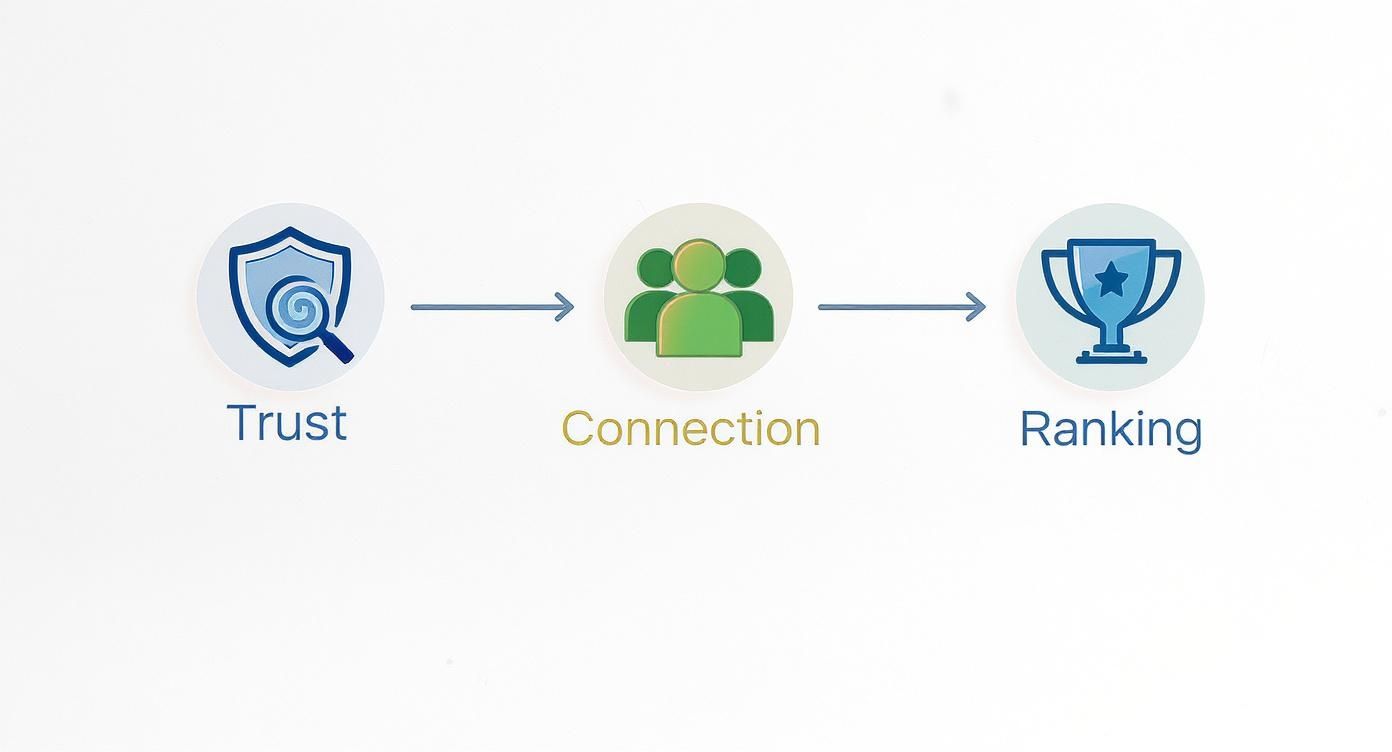
This graphic clearly shows that SEO success is not a product of chance. It is the result of a smart strategy that consistently puts people at the center.
The anatomy of a successful SEO text
To make this more tangible, let's look at the individual building blocks that make up a modern, high-performing SEO text. Each component fulfills a specific task – both for the human reader and for the search engine.
| component | Function for the reader | Function for SEO |
|---|---|---|
| Meta title & description | It sparks interest in the search results; it makes clear what it's about. | Most important on-page signal; influences the click-through rate (CTR). |
| Memorable H1 heading | Confirms to the reader that they are in the right place; summarizes the topic. | Defines the main topic of the page for the search engine. |
| Structuring subheadings (H2, H3) | Improve readability and scannability; structure the content logically. | They provide context and demonstrate the thematic depth and structure. |
| High-quality, relevant content | Answers the search query comprehensively; delivers real added value. | Core of the ranking; demonstrates expertise, authority and trust (EEAT). |
| Internal & external links | They provide further information and create context. | Strengthen the page architecture and signal thematic relevance. |
| Images, videos & graphics | They break up the text; visualize complex content; increase engagement. | They can rank well in image search; they keep users on the page longer. |
| Call-to-Action (CTA) | Guides the reader to the next desired action (e.g., purchase, contact). | Supports the page's conversion goals. |
Each of these elements plays a role. A good SEO text is like a well-rehearsed orchestra, where every component contributes to the overall effect.
A strategically written SEO text is your most direct line of communication to potential customers. It doesn't just answer a search query, but starts a dialogue that ideally leads to a conversion.
This guide provides you with the tools to create exactly these kinds of texts. Let's get started.
Keywords and search intent – the foundation for every good SEO text
Before even a single word is typed, we must ask ourselves the crucial question: What are my customers really searching for? A top-notch SEO text doesn't begin with writing, but with careful listening. It's about understanding the language of your target audience and identifying the problems they actually want solved. This is the core of a solid keyword and search intent analysis.

Focusing solely on search volume is a beginner's mistake I see time and time again. A keyword with 5,000 monthly searches It will do you absolutely no good if your text completely ignores the intention, the "why" behind the search. The real key to success lies in understanding this. Search intent to decipher.
The three faces of search intent
Every Google search can essentially be assigned to one of three categories. Learning to differentiate between them allows you to create content that fits like a tailor-made suit – precisely tailored to your users' expectations. This is a powerful lever for... SEO texts.
- Information search: Someone wants to know something here. The user is looking for answers, solutions, or explanations. Classic examples are search queries like "what are long tail keywords" or "how to write SEO text".
- Purchase intention (transactional): The situation is clear here: Someone wants to buy or book. Keywords like "seo agency Kaiserslautern" or "buy women's running shoes" indicate an immediate intention to purchase.
- Purchase preparation (commercial): In this phase, the user researches before making a purchase decision. They compare products, read reviews, or look for opinions. Queries like "best SEO text generator" or "Koala AI vs. Jenni AI" fall precisely into this category.
Your task is to identify the driving force behind each keyword. A user who googles "seo tips for beginners" wants a helpful guide, not an aggressive sales page.
Search intent is the foundation of your content strategy. If you ignore it, you're building your house on sand. You might write a beautiful text, but it won't rank or convert because it answers the wrong question.
A look beyond the obvious: The power of long-tail keywords
Instead of putting all your energy into the highly competitive main keywords (short-tail), the real gold often lies in the more specific search queries – the so-called Long-tail keywords. These usually consist of three or more words. While they have a lower search volume, their conversion rate is often many times higher.
Think about it: Someone searching for "shoes" might just be browsing. But someone typing in "waterproof hiking boots men size 44 gore-tex" practically already has the credit card in their hand.
Why you'll love long-tail keywords:
- Less competition: It's much easier to reach the top for a niche phrase.
- Higher relevance: They attract exactly the right people whose needs they can perfectly meet.
- Improved conversion rates: Anyone who searches so specifically knows exactly what they want – and is ready to take action.
To find these valuable phrases, you need to think like your customers. What specific questions do they ask? How do they describe their problems? You'll find a comprehensive guide on how to uncover these hidden gems in our detailed [article/guide/etc.]. Keyword Research Guide.
Practical tools for your research
Fortunately, you don't have to grope in the dark. There are a number of excellent tools available to help you find keywords, assess their potential, and understand the intent behind them.
| Tool | Main function | Ideal for |
|---|---|---|
| Google Keyword Planner | Provides keyword ideas and search volume data directly from Google. | Basic research and an understanding of search volume. |
| Ahrefs / Semrush | We offer comprehensive analyses, including competitor keywords and backlink data. | In-depth analysis and the development of a strategic keyword map. |
| AnswerThePublic | Visualizes search queries in the form of questions, prepositions, and comparisons. | Uncovering long-tail keywords and content ideas that answer real user questions. |
| Google Trends | Shows the seasonal and long-term development of interest in a keyword. | Identifying trends and planning content seasonally. |
My tip for getting started: Create a list of core topics (seed keywords) that define your business. Enter these into the tools and collect all the related terms, questions, and long-tail variations that are generated. Then organize your findings in a... Keyword map. This is a strategic map that assigns each keyword to a relevant page on your website. This ensures you don't accidentally compete with yourself (keyword cannibalization) and creates a structure that both users and search engines will love.
The structure: The invisible framework for readers and Google
A brilliant text without a clear structure is like a house without a foundation – it collapses before anyone can move in. Structure is the invisible skeleton that gives your content support and makes it accessible. It's the map for your readers and, at the same time, the blueprint for Google's bots.
A logical structure not only makes your text much easier to understand, but it also signals to search engines that you have truly thought through and thoroughly researched a topic. Without this clear structure, you risk readers becoming frustrated and losing interest, and Google will struggle to recognize the relevance and connections within your content.
Using HTML headings to send the right signals
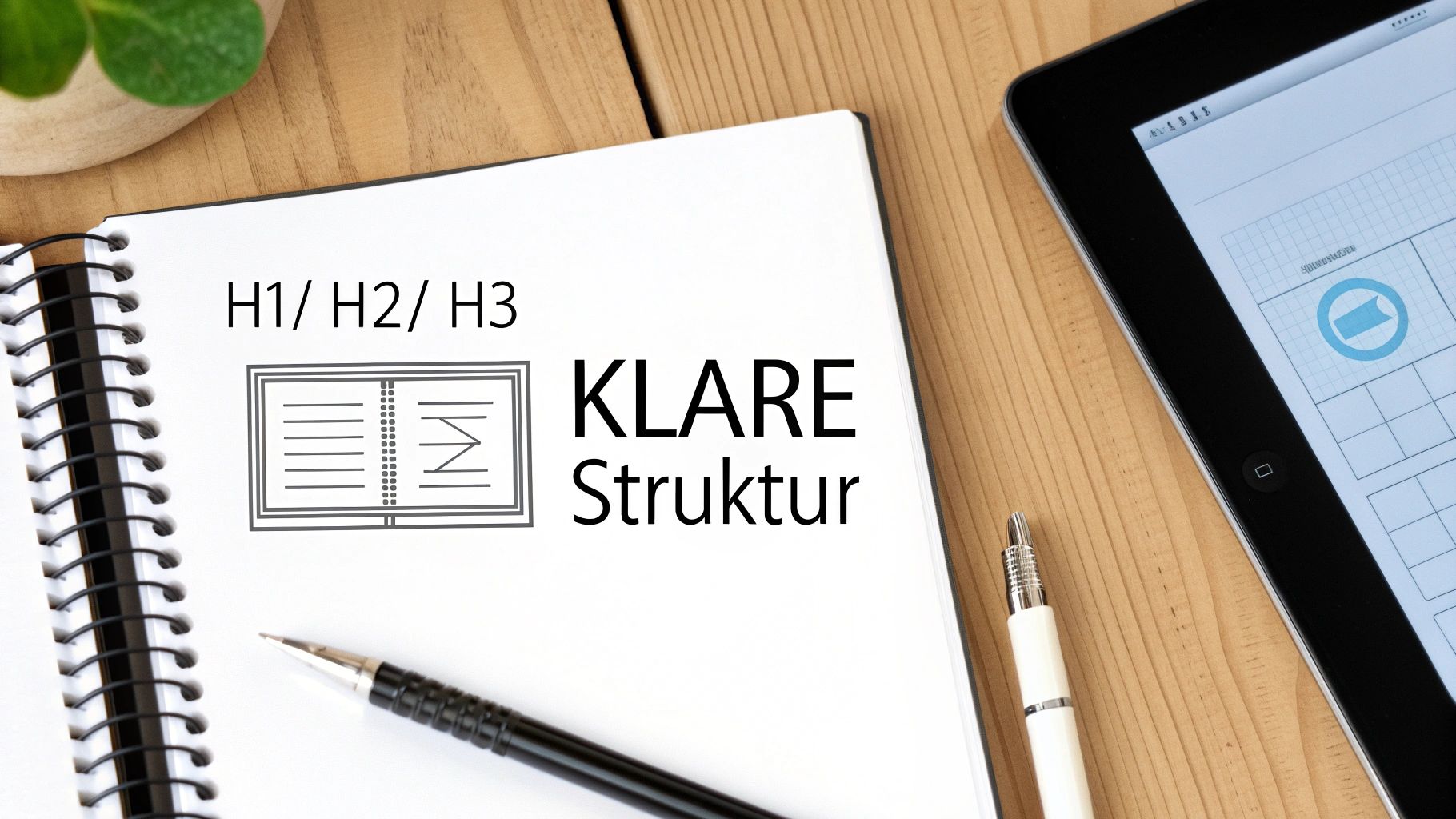
The foundation of any good outline is the HTML headings (H1, H2, H3, etc.). Don't see them merely as formatting; consider them the crucial guideposts for your text.
Her H1 heading This is the page title. There's only ever one, and it must clearly state what the page is about. Your main keyword belongs here so the reader immediately knows: "Yes, I've come to the right place."„
With the H2 headings Divide your text into large, thematic blocks. Each H2 heading should cover a key aspect of your topic. This is also a perfect place to include relevant secondary keywords.
The H3 headings Then go one level deeper and structure the sections under the H2 headings. This allows you to break down even complex topics into small, easily digestible pieces of information and ensure maximum clarity.
Imagine the structure simply like the table of contents of a non-fiction book: The H1 is the book title, the H2s are the main chapters, and the H3s are the respective subchapters.
A clear heading hierarchy is non-negotiable for SEO. It catapults readability to the top and helps search engine crawlers understand the thematic structure of your page in milliseconds.
How to create an SEO text that actually works
A truly effective SEO text almost always follows a proven structure that keeps the reader engaged from the first to the last line. This structure is essentially divided into three phases.
1. The opening that sparks curiosity
The first few sentences are crucial. They determine whether someone stays or clicks away. Forget lame phrases like "In this article you will learn…". Jump right in with the problem, a provocative question, or a surprising statistic. Show that you understand the reader's situation and make a clear promise about the solution they will find here.
2. The main part, which delivers what was promised.
Now we get down to brass tacks. This is where you deliver on the promise you made in the introduction and provide real added value. Your H2 and H3 headings will guide you in logically structuring your arguments. Each section should answer a specific question or illuminate a particular aspect of the topic. The main body is where you showcase your expertise, data, practical examples, and concrete solutions.
3. The conclusion that encourages action
Finally, concisely summarize the most important findings. But please don't just repeat everything! Give the reader the key takeaways. And very importantly: always end the text with a clear conclusion. Call-to-Action (CTA). Tell the reader clearly what the next step is: write a comment, try your product, or subscribe to the newsletter.
Visual anchor points against the text desert
Let's be honest: online we don't read text, we scan it. A massive wall of text is a total killer for attention and dwell time. Therefore, be sure to break up your content with visual elements to make it easier to consume.
- Short paragraphs: Keep your heels super short – one to three sentences They are ideal. Each thought gets its own little paragraph. This creates an enormous amount of white space and breathing room.
- Lists and enumerations: Information in list form (like this one) is much faster for our brain to process than the same content in continuous text.
- Bold and italic type: Highlight important keywords or concise statements. This will automatically draw the reader's attention to what really matters.
- Images and videos: Visual media are not just decoration. They break up the text, make complex content more understandable, and can drastically increase dwell time – an increasingly important signal for Google.
If you do that Write SEO text By tackling these strategic formatting changes, you'll not only make things more efficient for yourself, but above all, you'll create a reading experience your visitors will love. And what visitors love will sooner or later be rewarded by Google with better rankings.
Create content with real added value
A clear structure and the right keywords are the foundation. But now comes the real challenge. SEO textsThe goal is to create content that offers real, tangible added value not just for Google, but above all for people. The art lies in leaving your readers smarter, better informed, or simply well entertained.
It used to be enough to simply include the right keywords. Today, Google looks much more closely and rewards quality above all else. A text that only scratches the surface simply won't rank in the long run. Your goal must be to provide the best answer on the entire web to your target audience's question. Nothing less.
Building trust with the EEAT principle
To understand what Google means by "quality," we need to talk about EEAT (Evidence-Free Approach). It's not rocket science, but a clear concept based on four pillars of trustworthy content. Anyone who wants to be successful in SEO today needs to have internalized these criteria.
- Experience: This is about authenticity. Are you speaking from personal experience? Have you actually handled the product, used the service yourself? Personal insights are invaluable and create a connection that facts alone cannot.
- Expertise (specialized knowledge): Substantiate your statements. This means not just sharing opinions, but backing them up with facts, data, and well-researched information. Show that your words are based on in-depth knowledge.
- Authoritativeness (Authority): Position yourself as a reliable source in your industry. This can be achieved, for example, by referencing recognized studies, quoting industry leaders, or mentioning certificates and awards.
- Trustworthiness: Create a safe environment for your users. Transparency is paramount. A complete legal notice, easily accessible contact information, and honest reviews are absolute basics for building trust.
A text that takes these four points into account sends extremely strong signals to Google. It proves that substance is being offered here, not just hot air.
EEAT isn't a direct technical ranking factor, but rather Google's compass for quality assessment. It helps the search engine find content that people can truly trust. Focus on becoming the most trusted voice in your niche.
The art of natural writing
Forget keyword stuffing. The days of cramming a keyword into a text as often as possible are definitely over. These days, it does more harm than good.
Modern algorithms understand the thematic context of a page. It's not about..., how often a term occurs, but how comprehensive A topic is being discussed. Place your main keyword naturally in the H1 heading, in a few subheadings, and in the first paragraph. After that? Write for your readers.
Use synonyms and related terms, and answer the typical "W" questions (who, what, when, where, why, how). If your topic is "fully automatic coffee machines," then words like "grinder," "milk froth," "cleaning," and "espresso" should naturally appear in your text. This signals thematic depth.
A simple but effective test: Read your text aloud. Does it sound clunky or unnatural? Then it will feel the same to your readers.
The right format for the right purpose
SEO text is not all the same. The format must always be tailored to the user's search intent and the channel. A comprehensive how-to article has a completely different purpose than a concise product description.
Blog article
This allows you to primarily serve informational search queries and build your expert status. In-depth knowledge is key here. Analysis from suxeedo.de shows that the average length of blog articles has increased by [amount] in the last ten years. 77 % has increased. Particularly interesting: Content with over 3,000 words often generates three times more traffic and is shared four times more often.
Landing pages
This is about business. The goal is clearly defined: conversion. The copy must be persuasive, get to the point, and include a clear call to action. Every sentence serves to bring the user closer to clicking the button.
Product descriptions
These texts must bridge the gap between dry facts and emotional benefits. They answer the question: "What's in it for me, and how does this product improve my life?" Use bullet points for a quick overview and storytelling to create a sense of need.
Focus on Cornerstone content
One extremely effective strategy is the creation of so-called Cornerstone content. Think of these as your masterpieces: extremely detailed, in-depth articles that cover a central theme of your website from A to Z. They are the ultimate guides and knowledge hubs in your field.
An example would be a 5,000-word guide that explains how to Finding long-tail keywords You can. From this central article, you then link to smaller, more specific articles such as "The best tools for keyword research" or "Analyzing search intent correctly." This creates a crystal-clear thematic structure.
The advantages of Cornerstone content are enormous:
- Pure authority: They signal to Google and users that you are the absolute go-to source for this topic.
- A real backlink magnet: Such high-quality content naturally attracts links from other websites.
- Strong internal linking: They build a logical page architecture that makes it easier for users and search engines to find their way around.
Yes, creating such content is time-consuming. But the effort more than pays off through lasting visibility and invaluable expert status.
Now for the finishing touches: How to optimize your text for Google
The rough draft is finished – great! But the real work for the search engine only begins now. This phase is about turning a good text into a true SEO champion. We need to send Google clear signals about what this is about, while simultaneously encouraging users to click on the results.
Think of it this way: The text is the foundation of your house. Stable and well-thought-out. On-page optimization is the roof, the windows, and the inviting entrance. Without these details, no one will want to enter, no matter how solid the foundation.
First impressions: Meta title and description
Your calling card on Google – that's your meta title and meta description. They are often the very first point of contact with your target audience and decide in fractions of a second whether someone clicks on your link or simply scrolls on.
A truly good meta-title has no more than approximately 60 characters and places the main keyword as early as possible. It needs to pique the reader's interest. Instead of a generic "guide to SEO copywriting," "Writing SEO texts that rank: A guide for 2024" simply works better. It's specific and promises clear benefits.
The meta description gives you approximately 155 characters A little more leeway. Here you summarize the added value of your article and ideally include a short call to action.
A little tip from practical experience: Consider your title and description as your free Google ad. A high click-through rate (CTR) is an extremely strong signal for the search engine and can directly and positively influence your ranking.
Images are more than just decoration: Alt tags and file names
To be honest: Visual content is essential for a good reading experience, but it's also an often-overlooked SEO goldmine. Google can't "see" images; it relies entirely on the accompanying textual information.
- Descriptive file names: Before you upload an image, name it appropriately.
IMG_1234.jpgbecomesSEO text writing checklist.jpg. This gives Google the correct context immediately. - Meaningful alt tags: The alt tag (alternative text) describes what is shown in the image. It's used for accessibility (screen readers) and search engines. It should be short and include the keyword if it's relevant. For example: "Checklist with the most important steps for writing SEO text".
These tiny adjustments can ensure that your images appear in Google image search and bring you additional traffic.
Semantic keywords: Show that you know what you're talking about.
Anyone who still believes that simply repeating the main keyword is enough has been living under a rock for the past few years. Modern search algorithms understand the thematic context of a page. They reward content that truly delves into a topic in depth. This is precisely where semantically related terms come into play.
If your main keyword is "writing SEO text", then Google expects your article to naturally include terms like these:
- Keyword density
- Improve readability
- On-page optimization
- Meta description
- User intent
- Content structure
By using these related concepts, you signal to Google: "Hey, I'm an expert in this field and I'll answer the search query comprehensively."„
Strategic Signposts: The Power of Internal Links
Internal links are the signposts on your own website. They create a logical network between your content that both users and Google crawlers can easily follow. Well-planned internal linking is pure gold.
It distributes the link equity of your site (the so-called "link juice") and thus strengthens even weaker subpages. At the same time, it directs your readers to other relevant articles, which increases dwell time – and Google loves that. Anyone who truly wants to refine their strategy needs to know the rules of the game. Learn more about the crucial ones. Google ranking factors in our article Find out more here.
Always use meaningful link text. Instead of "click here," link to "our guide to keyword research." For very specific goals, such as increasing local visibility, a guide like the one on the topic can be helpful. SEO for small businesses also provide valuable insights.
Your ultimate checklist for on-page optimization
To ensure you don't forget any of the small details, I've compiled a checklist here that you can go through for every new text.
| Area | Task | Completed? |
|---|---|---|
| Metadata | High-impact meta title (max. 60 characters) created with main keyword. | ☐ |
| Compelling meta description (max. 155 characters) with CTA written. | ☐ | |
| Contents | Main keyword placed in H1, introduction and some H2/H3 headings. | ☐ |
| Semantically related keywords are naturally integrated into the text. | ☐ | |
| Readability checked (short sentences, active language). | ☐ | |
| Link | At least 2-3 relevant internal links with good anchor text have been set. | ☐ |
| Possibly 1-2 external links to trusted sources have been included. | ☐ | |
| multimedia | All images have descriptive filenames and alt tags. | ☐ |
By working through these points one by one, you will turn your draft into a perfectly optimized SEO text that is ready to conquer the search results.
Frequently asked questions about SEO text writing
Anyone who deals with the topic SEO texts Anyone tackling this topic will quickly encounter a host of questions, myths, and sometimes outdated advice. To keep you on the right track, we've compiled the most frequently asked questions here – with clear, practical answers that you can implement immediately.

How many keywords should I use in an SEO text?
Forget the old refrain about "keyword density." That concept is long outdated. What really matters today is the natural integration of your main keyword and thematically related terms. Your focus should be on covering a topic as comprehensively as possible.
The main keyword naturally belongs in strategically important places: in the title, the meta description, the H1 heading, and in one or more subheadings. Within the body text, however, it should blend in naturally without seeming out of place. Modern search engines are clever – they understand the context and reward thematic depth much more than the stubborn repetition of a single term.
Shift your focus: Don't think in terms of keyword counts, but rather about your users' questions. If you perfectly address the search intent, the relevant keywords will appear in your text naturally.
Does text length really play such a big role in SEO?
Yes, but with one important caveat: quality always trumps quantity. Numerous studies show that longer, more in-depth articles tend to rank better. The reason is simple: they can cover a topic more comprehensively and answer more user questions. Google interprets this as a clear signal of expertise and completeness.
However, a long text is no guarantee of a top ranking if the content is irrelevant or artificially padded. There is no perfect length – it always depends on the topic and the search intent.
- My practical tip: Look at the top 10 results for your keyword. This will give you a good sense of the depth and scope that Google considers relevant. You can use this as a guide to stay competitive.
How do I measure the success of my SEO texts?
The success of SEO texts is not a matter of chance, but can be tracked using concrete data. Crucially, you should define clear goals before publication. Only then can you truly assess whether the effort was worthwhile. The best way to do this is by using a combination of different tools.
Key metrics for your success:
- Rankings & Visibility: Maintain the positions of your most important keywords in the Google Search Console Keep an eye on it. Observe how rankings and impressions develop.
- Organic traffic: How many visitors actually come to your site via organic search? Google Analytics See if this value increases after the release of new content.
- Click-through rate (CTR): Search Console shows you the ratio of impressions to clicks. A good CTR indicates how compelling your meta title and description are in the search results.
- User behavior: Do visitors stay on your site or do they leave immediately? Key metrics like these Length of stay and the Bounce rate In Google Analytics, positive signals are invaluable. They show Google that your content is relevant.
- Backlinks: The number of high-quality links pointing to your article is a huge signal of authority. Tools like Ahrefs or Semrush help you keep track of things.
- Conversions: At the end of the day, what matters is the bottom line. Measure how many inquiries, sales, or newsletter sign-ups your SEO text actually generates.
Regularly analyzing these metrics gives you a clear picture of which content resonates with your target audience and where you need to make adjustments. This will make your SEO strategy more effective each time.
Do you want to ensure that your SEO texts are not only well-written but also deliver the desired results? At LinkITUp We support you with over 15 years Expertise in sustainably increasing your online visibility and achieving your goals on Google. Learn more about our customized SEO services.