





Imagine you're going fishing. You could cast a huge net and just hope something lands in it. That's like targeting very general keywords. The other option? You use a completely special bait, ...to hook exactly the fish you really want to catch. That's precisely the principle behind long-tail keywords.
Why specific search queries often have the greatest potential
Many entrepreneurs make the mistake of focusing solely on high-volume search terms – keywords like "shoes" or "marketing." The result is usually frustration. The competition for these so-called short-tail keywords is brutal, as they are dominated by large, established brands with huge budgets. You quickly feel like a small fishing boat trying to compete against a fleet of trawlers.
What's often overlooked with this tactic is a simple truth about human behavior online: the closer someone gets to making a purchase decision, the more precise and lengthy their search queries become. No one who truly wants to buy something just types "shoes" into Google. They're looking for a solution to a very specific problem or a particular need.
The power of precision
And this is precisely where the crucial question arises: What exactly are long-tail keywords? Quite simply: They are longer, very precise search phrases, usually consisting of three or more words. The most important thing about them is that they reveal a very clear intention.
A few examples immediately illustrate the difference:
Short-tail: „"coffee"“
Long-tail: „"fair trade organic coffee beans for portafilter machines"“
Short-tail: „SEO agency“
Long-tail: „SEO agency for local businesses in Kaiserslautern“
These detailed queries, taken individually, naturally have a lower search volume. But – and this is the crucial point – they bring exactly the right people to your website. These users already know pretty much exactly what they're looking for and are often close to making a decision.
The true value lies not in the sheer number of visitors, but in their relevance. Long-tail keywords allow you to reach people who have a specific problem for which your company offers the right solution.
By focusing on these niche queries, you elegantly avoid direct competition with industry giants and establish yourself as a specialist. This strategy is invaluable, not only for small businesses or niche providers, but for anyone who wants to grow online and attract the right customers. It's the key to targeted traffic and significantly improved conversion rates.
What exactly are long-tail keywords?
Forget the wide-net approach of trying to catch everything. Longtail keywords are about casting the perfect bait. Long-tail keyword It's essentially just a longer, much more specific search query. The great thing about it is that it tells us exactly what the user has in mind.
Imagine someone simply searching for "shoes". This very general search, a so-called Short-tail keyword, This leaves us in the dark. Is the person looking for men's shoes, women's running shoes, or elegant sandals? The intention is completely unclear.
The situation is completely different when someone types "waterproof winter hiking boots for women size 39" into the search bar. That's a prime example of a long-tail keyword. It's long, precise, and the purchase intent is practically palpable. This precision is precisely the decisive advantage.
The myth of low search volume
At first glance, the lower search volume of individual long-tail queries might seem daunting. Why focus on a search phrase that perhaps only 20 people search for per month when the main keyword has thousands of searches?
The answer lies in the sheer volume. There are countless variations of these specific searches. If you add up all these "small" queries, they make up a huge portion of the total search traffic – often even more than... 70 % of all Google searches.
The following graphic nicely illustrates how the combined volume of many small, specific searches can easily exceed the volume of a single, broad keyword.
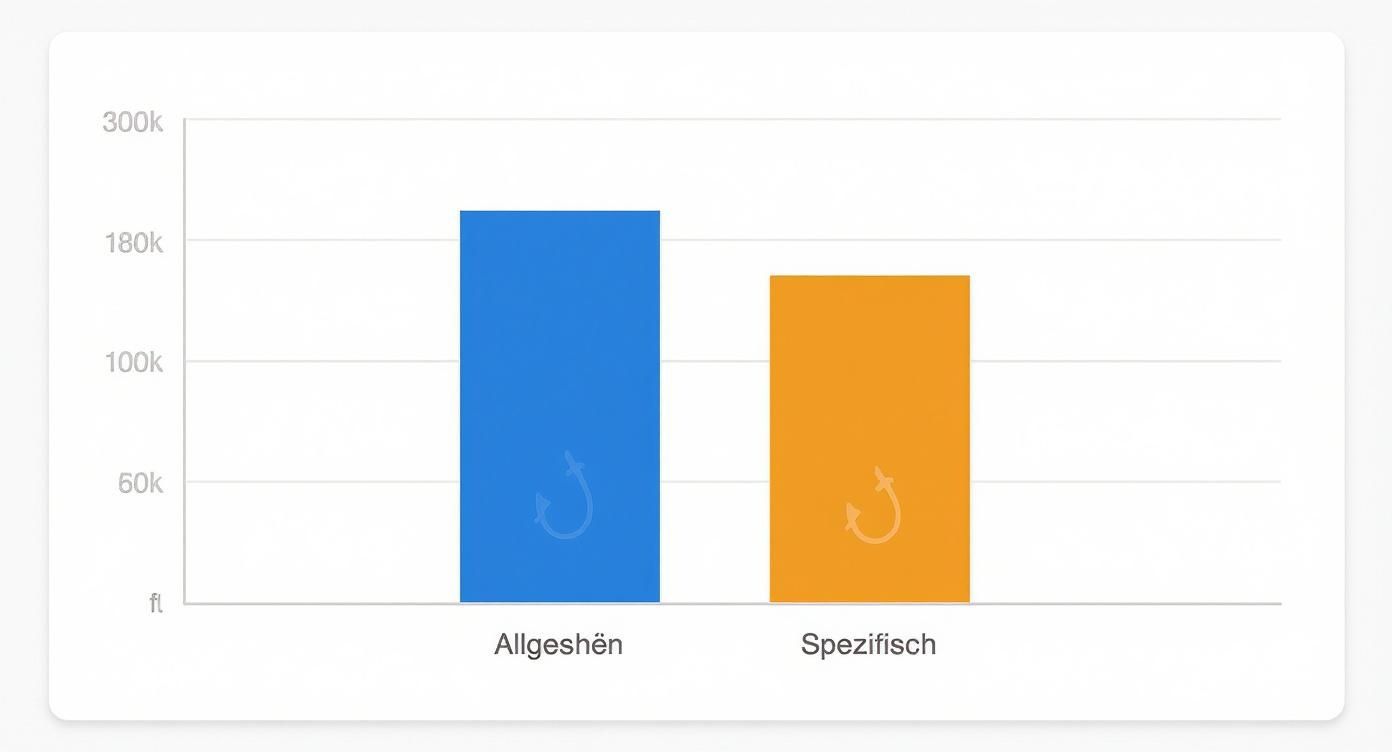
As you can see, the sum of many niche queries can open up a market that is just as large – or even larger – than a highly competitive, general term.
A clear comparison: Short-tail vs. Longtail
To make the differences more tangible, keywords can be roughly divided into three categories. Each has its own strengths and weaknesses in terms of length, competition, and the likelihood of converting a searcher into a customer.
This classification greatly helps in understanding why a balanced strategy is so important. Long-tail keywords are particularly valuable in German e-commerce, as they often target very specific needs, such as "buy vegan Christmas cookies Berlin." Such queries lead much more directly to the goal and thus to higher conversion rates. If you would like to delve deeper into the role of long-tail keywords in e-commerce, you can find further information here. There's a good article about it on digitalsprung.de.
This table directly compares the keyword types and makes the advantages even clearer.
Comparison of keyword types
This table shows the key differences between short-tail, mid-tail and long-tail keywords in terms of search volume, competition and conversion rate.
| feature | Short-tail keywords (e.g., 'coffee') | Mid-tail keywords (e.g., 'organic coffee beans') | Long-tail keywords (e.g., 'fair trade organic coffee beans for portafilter machines') |
|---|---|---|---|
| length | 1-2 words | 2-3 words | 3+ words |
| Search volume | Very high | Medium | Low per keyword |
| Competition | Very high | High | Low to medium |
| Search intent | Often unclear, broad | More specific | Very clear, often ready to buy |
| Conversion rate | Low | Medium | Very high |
The table makes it clear: The true treasure of long-tail keywords lies not in the individual search volume, but in the extremely high conversion probability. They may attract fewer visitors, but they attract exactly the right ones.
A visitor who arrives at your site via a long-tail keyword already knows exactly what they want. Your only task is to serve them the perfect solution on a silver platter.
In summary, long-tail keywords are characterized by three features: length, specificity, and a crystal-clear user intent. Understanding this is the first and most important step toward harnessing their power for your SEO strategy. Instead of fishing with a giant net in the ocean, you can target your ideal customers precisely where they are.
How long-tail keywords can take your SEO results to the next level
Why on earth should you waste time on search queries that hardly anyone seems to type in? Quite simply: these niches hold enormous strategic leverage. Instead of fighting with countless competitors for the same fiercely contested short-tail keywords, long-tail keywords pave a clever path to top rankings and truly qualified customers.
Focusing on long-tail keywords isn't a last resort, but a smart, proactive strategy. You're not targeting the broad, anonymous masses, but rather users who have a genuine, tangible interest in your offering. Let's take a closer look at the four key advantages that make long-tail keywords a true game-changer for your search engine optimization.
Elegantly evade competitive pressure
Perhaps the most obvious advantage of long-tail keywords is the significantly less competition. While large companies with huge budgets flock to generic terms like "marketing agency," highly specific phrases often go unnoticed. For a query like "content marketing for B2B software startups," there's simply far less competition.
This means that with truly excellent content, you can reach the first page of Google much faster and with less effort. You don't have to compete against industry giants; instead, you can position yourself as the sought-after expert in your niche and become visible precisely for the topics that matter to your business.
Benefit from significantly higher conversion rates
One of the most effective aspects of long-tail keywords is the underlying search intent. Someone searching for "best running shoes for marathon training" is much, much further along in the buying process than someone who simply enters "running shoes." The search query is so precise that it signals a crystal-clear intent.
Visitors who arrive at your site via a long-tail search are not random surfers. They are potential customers who have a specific problem and are actively searching for the right solution. If your content provides precisely that solution, the likelihood of a conversion – be it a purchase, an inquiry, or a registration – is exceptionally high.
Numerous studies prove that the Conversion rates for long-tail keywords are often 3–5 times higher. The results are better than with general search terms. Instead of attracting 1,000 unqualified visitors, it is far more profitable to gain 50 highly interested users who are close to making a decision.
Sustainably strengthen your thematic authority
Search engines like Google no longer evaluate websites based solely on individual keywords. They understand entire topic areas. By creating a comprehensive content series that answers various long-tail questions related to a core topic, you send a strong signal to Google: "Hey, we know our stuff in this area!"„
Let's take the main topic of "selling real estate" as an example. By creating targeted content for long-tail queries such as:
- „"What documents are needed for selling a house?"“
- „"Additional costs for sellers when selling a house"“
- „"Free and reliable online property valuation"“
…build a so-called thematic authority This not only strengthens the rankings of your specific articles, but also increases the visibility of your entire website for the overarching topic of "real estate sales".
The key to voice search
The way we search is changing. With the rise of voice assistants like Siri, Alexa, and Google Assistant, our search queries are increasingly becoming real conversations—and therefore longer. Nobody says to their smart speaker, "Weather Kaiserslautern." Instead, they ask, "Hey Google, do I need an umbrella in Kaiserslautern today?"„
These natural, question-based searches are essentially nothing more than long-tail keywords. In fact, around 82 % of all voice search queries long-tail phrases. Since a large proportion of users already use this technology daily, optimizing it for such dialogue-oriented questions is becoming increasingly important. You can find more interesting facts about this in the [link/section/etc.]. Statistics on long-tail keywords on embryo.com.
Companies that provide content answering these specific questions are perfectly positioned for the future of search. They not only meet current SEO requirements but also secure a decisive advantage in the rapidly growing field of voice search.
Systematically finding valuable long-tail keywords
We've now grasped the theory. But how do you actually snag these little gold nuggets in the SEO jungle? The good news is: it's not a mysterious treasure hunt, but rather solid, systematic work. And the best part is that you don't have to immediately spend a fortune on expensive professional tools to land those first crucial hits.
The starting point for our research is often the most powerful data source of all: Google itself. The search engine provides us with valuable insights, practically free of charge, into what really motivates users and how they formulate their questions. This approach requires a certain degree of systematic planning, similar to... Strategies for systematic research in science, but it's worth it.

Use the free methods first.
Before you spend a single cent, you should fully utilize Google's built-in tools. These tools are not only free, but they also provide completely authentic data that comes directly from people's real search behavior.
Start by focusing on these three gold mines:
Google Autocomplete: Type your main keyword (for example, "real estate agent") into Google Search, but don't press Enter yet. The suggestions Google automatically gives you are spot on. These are genuine long-tail variations like "real estate agent Kaiserslautern" or "real estate agent commission," which are frequently searched.
Similar questions (People Also Ask): Perform a search and pay attention to the "Related Questions" box. Here, Google presents you with complete sets of questions that users are asking. These are perfect long-tail keywords with a clear, informative search intent, for example: "How much does a real estate agent cost when selling a house?".
Related search queries: After performing a search, scroll to the very bottom of the results page. Under "Related searches," you'll find further long-tail ideas based on other users' searches. These might include phrases like "real estate agent costs seller 2024.".
With just these three simple methods, you can already build a considerable and extremely relevant keyword list.
Go deep with professional tools
If you want to take your research to the next level, professional SEO tools come into play. They provide valuable additional data such as... Search volume, the competitive strength and hundreds of related keyword ideas at the touch of a button.
A tool like AnswerThePublic is, for example, brilliant for graphically presenting the typical W-questions about a topic.
Platforms like Ahrefs or SEMrush go a step further. They allow you to spy on your competitors' keywords or generate huge lists of long-tail variations that you would never come up with manually. A comprehensive Keyword Research Guide can help you get the most out of these powerful tools.
Search intent: The key to success
Simply collecting keywords is only half the battle. The truly crucial step is... Search intent Understanding what the user wants behind each individual phrase is crucial. really How can he achieve this by entering something into the search?
Broadly speaking, there are four types of search intent:
- Informational: The user wants to know something ("how does a heat pump work").
- Navigational: The user wants to go to a specific page ("linkitup login").
- Transactional: The user wants to buy something ("buy Nike Air Max 90").
- Commercial Investigation: The user is about to make a purchase and is comparing options ("best SEO provider Kaiserslautern").
If you correctly interpret the intent behind a long-tail keyword, you can deliver exactly the content the user expects. A transactional query requires a product page, an informational query a well-researched blog article.
A practical example from beginning to end
Let's walk through this using the main keyword "real estate agent" as an example.
- Main keyword (short-tail): real estate agent
- Research (e.g. via Google Autocomplete): provides "costs for real estate agents when selling a house"„
- Refinement (local reference): results in „costs real estate agent house sale Munich“
- Analysis of search intent: The intention here is quite clear. informational, perhaps with a slight influence of Commercial Investigation. The prospective buyer wants to understand the costs before choosing a real estate agent.
The perfect content for this long-tail keyword would therefore not be a flat advertising text, but a detailed guide that transparently breaks down these costs.
Focusing on these specific search queries is, incidentally, extremely strategic. Data from the German market underscores the enormous dominance of these niche searches. Approximately. 74 % of all keywords are searched only ten times or less per month – that's the realm of long tails. In contrast, vanishingly few reach 0,024 % All keywords have more than 100,000 searches per month. This impressively demonstrates where the real action is.
How to effectively weave long-tail keywords into your content
The best keyword list is completely useless if it just gathers dust in an Excel spreadsheet. Long-tail keywords only unleash their true power when you strategically and, above all, naturally integrate them into your content. This isn't about desperately repeating a keyword as often as possible – an outdated tactic that... Keyword stuffing These are the things Google penalizes you for today. The real goal is to deliver genuine added value by answering the very specific questions of your target audience.
Once you've found your perfect long-tail phrases, the real work begins: placement. Think of your website like a well-structured book. Your keywords are the signposts in the chapter headings and table of contents, immediately signaling to both readers and search engines what the page is about.

Strategic placement: Where keywords work best
To ensure your long-tail keywords are fully effective, they should appear in several key positions on your page. The key to success is always a natural integration that doesn't disrupt the reading flow.
Here are the most important "hotspots" for your keywords:
- In the page title (Title Tag): This is the first point of contact in Google results. Your most important long-tail keyword belongs right here, ideally as close to the top as possible.
- In the meta description: While it's not a direct ranking factor, it's your calling card in search results. A well-placed keyword increases relevance and encourages clicks.
- In the main heading (H1): Each page should have a single H1 heading. It summarizes the main topic and must absolutely contain the primary long-tail keyword.
- In the subheadings (H2, H3): Use thematically relevant variations of your keywords in the subheadings. This structures your text effectively and sends additional relevance signals to Google.
- In the first paragraph: Include your main keyword as early as possible in the body of the text. This makes it clear from the very first sentence what the text is about.
- In image alt text: Google can't "see" images, but it can read the alt text. Describe what's in the image – a perfect opportunity to strategically place your keyword.
By paying attention to these points, you make it extremely easy for search engines to understand what your page is about and which queries it is relevant for.
Tailor-made content for specific search queries
The real art lies not just in distributing keywords, but in creating content that perfectly serves the intent behind a long-tail search. Certain formats are particularly well-suited for this.
Blog articles and how-to guides are perfect for information-driven long-tail questions. A search like "how long does it take to sell a house with a real estate agent" practically begs for a comprehensive article that explains the entire process step by step. In such an article, you can include not only the main keyword but also countless related questions.
Another incredibly powerful tool is FAQ sections. Whether as a separate section on your website or as part of a landing page, you can answer a whole range of specific long-tail questions directly and concisely. This not only improves the user experience but also increases your chances of appearing in Google's "Related Questions" boxes.
By answering specific questions with detailed content, you establish yourself as an expert. You not only provide a quick answer, but also build trust with potential customers even before they make contact.
Naturally, your product and service pages will also benefit enormously from this approach. Instead of just offering "SEO consulting," try optimizing for "SEO consulting for small businesses in Kaiserslautern." You'll see how the quality of your inquiries improves.
Topic Cluster: Build your thematic authority
An advanced strategy is the construction of so-called Topic Clusters. Imagine it like this: You have a major core topic, for example, "selling real estate." This is your "pillar page," essentially the sun in your content solar system—a comprehensive guide that covers the topic from A to Z.
Around this central page, you now create several smaller, highly specific articles, each contributing to a long-tail keyword (e.g., "additional costs when selling a house" or "energy certificate required for house sale"). Each of these "planet" articles then links back to the central "sun," i.e., the pillar page.
This structure has an unbeatable advantage: it signals to Google that you possess comprehensive authority on the entire topic. The shorter articles rank well on their own, but simultaneously strengthen the entire topic area and push the important pillar page up in the rankings. Crucial to this is the strategic use of... Internal links for SEO, to make thematic connections visible to search engines. This creates a content structure that solidifies your expertise and sustainably increases your visibility.
Measure and optimize the success of your long-tail strategy
A good long-tail strategy isn't a one-off action, but a continuous process of analysis and adaptation. But how do you know if your efforts are paying off? The answer lies in the data. Instead of groping in the dark, you need to make the success of your content measurable.
The measurement doesn't begin weeks later, but immediately after publication. The goal is to understand how Google and your target audience react to the new, specific content. Only then can you make data-driven decisions and refine your strategy step by step.
Keeping an eye on the most important key figures
To not only guess at success but to concretely demonstrate it, you should focus on a few key performance indicators (KPIs). These will give you a clear picture of what is working and where there are still problems.
The three most important metrics for your long-tail analysis are:
- Keyword rankings: Track your page's ranking for your target long-tail keyword. Tools like Google Search Console show you exactly which search queries are generating impressions and clicks for your page. A rise in ranking 20 on 8 is a clear success.
- Organic traffic: Check in Google Analytics how many visitors arrive at the specifically optimized page via organic searches. A steady increase in traffic for a long-tail optimized page indicates that your strategy is working.
- Conversion rate: This is the crucial metric. How many of the visitors who arrived via a long-tail keyword perform the desired action (e.g., submit an inquiry, purchase a product, fill out a form)? A high conversion rate demonstrates the business value of your keywords.
A deeper understanding of how to select the right metrics is crucial. Our guide will tell you more about the most important ones. KPIs in SEO, in order to precisely control the success of your measures.
Common mistakes and how to avoid them
Even with the best intentions, mistakes can creep into a long-tail strategy. Knowing these typical pitfalls allows you to avoid them from the outset and use your resources more effectively.
A common mistake is creating content for keywords that have no business relevance. Just because a phrase has low search volume doesn't automatically make it a good long-tail keyword. Always ask yourself: Is there a potential customer behind this search?
A successful long-tail strategy focuses not only on search volume, but above all on relevance to your business model. Ten highly qualified visitors who convert are more valuable than a thousand who only search for information and then leave.
Another critical mistake is ignoring user intent. If someone searches for "heat pump cost comparison," they expect a clear table or a detailed comparison article—not a generic homepage. If you don't deliver what the user expects, they will leave your site immediately, which Google interprets as a negative signal. Therefore, always analyze the search results for your keyword first to understand what kind of content Google considers relevant for that query.
Questions and answers about long-tail keywords
Finally, we'd like to address a few questions that frequently arise in practice. This should clear up any remaining doubts, allowing you to confidently launch your own long-tail strategy.
How many long-tail keywords fit on one page?
There's no single answer to this question like "three" or "five". A different approach is much more important: Focus on one thing per page. a primary long-tail keyword. This is the search term that best captures the intent of your target audience. This keyword should be prominently placed – in the title, the H1 heading, and right in the first paragraph.
Around this main keyword, you can then naturally incorporate other, thematically relevant long-tail variations. But remember: relevance always trumps sheer quantity. The content must truly and authentically answer the question behind the search. Ultimately, what matters is the added value for the reader, not keyword density.
Are long-tail keywords worthwhile for local businesses?
Absolutely! For local businesses, they are often a game-changer. A general search term like "restaurant" is incredibly competitive and expensive. A specific search like "Italian restaurant with gluten-free pizza in Kaiserslautern," on the other hand, is pure gold.
Anyone searching this way has a crystal-clear purchase intention and likely wants to make a reservation or visit immediately. By specifically targeting your content to these local long-tail queries, you attract precisely the customers who are looking for your offering. The result is more calls, more walk-in traffic, and increased sales.
For local service providers and retailers, long-tail keywords are the most direct way to reach qualified customers in their own city. They filter out the noise and address precisely the people who are truly important.
Will long-tail keywords become irrelevant due to AI searches like Google SGE?
Quite the contrary – their importance is actually increasing. AI-powered search results like Google's AI Overviews are trained to understand and answer complex, almost conversational questions. This is precisely the domain of long-tail keywords.
Content that answers a specific long-tail question in detail and with clarity has a much higher chance of being used by AI as a reliable source and cited directly in search results. This can dramatically increase your visibility because you'll be positioned at the top as an expert. Long-tail keywords are therefore not obsolete, but rather the key to visibility in the new era of search.
You see the potential of long-tail keywords, but don't know how to get started? LinkITUp is your experienced SEO partner here in Kaiserslautern. We find the right keywords for your business and develop a strategy that allows you to reach exactly the customers who are searching for you. Get your free initial consultation now at seobuchen.com/ And let's work together to make sure you get found.