





Stop wasting your energy fighting for the big, generic keywords. The real key to high-quality traffic and noticeably better conversions lies in choosing the right keywords. Finding longtail keywords and use them cleverly to your advantage. With these very specific search phrases, you reach exactly the people who already know what they want – and are close to making a decision.
Why long-tail keywords are turning your SEO upside down

In the SEO world, the belief persists that keywords with the highest search volume are automatically the most valuable. Sure, terms like "IT support" or "shoes" attract thousands of searchers. The problem? The competition is cutthroat, and the intent behind the search is often a complete mystery. This is precisely where long-tail keywords come into play.
Instead of relying on these broad, highly competitive terms, a smart long-tail strategy focuses on more detailed phrases. These usually consist of three or more words and tell us much more precisely what the user is really trying to achieve.
The small but significant difference in search intent
Let's imagine two search queries. The first is short and to the point: "IT support." What does this person want? To look up a definition? To find out about job opportunities? Or simply to browse aimlessly? The intention is completely unclear.
Now the second request: "Quick help with laptop problems in Kaiserslautern." Here, the situation is crystal clear. Someone has an urgent problem, needs an immediate solution, and is specifically looking for a local provider. The likelihood of this user becoming a paying customer is many times higher.
A long-tail strategy changes your entire SEO mindset. Instead of solely focusing on high search volumes, you specifically target users who are already ready to buy or take action. Here, relevance trumps reach.
This approach offers several tangible advantages that can catapult your overall SEO performance forward:
- Less competition: General "head keywords" are the domain of major brands with huge marketing budgets. For specific long-tail keywords, the competition is much more manageable. This gives smaller companies a realistic chance of ranking at the top of Google.
- Higher conversion rates: Anyone entering a detailed search phrase has already researched the topic and is much further along in the buying process. Traffic coming to your site via these keywords therefore converts at an above-average rate.
- Perfect target audience approach: By addressing your customers' exact questions and problems using long-tail keywords, you position yourself as a true expert. This builds trust. You're no longer appealing to the masses, but to precisely the right people.
The underestimated power of the niche
One might think that keywords with low search volume aren't very effective. Think again. In total, these countless niche keywords account for the lion's share of all search queries. An analysis by SE Ranking This impressively demonstrates how dominant these specific searches really are in Germany.
Almost 74 % of all keywords, The search terms entered into German search engines have a monthly search volume of ten or less. This number makes it clear: The overwhelming majority of searches consist of very specific, long phrases.
This means that with a well-thought-out long-tail strategy, you not only attract more qualified traffic, but also tap into a huge, often overlooked segment of the overall search market. Instead of competing with the big sharks in a crowded ocean, you're fishing in many small but extremely rich ponds. This is precisely what makes finding long-tail keywords one of the most effective SEO tactics available.
Free methods that actually work in practice

Theory is all well and good, but the best ideas for long-tail keywords are rarely found in spreadsheets, but rather directly in the field. The good news? You don't need a huge budget. Often, the most powerful tools are right in front of us – you just have to know where to look.
Using the following methods, we delve deep into the mindset of our target audience. Instead of just focusing on search volume, we learn to identify the real questions and problems that keep potential customers up at night.
Using Google itself as a detective
The quickest way to find relevant long-tail keywords is via Google. The search engine is designed to provide users with the most suitable answers and gives us countless clues about what people are really searching for.
Let's start with something very simple: Type a main keyword into the search bar, but don't press Enter yet. Google Autocomplete It immediately shows you a list of the most frequent search queries that begin with that. These aren't estimates, but real phrases that are often already perfect long-tail candidates.
Another treasure is hidden in the middle of the results page: the box „Similar questions“(or „People Also Ask“). These expandable questions are pure gold. They reveal the follow-up questions users have after their initial search. Each of these questions is a potential long-tail keyword around which you can build an entire blog post or at least a detailed section.
- Autocomplete in action: You type in "IT support Kaiserslautern". Google immediately suggests: "IT support Kaiserslautern for small businesses" or "IT support Kaiserslautern prices". Bingo, two highly specific search queries!
- „Uncovering “similar questions”: People searching for "laptop repair" often also want to know: "How much does a laptop repair cost?" or "How long does a laptop repair take?". These are the real concerns of users.
An important point to remember: Google isn't just making wild guesses here. These suggestions are based on the behavior of thousands of real people. This gives you a direct connection to the needs of your market.
The Google Search Console as a hidden goldmine
If your website has been online for a while, you're sitting on a treasure trove of data: the Google Search Console (GSC). This free tool from Google is like a behind-the-scenes look. It shows you which search terms your pages are already ranking for in search results – and this is precisely where untapped potential often lies.
Open the performance report and filter the search queries. You'll see not only what's already bringing you traffic, but more importantly, the terms with many impressions but few clicks.
These keywords with high impressions and low click-through rates (CTR) are extremely interesting. Google considers your page relevant for these queries, but your title or description isn't yet convincing users. Often, these are long-tail keywords that you haven't even considered.
If you want to delve deeper into the analysis and get even more out of your data, you will find what you need in our comprehensive Keyword Research Guide further tried and tested strategies.
Learn the language of customers in forums and communities
SEO tools provide us with the numbers, but to understand the real problems and the exact wording of your target audience, there's hardly anything better than online forums and communities. Platforms like Reddit, Quora, or specialized industry forums are places where people discuss their challenges unfiltered and authentically.
Search for your main topic there and simply read along. Pay attention to phrases that appear repeatedly.
- In a DIY forum you might stumble across a thread like: "What's the best way to fill and smooth a drywall without visible transitions?"„
- On gutefrage.net, a freelancer asks: "What insurance do you really need as a freelancer?"„
These are perfect long-tail keywords because they clearly convey the search intent. If you create content that answers these questions in your customers' language, you'll not only be perceived as an expert but also attract highly qualified traffic.
The importance of such specific search phrases is enormous. A 2019 study by Experian on search behavior in Germany concluded that 70 % of all online searches long-tail keywords accounted for the most searches. Particularly interesting: search queries with four words had the highest click-through rate. 31,8 %, This impressively demonstrates their relevance. Those interested in the underlying figures can find more information here. Insights into keyword research.
SEO tools: The turbocharger for your keyword research
Free methods are a great starting point, no doubt. But if you're serious and want to take your research to a professional level, you can't avoid specialized SEO tools. They not only save you tons of time, but also provide you with the hard facts: competition, search volume, related terms. This data often determines whether you land on page one or disappear into digital oblivion.
Instead of painstakingly clicking through autocomplete suggestions or manually digging through forums, these tools do the hard work for you. They search huge databases and spit out hundreds, sometimes thousands, of relevant keyword ideas in seconds – neatly presented and ready to use.
Discover the power of keyword explorers
Tools such as Ahrefs, SEMrush or the KWFinder They are essentially the Swiss Army knife for every SEO. The principle is ingeniously simple: You start with a single main term, a so-called "seed keyword," and the tools unfold a whole universe of long-tail variations for you.
Let's make this concrete. Imagine you sell sustainable yoga mats. Your seed keyword could simply be "sustainable yoga mat". If you now enter this term into Ahrefs' Keyword Explorer, you'll get much more than just data for that one keyword.
The real goldmine lies in the reports on relevant terms and new ideas. There you'll find search queries like these:
Cork yoga mat testnon-slip yoga mat for hot yogaYoga mat made of natural rubber, without chemicalsWhich yoga mat is truly sustainable?
Each of these terms is pure gold. They show you exactly what questions and needs your potential customers have.
The following screenshot from the Ahrefs Keyword Explorer illustrates this perfectly. From a single starting term, the tool generates hundreds of related keywords, including important metrics such as Keyword Difficulty (KD) and search volume.
You can immediately see how a range of specific long-tail keywords opens up from the general topic. These are the perfect basis for blog articles, new product categories, or a comprehensive FAQ section.
Comparison of long-tail research methods
To find the right strategy for you, a direct comparison of the different approaches is helpful. Not every method is equally suitable for every situation.
This table compares free and paid methods for identifying long-tail keywords in terms of their efficiency, data volume, and required effort.
| method | Cost | Data scope | Expense | Ideal for |
|---|---|---|---|---|
| Google Autocomplete | For free | Limited | Small amount | Rapid idea generation, topic brainstorming |
| Search Console | For free | Own website data | Medium | Optimize existing content, find untapped potential |
| Forums & Communities | For free | High (quality) | High | Understanding the "language of the target group", finding problem keywords |
| SEO tools (Ahrefs etc.) | Fee applies | Very high (quantitatively) | Small amount | Efficient mass research, competitive analysis, scaling |
As you can see, each method has its strengths. The smartest strategy is often a combination of the quick, free insights and the data-driven power of professional tools.
Separating the wheat from the chaff: Using filters cleverly
A list with a thousand keywords is, first and foremost, overwhelming. This is where the crucial advantage of professional tools comes into play – the filters. With them, you can specifically hunt for the real "hidden champions".
Two filters are particularly powerful for long-tail searches:
- Word count: Set the filter so that it only shows you phrases with at least four or five words This displays the results. This allows you to immediately exclude the highly competitive main keywords and delve deep into the niche.
- Keyword Difficulty (KD): This value (usually from 0-100This estimates how difficult it is to rank on the first page of Google for a keyword. Filter by a low KD, for example. under 20. This way you can find the terms where you have realistic ranking chances with manageable effort.
Pro tip: The sweet spot consists of keywords with a low KD (Key Word Count) and still relevant search volume. A term with a KD of 5 and 150 monthly searches is often more valuable than one with a KD of 50 and 1,000 searches. Why? Because you can actually rank for the former.
By combining these filters, you can quickly find the keywords with the best cost-benefit ratio. Incidentally, even beyond pure SEO tools, the use of AI can accelerate research, for example, when... AI-supported literature search.
Spying allowed: The competition as a source of inspiration
Another invaluable advantage of these tools is the ability to look over your competitors' shoulders. Simply enter a competitor's domain, and the tool will show you which keywords their website is already ranking for.
Now it gets interesting: Sort the list by keywords with low competition. Or even better: Look at which terms your competitor is only ranking on page two or three for. That's your chance! Grab these topics, present them better and more comprehensively, and drive the traffic to your site.
You see that a competitor is stuck at position 12 for "cleaning a cork yoga mat"? Perfect. Create the ultimate guide on exactly that topic and conquer the top spot. This way, the tools not only provide you with ideas, but also a strategic roadmap for gaining market share.
Evaluate your keyword list and set priorities – but do it right.
Okay, the research is complete, and you have a long list of long-tail keywords in front of you. Great, the first big step is done! But a huge, unsorted list is just potential. Without a clear plan, it's useless. Now comes the really crucial part: prioritization.
Not every keyword is worth its weight in gold. To separate the wheat from the chaff, we need a solid system. One that helps us find precisely the keywords with the greatest potential for our business. This ensures that we invest our time and budget in content that ultimately delivers results.
The whole process can be quite well imagined as a kind of filtering process – from the rough initial keyword to the final, hand-picked list.
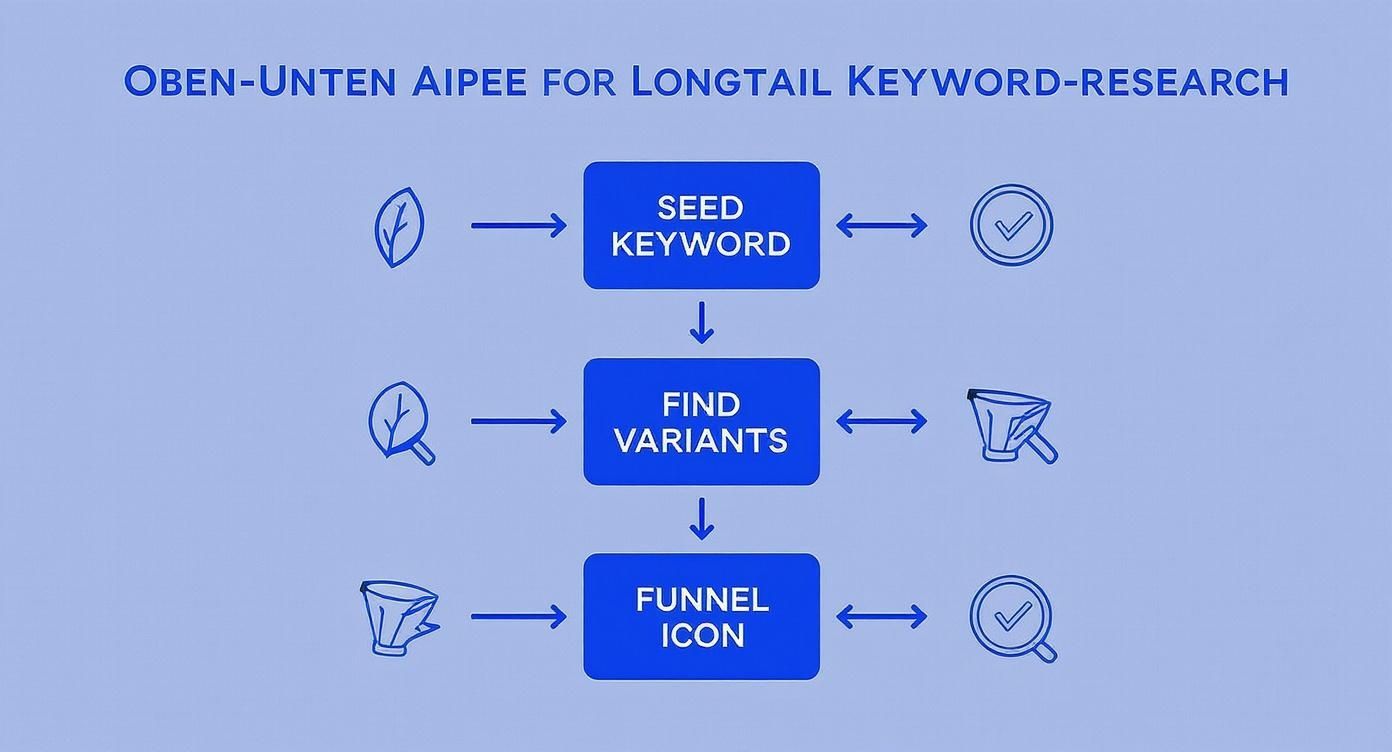
You start with a broad search and then filter systematically until only the truly relevant terms remain.
The three pillars of keyword evaluation
To make an informed decision, I examine each long-tail keyword from three perspectives: relevance, search volume, and commercial intent. A keyword that excels in all three areas is a clear candidate for the shortlist.
- Relevance: Does the keyword hit the nail on the head? Does it accurately describe what you offer, or does it address the real problems of your customers? A keyword like "cheapest IT help for students in Kaiserslautern" is completely irrelevant for a premium provider targeting business customers – no matter how often it is searched.
- Search volume: How many people search for it each month? Sure, with long-tail keywords, the volume is often low, but that's precisely the point. Look for the "sweet spot": keywords that have enough search volume to generate noticeable traffic, but aren't so popular that the competition is overwhelming.
- Purchase intention (conversion potential): Does the keyword reveal that the user is willing to spend money? Search queries with additions such as "buy," "prices," "test," or "comparison" signal a much stronger purchase intent than purely informational searches.
Deciphering the search intent
One of the most important filters is understanding search intent. What does the user really want when they enter something into Google? Every search can be roughly assigned to one of three categories, and that determines what kind of content we need to create.
- Information-oriented (Informational): The user wants to know something. ("How does a VPN work?")
- Transactional: The user wants to perform an action, usually a purchase. ("buy VPN provider for Germany")
- Pre-purchase investigation (Commercial Investigation): The user actively researches before making a purchase. ("best VPN provider test 2024")
Transaction-oriented keywords usually have the highest priority because they can directly lead to sales. Closely following are purchase-preparation keywords – these allow you to engage and persuade potential customers early in the decision-making process.
A simple points system for practical use
To make the process a bit more objective, I like to use a simple scoring system. Rate each keyword in the three main categories on a scale of 1 (weak) to 5 (strong).
| criterion | Rating (1-5) | Example: "fast laptop repair Kaiserslautern price"" |
|---|---|---|
| Relevance to your offer | 1 (irrelevant) – 5 (perfect fit) | 5 (is our core business) |
| Estimated search volume | 1 (<10) – 5 (>200) | 2 (approx. 30-50 searches/month) |
| Commercial intent | 1 (informational) – 5 (transactional) | 5 (clear intention to buy) |
| Total score | Maximum 15 | 12 |
Keywords with the highest scores move to the top of the to-do list. This approach provides you with a data-driven roadmap for your content planning and prevents you from getting bogged down in details. Monitoring the performance of these keywords is then a key component of measuring success – you can find out more in our article about the most important keywords. KPIs in SEO.
The local factor as a turbocharger for prioritization
Especially for local service providers, like the one in our example from the Kaiserslautern region, local relevance is a crucial factor. Keywords with city names, districts, or additions like "nearby" should almost always be given higher priority.
A keyword like "iPhone 13 display repair" isn't bad. But "iPhone 13 display repair in Kaiserslautern" is pure gold. While the search volume is lower, the relevance and the likelihood of a conversion are many times higher. The searcher doesn't want just any repair shop; they want one right here, locally.
Always prioritize keywords with a clear local focus. This allows you to reach a highly qualified and ready-to-buy target group that you could never reach so effectively with general terms.
Implementing identified keywords in ranking content

A well-researched and prioritized keyword list is invaluable. It's practically the blueprint for your success. But even the best list is useless if the execution isn't right. Now it's time to get down to brass tacks: Dry data and search phrases need to be transformed into vibrant, helpful content that truly benefits people.
The real trick? Integrating keywords so cleverly and naturally into the text that they don't disrupt the flow of reading, but actually enhance the user experience. Every sentence and every heading must provide clear added value to the reader while simultaneously sending the right signals to Google.
Understanding the principle of keyword clustering
One mistake I see time and again is trying to write a separate, short article for every single long-tail keyword. The result is usually a cluttered website structure with a lot of "thin content," meaning content lacking real depth.
The concept of [missing information] is much smarter and more sustainable. Keyword clustering.
Imagine it like this: You bundle a whole group of long-tail keywords that are closely related thematically into a single, comprehensive lead article. This so-called "pillar content" illuminates a topic from all important perspectives and answers dozens of user questions in one go.
- Primary keyword: This is the core, the main long-tail keyword that reflects the central search intent of the article (e.g., "how can I optimize my website for local searches").
- Secondary keywords: These are all the relevant variations and related questions that arise in the same context (e.g., "local SEO tips for service providers", "optimize Google My Business listing", or "why is local search important").
Instead of creating three separate, superficial articles on these topics, write a single, comprehensive guide. This signals enormous thematic authority to Google and gives your readers exactly what they want: a central resource for their problem.
Keyword clustering has a crucial advantage: it prevents cannibalization of your own content, where multiple pages on your website compete for the same keywords. Instead, you create a strong, central resource that can rank for a wide range of related search queries.
Place keywords strategically and naturally
Once your content concept is in place, it's time for the fine-tuning. Forget the old SEO myths about "keyword stuffing"—that is, cramming texts full of keywords. These days, relevance and a natural flow of language are what count. Your task is to integrate the primary long-tail keyword and its most important variations at strategically crucial points.
This is where your keywords belong:
- SEO Title (Title Tag): This remains the strongest signal for Google. Place your main keyword as early as possible.
- H1 heading: The main heading on the page itself should also contain the keyword and summarize the content.
- H2 and H3 subheadings: Perfect for including secondary keywords and thematic variations. This structures the article logically and makes it easier to read.
- Introduction: Place your main keyword in the first paragraph. 100 words below. This way you make it clear from the beginning what it's about.
- Image alt text: Describe your images for search engines and users with visual impairments. This is a great place to incorporate relevant keywords.
- Meta description: While it's not a direct ranking factor, it's your calling card in search results. A concise text with a keyword encourages clicks.
So it's not about repeating the keyword excessively. It's about placing it where it makes perfect sense for the reader and the topic.
Harnessing the invisible power of internal links
You've written a brilliant new article – but what good is it if it exists like a lonely island on your website? If neither users nor Google can easily find it? This is precisely where internal links come into play. They are the nervous system of your website. They not only guide visitors but also distribute the so-called "link juice" from strong pages to new ones.
When you link to your new long-tail content from existing, thematically relevant articles, you send Google an unambiguous signal: "Hey, there's new, important information on this topic here!" This not only speeds up indexing but also strengthens the thematic authority of your entire domain.
A concrete example: You already have a strong blog post about the basics of SEO. From there, you can use a meaningful anchor text like "Learn how" Internal links support your SEO strategy“Link to your new, detailed article. Such links weave a logical information network that is equally valuable for users and search engine crawlers. A well-thought-out strategy for Internal linking in SEO This is therefore a crucial lever to get the most out of your new content.
Frequently asked questions about long-tail keyword research
Even with the best plan in hand, the same questions repeatedly arise in practice. Therefore, I have compiled the most common stumbling blocks for you here and provide you with clear, tried-and-tested answers.
How many long-tail keywords are appropriate per page?
Forget the old rule of thumb about cramming a certain number of keywords into a text. That's long outdated. Instead, focus on... a single, primary long-tail keyword, This keyword hits the nail on the head – perfectly reflecting the central search intent of your page. This keyword is your guiding principle.
Then round it all off with three to five additional, thematically relevant keywords. Think of them as supporting terms that illuminate the topic from different perspectives. The goal isn't to work through a checklist, but to cover a topic so comprehensively and naturally that your readers can find all the answers in one place.
Today, thematic depth far surpasses mere keyword density. Google understands the context and rewards content that covers a topic holistically, rather than simply repeating a phrase.
What to do with keywords that have a search volume of zero?
If an SEO tool shows a search volume of 0, that's no reason to abandon the keyword. Most of the time, it simply means that the monthly search queries are too infrequent to appear in the statistics – not that absolutely no one is searching for it.
This is precisely where hidden gems often lie. If such a keyword is highly relevant to your offering and signals a crystal-clear intention (such as a purchase intent), then suitable content can be invaluable. Just think of very specific product queries or extremely niche problems.
- A real-world example: The keyword „Bosch motor e-bike repair Kaiserslautern“It probably has a search volume of zero. But the handful of people who are searching for exactly that? Those are highly qualified leads with a burning problem for which you offer the perfect solution.”.
How do I actually measure the success of my long-tail strategy?
A good long-tail strategy rarely leads to an explosive increase in traffic to a single page. Its success is more subtle, but often much more sustainable. Instead of waiting for one big spike, you should pay attention to a combination of several indicators.
So don't just look at the ranking for a single keyword. Keep in mind your... Google Search Console and keep these points in mind for your analysis tool:
- The total number of ranking keywords: Does the number of keywords for which your website ranks increase over time? That's a strong sign, because good long-tail content captures countless related search queries.
- Organic traffic to the new pages: Specifically monitor the traffic development of the pages you have created for your long-tail topics.
- The conversion rate: This is often the decisive metric. Highly qualified traffic via long-tail searches almost always leads to better interaction rates and – what ultimately matters – to more conversions, whether it's an inquiry, a download, or a direct purchase.
Do you want to strategically expand your online visibility and attract customers who are a perfect fit for you? At LinkITUp We develop well-thought-out SEO strategies tailored precisely to your goals – from keyword research to building strong backlinks. Find out how we can sustainably improve your ranking on [website address]. https://seobuchen.com/.