





""How much does Google advertising cost?" – that's one of the most frequently asked questions we get. There's no one-size-fits-all answer, because the costs are as individual as your own business. There's no fixed price tag to stick to. Instead, everything works according to... Pay-per-click (PPC)-Principle: You only pay when someone clicks on your ad.
The cost of such a click can range from a few cents to over 5 euros. What you ultimately pay depends heavily on your industry, the competition, and the quality of your campaign.
A realistic look at Google Ads costs in Germany
Before we look at the technical details of the Google Ads auction, we should first get a feel for what's common practice in Germany. Click prices, in technical terms... Cost-per-Click (CPC) These costs are extremely industry-dependent. In highly competitive markets – think of lawyers or insurance companies – click prices are logically much higher than in smaller niches.
The German market for search engine advertising is huge and continues to grow. Forecasts predict that advertising spending in Germany will reach approximately [amount missing] by 2025. 7.14 billion euros will climb. This figure alone shows how central Google Ads has become for businesses and why smart budget planning determines success or failure. Detailed insights into this development are provided, for example, by... Statista in his market analyses.
Typical CPC costs by industry in Germany
To give you an initial idea, we've compiled a table with typical CPC ranges for various industries in Germany. These are, of course, only guidelines – your actual costs always depend on the chosen keyword, ad quality, and your regional target audience.
Typical CPC costs by industry in Germany
This table shows estimated average cost-per-click (CPC) ranges for various industries in Germany to provide an initial budget orientation.
| Industry | Average CPC margin (€) |
|---|---|
| E-commerce & Clothing | 0.50 – 1.50 |
| Crafts & local services | 1.00 – 3.00 |
| Travel & Hospitality | 0.80 – 2.00 |
| B2B services | 2.50 – 4.50 |
| Finance & Insurance | 3.00 – 6.00+ |
| Legal advice | 3.50 – 7.00+ |
These figures make one thing very clear: it's not enough to simply spend money. The goal must be to make every single click profitable.
A low CPC in an industry with low purchase intent may be less valuable than a high CPC in a sector where every click potentially brings in a high-value customer.
A clever and efficient use of your budget is the foundation of any successful advertising strategy. For small and medium-sized businesses in particular, it's crucial to get the most out of every euro invested. We explain in detail how to best utilize your resources in our guide to... Online marketing for SMEs. This basic knowledge will help you to better understand the following, more in-depth sections.
How the Google Ads auction determines your prices
Behind every single Google search, an invisible auction takes place in milliseconds. It determines which ads you see and what advertisers ultimately pay for them. Many people assume this is a classic auction where the highest bidder simply wins. However, this is a widespread misconception that can quickly lead to costly mistakes.
Imagine the Google Ads The auction shouldn't be treated like a simple auction, but rather like a talent competition. It's not just about how much money you put on the table, but above all, how good your "performance" is. Google ultimately wants to deliver the best possible and most relevant results to its users – and that also applies to paid ads. An expensive but irrelevant ad disrupts the user experience, and that's precisely what Google wants to avoid at all costs.
This graphic illustrates the direct relationship between your industry, typical cost-per-click (CPC) rates, and the budget you should plan for.
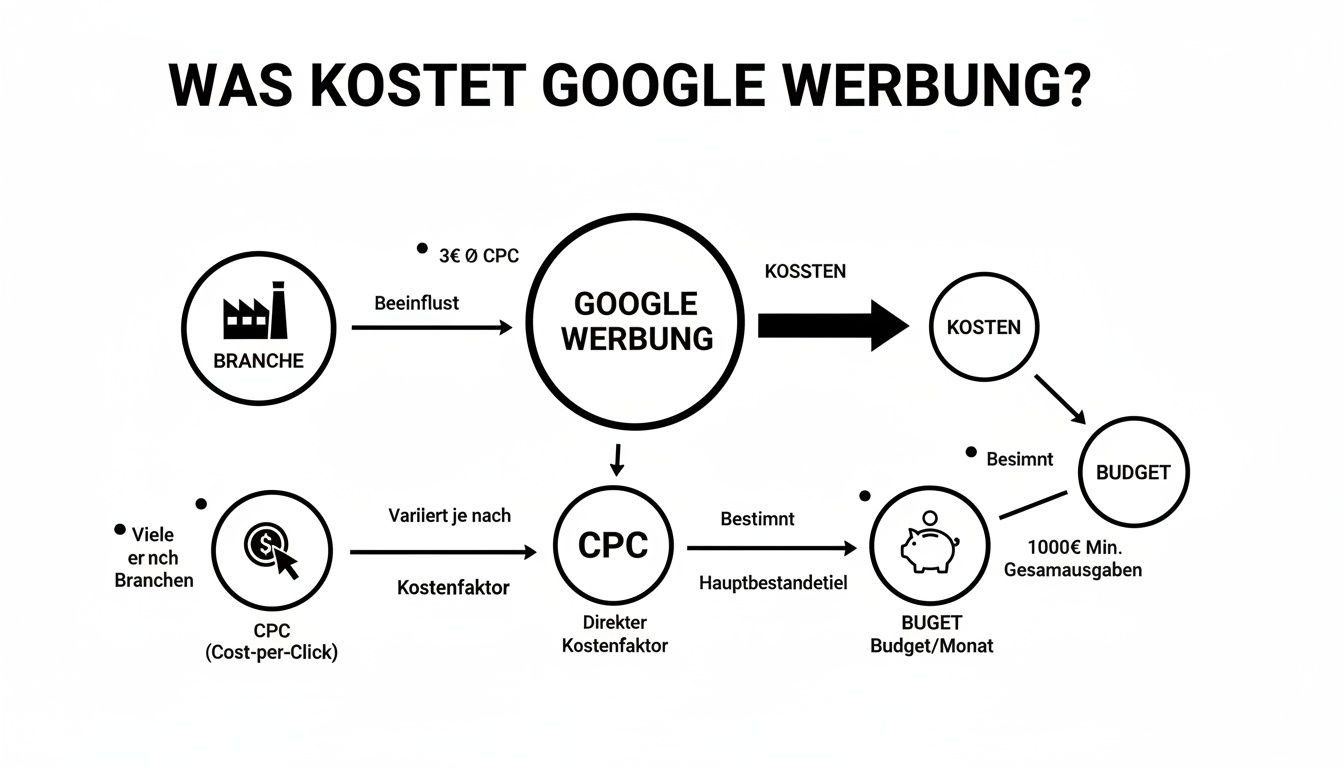
It's clear: the fiercer the competition in an industry, the higher the click prices usually climb. This inevitably means you need a larger budget just to gain visibility.
The ad ranking as a decisive formula
The real key to success in the Google Ads auction is the so-called Ad rank, Ad Rank, also known as Ad Rank in English, is a key metric that directly determines your ad position. It's quite simple: the advertiser with the highest Ad Rank secures the best placement – and that's not necessarily the one with the highest bid.
The formula behind it is surprisingly simple yet extremely effective:
Ad Rank = Maximum Bid (max. CPC) x Quality Score
This formula shows you the two levers you can pull: your bid and the quality of your ad. A very strong Quality Score can easily compensate for a lower bid. This is the key mechanism you need to internalize to truly answer the question "What does Google advertising cost?" for your business.
The power of the quality factor
The Quality factor (or "Quality Score") is essentially Google's grade for the relevance and quality of your ad, your keywords, and your landing page. It is given on a scale of 1 to 10 Rated, with 10 being the best score. A high score signals to Google that your ad is a perfect match for the searcher.
Google rewards high quality scores twice:
- Better ad positions: You can outbid competitors with higher bids if your quality score is simply better.
- Lower click costs: You often pay significantly less per click because Google prioritizes showing your relevant ad to users.
The quality factor can be thought of as an overall judgment composed of three main components:
- Expected click-through rate (CTR): How likely is it that users will click on your ad when it appears?
- Advertising relevance: Does your ad text really match the search query perfectly?
- User experience with the landing page: Is your landing page clear, helpful, and does it deliver exactly what the ad promised?
A practical example to illustrate this.
Let's imagine two law firms bid on the keyword "tax advisor Kaiserslautern".
| advertiser | Maximum bid (CPC) | Quality factor | Ad rank (bid x quality) |
|---|---|---|---|
| Company A | 2,00 € | 10/10 | 20 |
| Company B | 3,00 € | 5/10 | 15 |
Although Company B is prepared to pay a substantial amount 50 % more By paying per click, Company A secures the better ad position. Why? Because Company A's ad, with a Quality Score of 10, is perfectly tailored to the search query. The ad is more relevant, the landing page delivers exactly the information users are looking for, and users are more likely to click on it.
This is the essence of the Google Ads auction: Relevance beats budget. A large budget can never permanently compensate for poor ad quality. Conversely, with a smart approach and a focus on quality, you can actively reduce your advertising costs while achieving better results.
What factors really influence your Google Ads costs
Unfortunately, there's no single, general answer to the question "How much does Google advertising cost?". Think of it like a complex mixing console: there are many different controls, and each one influences the final sound – or in our case, the price you pay per click.
But if you know which levers you can pull, you're in control. Then you don't just use your advertising budget, you invest it strategically and get the maximum return.
The competition: Who wants what and how much?
Some keywords are like a prime piece of real estate in a top downtown location. Everyone wants it, and that drives up the price. That's the basic principle of competition in Google Ads.
Keyword competition: Search queries like "buy insurance online" or "employment lawyer" are extremely competitive. Countless companies bid for the top spots, causing bids and therefore click prices to skyrocket. Those operating in a niche market, however, often pay only a fraction of that.
Your industry: This obviously depends heavily on your industry. In sectors where a single customer is very valuable (think finance, law, or expensive B2B services), companies are willing to pay significantly more for a click. A click for a lawyer can easily cost over €6 cost, while a small shop for handmade soap might cost 0,80 € is there.
The purchase intent (Search Intent): It makes a huge difference whether someone googles "buy new running shoes" or "benefits of jogging". The former is a clear buy signal. Such keywords are naturally more valuable and expensive, but ideally lead directly to sales.
The market is constantly in flux. An analysis by AdPoint impressively demonstrates how drastically click prices can change. While the keyword "Google Ads" had an astronomical average CPC of over €370 in 2022, this fell to below €17 by 2024. At the same time, prices in sectors like insurance remain consistently high. More on this You can find dramatic changes in click prices at AdPoint..
The quality factor: Your most powerful lever for cost control
Google rates your ads with a Quality Score. Think of it as a kind of grade for the relevance of your entire campaign. And this score is by far your most important tool for actively reducing costs. Why? Because Google rewards good, relevant ads with lower click prices and better ad positions.
A high quality score is like a substantial discount on every single click. You pay less than your competitors and still achieve better placement.
Three things are crucial here: Does your ad match the search query? Is your ad worded in a way that makes users actually want to click on it (expected click-through rate)? And what happens after they click? The last point is critical: The user experience on your landing page must be right. A fast, clear, and compelling landing page is the foundation for a good Quality Score and a high conversion rate. A professional Landing Page Optimization It is therefore not a "nice-to-have", but an absolute necessity.
Location and season: Where and when to advertise
Two factors that are often underestimated, but have a direct impact on your budget: where and When You can place your ads.
Regional differences: Advertising in major cities like Hamburg, Munich, or Berlin is almost always more expensive than in rural areas. Purchasing power is higher there, and competition is fierce. As a local business in Kaiserslautern, you therefore have a good chance of paying significantly less per click than a comparable business in a large city.
Seasonal demand: Everyone knows the feeling. The Christmas rush in e-commerce, Valentine's Day for florists, or the summer holidays for travel providers. During these times, demand explodes – and with it, advertising costs. You need to plan ahead and allocate a larger budget for these peak periods.
Last but not least, your chosen [option] also plays a role. Bidding strategy It plays a role. Do you take manual control and set each click price yourself? Or do you rely on Google's automated strategies, such as "Maximize Conversions"? Each method has its own advantages and disadvantages and directly impacts your daily expenses.
Practical budget examples for small businesses
Theory is all well and good, but at the end of the day you want to know: What jumps for my What exactly is the budget involved? To make the question "What does Google advertising cost?" more tangible, let's look at three typical scenarios for small and medium-sized enterprises (SMEs) in Germany.
Consider these examples as a kind of blueprint. They will give you a sense of what is possible with a given budget and what results you can realistically expect.
Scenario 1: The local craft business
Imagine an electrician from Kaiserslautern. His goal is to specifically target inquiries for services where he earns a good living – say, installing wallboxes or upgrading fuse boxes. Crucially, he only wants jobs from his region, so... Kaiserslautern and a radius of 25 kilometers.
This is what his budget planning could look like:
- Goal: Calls and inquiries via the contact form on his website. Real, tangible orders.
- Keywords: This is about clear purchase intentions, i.e. keywords such as "electrician Kaiserslautern", "wallbox installation Kaiserslautern" or "cost of replacing a fuse box".
- Average CPC: In the skilled trades, click prices often range from €1.50 to €3.00. Let's conservatively estimate an average of €2.20.
- Recommended monthly budget: A budget of approximately €450 This is an absolutely sensible starting point.
With this effort, our electrician could Approximately 200 to 210 clicks per month to direct them to his website. Assuming a solid conversion rate of 5 % (meaning every 20th click results in an inquiry), he wins with this. 10 new, qualified customer inquiries a month.
For local service providers, one thing is crucial: it's not the quantity of clicks that counts, but the quality. Every click must come from a potential customer in the neighborhood who has a problem right now that you can solve.
Scenario 2: The niche online shop
Next, we'll look at a small but excellent online shop for handcrafted leather goods that ships throughout Germany. Here, the goal is crystal clear: to boost sales.
The strategy needs to be broader here. We don't just need classic search ads, but absolutely also... Google Shopping ads, so that the products appear directly in the search results with image and price.
- Goal: Direct sales (conversions) via the shop and the highest possible return on ad spend (ROAS).
- Keywords: Here, search queries include „buy handmade leather belt“, „personalized leather bag“, or „high-quality leather wallet“.
- Average CPC: In e-commerce, click prices are often somewhat lower. We calculate with approx. €0.90.
- Recommended monthly budget: To collect enough data for optimization, 750 € a good starting point.
This budget brings the shop approximately 830 clicks per month. Assuming an industry-standard conversion rate of 2.8 %, this leads to approximately 23 direct sales. The key to greater success lies in continuous optimization – from the product feed to the ad texts.
Scenario 3: The B2B service provider
Our third example: a software company that offers a specialized project management solution for architectural firms. In this case, a single customer is extremely valuable, but the decision-making process takes significantly longer. It's not about a quick sale.
The goal is to collect qualified leads, i.e., contacts of potential customers who, for example, register for a software demo.
- Goal: Generate leads, for example through demo bookings or whitepaper downloads.
- Keywords: „Project management software for architects“, „BIM software solution“, „AVA program for architectural offices“.
- Average CPC: In the B2B sector, keywords are highly competitive and therefore expensive. We have to expect an average price of... €4.50 per click calculate.
- Recommended monthly budget: To even have a chance of visibility in this field, a budget of at least €1,200 realistic.
The budget would be approximately 265 highly relevant clicks per month This could lead to a B2B conversion rate of an assumed 3 %. almost 8 qualified leads generate. Each of these leads is worth its weight in gold and has the potential to become a long-term customer.
Example budgets and expected results for SMEs
The three scenarios illustrate how different budgets and goals can be. The following table summarizes the examples clearly and helps you better assess your own situation.
| scenario | Monthly budget (€) | Ø CPC (€) | Estimated clicks/month | Primary goal |
|---|---|---|---|---|
| Local craftsman (e.g. electrician) | 450 | 2,20 | ~205 | Local inquiries & calls |
| Niche online shop (e.g. leather goods) | 750 | 0,90 | ~830 | Direct Online Sales (ROAS) |
| B2B service provider (e.g., software) | 1.200 | 4,50 | ~265 | Qualified leads (demos) |
These figures make one thing very clear: there is no one-size-fits-all answer to the question "How much does Google advertising cost?". Your optimal budget always depends on your industry, your goals, and, last but not least, the value that a new customer brings to your business.
How to plan and optimize your Google Ads budget
Effective campaign management isn't about spending as little as possible. It's about getting the maximum return on every euro invested. Consider this section your guide to smart cost control. This way, you can not only answer the question "How much does Google advertising cost?" but actively influence the outcome in your favor.
The trick is to view your budget not as a rigid cost block, but as a dynamic investment. With the right strategies, you can transform your advertising spending into a profitable engine for your company's growth.
Set a sensible starting budget
The first question is always: How much money should I actually invest? Finding a sensible starting budget is easier than you think if you focus on your goals. Instead of just throwing out an arbitrary sum, it's better to proceed strategically.
First, research the average cost-per-click (CPC) for your most important keywords. Then, multiply this value by a realistic number of clicks you want to achieve per day to gather meaningful data. To begin with, 20 to 30 clicks per day is a good guideline.
A practical example calculation:
Assumed average CPC: 2,50 €
Desired clicks per day: 25
Daily budget: €2.50 x 25 = 62,50 €
Monthly starting budget: €62.50 x 30.4 (average days/month) ≈ 1.900 €
This daily budget acts as a guideline. It gives Google clear instructions on how much you want to spend per day – your most important control mechanism to prevent unexpected cost overruns from the outset.
Leveraging the power of negative keywords
One of the most effective and at the same time most underestimated methods for cost reduction is the targeted use of Keywords to exclude, These are also known as negative keywords. They ensure that your ads don't appear for irrelevant search queries. These are precisely the searches that generate clicks but never customers.
Imagine you sell high-quality, new designer furniture. Without a good list of negative keywords, your ad could also appear for searches like "used furniture," "furniture repair," or "free designer furniture." Every click on those would be pure, wasted money.
Typical keywords you should exclude are:
- Irrelevant purchase intentions: free, gratis, used, repair, do it yourself
- Pure information searches: What is it, how does it work, definition, test, comparison
- Job searches: Job, career, education, salary, internship
By proactively adding these and similar terms to your blacklist, you significantly refine your targeting. This ensures that your budget is spent exclusively on genuinely potential customers.
Continuously improve the quality factor
As we've already mentioned, the Quality Score is your biggest lever for paying less for better ad positions on Google. Optimizing it isn't a one-time task, but an ongoing process.
Always focus on these three pillars:
- Advertising relevance: Build highly specific ad groups for closely related keywords. An ad for "red men's running shoes" should contain exactly that text and not just refer generally to "sports shoes".
- Expected click-through rate (CTR): Run A/B tests to compare different ad texts. Vary headlines and descriptions to find out which wording appeals to users most and encourages clicks.
- User experience of the landing page: Ensure that the page users land on after clicking loads lightning fast and delivers exactly what the ad promised.
Remarketing as a cost-effective second chance
Very few visitors to your website make a purchase immediately. In fact, over 95 % The first visitor returns to a page without taking any action. This is precisely where the problem arises. Remarketing This clever technique allows you to specifically target users who have previously shown interest and visited your site with special ads.
Since this target group is already familiar with your company, click costs for remarketing campaigns are often significantly lower than for acquiring new customers. At the same time, conversion rates are usually higher. It's the perfect method to win back undecided prospects and maximize the value of each individual click.
Ultimately, budget optimization is about... Return on Ad Spend (ROAS) to maximize – that is, to generate the greatest possible revenue for every euro invested. To delve deeper into the topic of profitability measurement, we recommend our comprehensive article on how to... Calculate Return on Investment in Marketing. This metric is crucial for assessing the true success of your advertising efforts.
The most pressing questions about the costs of Google advertising – answered briefly and concisely
Finally, let's revisit the questions we encounter most frequently in practice. Here are the answers – straight from agency life, straightforward and to the point.
Is there a minimum budget for Google Ads?
Officially? No. Google doesn't impose a minimum. You could theoretically even start with €5 a day. But the really crucial question is: What is a meaningful Budget?
The hard truth is: with a Mickey Mouse budget, say under €10 per day in a competitive market, you're groping in the dark. You simply aren't gathering enough data to learn what works and what doesn't. As a rough guideline from our experience: plan your budget so that it covers at least... 10 to 20 clicks per day That's enough. Only then will you get a usable data basis.
How quickly will I see results?
The first clicks and impressions often start rolling in just a few hours after launch. That's the beauty of Google Ads. But before you can truly assess whether it's paying off for you, you should familiarize yourself with the system. two to four weeks Give it time.
Why so long? During this time, the Google algorithm learns who your ads are relevant to, and you gather enough data about your conversion rate. Anyone who is too impatient and tweaks the settings too hastily will stifle the learning phase and only harm themselves.
From practical experience: Don't confuse "results" with "profit." The first few weeks are an investment in data and optimization. The true return on investment (ROI) only becomes clear once this initial phase is complete.
Can I guarantee myself first place?
A clear no. And quite frankly, you shouldn't even want that. The Google auction is a live event that takes place anew for every single search query. Your ad rank is always a mix of your bid and your Quality Score – in direct comparison with everyone else bidding at that exact moment.
Furthermore, the top spot is often the most expensive and not necessarily the most profitable. Sometimes the click prices for positions 2 or 3 are significantly cheaper, while the users' purchase intent is hardly lower. The goal is not pole position, but the best result for your money.
What is a good cost-per-click (CPC) rate?
This question cannot be answered in general terms, because a "good" CPC depends solely on what a click is worth to your business. A click for 5 € It can be an absolute bargain if it brings in a customer from whom you earn €500. Conversely, a single click can cost you €500. 0,50 € It would be a pure waste of money if it never results in a contract.
Instead of looking at any industry benchmarks, calculate your own., maximum CPC That's it. You only need three numbers for that:
- Your average order value or customer value
- Your conversion rate (How many clicks do you need to acquire a customer?)
- Your profit margin
Only those who know their own numbers can advertise profitably.
How do I really measure the success of my Google Ads?
Forget clicks and impressions as the sole measure of success. Those are secondary considerations. What ultimately matters are hard business results. The most important metric for that is... Return on Ad Spend (ROAS). He tells you clearly and concisely how many euros in revenue you will get back for every euro spent on advertising.
The technical prerequisite for this is a seamless and cleanly set up system. Conversion tracking. Without this, you're flying blind. Only by precisely tracking which click led to a purchase, a call, or an inquiry can you optimize your campaigns for maximum profit.
Are you ready to use your advertising budget effectively and take your online visibility to the next level? We at LinkITUp For over 15 years, we've been helping businesses in Kaiserslautern and the surrounding area achieve success on Google with tailored SEO and SEA strategies. Contact us – we'll find out what really works for you. Learn more at seobuchen.com/.