




What exactly is online reputation management? Quite simply: it's the active shaping of how your company is perceived online. It's about strategically monitoring, influencing, and protecting your digital reputation. This discipline is vital for survival today, because 90% of German consumers trust online reviews. – and these factors ultimately determine the purchase.
Why online reputation management is crucial
Your digital reputation is one of the most valuable assets for your business today. It's the sum of everything that can be found about you online – every opinion, every review, every social media post. Even before a potential customer clicks on your website, they've already formed an opinion. The basis for this? What Google, review portals, and social networks reveal.
A good one Online Reputation Management Therefore, it's much more than just putting out fires after a crisis. It's an ongoing process, a kind of digital brand maintenance. You can think of it like gardening: without regular care, weeds spread – in this case, negative comments or misinformation. And that quickly chokes out the flowers, meaning all the positive content you've sown about your brand.
The direct business impact
A strong online reputation isn't just a nice bonus; it has a very real impact on your success. The perception of your brand online is directly reflected in the numbers.
- Sales and customer acquisition: A positive reputation builds trust, and trust makes customers more likely to buy. Numerous studies show that companies with better star ratings generate significantly more revenue. Conversely, a single negative review can be enough to deter a substantial portion of potential customers.
- Talent acquisition: The "war for talent" is real. Good people are very careful about where they apply. Bad reviews on platforms like... Kununu A negative image in the media is often the reason why top talent avoids a company.
- Brand value and trust: Trust is the foundation of every business relationship. A positive digital presence not only strengthens your brand value but also makes your company more resilient in times of crisis. Both customers and business partners prefer to work with someone they trust.
Proactive reputation management gives you back control over your brand's narrative. Instead of just reacting to what others say about you, you shape the story that potential customers and partners find about you online.
Ultimately, investing in your digital reputation is an investment in your company's future viability. It's about building a digital fortress – from positive content, authentic customer feedback, and transparent communication. This fortress not only protects you from attacks but also actively attracts new business opportunities. Anyone without a targeted strategy here is leaving their most valuable resource to chance. A risk that no one can afford today.
Analyze your digital reputation objectively
Before you can actively shape your online reputation, you first need to know where you stand. A reputation audit is like a thorough health check for your brand: It provides an honest, data-driven diagnosis of your digital state. Without this assessment, you're flying blind.
This process involves systematically examining all digital touchpoints where people form an opinion about your company. The goal is to capture the complete picture – the good, the bad, and even what seems insignificant at first glance.
The following cycle shows how the central phases of reputation management – observing, analyzing and shaping – go hand in hand.
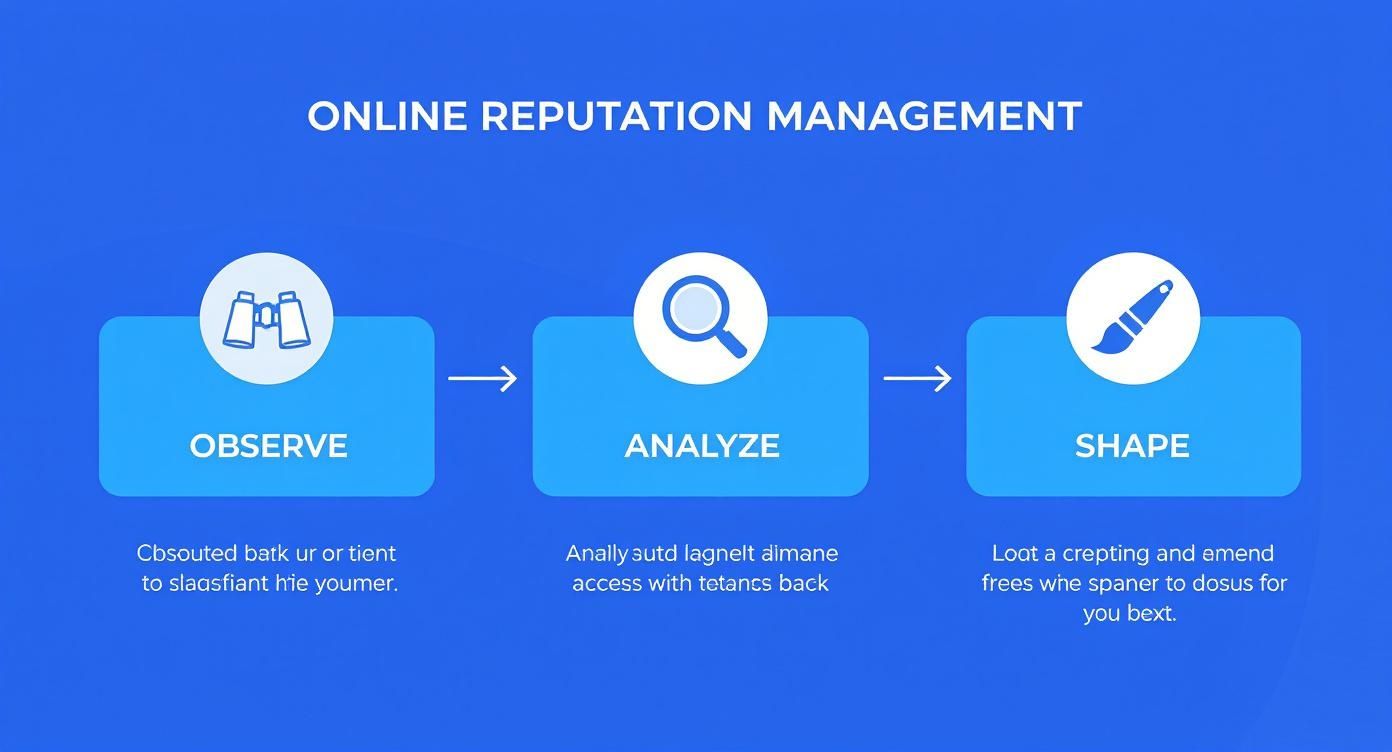
This clearly shows that good reputation management is not a one-off project, but a continuous process in which each phase builds on the previous one.
Google search as a truth serum
Start right where 97 % of all users Begin your research with Google. The first, but crucial, step is a simple search for your brand name. Important: Use your browser's incognito mode. This ensures that your personal search history doesn't skew the results, and you see what a completely unbiased user would see.
Take a close look at the top 10 results and note down what you find.
- Your own website: Is she at the very top? Perfect, that's a very good sign.
- Rating portals: Which platforms appear and what is the average grade on each?
- Press or blogs: Is the overall tone of these posts positive, neutral, or rather critical?
- Social media: Which of your profiles make it to the first page?
Afterwards, be sure to also check out the image and news search. Images often convey a more direct and faster impression than text alone.
Examining rating platforms and social media
The next step takes you directly to the heart of customer opinions. This requires a systematic analysis of all relevant channels. For a local business, a Google Business Profile is essential. In the B2B sector, however, platforms like LinkedIn or specialized industry portals become more important.
An audit is more than just hunting for problems. It's also a search for untapped potential. Positive mentions that hardly anyone sees, or satisfied customers who could become advocates – these are the real treasures you can uncover.
A comprehensive analysis also includes thinking outside the box. It often helps to see how other industries handle feedback, for example, to learn how to... Compare customer reviews and can draw the right conclusions from it.
Overview of tools for reputation auditing
Manual searches are often insufficient for truly in-depth analysis. This is where specialized tools come into play. They help automate the process, maintain continuous progress, and dig much deeper than would be possible manually.
The selection of tools is huge, but the following overview gives you a good starting point to find the right tool for your needs.
| Tool | type | Main function | Ideal for |
|---|---|---|---|
| Google Alerts | For free | Real-time notifications about new mentions of your keywords on the web and in news. | Every company needs this as an absolutely essential basic monitoring system. |
| Mention | Fee applies | Comprehensive monitoring of web and social media channels, including sentiment analysis. | SMEs and agencies that want to seriously engage in social listening. |
| Brand24 | Fee applies | Similar to Mention, but with a strong focus on measuring conversation volume and reach. | Marketing teams who want to quantify the "buzz" surrounding their brand. |
| Hootsuite | Fee applies | A social media management platform that also bundles listening functions for various networks. | Companies for whom social media marketing is a key channel. |
Such tools not only save you tedious manual work, but also provide data that would otherwise remain hidden. They enable continuous monitoring – the basis for proactive action. Online Reputation Management.
Interpreting the data and deriving areas for action
The collected information is initially just a collection of raw data. The truly crucial step now is the interpretation. A so-called sentiment analysis, which many tools perform automatically, classifies mentions as positive, negative, or neutral. This gives you a quick overview of the general mood.
It's best to summarize the results in a short audit report. A simple SWOT analysis will help identify clear strengths, weaknesses, opportunities, and threats.
- Strengthen: A highly rated product on a major portal.
- Weaken: Ancient, negative comments on page one of Google search results.
- Opportunities: A positive mention in a high-reach blog that hardly anyone has noticed so far.
- Risks: A recurring service problem that is addressed in many reviews.
This analysis is the foundation for everything that follows. And current figures from Germany show why the effort is worthwhile: With a click-through rate of 39,8 % The top positions in the very first search result completely dominate perception. Those who don't control this are leaving their reputation to chance. Our audit will show you exactly where you need to start to change that.
Proactively build a positive reputation
A strong reputation doesn't fall from the sky. It's the result of targeted and consistent work. Instead of just reacting to negative comments, the focus is on proactively building a strong reputation. Online Reputation Management Therefore, take control of your brand's digital narrative. Imagine it like this: you build a bulwark of positive content and genuine customer feedback that not only makes your brand more resilient but, above all, builds trust.
The core message? Don't let others tell your story. Dominate the conversation about your brand by placing your own messages, successes, and values at the forefront of search results and social media feeds.

Conquer search results with content marketing
The first page of Google search results is your company's digital storefront. What appears here forms the first, and often decisive, impression. The goal is crystal clear: this valuable space must be filled with content that you control and that reflects positively on you. This is precisely where a well-thought-out content strategy comes into play.
By creating high-quality, relevant content, you can literally push negative or neutral mentions to the back of your mind. Every blog post, press release, and case study is a new opportunity to showcase your expertise and firmly establish your brand message. If you need a concrete roadmap for this, check out our guide on how to create a Develop a content strategy.
Some formats work particularly well to score points with search engines:
- Blog articles and guides: Position yourself as the expert in your niche. Content that solves real problems is not only well-received but also shared – this greatly strengthens your authority.
- Success stories and case studies: Nothing is more convincing than proof. Show potential customers concretely the added value you have created for others.
- Press releases: Inform the world about positive developments, be it a new partnership, an award, or social engagement.
Systematizing the management of customer reviews
Online reviews are the new currency of digital trust. They often determine whether a potential customer chooses you or a competitor. Being proactive here means actively managing the review process instead of simply letting it happen.
The importance of reviews can hardly be overstated. Data from CSW.agency shows that 42 % of German consumers Trust online reviews just as much as personal recommendations. And 92 % the user They only consider companies with at least four stars. It's no coincidence that spending on online reputation management in Germany is projected to explode from $50.3 million in 2025 to over $212 million by 2035. Companies are investing because they have to.
To get authentic, positive reviews, you need to make it as easy as possible for your satisfied customers.
- To catch the perfect moment: Ask for a review when the customer is happiest – right after a successful project completion or a great service experience.
- Automating processes: Use your email tools to automatically send a friendly request for feedback a few days after a purchase or service. It's not rocket science, but incredibly effective.
- Provide direct links: Send your customers directly to the review site with just one click. Whether it's a Google Business Profile or an industry-specific portal – no detours, no searching.
Every review, whether positive or negative, is a gift. A positive one is free marketing. A negative one is free business consulting that shows you exactly where you need to improve.
Social media as a stage for your brand story
Social networks are far more than just advertising channels. They are platforms for dialogue where you can build a genuine relationship with your target audience. An authentic and transparent presence is a key component of your reputation management.
This isn't about glossy advertising, but about storytelling. Offer insights behind the scenes, introduce your team, and openly communicate what your company stands for.
A real-world example: A local café doesn't just post photos of perfect milk foam. It also shows short videos where the barista explains the origin of the beans or the team laughs during a training session. This creates a sense of connection and a loyal community that acts as a protective shield for the brand in times of crisis.
The power of personal and visual reputation
Your online reputation isn't just about text and star ratings. The visual presentation of your company and the personal reputation of your key personnel also carry enormous weight. Professional photos and profiles project competence and trustworthiness long before anyone has read a single word.
A professional presence on business networks is crucial, especially for management and employees with customer contact. Learn more about The importance of a professional profile picture on platforms like LinkedIn and Xing, to understand how strongly a single image can influence perception.
Ultimately, proactively building a positive reputation is a combination of strategic content creation, smart review management, and authentic communication. It's an ongoing investment in your most valuable asset: your customers' trust.
Handling criticism and negative comments with composure
Quite frankly: Negative reviews and critical comments are part of the business. They are unavoidable. No matter how hard you try, someone will complain eventually. The crucial question in Online Reputation Management So it is not, whether They receive criticism, but How How to handle it. An ill-considered, emotionally driven response can quickly turn a small spark into a PR conflagration.
A professional, prompt, and empathetic approach can achieve the exact opposite. A dissatisfied customer might become a loyal fan, and hundreds of potential new customers will see that you truly take feedback seriously. Your response is never just for the sender—it's always also a public demonstration of your company values.
A tried and tested method for your answer
When a negative assessment arrives, the first impulse is often defensiveness. Resist this urge. Take a deep breath and follow a proven process based on four pillars: speed, transparency, empathy, and a solution-oriented approach.
- React quickly, but not hastily: Set yourself the goal of achieving within 24 hours Responding signals that you are listening. However, take enough time to review the case internally. A response without a factual basis can backfire.
- Take responsibility and show empathy: Always start by apologizing for the negative experience. Even if you don't see the fault as yours, a simple "We are truly sorry that your experience did not meet your expectations" works wonders and de-escalates the situation immediately.
- Move the conversation offline: Offer to resolve the matter personally. Provide a direct email address or phone number. This demonstrates a genuine willingness to find a solution and removes a potentially heated discussion from the public eye.
- Keep it short and professional: Avoid lengthy justifications, technical details, or blame games. Your public response should be concise and focus entirely on the solution, not the problem.
Your reaction to a single negative review has an enormous reach. It sends a signal to hundreds or thousands of silent readers who infer from it how you handle customers when something goes wrong.
Practical examples: Good vs. bad reactions
The difference between a sovereign and a catastrophic response becomes clearest when looking at concrete examples.
Poor response (hotel review):
- Customer review: „"The room was noisy and the breakfast disappointing. A disgrace for the price!"“
- Hotel's response: „"Our other guests never complain about noise. The breakfast buffet is plentiful and always receives praise. Perhaps your expectations are simply too high."“
This response is defensive, confrontational, and blames the guest. It escalates the situation and deters any potential new customer who reads it.
Good response (same hotel rating):
- Hotel's response: „"Thank you for your honest feedback. We are very sorry to hear that your stay was disturbed by noise and that you were not satisfied with the breakfast. This is absolutely not up to our standards. Please contact us directly at [email address] so that we can find a suitable solution for you. We would really appreciate a second chance."“
This response is empathetic, solution-oriented, and professional. It has the potential to restore trust and demonstrates to all readers that management takes criticism seriously. Incidentally, handling criticism with composure can even benefit you. Improve search engine ranking, because Google definitely rates positive user signals such as engagement and trust positively.
When you can have a review removed
You don't have to simply accept every negative review. There are clear legal boundaries. The crucial point is usually the distinction between a permissible expression of opinion and an impermissible statement of fact.
- Expression of opinion: „"I found the service slow." – This is a subjective feeling and generally permissible.
- Untrue statement of fact: „"The restaurant has vermin in the kitchen." – If this is demonstrably false, the review can and should be removed.
Your chances of having a review removed are good if it contains the following:
- Demonstrably false information: Outright lies about your company.
- Insults or defamatory criticism: Personal attacks that have nothing to do with objective criticism.
- Violations of platform guidelines: This includes spam, obvious conflicts of interest, or the publication of private data.
The first step is usually to report the review directly to the platform (e.g., Google) with a sound explanation. In serious cases such as defamation, consulting a lawyer is the next logical step.
The digital world is full of opinions – and that's a good thing. According to the Gastro WebReview study 2025, in Germany... 85,8 % All reviews were positive. The proportion of negative reviews even decreased slightly to 8,26 %. The study also highlights: 89 % of consumers Companies that actively respond to reviews are preferred. This shows what matters: their response is almost more important than the original criticism. Further insights can be found in the complete study by Respondelligent.
Measuring ORM success and anchoring it in the company for the long term
Online reputation management isn't a project you can launch once and then check off as done. Think of it as a marathon, not a sprint. It's an ongoing task that needs to be deeply rooted in your company culture. To ensure your efforts are truly effective, you need to make your success measurable. Without solid data, you're just groping in the dark and can't refine your strategy effectively.
Essentially, it's about translating the elusive concept of "reputation" into clear, understandable numbers. Only when you see your progress in black and white can you make informed decisions instead of relying solely on gut feeling.
Define the key performance indicators
To ensure success in Online Reputation Management To measure your success, you need the right Key Performance Indicators (KPIs). These metrics are your compass – they show you whether you're on the right track or need to adjust your course. Focus on metrics that directly and honestly reflect the state of your digital reputation.
The following KPIs have proven to be particularly meaningful in practice:
- Average star rating: The classic metric, but still one of the most important. Track its development on all platforms that are relevant to you – whether Google, Trustpilot, or Kununu.
- Sentiment score: What's the general mood out there? Modern sentiment analysis tools scan mentions and rate them as positive, negative, or neutral. The result is summarized in a single score. If this score is rising, you're doing something right.
- SERP Control (Search Engine Results Page): How many of the top 10 search results for your brand name belong to you? Add it all up: your own website, your social media channels, positive press coverage. Your goal must be to capture this share bit by bit.
- Number and quality of reviews: It's not just about the average rating. A steady stream of fresh, positive reviews signals to Google and potential customers that you are relevant and trustworthy.
Selecting and consistently tracking these key performance indicators (KPIs) is crucial for demonstrating the ROI of your initiatives. If you'd like to delve deeper into the subject, you can find more information in our article about... KPIs in SEO You will find valuable insights whose principles can be directly applied to reputation management.
A dashboard for a complete overview
All the collected data is of little use if it's slumbering disorganized in various spreadsheets. Its full potential is only realized when it's presented visually. An ORM dashboard consolidates all the important KPIs in one central location. This could be a cleverly designed spreadsheet or a professional analytics tool – the only crucial point is that you can grasp trends at a glance and react immediately.
A good dashboard tells a story. It doesn't just show, What happens, but helps you understand, Why It happens, and provides the basis for adapting your strategy.
With a dashboard like this, you can see the direct correlation between action and reaction. You launch a campaign to collect more reviews and see your star rating rise? Perfect. You notice a sudden drop in your sentiment score? Then you can immediately start investigating.
The emergency plan for a worst-case scenario
Even with the best proactive strategy, a crisis can catch you off guard. A social media firestorm, a critical press article – these things can develop into a serious problem overnight. For moments like these, you need a clear crisis plan, ready and waiting.
This plan should cover at least these points:
- Responsibilities: Who is part of the crisis team? Who has final approval for public statements? Clarify the roles and responsibilities., before the emergency occurs.
- Communication processes: How will internal communication ensure everyone is on the same page? Who informs management? Establish a clear and unambiguous flow of information.
- Language rules: Prepare pre-written text snippets for your initial response. These should, of course, be adapted to the specific situation, but they save valuable time and prevent ill-considered, ad-hoc answers under pressure.
Reputation always begins offline
At the end of the day, Online Reputation Management It's merely the digital reflection of your offline reality. By far the most sustainable strategy for a good reputation is to be an outstanding company. Enthusiastic employees will naturally become your best brand ambassadors. An excellent product and first-class customer service are the best source of authentic five-star reviews.
Therefore, firmly embed ORM in your company culture. Train your employees, especially those with direct customer contact, and make it clear to everyone that they contribute to the reputation of the entire company. A strong reputation is earned offline and defended online.
Practical questions: Online Reputation Management
Over the years, a few questions have consistently emerged when we talk to companies about their online reputation. Here are the answers to the most frequently asked questions, which will help you clear up any remaining uncertainties and refine your strategy.
Act proactively or delete reactively? What's the difference?
Reactive reputation management is essentially like firefighting. You only get involved once the situation has already escalated – after a social media backlash, a wave of negative reviews, or a critical press article. The sole objective then becomes damage control.
A proactive approach is far smarter. Here, you proactively build a positive, strong reputation long before a crisis can even arise. You actively create high-quality content, gather authentic positive reviews, and thus build a kind of digital protective barrier around your brand. A truly successful strategy is always proactive.
Think about it: If you already 100 With positive reviews, a single negative review loses significant weight. Proactive management simply makes your brand more resilient.
Is it possible to simply have a negative review deleted?
In short: usually not. Simply removing a legitimate, albeit critical, opinion is extremely difficult. Platforms like Google or Trustpilot strongly protect the right to freedom of expression.
A review only has a chance of being deleted if it clearly violates the platform's guidelines. This is typically the case with:
- Untrue factual claims: When someone is proven to be lying.
- Personal insults or defamatory criticism: When it's no longer about the issue at hand, but only about personal attacks.
- Obvious conflicts of interest: For example, if a direct competitor leaves a fake review.
In almost all other cases, the best response is to address the criticism publicly and professionally. Show that you take the problem seriously and offer a solution. This often has a more positive effect on other readers than deleting a review.
How long does it take to repair a damaged reputation?
That obviously depends heavily on the damage. A few unfortunate comments are one thing, a nationwide scandal is quite another.
For smaller problems, a consistent strategy can often resolve them within... two to three months Significant improvements will be seen. The goal is to push negative entries down in the search results with new, positive content.
In the case of a serious crisis, such as a viral negative article, you should be prepared for a longer process. Rebuilding can easily take a considerable amount of time. six to twelve months or even longer. Regaining trust is a marathon, not a sprint.
How much budget should one allocate for ORM?
Costs can vary significantly. A small, local business can often manage with free tools such as... Google Alerts Start by handling the monitoring internally with a few hours per week. The focus here is on direct customer contact.
A medium-sized company or an established brand should definitely invest in professional monitoring software (expect to pay around [amount]). from approximately €100 per month) and perhaps consider the help of a specialized agency. However, don't see this as a cost, but rather as an absolutely necessary investment in protecting your most important digital asset: your good reputation.
A strong online reputation doesn't happen by chance – it's the result of a clear, well-thought-out strategy. If you want to actively shape your digital image and take your brand to the top, we have the resources to help you. LinkITUp We are an experienced partner at your side. We help you to sustainably strengthen your online presence. Learn more about our services. SEO services.