




SEO for online shops is essentially the art of optimizing your digital store so that Google ranks it at the top for the right search queries. It's about your Products, categories and content to present them in such a way that they become impossible to miss for search engines. The goal is to attract precisely those customers who are actively searching for what you have to offer.
Why SEO makes the difference for online shops
Imagine your shop as a small but exquisite specialty store on a huge, confusing high street. Without good signage or an inviting window display, most people will simply walk right past it – even those specifically looking for your products. SEO is your digital guidepost. A clever system that leads ready-to-buy customers directly to your door.

Unlike paid advertising, where you're charged for every single click, SEO builds a sustainable channel for high-quality traffic. Every visitor who comes via organic search has a real problem or a specific need – and your product might be the solution.
The cornerstones of e-commerce SEO
SEO for online shops SEO operates somewhat differently than general SEO. It's less about simply ranking informative articles. The focus is clearly on directing users ready to buy to pages that lead to a conversion – namely, your product and category pages. The goals are therefore very precisely defined:
- Attracting the right visitors: They don't want just anyone, but users whose search query reveals a clear intention to buy.
- Visibility at the right moment: Your products must appear precisely when a potential customer needs them most urgently.
- Building trust and authority: A top ranking acts like a seal of approval. It signals expertise and positively influences purchasing decisions.
- Increase revenue sustainably: More qualified traffic almost inevitably leads to better conversion rates and more sales.
SEO is not a sprint, but a marathon. It's a continuous process that ensures your shop is found not only today, but also in the future – regardless of how algorithms and customer behavior change.
This guide is your foundation. It shows you how the individual puzzle pieces – from technology and content to backlinks – work together to create a coherent overall picture for your success.
Let's break this down to its essential pillars.
An overview of the core areas of shop optimization
This table summarizes the four central pillars that form the foundation of any successful SEO strategy for online shops.
| SEO area | Main goal | Typical measures |
|---|---|---|
| Technical SEO | Ensure that Google can crawl and index the shop without errors. | Site architecture, loading times (Core Web Vitals), mobile friendliness, SSL. |
| On-page SEO | Optimize page content for users and search engines. | Keyword research, product and category texts, title/meta, internal linking. |
| Content marketing | Build reach and authority through useful content. | Guides, blog articles, and buying advice aimed at informal search queries. |
| Off-page SEO | Generate external trust signals (backlinks) from relevant websites. | Link building through collaborations, guest articles or mentions in the press. |
Each of these areas is crucial. Neglect one, and the entire system will be jeopardized. We will discuss each of these points in detail below.
Laying the technical foundation for your shop
Every successful online shop rests on a rock-solid technical foundation. Without this solid base, all marketing efforts are like a house of cards, collapsing at the first gust of wind. Technical SEO ensures that search engines like Google not only find your shop, but can also easily understand, evaluate, and correctly display it in search results. It's essentially the invisible infrastructure that determines visibility or invisibility.
Imagine Google as a very thorough, but also incredibly busy librarian. This librarian has to sort thousands of new books (i.e., websites) every day. A shop with a clean technical structure is like a book with a clear table of contents, correct page numbers, and a sturdy cover – incredibly easy to catalog. A technically flawed shop? That's like a book with missing pages, incorrect numbering, and a loose cover. The librarian will put it aside in frustration.
The importance of a clear page architecture
A logical site architecture is essential for your e-commerce success. It not only helps customers navigate intuitively, but also helps Google's crawlers understand the relationships between your pages. The key lies in a flat and clear hierarchy.
A good online store architecture follows the three-click rule: Every user should be able to reach any product from the homepage with a maximum of three clicks. This not only improves the user experience but also makes life easier for Google.
A proven and effective structure looks like this, for example:
- Homepage > Category page > Subcategory page > Product page
This structure logically distributes the "link power" of your homepage across the most important areas of your shop. This signals to Google which pages have priority. Absolutely avoid complicated and deeply nested paths, otherwise important product pages will become virtually inaccessible to search engines.
Loading time and Core Web Vitals as a hard-hitting ranking factor
Online shoppers have notoriously short patience. A page that takes more than a few seconds to load is immediately clicked away. Google knows this, of course, and has made user experience – especially loading time – a crucial ranking factor. This is precisely where the Core Web Vitals into the game.
These metrics objectively measure how quickly and reliably your website loads and becomes usable for a real user. Poor scores can directly drag your ranking down. There's a significant need for improvement in this area, especially in the German market; reality shows that many online stores are far from technically optimal. If you'd like to delve deeper into this topic, you'll find all the details in our guide to... Google Core Web Vitals.
With free tools like Google PageSpeed Insights, you can easily examine the performance of your shop yourself.
The tool provides you with a detailed analysis and specific tips on how to improve loading times for mobile devices and desktops.
Overcoming typical technical hurdles in e-commerce
Online shops present their own unique technical challenges that need to be understood and addressed. A clean implementation is a crucial building block for success. SEO for online shops.
Here are three of the most common problems – and how to solve them:
- Duplicate Content: This often arises from product variations, for example, different colors or sizes. Each variation has its own URL but displays almost the same content. The solution is... Canonical Tags. This small code snippet tells Google which URL is the "original" and should be indexed. Problem solved.
- Faceted navigation (filters): Filter functions for price, brand, or size are extremely important to customers. Technically, however, they can be a nightmare because they generate thousands of URLs with duplicate content. Here, you need a crystal-clear indexing strategy: Define which filter combinations are allowed to be indexed and which are blocked for crawlers via the "noindex" tag or the robots.txt file.
- Mobile optimization: Most searches now take place on smartphones. However, a recent study paints an alarming picture: A whopping 85 percent German online shops do not meet Google's requirements for good mobile usability. They fail on desktop as well. 67 percent the Core Web Vitals, which further underscores the urgency of technical optimization. The full analysis can be found at Current figures for e-commerce professionals.
Product and category pages that sell and rank
Think of your product and category pages as the heart of your online store. Here, in your digital shelves, the crucial purchasing decision is made. Good SEO for online shops This means, above all, one thing: designing these pages in such a way that they are absolutely convincing for both Google and your customers.
A classic mistake many online shop owners make? Simply copying the manufacturers' texts. This is not only incredibly boring, but also leads to duplicate content, which Google penalizes directly. The key is to create your own unique content that delivers real added value.
More than just copying text
Your product descriptions are essentially your best salespeople – and they work 24/7. Really good texts are much more than just a dry list of technical data.
Their job is to evoke emotions, answer their customers' most pressing questions in advance, and provide a clear incentive to buy.
- Speak the language of your customers: Put yourself in your target audience's shoes. What problem does your product truly solve? How does it improve everyday life? Formulate tangible benefits, not just abstract features.
- Clarify the "what if" questions: You can't touch anything online. Alleviate this uncertainty for your customers by providing detailed information about the material, size, application, and any potential concerns. Be the helpful, expert salesperson.
- Focus on strong images and videos: Informative product images from different angles, a 360-degree view, or a short video demonstrating the product's use are invaluable. Visual content often conveys information much faster than text and immediately builds trust.
Remember: A product page shouldn't just inform, it should inspire. Tell a short story about the product. This builds an emotional connection and immediately sets you apart from the competition.
The following table gives you a concise overview of what is important.
Use this checklist as a step-by-step guide to transform each of your product pages into a high-converting SEO magnet.
| element | Optimization goal | Practical tip |
|---|---|---|
| Unique product description | Avoid duplicate content & convince users | Write at least 300 words Write your own text. Answer the most important W-questions (What, How, Why?). |
| Clear headings (H1, H2) | Structure and keyword relevance signal | The H1 heading should contain the exact product name. Use H2 headings for sections such as "Benefits" or "Application". |
| High-quality media | Build trust & improve product experience | At least 3-5 high-resolution images From different perspectives. A short application video can massively increase the conversion rate. |
| User reviews | Generate social proof and fresh content | Integrate genuine customer reviews. This builds trust and constantly provides Google with new, relevant content. |
| Meaningful Title & Meta | Increase click-through rate in search results | The title should contain the main keyword and the brand name (approximately 60 charactersThe meta description is your advertising text (approx. 155 characters). |
| Structured data | Visibility through Rich Snippets (stars, price) | Implement schema markup for products to display rating stars and pricing information directly in search results. |
| Clear call to action (CTA) | Motivate users to take action | The "Add to Cart" button must immediately catch the eye. Use a high-contrast color and clear labeling. |
By systematically working through these points, you lay the foundation for pages that not only rank well but also sell reliably.
Title tags and meta descriptions that generate clicks
In Google search results, you only have a split second to grab attention. Your title tag (the blue, clickable title) and the meta description (the small text below it) are your calling card.
A cleverly formulated combination can greatly increase your click-through rate (CTR) – even if you are not in first place.
- The perfect title tag: Place your most important keyword as early as possible. The title must accurately reflect the page content and should 55 to 60 characters It should be long so that it isn't cut off unattractively.
- The irresistible meta description: Think of the meta description as your free mini-ad. Summarize your strongest selling points here, include a clear call to action (CTA), and keep it concise. 155 characters.
This infographic clearly illustrates the pillars on which a strong technical SEO foundation for every online store rests.
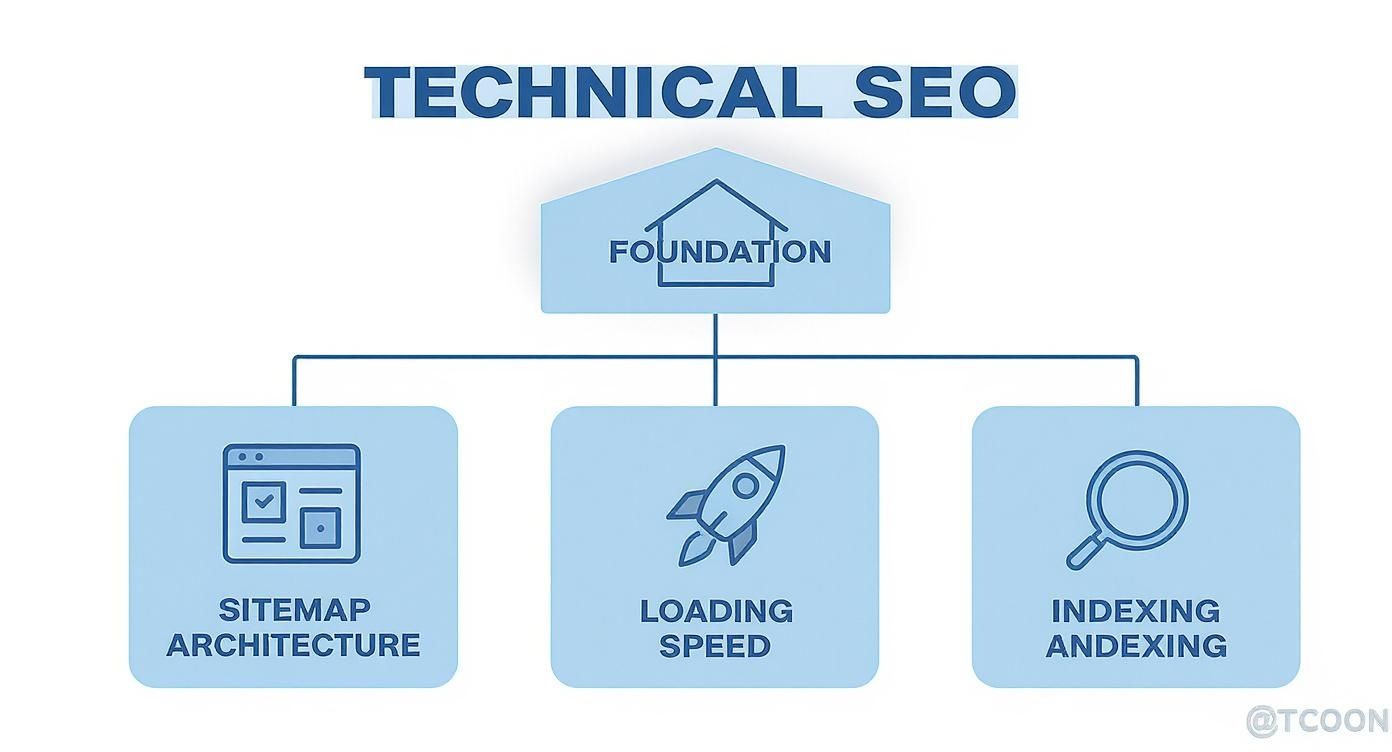
It's immediately clear: Without a stable foundation of good page architecture, fast loading times and clean indexing, even the best on-page measures are wasted.
Stand out from the crowd with structured data
Structured data, also known as schema markup, is a real game-changer for online shops. Essentially, it's a small snippet of code that you add to your website to tell search engines exactly what the page is about.
Imagine it like digital price tags that you attach to your products. Google reads these "tags" and can use this information to create so-called... Rich Snippets Display directly in the search results.
For e-commerce, these are the three most important things:
- Rating stars: Displays the average customer rating directly below the page title.
- Price information: The current price of the product is immediately visible.
- Availability: A clear statement like "In stock" or "Sold out" immediately provides clarity.
These small visual extras make your search result stand out immediately and can increase the click-through rate by up to... 30 % Increase your website traffic. You build trust even before the user visits your site. Implementation sounds more technical than it often is – many shop systems offer suitable plugins or apps for this. If you want to get the most out of your visitors, enriching your snippets is an essential step. To further boost your click-through and sales figures, we recommend our guide, which will help you optimize your snippets. Optimize conversion rate.
Achieving true authority through content marketing and link building
An online shop with perfectly optimized product pages is half the battle. But to truly stand out in your niche and be perceived as the one reliable source, you need more. You have to offer potential customers genuine added value that goes far beyond simply making a sale.
This is precisely where content marketing and the strategic building of backlinks come into play. Consider these two disciplines as an unbeatable team: Content builds trust with your customers, and links build trust with Google.
Imagine your shop as a subject matter expert. Who would you trust more? The expert who only sings the praises of their own products, or the one who shares their knowledge, answers your questions honestly, and helps you make the best decision? Clearly, the latter. A good blog or advice section is your platform to become precisely that helpful expert.
More than just a blog: The difference between content and real added value
Many online shop owners hear "content marketing" and immediately think: "Okay, I need to start a blog and write about my products." But that's just the tip of the iceberg. The real key is creating content that engages your potential customers right at the beginning of their search – at a point when they might not even know exactly which product they need.
The goal is not to indiscriminately drive traffic to the site. The aim is to... correct people with the correct content about correct Time to reach your target audience. So instead of just packaging product descriptions into blog articles, you should focus entirely on the problems, questions, and desires of your target group.
A compelling piece of content is like free, top-notch expert advice. It solves a pressing problem for the reader and, incidentally, positions your shop as the logical place to find the right solution.
What works particularly well for online shops? Here are a few ideas:
- Comprehensive buying advice: Compare different product types and help people make the right choice. A classic: "The Ultimate Running Shoe Guide: Which Shoe Really Suits Your Running Style?"„
- Detailed instructions & how-to articles: Show how to use your products correctly in everyday life or how to solve a specific problem with them. For example: "How to properly care for your cast iron pan – a step-by-step guide".
- Inspiring stories and application examples: Showcase your products in action. Real customer stories or creative applications create an emotional connection that pure product facts can never achieve.
Such content not only attracts interested readers, but also has a huge advantage: it's frequently linked to by other websites. And that brings us to the next crucial point.
Link building: The currency for trust on the web
Think of a backlink as a personal recommendation from another website. Google sees it much the same way: every link is a sign of trust. The more high-quality and thematically relevant websites link to your shop, the more Google considers you a credible authority. The result? Your rankings improve.
The problem for online shops: Getting direct links to product or category pages is incredibly difficult. Hardly any blogger or magazine links to a commercial sales page out of pure altruism. But this is precisely where content marketing comes into play.
Your top-notch advice content is the perfect "link magnet." A truly helpful guide is much more likely to be recommended and linked to as a useful resource by industry magazines, bloggers, or in forums. Each of these links strengthens the authority of your entire website. This authority—often referred to as "link juice"—can then be strategically directed from your blog article to the relevant product pages through internal linking, significantly boosting their rankings.
Strategies for valuable backlinks
Good links rarely fall from the sky. Building them is a proactive process that requires you to take an active role.
- Collaborations with influencers and bloggers: Identify relevant personalities in your niche and collaborate with them. This could involve product reviews, joint giveaways, or sponsored posts, which almost always include a valuable link.
- Guest articles on specialist portals: Write a well-researched expert article for a well-known online magazine in your industry. In return, you will typically receive an author's box with a link back to your shop.
- Broken Link Building: Find relevant websites that link to a page that no longer exists (generating a so-called 404 error). Contact the website owner, politely point out the broken link, and suggest your own relevant content as a perfect replacement.
Yes, these measures require time and commitment. But they pay off many times over in the long run. If you'd like to delve deeper into this topic, we have more tried-and-tested methods in our comprehensive article. Link building strategies collected that work specifically for e-commerce businesses.
The untapped power of internal search and UX
Okay, all your hard SEO work has paid off: A potential customer has landed on your shop via Google. And now? This is the moment of truth. You've brought the visitor to the door – but whether they actually go in and buy something will now be determined by the user experience. User Experience (UX).
A smooth and intuitive user experience in your online store not only makes customers happy and fills their shopping carts, but it also sends subtle yet important signals to Google. When a visitor stays for a while, clicks through various products, and ultimately makes a purchase, the search engine interprets this as a direct hit. Your site appears relevant and high-quality, which can indirectly improve your rankings. One often criminally overlooked lever in this process is the small search bar in your online store.
Why your internal search is a goldmine
Don't just think of the search bar as a nice extra. It's your direct line to your most ready-to-buy customers. Those who use the search function often already know exactly what they want and don't want to waste time navigating. If you don't deliver relevant results, that customer will be gone with a single click – and probably never return.
The numbers speak for themselves. For online shoppers in Germany, the internal search function is an absolutely essential tool. Incredible. 83 percent All buyers use the search bar to find products. 43 percent It's actually the very first thing people look for after entering a shop. Anyone wanting to delve deeper into the subject will find fascinating information. Statistics on online shopping behavior.
An intelligent, forgiving search function is therefore not a luxury, but a pure necessity. Customers who quickly find what they are looking for are also significantly more likely to buy.
What makes a search function high in conversions
A simple search bar that only returns exact matches is no longer sufficient. Think about your customers: they are often on mobile devices, make typos on small screens, or only know a colloquial term for a product. Your search needs to be prepared for this.
A truly good search function should therefore:
- Be fault-tolerant: It must recognize typos, synonyms or alternative spellings and still display the correct result.
- Suggestions (Autocomplete): Relevant products or categories should appear as you type. This saves time and frustration.
- Useful filters offer: After the search, users must be able to refine the results list – by price, brand, size, color, or customer reviews. This allows them to quickly narrow down their selection.
- Visually convincing: Display product images, prices, and perhaps even star ratings directly in the search results. This greatly helps with the decision-making process.
A good internal search function is like an experienced salesperson in a store. It understands even vague requests, uses filters to ask the right follow-up questions, and guides the customer directly to the right product.
More than just search: the entire user journey in view
Of course, user experience doesn't end with the search bar. Every single click in the shop, from the homepage to the "Buy" button, contributes to the overall impression. Logical navigation and a user-friendly checkout process are at least as important.
Ensure your menu structure is self-explanatory. A customer should never feel lost. Every click should bring them closer to their goal, not lead them to a dead end.
Checkout is the last hurdle before the finish line. Complicated forms, hidden costs, or forced registration are the most common reasons for abandoned shopping carts. Make this final step as simple, transparent, and quick as possible. Every avoided abandonment not only represents direct revenue but also sends another positive signal for your website.
Measuring SEO success and using the right KPIs
An SEO strategy without proper tracking is like sailing without a compass. You might drift forward somehow, but you have no idea if you're getting any closer to your destination. To truly understand whether your efforts in this area are paying off... SEO for online shops To get a clear picture of your results, you need to focus on the key performance indicators (KPIs) that are directly linked to your business goals. Gut feeling is a poor guide here – what counts are hard facts.
Imagine this: You invest months of work in new content and technical optimizations, but your sales don't budge. Without the right analytics tools, you're completely in the dark. Only data-driven analysis reveals which pages are truly performing well, where untapped potential lies, and which keywords actually lead to orders.
The key performance indicators that really matter for your shop
Don't get lost in a jumble of unimportant metrics. For shop owners, only a handful of crucial KPIs matter at the end of the day, making the direct impact of SEO on revenue measurable:
- Organic sales: This is the ultimate challenge. How much money do visitors bring into your coffers who come via the unpaid search results of Google & Co.?
- Conversion rate (organic): How many visitors from organic search actually click the "Buy" button? Lots of traffic, but hardly any sales? That's a clear warning sign.
- Visibility index: Tools such as Sistrix or Ahrefs They offer a practical index value that reflects your shop's overall presence on Google. An upward curve is an excellent sign of growing authority.
- Ranking development: Keep an eye on the rankings of your most important, purchase-relevant keywords and keyword groups. If these are rising, you're on the right track.
The true value of SEO isn't reflected in short-term traffic spikes. It lies in a steadily growing stream of qualified, ready-to-buy visitors who cost you nothing per click. Your goal is sustainable, profitable growth.
Their most important allies are the free tools directly from Google: the Google Search Console and Google Analytics 4. They provide you with invaluable first-hand insights.
This screenshot from Google Analytics shows a typical acquisition report that breaks down traffic by channel.
Here you can see at a glance how many users reach your site via organic search compared to other channels such as paid advertising or direct visits.
From data to action: How you need to react
Pure analysis won't bring you a single extra euro in revenue. The crucial step is drawing the right conclusions from the data and adjusting your strategy accordingly.
A classic example: You discover a category page with many impressions but a dismal click-through rate. This is a clear signal to revisit the title tag and meta description and make them more appealing. It's also worthwhile to keep an eye on the entire search results page. Data shows that the organic click-through rate for the top spot is impressively high. 39.8 percent lies, while at the same time 19 percent Product-related searches will no longer lead directly to Google Shopping offers.
These figures clearly demonstrate the importance of ranking at the top organically as well as being visible in other areas of Google. Take a look at more exciting SEO statistics, to gain an even better understanding of the connections and to refine your strategy.
In conclusion: The most frequently asked questions from practice
After all that theory, let's get to the questions that shop owners ask me time and again. Here you'll find quick and clear answers so you can overcome any remaining hurdles and start your SEO work with confidence.
How long will it take before I really notice a difference with SEO?
Patience is key here. SEO isn't like flipping a light switch and everything instantly lights up. It's more like planting a garden. You sow, water, and tend before you can harvest.
Realistically speaking, you will often see initial positive movements – for example, better rankings for specific long-tail keywords – after three to six months. For truly noticeable results, meaning significantly more visitors and tangible sales, you should expect six to twelve months of continuous work. How quickly this happens naturally depends heavily on how competitive your niche is and where your shop currently stands.
What budget should I allocate for SEO?
That's one of the trickiest questions, because the answer is: it depends. A small start-up serving a specific niche logically needs a smaller budget than a large shop that wants to compete against the industry giants.
To get started, a few hundred euros a month might be enough to run the most important analyses and make some initial adjustments. However, when it comes to a comprehensive strategy with professional content creation and targeted link building, you'll quickly be looking at four-figure monthly costs.
But what I can tell you from experience is that consistency trumps budget size. Investing regularly and consistently in SEO yields far greater long-term results than one-off, large-scale campaigns. Don't see it as an expense, but as an investment in the value of your business.
Where do I begin: optimizing product pages or starting a blog?
The answer is crystal clear: Focus on your product and category pages first. This is the heart of your shop. This is where sales happen, this is where customers who already know what they want land. These pages must be absolutely perfect before you even think about anything else.
A blog is then the brilliant second step. It allows you to build expert status, attract people who are still in the early stages of their buying process, and naturally gather valuable links from other websites. So, while the blog supports your sales pages, it will never replace them.
What is the one most important factor for shop SEO?
If only it were that easy! Successful SEO for online shops It's always an interplay of many small and large cogs. a There is no magic bullet. But if I had to pinpoint the most important thing, it would be a combination of two things:
- A spotless technical foundation: Your shop needs to load quickly, work perfectly on mobile devices, and have a logical structure. That's the foundation on which everything else is built.
- Unique and truly helpful content: By this I mean, above all, first-class product and category pages that offer exactly what the searcher expects.
Without a solid technical foundation, even the best content is wasted. And a technically perfect website without compelling content? It will never reach the top. Both must go hand in hand.
Do you want to ensure that your online shop reaches its full potential and is found by customers ready to buy? LinkITUp is your experienced partner for sustainable SEO success. We help you develop a strategy that truly suits you and delivers measurable results. Visit us at https://seobuchen.com/ and request a free, no-obligation analysis.