




At first glance, SEO and social media might seem like two completely different things. One optimizes for search engines, the other for the news feed. In reality, however, they have long been an inseparable team. The trick is to understand that social media activities don't directly boost SEO performance, but indirectly, yet all the more effectively.
So it's not about every like being a direct ranking factor. Rather, it's about using smart social media activities to positively influence the key factors for Google: Visibility, traffic and trust.
How social media really affects your SEO
Many marketing teams still treat SEO and social media as separate departments. This is a mistake. In practice, they are constantly interacting, and those who aren't listening are missing out on enormous potential. Sure, a viral post alone won't catapult your website to the top of Google overnight. But a well-thought-out, long-term social media strategy is a powerful amplifier for your SEO success.
Imagine social media as a vast, bustling marketplace. Here, people talk about your brand, make recommendations, and share content. SEO, in this analogy, is the vast library that registers all these conversations and interprets them as tangible proof of your relevance and reputation. Every interaction, every shared post, and every comment cements your brand's standing in the digital space.
This infographic highlights the indirect but crucial connection: Social media is the megaphone for your brand and SEO is the magnifying glass with which Google assesses its relevance.
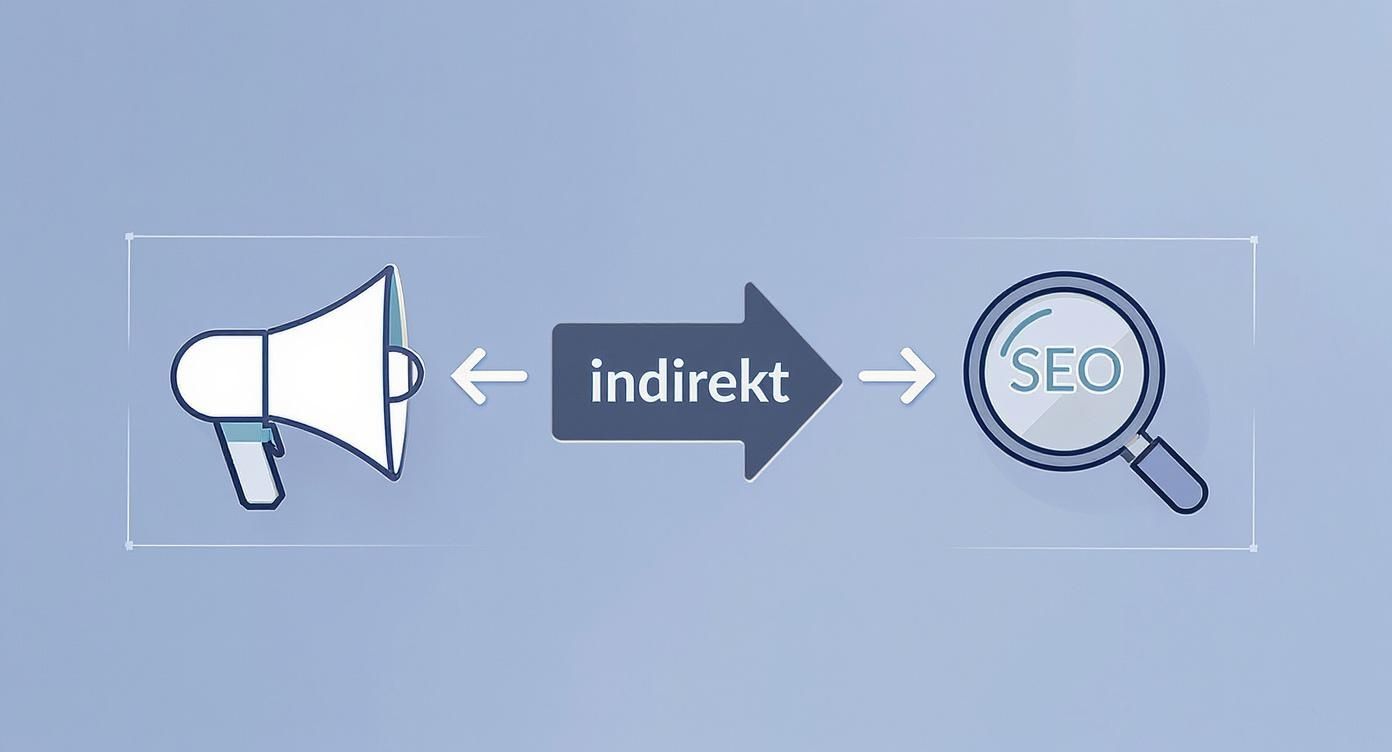
As the diagram shows, results from social networks do not directly appear in search engine rankings, but take a clever detour that is often even more effective in the end.
This table illustrates the difference between direct SEO factors and the indirect but effective influence of social media.
| Area | Direct SEO factor | Indirect influence through social media |
|---|---|---|
| Backlinks | Direct links from authoritative sites are a top ranking factor. | Great content gets shared and discovered by bloggers or journalists, leading to natural, high-quality backlinks. |
| traffic | Organic search traffic is a key target and a quality indicator. | Viral posts or targeted campaigns drive massive traffic (Direct & Referral) to the website, signaling its relevance to Google. |
| Brand authority | The "EEAT" rating (Experience, Expertise, Authoritativeness, Trustworthiness) influences the ranking. | An active, large community and expert status on social networks underpin the authority and trust in the brand. |
| Content relevance | Keywords and thematic depth in website content. | Shares, comments and discussions show search engines that the content is highly relevant and appealing to the target audience. |
In summary, while SEO does the technical and content-related homework, social media provides the necessary word-of-mouth marketing and social proof that this homework is actually good.
The indirect effect on their authority
Google evaluates websites according to the so-called EEAT principleExperience, expertise, authority, and trustworthiness. A strong, vibrant presence on social media is a clear signal of these four pillars. When countless people share your content, discuss it, and see your brand as a go-to resource, it signals to search engines: Here, a recognized authority is at work.
A vibrant community on social media is like a constant, public seal of approval for your brand. Search engines listen closely to these conversations, even if they don't count every single like.
This increased trust translates into very concrete SEO benefits:
- More organic traffic: When content is well-received or even goes viral, more people inevitably click on your website. This surge in direct and referral traffic is a clear signal to Google that your site is relevant.
- Increased brand awareness: Users who discover your brand on Instagram or LinkedIn are highly likely to later search for your name directly on Google. Such direct branded searches are an extremely strong, positive signal for the search engine. To maximize this effect, you should strategically optimize your branding. Increase brand awareness.
- Natural link building: This is the holy grail of SEO. Truly excellent social media content is seen by bloggers, journalists, and other companies, deemed valuable, and naturally linked to in their own articles. These organically generated backlinks are among the most important ranking factors.
Why consistency is key
Posting occasionally is far from sufficient. A consistent strategy is needed that conveys a clear, recognizable message across all channels. Only in this way can you build a loyal following and a strong brand identity over time. This consistency also helps search engines to accurately categorize your brand thematically and recognize it as a reliable source for a specific topic.
Ultimately, it's about creating genuine synergy. Every shared post that drives new traffic to your site, and every optimized social media profile that appears in search results, is another building block for a stable and successful SEO structure. Social media provides the fuel in the form of visibility and engagement, which SEO then transforms into better rankings and sustainable digital success.
What Social Signals Really Mean for Google
The term "social signals" is hotly debated in the SEO world. Do likes, shares, and comments directly affect Google ranking? If you ask Google directly, the official answer is: No. But anyone who stops reading here will miss the real point. Because the indirect impact of these signals is enormous.
Imagine a bustling shopping street. A huge crowd gathers in front of a shop, laughing, discussing, and pointing enthusiastically at the display. What do you think as a passerby? "There must be something special in there!" It works exactly the same way online. Google doesn't see the queue itself, but it notices all the people suddenly flocking to that one shop.
More than just a popularity contest
Social signals aren't direct ranking factors. Rather, they trigger the things Google is truly interested in. A viral post won't automatically catapult your site to the top of the search results, but it creates the perfect conditions for it. It's the spark that ignites the SEO fire.
When thousands of people share your post, a chain reaction happens in the background:
- Explosive visibility: Suddenly, your content reaches people far outside your usual bubble.
- Massive traffic: Some of these new people become curious and click through to your website. These are real visitors that Google registers.
- Natural backlinks: Among the thousands who are currently viewing your content, there's a high probability that bloggers, journalists, or other experts are involved. If your content is truly excellent, some of them will link to it – and these organic backlinks are pure gold for your SEO.
Google doesn't count likes. Google measures what because of The likes are happening. The sudden increase in visitors and the new, organic backlinks are the real signals to which the algorithm reacts.
It is therefore not about the sheer number of interactions, but about the tangible results that arise from them.
The quality of the entertainment counts.
A quick like is easily forgotten and carries little weight. A lively discussion in the comments, where users share their own experiences or ask critical questions, sends a much stronger signal. It shows that your content isn't just being skimmed, but is truly engaging people.
Let's compare two scenarios:
- A post is received 10,000 Likes, but hardly any comments or shares. Website traffic is barely registering.
- Another post only gets 500 Likes, but 150 It was shared once and sparked a lively discussion with 80 Comments. As a result, three bloggers discover it and link to their article.
For your SEO, the second scenario is infinitely more valuable. It delivered measurable results: high-quality traffic and, more importantly, real backlinks.
Social proof and trust in your brand
Ultimately, all of this is a form of Social Proof – social proof. An active community and lively interactions show not only users, but also Google, that your brand is alive, relevant, and valued by real people. This directly contributes to your authority and trustworthiness (keyword: EEAT).
When people speak positively about you on social media, they are much more likely to later search specifically for your brand name on Google. Such "branded searches" send an extremely strong signal to Google. They tell the search engine unequivocally: This brand is a well-established name.
Your task, therefore, is to create content that doesn't just farm likes, but sparks genuine conversations. Content so useful that others want to share it and use it as a resource of their own accord. This is the lever that social media uses to indirectly, but sustainably, boost your SEO performance.
How to turn your social media profile into an SEO powerhouse
Your social media profile is so much more than a digital business card. Think of it as valuable online real estate that can rank not only on social media but also directly in Google search results. It's often the very first point of contact potential customers have with your brand. A cleverly optimized profile can work wonders for your visibility.
Profile optimization is one of those fundamental tasks that is often overlooked, but it offers a huge leverage point for your entire performance. Social Media SEO This represents a strategy. Essentially, it's about sending crystal-clear signals to both human visitors and search engine crawlers about what your brand stands for.
The correct username and name
It all starts with your username (the "handle") and your profile name. These two elements are absolutely crucial, as they often appear in the profile URL and page title – both of which are important SEO factors.
The golden rule here is: consistency. Use the same username across all platforms whenever possible. This not only creates instant brand recognition but also helps Google combine all your profiles into a single, strong brand identity.
- Username/Handle: Choose your exact brand name. Is it already taken? Then add a logical complement, for example with
YourBrandDEorYourBrandApp. - Profile name: Here you have more flexibility. Use your full brand name and, if appropriate, add an important keyword. For example, a financial advisor could call themselves "Max Mustermann | Financial Planning".
The bio as a keyword magnet
Your bio is the heart of your profile. Obviously, it needs to explain who you are and what you do in just a few seconds. But from an SEO perspective, it's also the perfect place to include your most important keywords. Search engines scan this text to understand the thematic context of your account.
Avoid generic phrases at all costs. Be specific and use terms your target audience actually searches for. Instead of "We help companies grow," write "SEO agency for B2B software companies with a focus on link building." That's tangible and relevant.
Treat your profile bio like the meta title of a website. It needs to be short and snappy, contain the most important keywords, and encourage clicks – whether on the follow button or the link in your bio.
The link in the profile as a valuable source of traffic
The famous "link in bio" is your most valuable piece of digital building land for driving traffic from social media to your website. This single link is often the only clickable connection you can place directly in your profile. So treat it accordingly.
Don't just link to your homepage. Strategically consider which page offers your followers the most value right now. This could be:
- A specially created landing page that bundles your most important links.
- Her brand new blog post, which expands on a viral social media post.
- A page for lead generation, such as registering for a webinar or downloading an e-book.
This link creates a direct bridge between your social media presence and your website. This increases referral traffic – a consistently positive signal for Google.
Authority signals that strengthen your profile
Besides pure text optimization, there are other factors that significantly influence the authority and thus the SEO effectiveness of your profile. These include, above all, verification and the size of your community.
A Verification badge The familiar blue checkmark is an extremely strong trust signal. It confirms the authenticity and relevance of your account to both users and search engines. Meta even openly admits that verified accounts may be given preference in search results on Instagram and Facebook.
Also the number of your Followers and the Interaction rate They do play a role. A profile with a large, active community simply appears more credible and authoritative. This directly contributes to your brand's EEAT profile (Experience, Expertise, Authoritativeness, Trustworthiness) and signals to Google that your brand is an important voice in its niche.
The relevance of social media in Germany can hardly be overestimated: 65.5 million people actively use social networks, which 77.6 % of the population corresponds. Platforms like Instagram (62,8 %) and Facebook (53,7 %These are an integral part of everyday life. For companies, their presence here is becoming increasingly crucial, because already 24 % They use social media specifically for lead generation. Those who want to delve deeper into the numbers can find further insights in the... Social media usage in Germany on OMR.com.
How to create content that works for social media and SEO
Good content is the heart that connects your social media and SEO strategies. Think of it like a bridge: content that sparks conversation and is shared extensively on social networks not only generates valuable engagement, but also creates the best conditions for increased website traffic and potential backlinks – pure gold for search engine optimization.
The real art lies in designing content from the outset so that it shines on both channels. It's about creating genuine synergy, where every blog post provides fodder for your social media channels and every viral post boosts your website's SEO.
Link magnets: The foundation of your strategy
Not all content has the potential to naturally attract links. The key to success lies in creating so-called... „"linkable assets"“. These are not ordinary blog posts, but extremely high-quality, in-depth content that is so useful, unique, or insightful that others – bloggers, journalists, industry experts – link to it all by themselves. want.
Think of these assets as magnets. They are so valuable that they are naturally cited as references or sources in other posts.
Examples of such highly effective link magnets:
- Comprehensive guides (Ultimate Guides): An extremely detailed guide that covers a complex topic from A to Z and leaves no questions unanswered.
- Original studies and data: Conduct your own survey or analyze data in a completely new way. Exclusive insights are highly sought after and frequently shared.
- Interactive tools or calculators: A simple but clever tool that solves a specific problem for your target audience (e.g., a budget calculator or a product configurator).
- Professional infographics: Visually appealing graphics that present complex information in an understandable way and are easy to share.
A single, outstanding, link-worthy asset can generate valuable backlinks and high-quality traffic for months or even years. It's an investment that pays off many times over compared to dozens of superficial posts.
Such content doesn't appear overnight, of course. It's the result of a strategic approach. A well-thought-out plan. Content plan This is essential for that. It helps you find topics that are not only relevant to your target audience but also have the potential to generate valuable links. If you would like to delve deeper into this topic, you will find valuable tips here on how to create one. Create an effective content plan.
Content recycling: The clever bridge between blog and social media
You don't have to reinvent the wheel for every channel. One of the most efficient ways to bridge the gap between SEO and social media is this. strategic recycling Existing blog articles. A well-researched, detailed blog post is a true goldmine for countless social media content.
This method not only saves a tremendous amount of time, but also ensures a clear and consistent message across all channels.
Here's how to turn a single blog post into pure social media gold:
- Carousel posts (Instagram/LinkedIn): Summarize the 5–7 key messages or combine steps of your article into individual graphics.
- Short videos (TikTok/Reels): Take a key tip or surprising statistic from the article and explain it in a 30-second video.
- Infographic excerpts: Share individual sections of your large infographic as standalone, easily digestible posts.
- Discussion questions (X/Facebook): Formulate a provocative thesis from your article as a question to spark a lively discussion in the community.
The call-to-action as a traffic driver
Every single social media post should have a clear goal. Besides engagement and reach, one of the most important goals is to drive users from the platform to your own website. Without a clear goal, you'll be lost. Call-to-Action (CTA) The potential of your contributions is wasted without effect.
A good call to action (CTA) is direct, clear, and offers genuine added value. Tell people precisely what they should do next and why it's worthwhile for them. Instead of a boring "Click here," use specific, action-oriented language.
- „"Read the full instructions now on our blog!"“
- „"Download our free checklist here!"“
- „"Discover all the study results in our new report."“
The data shows how crucial high-quality content is for visibility. An analysis by SE Ranking revealed that the average monthly share of organic traffic is at 58 % lies and over 99 % The user should remain on the first page of search results. At the same time, the average length of blog articles has increased by [amount] in the last ten years. 77 % The number of views has increased. This trend underscores that comprehensive, thoroughly researched content is the key to success. You can find many more exciting insights in the... Detailed SEO statistics are available at seranking.com.
Platform-specific strategies for greater visibility
Each social network has its own rules and therefore its own unique set of rules. SEO levers, These are things you need to know. What works on Instagram doesn't necessarily work on LinkedIn – and vice versa.
Those who understand the algorithms and the "language" of the individual platforms can strategically expand their presence and their Social Media SEO Take it to the next level. So let's look at some tried-and-tested tricks for the most important channels. We'll start with simple but effective levers, such as alt text for images or cleverly optimized profiles.
Instagram: More than just beautiful pictures
At Instagram Most people think of visual aesthetics, but here lies an often overlooked SEO potential: alt text. These short descriptions are essentially mini SEO texts for your images.
If you start each post with a meaningful caption Alt text Tagging your image with keywords that include your most important ones not only helps users with visual impairments. More importantly, it signals to Instagram's algorithm what your image is about. The result? Your content ranks higher for relevant search queries.
It's really easy:
- Formulate alt text: Describe in 1-2 concise sentences, which can be seen in the picture.
- Include keywords: Include terms that your target audience would search for, but avoid blatant keyword stuffing.
- Adjust regularly: Observe trends and adapt your texts accordingly to remain relevant.
A fashion shop that consistently implemented this was able to increase its organic reach via the Discover page by 73 % Increase. This shows how systematically one can improve their own discoverability here.
LinkedIn: Your digital business card with SEO power
LinkedIn It's far more than just a professional network – it's a powerful search engine for specialist expertise. That's precisely why optimized profiles and articles here are invaluable.
Start with the basics: Your profile name, title, and summary should... Keywords It includes posts that best describe your industry and your role. But the real game-changer is regularly published long-form articles. These are not only found within LinkedIn, but often rank surprisingly well on Google as well.
An excellently optimized LinkedIn profile often appears in search results even before the company website. This is a huge opportunity to strengthen your personal brand.
A concrete example: A B2B service provider increased its profile views by [amount missing] after publishing a series of articles on a niche topic. 45 % increased. Coupled with an actively maintained network, this strengthens not only visibility, but also the EEAT-The values of your brand.
Facebook: The Power of Completeness
Even though it often seems otherwise: Facebook Google is still an important source of information. The key lies in a consistently well-maintained company profile.
Every detail counts: From the company description and opening hours to the legal notice – all this information sends clear signals to Google. When sharing links, make sure you have clear titles and informative preview descriptions, as these are directly captured and evaluated by the crawlers.
The top platforms in a direct SEO comparison
Each network requires a different focus. To help you keep track, I've summarized the most effective tactics in a table.
SEO tactics for top social media platforms
| platform | Most important SEO tactic | focus |
|---|---|---|
| Fully completed profile | On-page signals for Google | |
| Alt text for images | Image SEO | |
| Keyword-optimized articles and profile fields | Content ranking and authority | |
| X (Twitter) | Relevant hashtags and fast indexing | Real-time discoverability |
This comparison makes it clear which lever Determine which platform has the greatest impact. Use this as a checklist to optimize your channels effectively.
X (formerly Twitter): Speed is everything
On X (formerly Twitter) reigns supreme in real time and virality. Anyone who wants to be found here must be fast and relevant.
Integrate your most important keywords and hashtags directly into the first sentence of your post so that the context is immediately clear. Short, thematically related threads are also well-received by search engines and increase the chance of a top ranking for niche topics.
A few quick tips for X:
- Branded Hashtags: Use your own hashtags to strengthen your brand and bring discussions together.
- Timing is crucial: Post during your target audience's peak hours to generate instant interactions.
- Meaningful retweeting: Share relevant content from others to anchor your profile in the context of your topic.
A startup managed to reach a global audience within just a few hours through a viral tweet and the subsequent retweets. 150 backlinks to generate. This shows how X can become an unexpected lever in your SEO strategy.
How to properly measure the success of your strategy
A sophisticated strategy is worthless if you can't measure its success. To understand the true impact of your social media activities on SEO performance, you need the right key performance indicators (KPIs), the so-called metrics. KPIs, keep an eye on it.
The key point here is the Referral Traffic, This includes visitors who come to your website via social networks. You can easily track these visitors in Google Analytics.
Take a close look at which channels like Facebook, Instagram, or LinkedIn send you the most visitors. But quantity isn't everything: Length of stay and the Bounce rate This will tell you how valuable this traffic really is. Do users stay long and click through your site, or do they leave again after just a few seconds?
Ultimately, what matters is the bottom line. Conversion Rate Your referral traffic shows you in black and white how many visitors from social networks perform a desired action – be it a purchase, a newsletter subscription, or a contact request. Even a conversion rate of 3 % Clicks from Instagram links can be considered excellent. There are examples where online shops generated an additional month's revenue with a single viral post. 12.000 € have achieved.
Referral traffic is the most tangible proof that your social media efforts directly contribute to your SEO goals.
How to analyze referral traffic in Google Analytics
Looking at referral traffic is like a treasure map: it shows you which social media channels are delivering the most engaged and high-spending visitors. You can find this data in Google Analytics under Acquisition > All Accesses > Sources/Medium.
Look out for channels that not only generate a lot of clicks, but whose visitors also stay for a long time and rarely bounce. An increase in referral traffic from 25 % Success within a month is already a strong signal for a successful campaign.
Focus on the following points:
- Traffic analysis by channel: Which network delivers the best results?
- Comparison of engagement metrics: Where are dwell time and bounce rate best?
- Identifying top content: Which posts generated the most traffic?
Two other, often underestimated KPIs are Brand Searches (Brand search queries) and the Backlink monitoring. If the number of users specifically searching for your brand increases – for example, by… 15 % This is a clear indication of growing brand awareness, often fueled by social media. At the same time, viral content can generate valuable backlinks that sustainably strengthen your domain authority with Google.
Keep an eye on other important key figures
Brand searches and new backlinks are crucial for the return on investment (ROI) of your efforts. Brand search queries can be easily tracked using Google Search Console or tools like Ahrefs. Specialized tools are also available for monitoring backlinks.
Your checklist for meaningful KPI reporting could look like this:
- Development of referral traffic (broken down by channel)
- Average session duration of social media visitors
- Bounce rate per channel
- Growth in direct brand search queries
- Number and quality of newly generated backlinks
With this data, you can clearly demonstrate successes and immediately identify areas where there is still room for improvement.
If you would like to delve deeper into the topic, you can find all the key figures in our KPIs in the SEO guide.
Regular monthly reporting helps to uncover trends and seasonal fluctuations. A quick tip: Visualize your data with tools like Google Data Studio. This makes presentations much clearer and more convincing for colleagues and superiors.
It is best to arrange the following:
- A clear dashboard with the most important data in real time.
- Monthly comparisons, ideally with the same period of the previous year.
- Automatic notifications for significant positive or negative deviations.
Don't forget to think outside the box. Internal benchmarking, i.e., comparing your KPIs with those of your strongest competitors, can provide you with valuable insights and new perspectives. This way, you'll always stay one step ahead of the competition.
Finally, directly incorporate the insights gained into your content planning. This creates a cycle in which your social media efforts become increasingly effective and your ranking is strengthened in the long term.
Frequently Asked Questions about SEO and Social Media
Many companies are wondering what influence social media really has on their search engine ranking. Here you will find the answers. clear facts and practical recommendations for action. This way you can eliminate uncertainties and optimize your measures in a targeted manner.
The three main topics at a glance:
- Direct benefits Likes and shares in Google ranking
- Correct channel selection and optimal resource utilization
- Realistic time horizon for visible successes
Answers to frequently asked questions
1. Are likes and shares direct ranking factors for Google?
In short: No. Google doesn't evaluate social signals directly. Likes and shares act more like amplifiers for your content and increase its reach. Referral traffic. More visitors mean higher chances of natural backlinks – and those are exactly what boost your ranking.
Just as applause at a concert reveals the audience's mood, Google interprets social signals as an indicator of user interest.
2. Do I need to be present on all social media platforms?
Those who post everywhere quickly lose focus. It's better to concentrate on... two to three Networks where your target audience is active. This specialization increases engagement and provides more reliable SEO signals.
- Concise profiles sharpen your brand identity.
- Regular updates build trust
- High interaction rates demonstrate relevance
3. When will the first SEO successes through social media become apparent?
Social media is like a garden that slowly bears fruit. Immediate traffic spikes are possible. Sustainable effects – such as increased domain authority or more backlinks – usually develop over time. three to six months Yes. It's worth sticking with it.
More tips
- Formulate questions with highly relevant keywords
- Create FAQs as separate subpages to achieve additional rankings.
- Use internal links to guide visitors effectively.
These measures can be implemented immediately and noticeably improve the user experience.
Are you interested in a customized social SEO strategy? LinkITUp accesses over 15 years We draw on our experience and deliver demonstrable results. Contact us for a free consultation or request your free SEO analysis. Get started now and achieve long-term growth!